
The list of the best ROI renovations changes each year as trends evolve.
For example, between 2015 and 2020, all-white kitchens and “millennial grey” interiors were highly sought after, with buyers paying a premium for bright, minimalist finishes. As more homes adopted this style, however, the market became saturated with identical properties and, this made them less appealing, shifting buyer preferences.
High-value renovations also change depending on the property type, zoning bylaws (which restrict certain renovations), and available financial incentives. For instance, in Quebec, programs like Rénoclimat and Canada Greener Homes Loan offer grants and interest-free loans for upgrades such as windows, insulation, and heating systems. These programs reduce upfront costs, which can contribute to a higher ROI.
As such, before renovating, you should understand local market trends, demand for your property type, and available funding programs to identify the projects that will deliver the highest return on investment.
 Immovision
Not all renovations add value — some actually lose money.
Speak with a top performing local realtor to find out exactly which upgrades are worth it for your home and in your local market.
In this article, we’ve compiled the renovations most consistently ranked for the best home improvements across Canadian real estate sources to give you a clear, practical shortlist.
Best ROI Renovations (At a Glance)
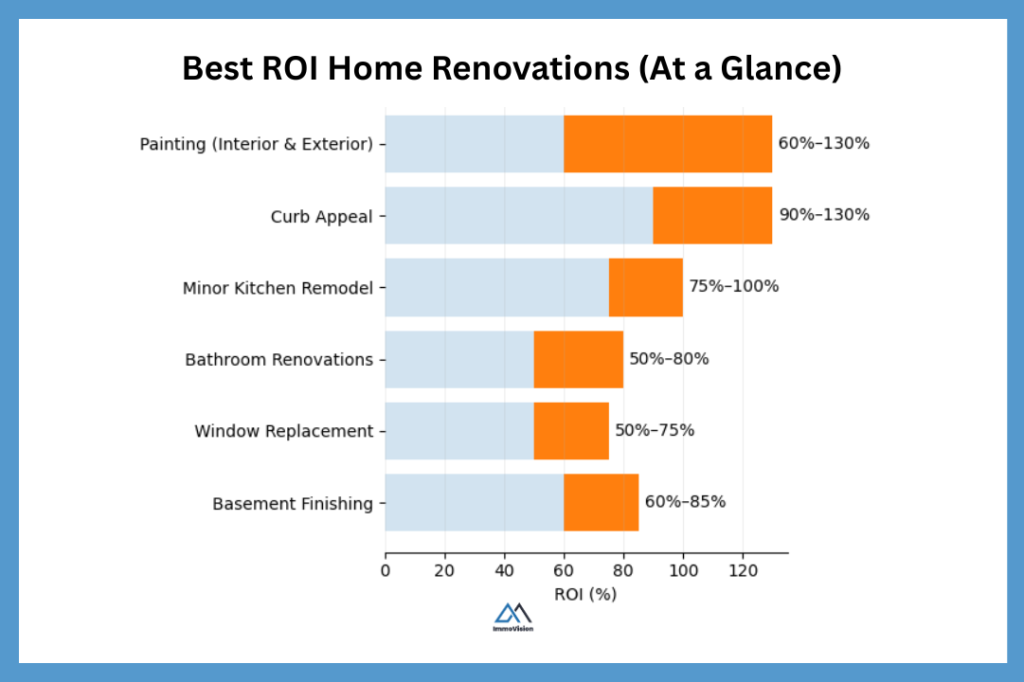
From our market analysis, the top 6 highest value ROI renovations in Canada are:
- Painting (interior & exterior)
- Curb appeal (garage door, front door, landscaping)
- Minor kitchen remodels
- Bathroom renovations
- Window replacement
- Basement finishing
Across these categories, we found that the ROI can vary significantly based on a whole range of factors such the scope of work, cost of local labour, and the amount of DIY done. We also found that most renovations, if not properly scoped, can actually lead to a net negative gain, meaning that you will lose money on the investment.
Note
ROI in real estate refers to how much of your renovation cost is reflected in your home’s resale value.
It does not measure profit. ROI measures value recovery.
For example, a 75% ROI means that for every $1 you invest, your home’s value increases by $0.75. A 100% ROI means you recover the full cost of the renovation (break-even), while anything above 100% represents a net gain.
That said, not all renovations are done purely for financial return. Even projects with lower ROI can still be worthwhile for several reasons:
- Better living experience while you own the home
- Improved marketability, helping your home stand out to buyers
- Reduced days on market (DOM) and a faster sale
- Stronger negotiation position, reducing the risk of price reductions
You can also improve your effective ROI by completing some of the work yourself. DIY projects reduce labour costs, which lowers your total investment and increases the percentage of value you recover.
Before choosing renovations, you need a baseline for your home value. Knowing your current home value is what determines whether a project is worth it, or not.
Check your home value instantly with home value estimator.
1. Painting (Interior & Exterior)
Re-painting your home can yield between 60% to 130%+ ROI. This makes it the number one renovation for your home.
For instance, the typical cost to repaint the interior of a Canadian home is $2 to $6 per square foot, or roughly $4,000 to $7,000 for a 2,000 sq. ft. home. This means that for an investment of around $5,000, you could add $3,000 to $6,000+ in property value.
These numbers are based on hiring out labor which, with painting can be 75% – 80% of your total bill. This means that if you do some, or all of the work yourself, the ROI can be more than 200%. Note that labor rates vary by province. For instance, in the Toronto market, you can expect to pay $1.80 per square foot, whereas in Quebec (including Montreal), costs are typically about 10% to 20% cheaper.
To maximize your investment, you should focus on using the right finishes, textures and colors. Ideally, you should use flat, matte, or eggshell finishes for the walls inside your home, flat white for your ceilings, and satin finishes for the exterior of your home. Semi- and high-gloss paints, with a high sheen, should be used sparingly. You should also use high-quality paints (such as premium brands like Benjamin Moore).
If you’re working with a limited time, or you are not sure about how much money you want to invest, prioritize high-impact areas such as main living spaces, kitchens, entryways, and primary bedrooms. These are the areas that create the strongest first impression for buyers, and that improve online photos. And, as an absolute minimum, you should paint over any scuff marks, or visual signs of wear and tear, as you prepare your home for sale.
2. Curb Appeal (Garage Door, Front Door, Landscaping)
The next best ROI renovations are those that improve your home’s curb appeal. This is what will give prospective buyer’s a good first impression of your home.
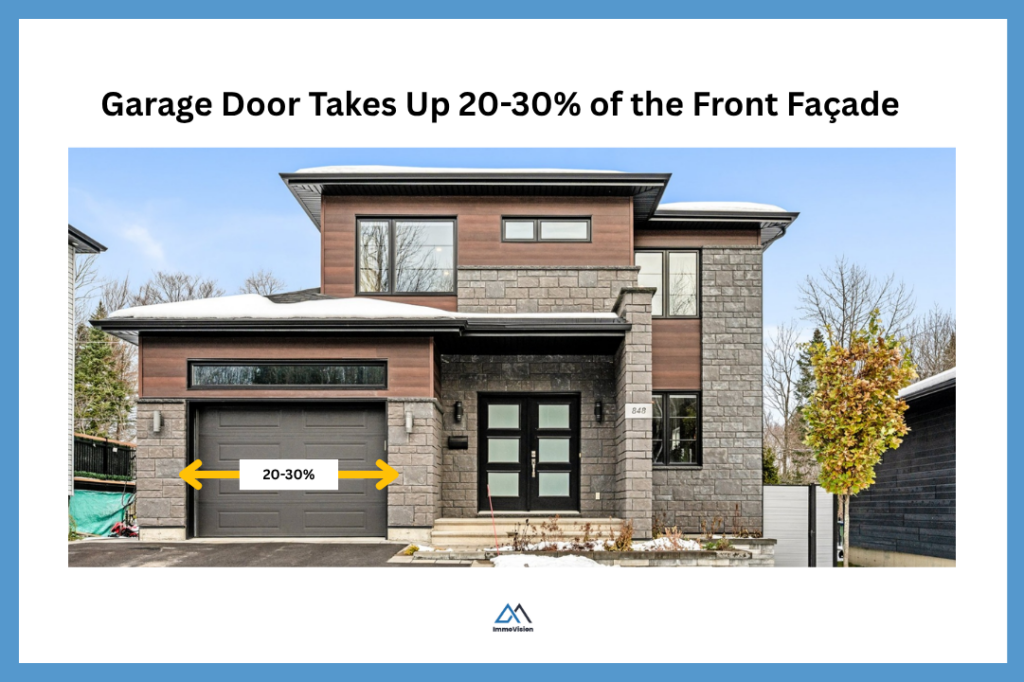
Among curb appeal upgrades, garage door replacement consistently ranks as one of the highest-return upgrades, with ROI often ranging from 90% to 130%+. This is because your garage door is one of the largest and most visible exterior elements of your home. For many properties, it can take up 20% to 30% of the front façade and as such, it plays a major role in how buyers perceive the overall condition and value of the property.
That said, replacement isn’t always necessary. In this case, simple improvements like repainting, or updating hardware so that it doesn’t creek, can deliver a strong return at a much lower cost.
Beyond the garage, upgrading your front entry door is another high-impact improvement. Steel entry doors, in particular, can deliver up to ~150%–180% ROI, making them one of the few renovations that can exceed full cost recovery. Fiberglass doors are also a popular option, as they mimic the look of real wood while offering better durability and resistance to Canada’s harsh weather conditions.
However, the key is cohesion. Any exterior upgrade should match the architectural style and color palette of your home. A large steel door on a traditional façade (or vice versa) can feel out of place and reduce the perceived value.
3. Minor Kitchen Remodel
A common belief is that a full kitchen renovation delivers the highest ROI. In reality, large-scale remodels often fail to break even, especially in the short term.
Immovision
Find out if a kitchen remodel will pay off in your area
Speak with a top performing local realtor to find out exactly which upgrades are worth it for your home and neighbourhood.
A much more effective approach is a minor kitchen remodel which can yield an ROI of 75%-100%, where you keep the existing layout but upgrade finishes, fixtures, and key surfaces. This significantly reduces costs while still delivering a strong visual impact, that will help your home stand out to buyers in their online search.
Instead of tearing everything out, you should focus on targeted improvements. Your kitchen cabinets are one of the highest-impact areas. Repainting cabinets in neutral tones, typically white, or off-white, can instantly modernize the space. You can also update hinges and handles cheaply, without needing to hire external contractors.
Countertops are another major value driver. Replacing outdated surfaces with quartz, especially styles with grey veining, can give the kitchen a clean, contemporary look. However, this is one area where professional installation is strongly recommended. Quartz is heavy and improper installation can lead to cracking. Hiring a professional reduces this risk, since if the countertop breaks during installation, the company you hire will have to replace it.
Meanwhile, if the flooring needs updating, consider luxury vinyl plank (LVP), tiles, or durable laminate.
4. Bathroom Renovations
The next best ROI renovation’s can be found in the bathroom. These typically yield 50%-80% ROI, depending on the scope of work and quality of finishes.
However, as with kitchen remodelling, the key is knowing where to spend your money, so that you get the biggest bang for your buck.
The first bathroom renovation to consider are your cabinets. By modernizing to a floating vanity, or a simple classic cabinet, this will instantly make your bathroom look newer.

Fixtures are another easy win. Updating faucets, shower heads, and hardware to neutral finishes such as chrome, brushed nickel, or matte black will help to modernize the space, while appealing to a broad range of buyers. The goal here is to stay timeless and avoid overly personalized design choices.
Flooring is also a high-impact improvement. You should replace any worn or dated tile with luxury vinyl plank (LVP). This is a cost-effective option that will give your bathroom a clean, updated look. For higher-end results, fully tiled floors are unbeatable, especially when paired with a walk-in shower. However, these significantly more expensive to install and may yield a negative ROI.
Other simple things you can do, replace any broken bulbs with high watt LED bulbs, and re-caulk your bath tub and shower, replace worn grout, update mirrors, and ensuring everything is clean.
5. Window Replacement: Is It Worth It?
Upgrading your windows generally delivers a moderate to low ROI, often in the range of 50%-75%, which is lower than many other renovation categories. Because of this, window replacement is not always the best pre-sale investment, especially if your existing windows are still functional and presentable.
If your windows are older but in decent condition, a more strategic approach is to leave them as-is and disclose their age and condition to potential buyers. Being transparent in your seller’s declaration builds trust and helps prevent buyer’s asking for price drops during the transaction. In many cases, this approach will not have any impact your home’s valuation particularly if the rest of the property is well-maintained.
However, there are exceptions.
If your windows are visibly damaged, drafty, or showing signs of seal failure (such as condensation between panes), replacement may be necessary. Depending on how long you live in the property, you may also benefit from adding more energy efficient windows. There are multiple federal and provincial schemes in Canada for people who want to make energy efficient upgrades to their homes. In this case, the right strategy depends on your budget, timeline, and when you plan to resell your home.
To get a better sense if this is the right move for you, it is best to establish a baseline value for your home first, so that you can accurately measure whether the cost of replacing your windows will be reflected in your resale price.
👉 Check your home value in seconds to see if window replacement is worth it for your property
6. Basement Finishing: When It Adds Value
In Canadian real-estate, you will often hear about basement finishing. This is because, unlike in warmer climates, many homes in Canada have basement foundations, dug deep below the frost line. Basement finishing is one of the lowest ROI renovations you can do, typically ranging between 60%-85%.
However, not all basements were ment to be finished, this applies in particular to basements build entirely “below grade”, or those in older homes.
Before you start thinking about upgrading your basement, you should find out weather your basement is sufficiently waterproof, and has adequate drainage such as a waterproof membrane around the foundation, a sump-pump, french drain, and proper grading around your home. Without these, the risk of water infiltration is significant, especially in Quebec with the freeze and thaw cycles in the spring months. If your home is built on a block foundation, you are probably also at high risk, although poured concrete foundations can still flood.
If your basement is dry, properly insulated, and at least partially above grade, then finishing becomes a much more viable investment.
The highest-value improvements are those that increase functional living space. This can include creating a family room, home office, rental suite (where permitted), or adding an additional bedroom.
However, it’s important to understand local regulations. Most municipalities require egress windows in basement bedrooms to meet fire safety standards. Without proper egress, the space may not be legally recognized as a bedroom, which can limit its impact on appraised value.
How to Maximize ROI on Renovations: DIY vs. Contractors
Most of us have seen the good, the bad, and the ugly of DIY home renovations.
Taking on renovations yourself can significantly increase your ROI, especially for projects where labour makes up the majority of the cost, such as painting or simple cosmetic updates. By eliminating labour expenses, you can reduce your total investment by 50-80% which clearly improves the ROI.
However, if poorly executed, DIY can also deliver the worst ROI home improvements.
The key is understanding both your skill level and your limits. Without the right tools, experience, or attention to detail, a DIY project can quickly lead to subpar results, wasted materials, and in some cases, you may need to hire someone to redo the work entirely, often at a higher cost than hiring a professional from the start.
There’s also a cost consideration when it comes to equipment. For small or highly specific repairs, purchasing specialized tools may not be worthwhile. In these cases, a more efficient approach is to bundle multiple tasks together and hire a professional once to handle everything in a single visit. This is often more cost-effective than tackling projects individually over time.
For larger or more complex renovations, hiring a professional is usually the safer and smarter decision. This is particularly true for work that involves structural elements, waterproofing, electrical systems, or anything where mistakes can be expensive to fix. In Quebec, you should always look for contractors with a valid RBQ license. This helps ensure the work meets regulatory standards and reduces your risk as a homeowner.
As a rule of thumb: use DIY for cosmetic, low-risk improvements, and hire professionals for technical, high-risk, or high-cost projects. Done right, this balance allows you to maximize ROI while avoiding expensive mistakes.
Frequently asked questions
For the highest ROI, you should use quality paints, and use the right finishes. For the walls inside your home, use flat, matte, or eggshell finishes, flat white for your ceilings, and satin finishes for the exterior of your home. Semi- and high-gloss paints, with a high sheen, should be used sparingly, for instance, for trim.
Alongside failing to keep up with maintenance, any hyper personalized renovations can also lower the value of your home. When prospective buyers see over personalized wall paper, or bright, bold colors, they will immediately start to calculate the cost of replacement. This cost will then be deducted from the final value of the home.
For more information read, Is now a good time to sell my house in Montreal?
Wallpaper, especially if it’s dated, bold, or highly personalized, can turn buyers off. Many buyers will look at it and immediately factor in the cost and effort to remove it. This can lead to lower offers or hesitation during the buying process.
By removing wallpaper and replacing it with neutral paint, you create a cleaner, more modern look that appeals to a wider range of buyers. This improves first impressions and can make the home feel more move-in ready.
Final Thoughts on the Best ROI Renovations
The reality is that the best renovations aren’t universal. In fact they depend entirely on your home, your neighbourhood, and what buyers in your market are willing to pay for. The difference between a renovation that adds value and one that loses money often comes down to timing, positioning, and local demand.
Before you invest thousands into upgrades, the smartest move is to understand exactly what the value of your home is today relative to other properties in your area. You can then create a plan for home improvements that will make your home stand out to potential buyers, so that you can you can sell faster, and for a higher price.
If you want clarity before making any decisions, the best next step is to get a personalized renovation plan based on your specific property. Get matched with a local expert who will tell you exactly what your home is worth today, which renovations will add value, and which ones to avoid.