
When it comes to building a house, low- or high-rise condo, or commercial building, nothing is more important than laying a solid foundation. Without a well-built foundation, the building will end up costing much more to maintain, it will develop structural problems over time, and may even become unsafe to occupy.
The most commonly used material for building a foundation is concrete. This is because of its strength, durability, resistance to moisture and soil pressure, and relative low cost. However, did you know that there are many different types of concrete foundation? Each type has its own advantages and disadvantages that will depend on the environment.
In this article, we give you a basic introduction to:
- What is a concrete foundation
- Different types of soil and how they impact your foundation
- Poured concrete vs concrete block foundations
- Different types of concrete foundations
- How to lay a concrete foundation
- What is the cost of a concrete foundation
- Alternatives to a concrete foundation
- Pros and cons of concrete foundations
- The best concrete for concrete foundations
- Frequently asked questions
- Final remarks
What is a concrete foundation?
A concrete foundations uses poured concrete or concrete blocks, typically reinforced with steel rebar to create a structural base for your home. You can make concrete by mixing cement, water, sand, and aggregates such as gravel or crushed stone. When these combine together, the cement reacts with water in a chemical process called hydration, which causes the mixture to harden into a strong structural material.
Why do you need a concrete foundation?
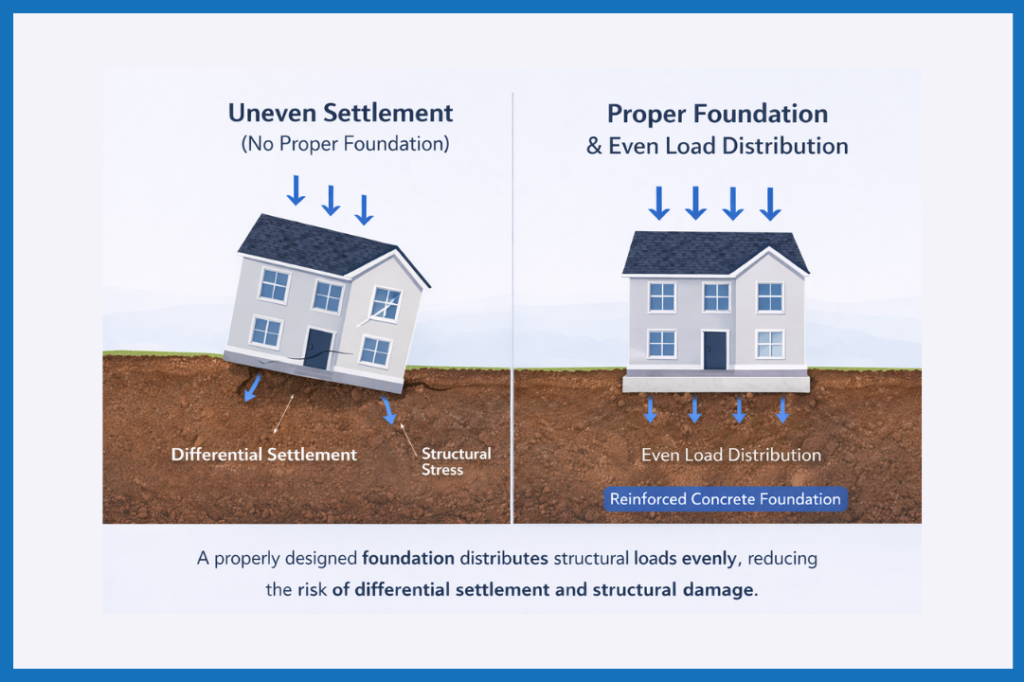
The concrete foundation transfers the building’s weight evenly into the ground and distributes the load consistently across the supporting soil. Without a foundation, the soil beneath the building would shift unevenly over time. For example, after heavy rainfall, the soil beneath one part of the house may become saturated and lose strength while other areas remain firm. This uneven support can cause the structure to tilt, leading to cracks and structural damage.
There are many different types of material that you can use for a foundation however, concrete foundations are the most popular in Quebec.
Note
– The structure must be strong enough not to fail, and
– It must comply with the Québec Building Code.
For small residential buildings, the code assumes that you build on a type of soil with a minimum bearing capacity of 75 kPa. Larger buildings require engineered foundation design based on the actual soil conditions.
Different types of soil and how they impact your foundation
Before discussing different foundation systems, it’s important to examine the soil and substructures that your property sits on. This is either a clay, silt, sand, gravel or rock. The type of soil impacts your choice of foundation. This is because the soil determines how much load the ground can safely support and how much the building may shift over time. If the soil is too weak to support the home, the foundation can sink unevenly into the soil and this can cause the structure to tilt and then crack.
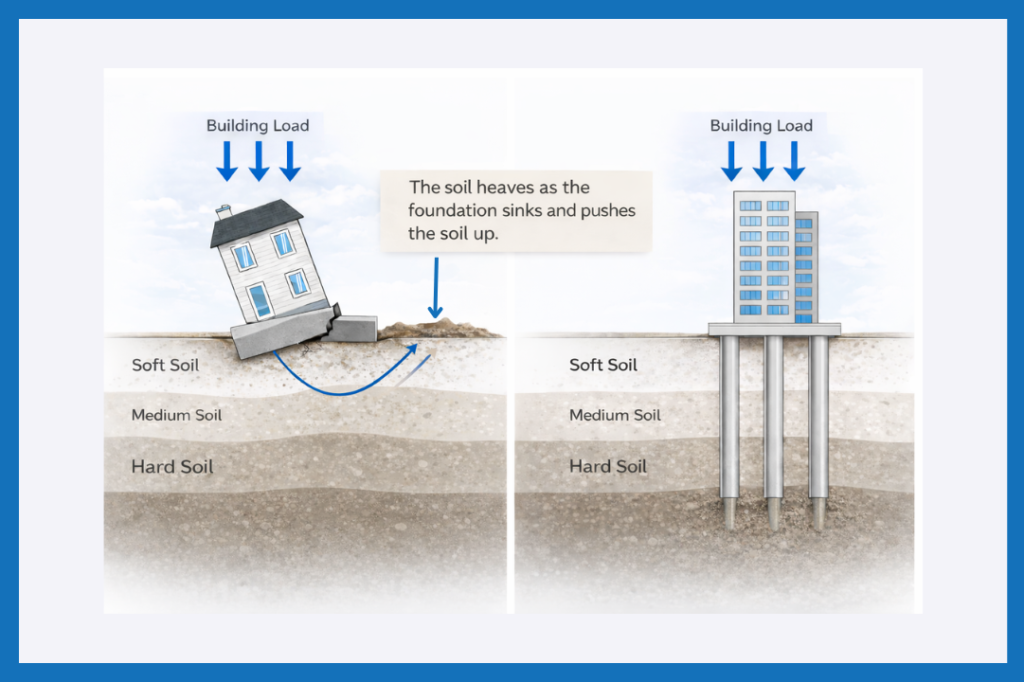
Before a building is constructed, a geotechnical engineer will analyze the soil conditions and determine its bearing capacity, drainage characteristics, and susceptibility to movement. Building designers use the geotechnical report to design the correct foundation for the site.
In Quebec, you can see practical examples of how soil type impacts foundation design in residential buildings constructed in the St. Lawrence Valley. These homes tend to sit on clay-rich deposits, which often require deeper footings and reinforced foundations compared to those built in the Laurentians, where sandier soils or shallow bedrock can allow for simpler and less expensive foundation designs.
Poured concrete vs concrete block foundation
In Quebec, you will find two primary methods used to build a concrete foundation: poured concrete foundations and concrete block foundations.
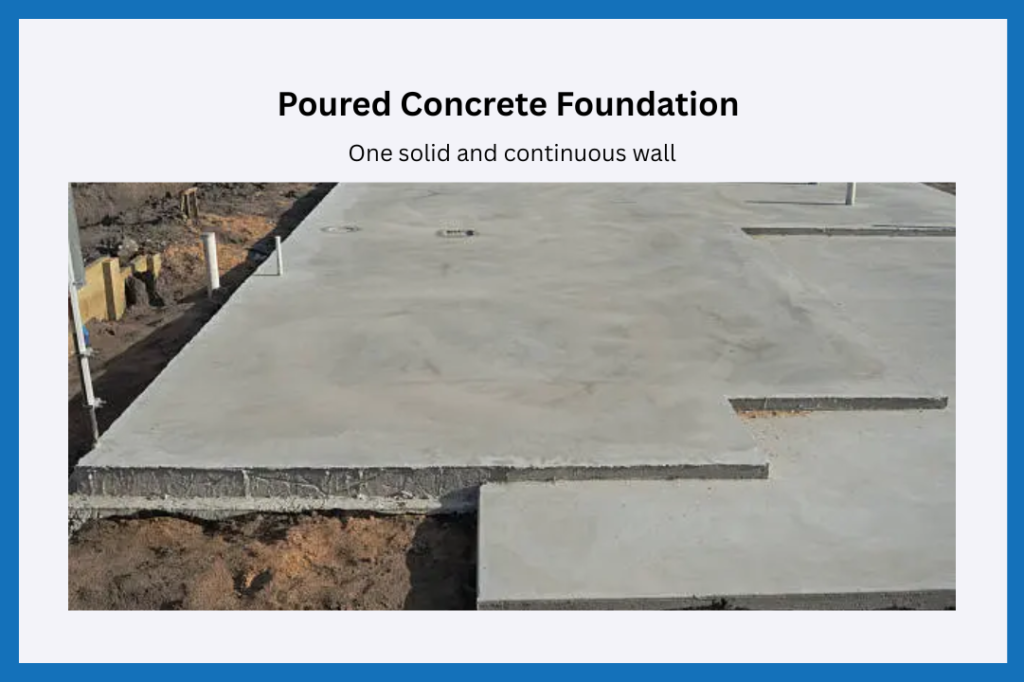
Builders construct a poured concrete foundation by pouring liquid concrete into temporary forms at the job site and allowing it to cure into one solid wall. They place steel reinforcing bars (rebar) inside the forms to strengthen the concrete and reduce cracking. The finished wall forms a seamless, monolithic structure that supports the home and spreads its weight evenly into the soil.
Builders create a concrete block (cinder block or CMU) foundation by stacking and mortaring individual concrete masonry units to form foundation walls. Manufacturers design the blocks with hollow cores to reduce weight and allow reinforcement. Contractors insert steel rebar vertically through the cores and often fill them with grout or concrete to increase strength and stability.
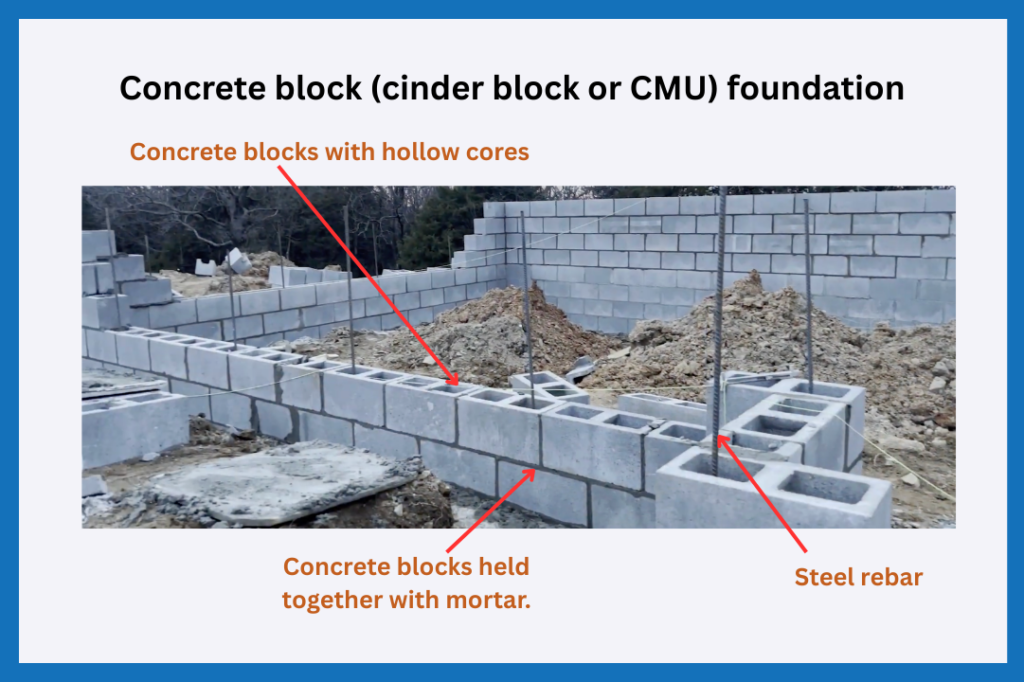
Advantages and disadvantages of poured concrete vs block foundations
Concrete block foundations typically cost less to build than poured concrete foundations, but each mortar joint creates a potential point of weakness. Over time, these joints can allow water to infiltrate the wall system, leading to flooding, damp conditions, mould growth, and other moisture-related issues. As a result, block foundations require careful waterproofing and regular maintenance to ensure long-term performance. In Quebec, builders most commonly used block foundations in residential construction between the 1950s and 1980s.
Poured concrete foundations, by contrast, form a continuous monolithic wall with far fewer seams. This structure allows them to resist water intrusion and lateral soil pressure more effectively, which is why modern residential construction typically uses poured concrete foundations and why buyers generally prefer them.
Different types of concrete foundation
Although poured concrete and concrete block describe how builders construct foundation walls, engineers classify foundations by how they transfer a building’s weight to the ground. In this context, foundations are generally classified into two broad categories: shallow foundations and deep foundations.
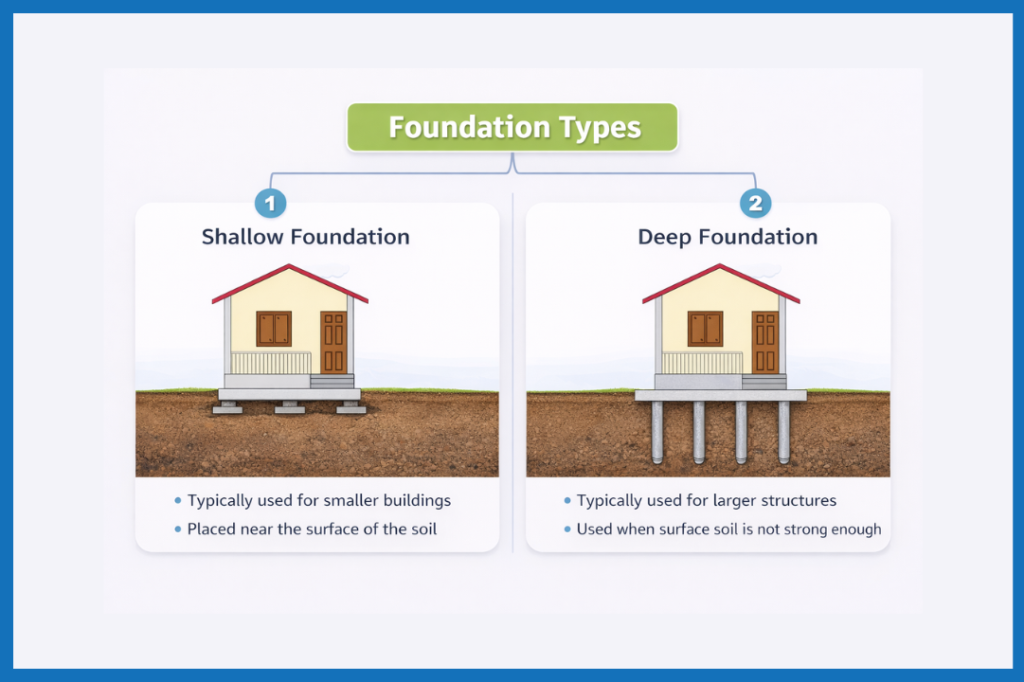
Types of shallow foundation
Builders use shallow foundations when the soil near the surface is strong enough to support the structure’s weight without the need to transfer loads to deeper ground. There are various types of shallow foundation, each with its advantages and disadvantages for particular environments. Typically low-rise residential buildings and other light structures will use shallow foundations. The most common types of shallow foundation include:
- Slab-on-Grade Foundation
- Crawl Space Foundation
- Basement Foundation
- T-Shaped Foundation
- Mat or Raft Foundation
- Frost-Protected Shallow Foundation (FPSF)
Let’s take a closer look and what each of these types of foundation are, and what are their use cases.
Slab-on-Grade Foundation
A slab-on-grade foundation is a single, thick layer of concrete poured directly onto the ground, often with a gravel or sand base, and with a moisture barrier. There are two main types of slab-on-grade: monolithic and floating slab.
A monolithic slab foundation
In a monolithic slab foundation, builders pour the footings and slab together as one continuous concrete structure. They place the footings under load-bearing walls and form thickened edges around the perimeter to support the exterior walls. This foundation requires only shallow excavation, typically a 4-inch slab with 12–24 inch thickened edge footings, making it faster and more cost-effective than foundations that require deeper excavation and multiple pours.
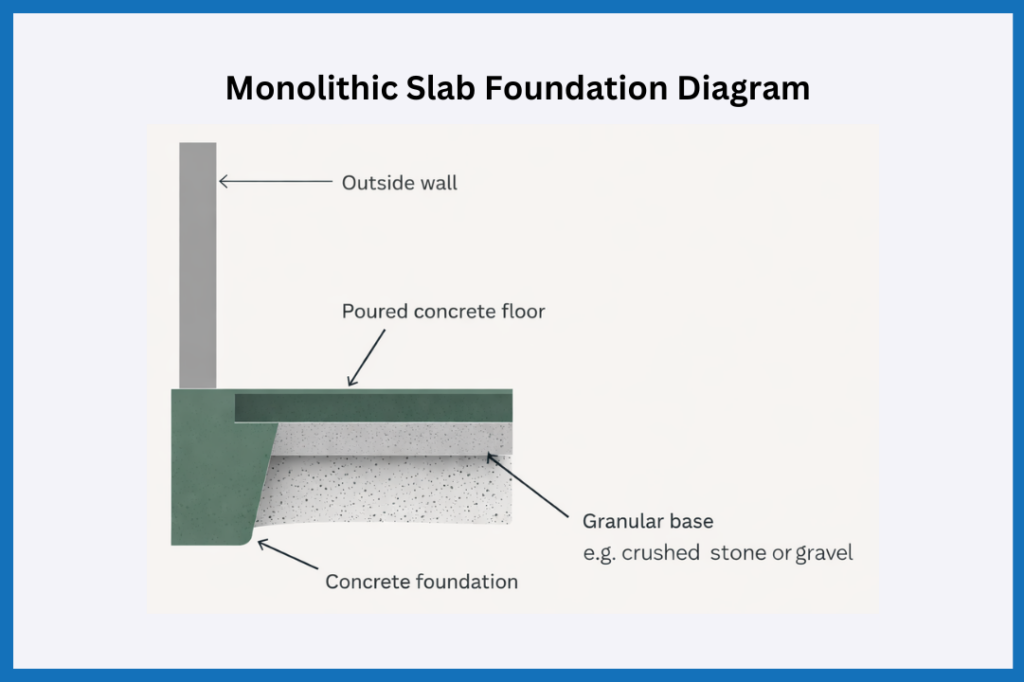
In Quebec, builders rarely use this type of foundation. This is because the Quebec building code requires builders to dig footings below the frost line (up to 1.8 meters deep) to prevent frost heave. They can use it if they install a frost-protected shallow foundation, which keeps the soil beneath the footing from freezing.
A floating slab foundation
A floating slab is one where the builder will pour the slab separately from the concrete foundation. In this configuration, the slab sits within the inside perimeter of the foundation walls and rests on compacted granular fill, allowing it to move independently from the foundation structure.
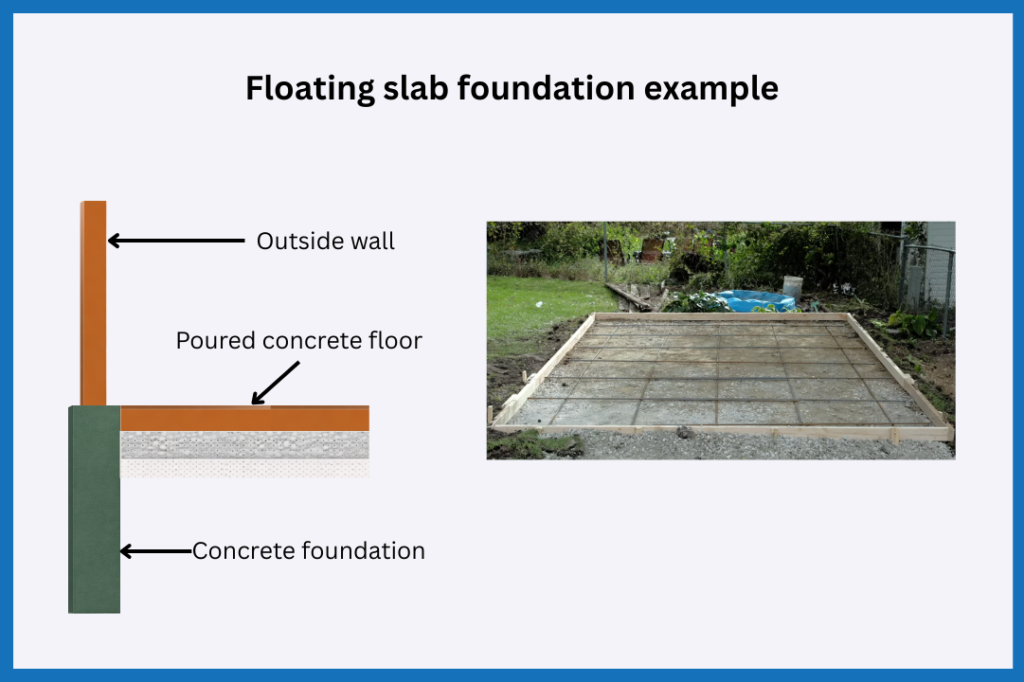
In Quebec, builders should either extend the concrete foundation below the frost line or properly insulate it to prevent frost heave and soil movement during freeze-thaw cycles. However, builders do not need to apply frost protection to the poured concrete floor. This works because the design lets the floor move independently of the walls, since it does not rigidly connect to the superstructure. This type of foundation is typically only good for smaller structures like patios and garden sheds use this type of structure.
Crawl Space Foundation
A crawl space foundation raises the building slightly off the ground, forming a space beneath the structure. Builders construct crawl space foundations on stem walls, short structural walls that sit on concrete footings. In Quebec, they usually build stem walls four feet or less using poured concrete, concrete blocks, or rubble (stone). Builders will often put a thin concrete strip over the based of the crawl space called a rat slab.
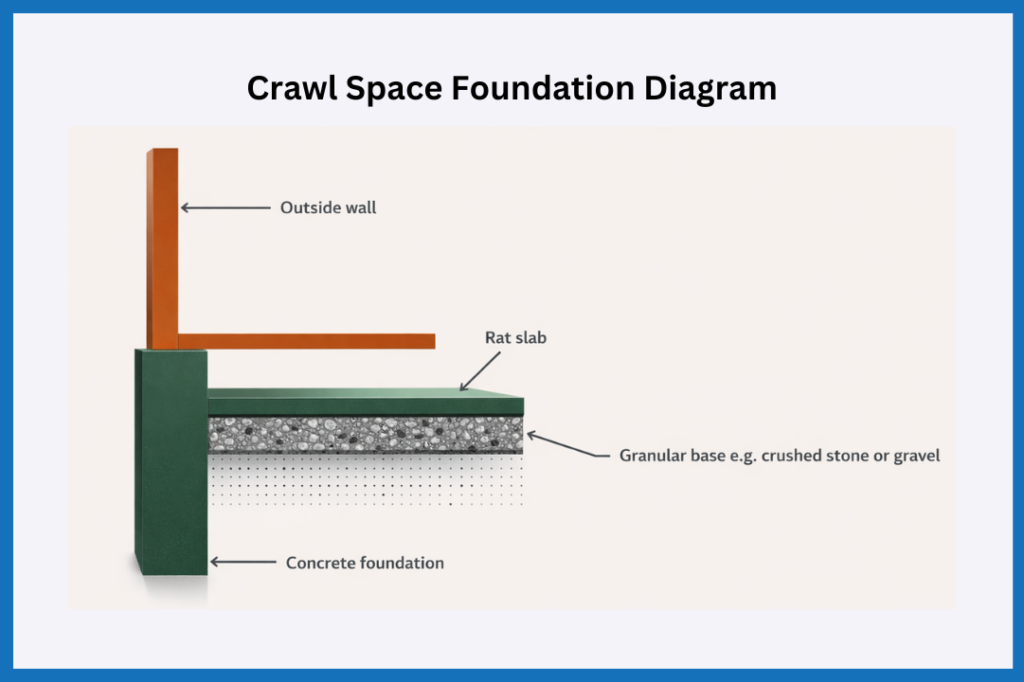
This type of foundation is less expensive than a full basement, often costing roughly $8,000–$12,000 less to build. If the construction company designs the crawl space well, it can be great since it is easier to access electrical wiring, plumbing systems, and other utilities beneath the superstructure compared to a full basement. Moreover, because the crawl space elevates the home, it can provide some protection from flooding.
Basement foundation
Basement foundations are the deepest type of shallow foundation and are especially common in Quebec. Since builders must already excavate to reach the frost line, they often construct a basement at the same time. This type of foundation can provide additional living or storage space below the main level of the building.
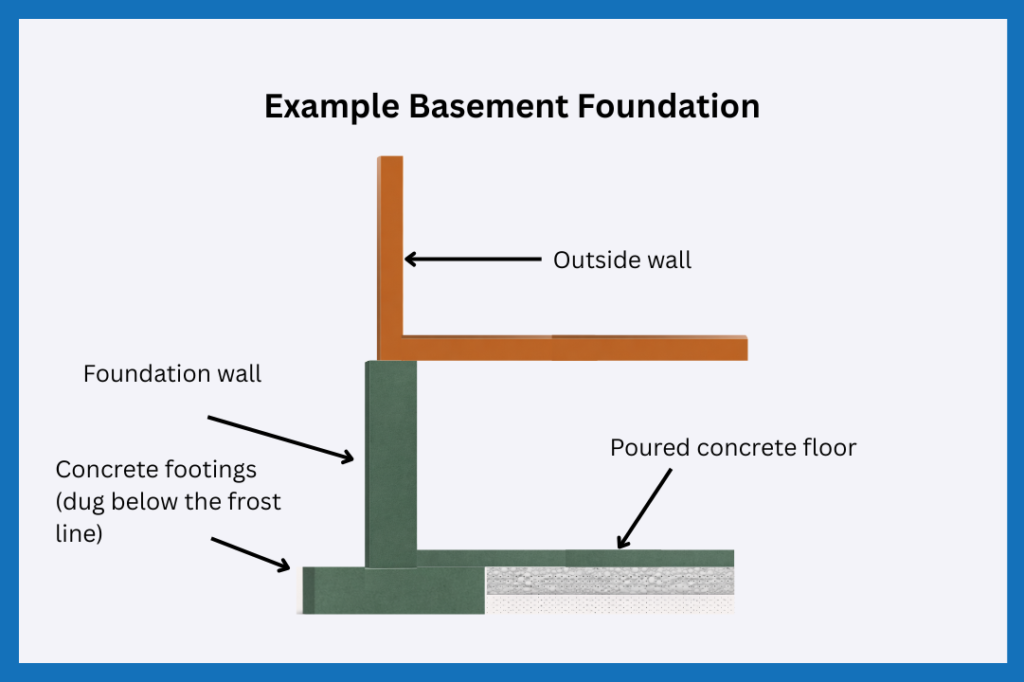
There are two common types of basement foundation in Quebec: full basements and partial basements. Full basements feature a foundation wall that will run along the entire perimeter of the ground floor. For instance, if the basement is 1000 square foot, a full basement will also be 1000 square foot. Partial basements have foundation walls that support only part of the house footprint, meaning the basement occupies only a portion of the space beneath the home. The remaining area may sit on a crawl space or slab foundation.
Note
T-Shaped Foundation
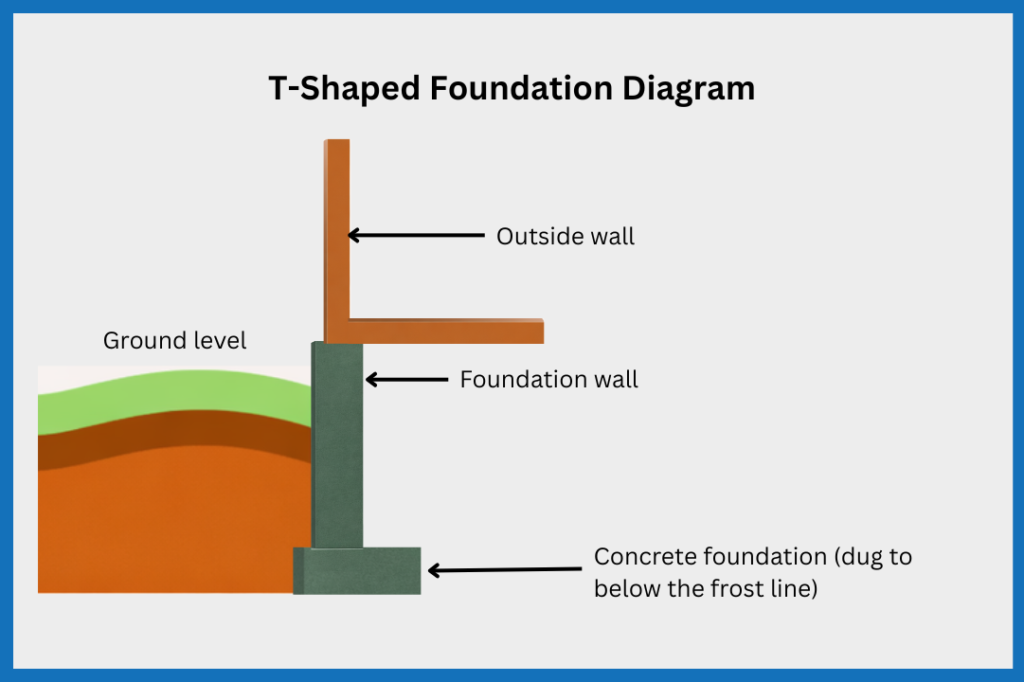
A T-Shaped foundation is when you add a T shape to the foot of the foundation below the frost line. This type of foundation is especially common in colder climates since the footing extends below the frost depth, preventing frost heave from lifting or cracking the foundation walls. The vertical stem wall above the footing supports the house superstructure, and you can pour a slab inside the T perimeter to create a basement floor.
Mat (or Raft) Foundation
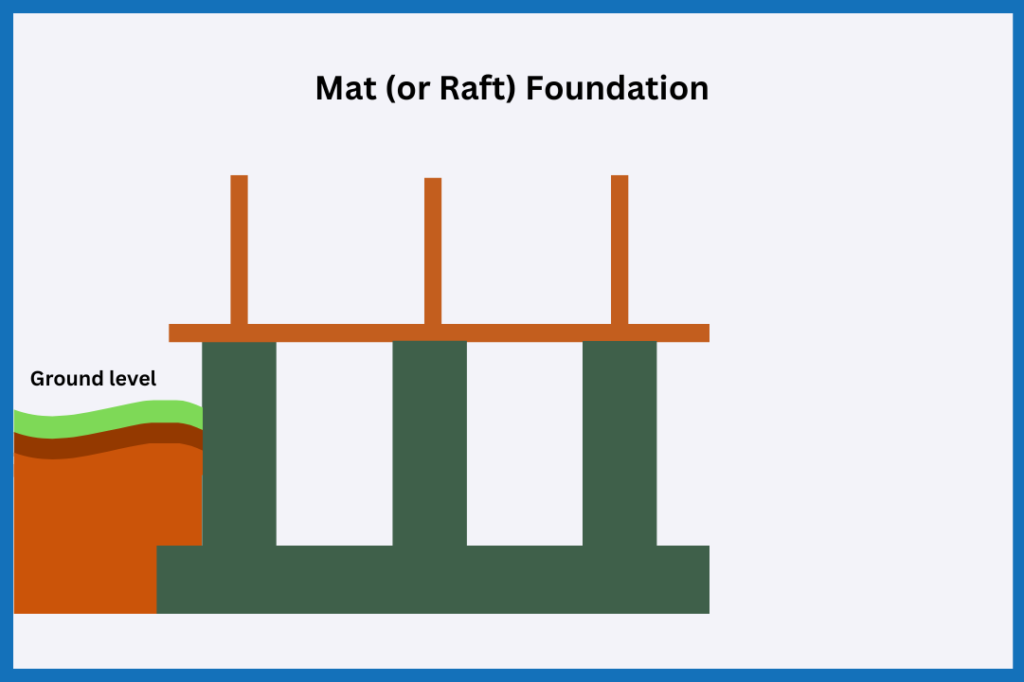
A mat (or raft) foundation consists of a single large continuous rectangular or circular slab under a building. The foundation has pillars that are built on top of the slab. Supporting walls from the superstructure are built onto of these pillars. Mat foundations are common in commercial building projects and in areas where basements are popular.
Frost-Protected Shallow Foundation (FPSF)
A frost-protected shallow foundation is similar to a slab-on-grade foundation, where the foundation does not extend as deep as basement or T-shaped foundations. Instead of placing the footing below the frost line, builders install rigid insulation horizontally in the soil as an insulation skirt extending outward from the foundation wall. This insulation helps prevent frost from penetrating beneath the footing, allowing the foundation to remain shallower without the risk of frost heave.
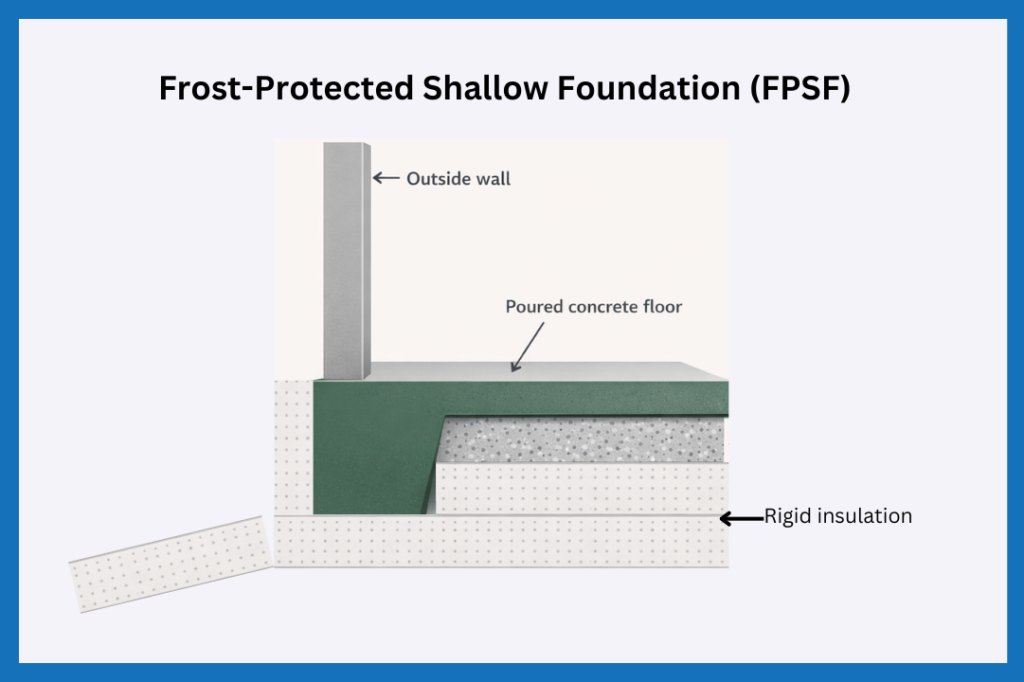
This type of foundation is ideal in cold climates or where soil depths are quite low, for instance those with bedrock or ledge just several inches below the surface.
Types of deep foundation
Builders use deep foundations when the soil near the surface cannot safely support the weight of the structure and the loads must be transferred to stronger soil or bedrock deeper underground. Typically large buildings and other heavy structures will use deep foundations. The most common type of deep foundations are pile foundations.
Pile foundations
Pile foundations are a type of deep foundation that drill through weaker surface soils and transfer the building’s load to deeper, stronger soil or rock layers. There are two main types of pile foundation: non-displacement and displacement pile foundations. Non-displacement piles are created by drilling a hole and filling it with reinforced concrete. Displacement piles are driven into the ground, pushing the surrounding soil aside as the pile goes in.
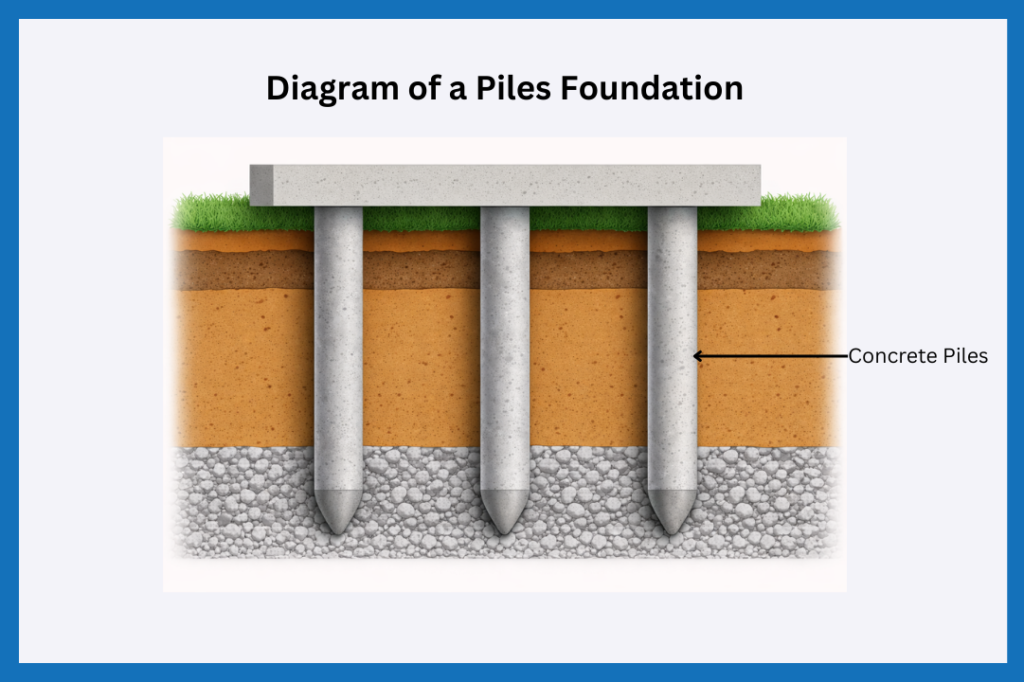
Pile foundations must be used whenever the near-surface soil does not have sufficient bearing capacity to support the loads imposed by the structure. They may also be required when building on sloped sites, where excavation could surcharge or undermine adjacent structures, or where the groundwater table is close to the surface and conventional shallow foundations may be unstable.
How to lay a concrete foundation
Laying a concrete foundation requires meticulous planning and execution. The process, from site preparation to formwork and curing, demands precision to ensure the foundation’s durability and strength. Each step contributes significantly to the structures stability and longevity.
Step 1 – Planning
Before you start laying the foundation, the first step is plan. The steps here are to decide what type of foundation you are going to build, design the foundation, work out what materials and equipment you will need and how much it is going to cost. To do this, you will need to hire the following experts.
| Role | What They Do | When Best to Hire |
|---|---|---|
| Project Manager | Oversees the entire foundation project. Coordinates schedules, budgets, materials, and communication between engineers, architects, and contractors. Ensures the project stays on time and within budget. | At the start of the planning phase for larger or complex projects. For smaller projects the contractor may take on this role. |
| Geotechnical Engineer | Analyzes soil and ground conditions. Tests soil bearing capacity, groundwater levels, and stability to determine the safest type and depth of foundation. | Very early in planning, before designing the foundation. Especially important when soil conditions are unknown or the project is large. |
| Architect | Designs the building layout, structure, and appearance. Works with engineers to ensure the foundation supports the building safely and complies with building codes. | Early in the design stage after site feasibility but before final structural plans are completed. |
| Civil / Structural Engineer | Designs the technical foundation system including footings, reinforcement, and load calculations. Ensures the structure distributes weight safely into the soil. | After soil testing but before construction drawings are finalized. |
| Designer / Draftsperson | Produces detailed drawings and technical plans from the architect’s and engineer’s specifications so contractors can build the foundation accurately. | During the design phase once major engineering and architectural decisions are made. |
| Contractor / Builder | Carries out the construction work including excavation, formwork, reinforcement placement, concrete pouring, and curing. | After plans and permits are approved, just before construction begins. Contractors may also be consulted earlier for cost estimates. |
Step 2 – Excavate the side
After you have got a good plan in place, it is time to start digging! The first thing to do here is to clear the area that you plan to build on and then excavate it to the required depth and dimensions, as per the foundation design. You will then need to compact the soil to create a stable base. To do this, you can use a something like a Jumping Jack Compactor or Compact Roller for large areas. You should aim for a 90 – 95% compaction percentage.
Step 3 – Setting out
Once you have excavated the site, use surveying tools to mark the layout of the foundation according to the building plans. You can use builders’ string and boundary pegs to mark the exact perimeter and corners of the foundation on the site.
Step 4 – Building the formwork
Next you need to construct the formwork using wood, steel or any other materials to contain the concrete while it sets. When you do this, you must make to correclty align, level and securely brace the formwork. If the design requires reinforcement, you can add the rebar inside the formwork. You will eventually pour the concrete into this form so that concrete will cover the rebar and add strength to your foundation.
Step 5 – Mix and pour the concrete
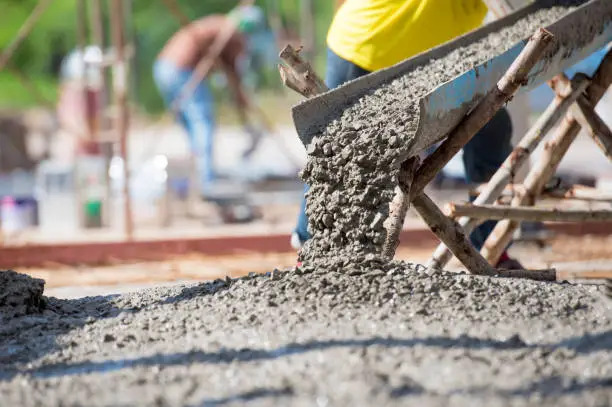
To mix concrete you will need three things: an aggregate, sharp sand and cement. You will then pour these three things into a concrete mixer to combine them with water and create a uniform, workable concrete mix. You will then take the concrete mix and pour the concrete into the formwork using a chute or pump if necessary.
Step 6 – Leveling and consolidating
Use shovels, rakes, and/or concrete vibrators to spread and consolidate the concrete evenly within the formwork. Tap the sides of the formwork as you work to release trapped air and ensure the entire concrete pour is free of air pockets or voids.
Step 7 – Curing and protection
Once the concrete has been poured, it starts to dry out and harden immediately. If this happens too fast, the concrete foundation can become weaker and crack. Concrete curing keeps the concrete moist and at the right temperature so that it hardens at the right pace and becomes strong. To cure concrete, builders often use curing compounds, wet burlap, or plastic sheeting to retain moisture and allow it to cure slowly for optimal strength.
Builders must also protect the concrete from extreme weather conditions while it drys out. This includes rain, direct sunlight, or freezing temperatures. All of these will effect the curing process.
Step 8 – Remove the formwork and inspect
Once the concrete has cured for the correct amount of time, you can carefully remove the formwork and inspect the surface and structure for any signs of damage. Typically you will look for cracks, flaking or uneven areas. You should also check the concrete has set evenly, that there is no deformation, and that the edges are straight.
What is the cost of a concrete foundation?
The cost of a concrete foundation will depend on the type of foundation, the exact materials that you use and local labour costs. Below are some examples of what you might expect to pay in Quebec. For an accurate cost estimate, a contractor or engineer must evaluate the exact soil conditions, foundation design, and construction requirements.
| Type of Foundation | Price Range per sq ft | Estimated Cost for 1000 sq ft | Other Considerations |
|---|---|---|---|
| Slab-on-Grade Foundation | $5.50 – $19 CAD | $5,500 – $19,000 CAD | Costs vary depending on excavation depth, concrete thickness, and finishing options. |
| Crawl Space Foundation | $9.60 – $22 CAD | $9,600 – $22,000 CAD | Depends on crawl space height, excavation requirements, and construction access. |
| Basement Foundation | $13.70 – $55 CAD+ | $13,700 – $55,000 CAD+ | Higher cost due to deeper excavation, additional materials, and construction complexity. |
| Pile Foundations | N/A (priced per pile) | $2,050 – $4,100 CAD per pile | Costs depend on soil conditions, pile depth, and number of piles required. |
| T-Shaped Foundation | $13.70 – $27.40 CAD | $13,700 – $27,400 CAD | Costs vary based on excavation depth and thickness of the footing and slab. |
| Mat / Raft Foundation | $13.70 – $27.40 CAD+ | $13,700 – $27,400 CAD+ | Requires a large volume of reinforced concrete across the entire footprint. |
Note: Costs are approximate and can vary depending on soil conditions, labour rates, excavation difficulty, and local building codes.