
If you are buying or selling a house in Quebec that was built between the 1940s and the late 1980s, you need to be aware of asbestos.
This mineral was once widely used in construction throughout Quebec and across Canada. You will find asbestos in a significant number of properties and, in a range of building materials, including insulation, cement products, drywall joint compounds, ceiling tiles, pipe wrapping, and flooring materials.
While asbestos is not dangerous when it is left intact and sealed inside materials, problems arise when it is disturbed. In these cases, microscopic fibers can become airborne, be inhaled, and this can lead to serious illnesses, including cancer and other lung diseases.
In this article, we will explain how to spot asbestos in the home, and what you need to do to protect yourself legally, financially, and health-wise, before you either buy, or sell a home that contains asbestos.
What Does Asbestos Look Like?
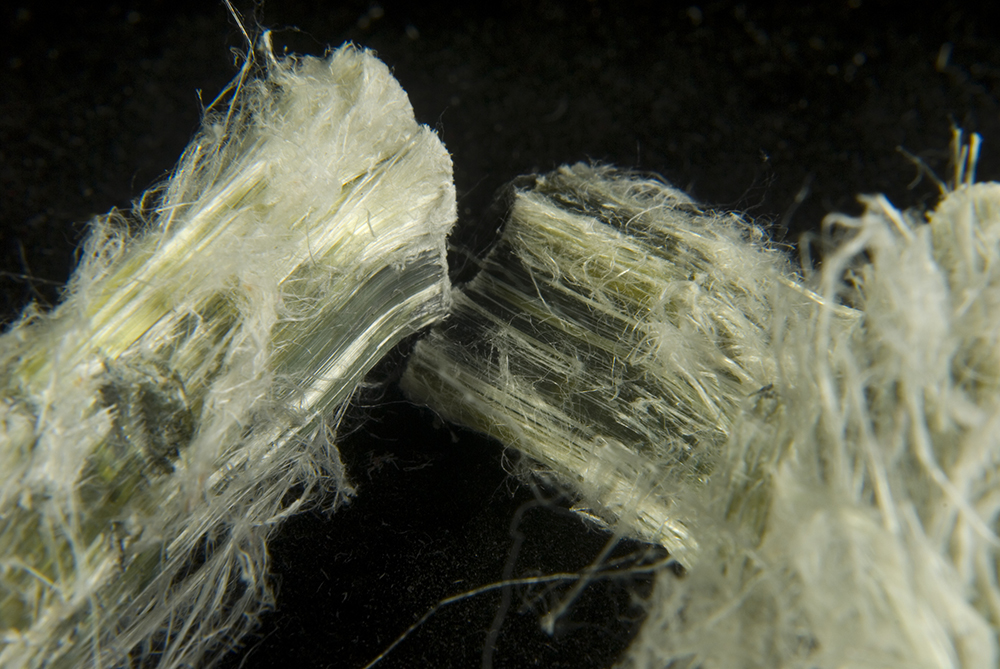
Asbestos is a naturally occurring mineral. In its raw form, it looks like a black rock covered in white fibers, almost like fine strands of hair or fluff.
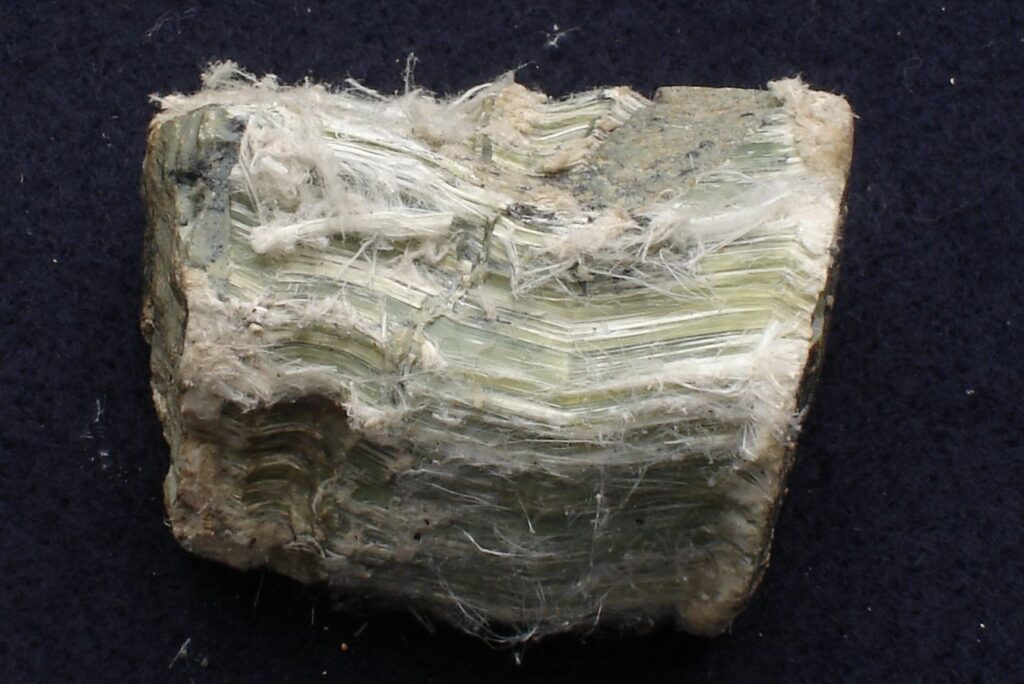
The fibers on the rock have several qualities that make them very useful. Essentially, they are highly resistant to heat, fire, and chemicals, and can be easily pulled apart and woven together. This combination of durability and versatility meant that manufacturers incorporated asbestos into a wide range of building materials. As a result, it can be found in insulation, cement products, ceiling tiles, pipe coverings, and many other products.
Because manufacturers mixed asbestos into other materials, it is not always easy to identify it. For this reason, specialized asbestos testing is often required to confirm its presence within a product. However, certain materials are known to commonly contain asbestos, for instance popcorn ceilings. In other cases, asbestos may be visually identifiable, such as in fibrous insulation.
Is Asbestos In Your Home Dangerous?
Asbestos is not harmful when it is undisturbed. However, if you drill into a dry wall, remove a floor tile, replace an old pipe, or if an animal gets into your attic and rips up your insulation, this can release dust.
If you have asbestos, then inside that dust, you will get tiny asbestos fibers which can be easily inhaled. Inhaled asbestos fibers can lodge deep in lung tissue. Because they resist breakdown, they can remain there for years and, during this time, the fibers will scratch the insides of your lungs.
When this happens, your bodies auto immune response is to generate scar tissue inside your lungs. Over time, this scarring can build up, causing the lungs to stiffen which, makes it increasingly difficult to breathe. In addition to this, if you get asbestos in your lungs this can lead to an aggressive form of cancer known as mesothelioma.
A long-term study of more than 4,500 asbestos miners in Quebec found significantly elevated mortality rates, particularly among those with higher levels of dust exposure. In the most heavily exposed workers, death rates were about 20% higher than in less exposed groups, with much higher risks for lung disease and cancer.
Where Can Asbestos Be Found In Your Home?
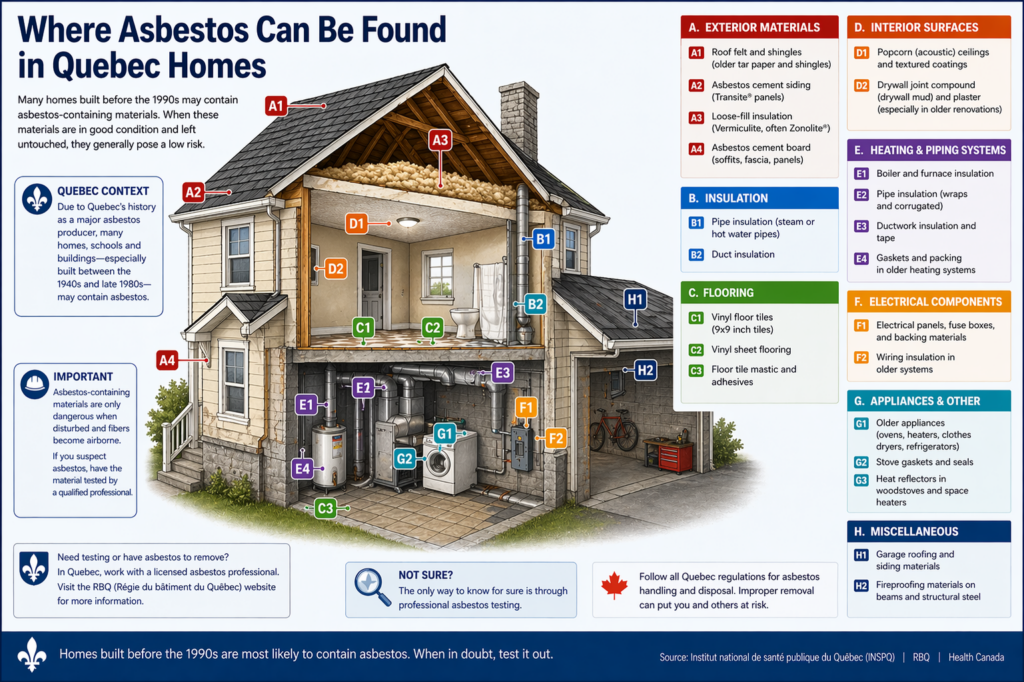
Asbestos can be found in a wide range of household products such as paint, floor tiles, insulation, and piping. Vintage products such as ovens, heaters, clothes dryers and refrigerators can also contain asbestos.
In Quebec, asbestos is most commonly found in:
- Vermiculite insulation (attics) — especially loose-fill insulation (often associated with older products like Zonolite)
- Popcorn ceilings (acoustic ceilings) — common in homes from the 1960s–1980s
- Vinyl floor tiles and the adhesives beneath them — particularly 9×9 inch tiles
- Pipe insulation — including wrapped or corrugated insulation around hot water or steam pipes
- Boiler and furnace insulation — older heating systems often used asbestos-containing materials
- Cement products — such as asbestos cement siding, roofing shingles, and exterior panels
- Drywall joint compound (mud) and plaster — especially in older renovations
- Duct insulation and tape — around HVAC systems
- Roofing materials — including felt, tar, and shingles
- Fireproofing materials — used around electrical panels, structural beams, or in utility rooms
How to identify asbestos?
To identify asbestos can be challenging for two main reasons. First, it was used in thousands of products (more than 3,000 globally at its peak). Second, there is no centralized database in Canada that identifies specific products containing asbestos. As a result, building inspectors and real estate professionals typically rely on the following factors to assess the likelihood of its presence:
- Age of construction
- Material type and appearance
- Location and use (e.g., mechanical vs. decorative)
- Laboratory testing for confirmation
For example, if you find insulation in an attic built in the 1960s that resembles vermiculite, an experienced inspector will likely recommend sending a sample for laboratory testing to confirm whether asbestos is present.
 Immovision
Free Online Asbestos Risk Check
Instantly know if a product in your home is likely to contain asbestos.
What Does Asbestos Look Like in a Home?
Asbestos cannot be confirmed by sight alone. However, certain materials and appearances may indicate its presence, especially in older homes.
What does asbestos insulation look like? (Attics and Walls)
There are two common places that you get asbestos: in attic and wall insulation.
First, if you see loose-fill (blown-in) insulation in your attic, that looks like small, lightweight pebbles, this may in fact be vermiculite. By itself, vermiculite is a harmless material; however, some vermiculite insulation produced before the 1990s may be contaminated with asbestos. For this reason, if you see this in an older building, it is a good idea to get this sent off for specialist asbestos testing.
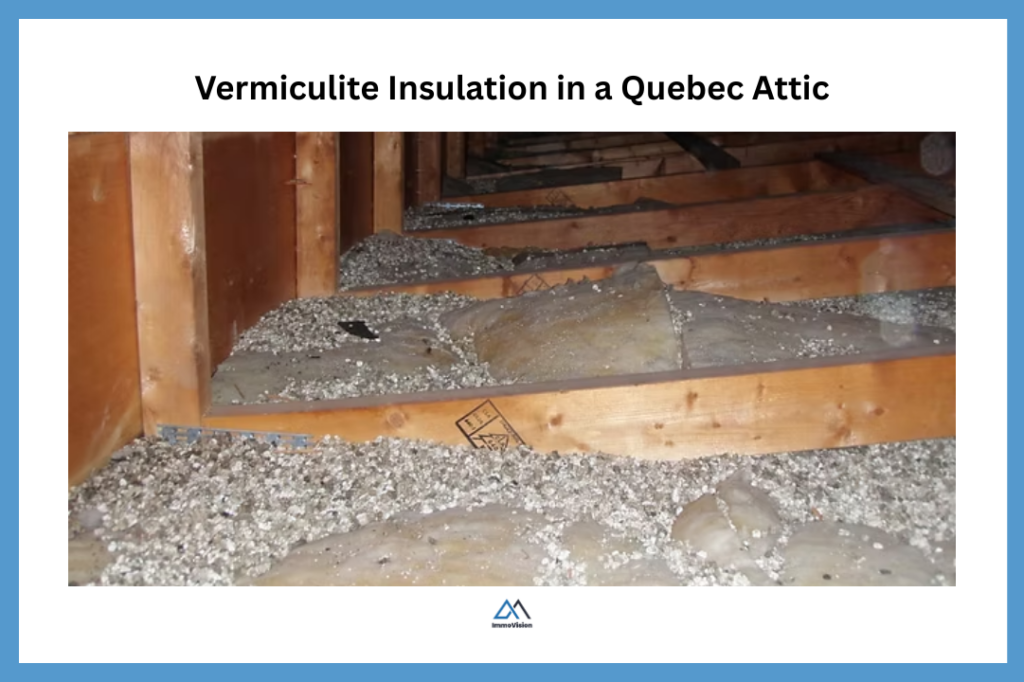
Second, asbestos may be present in your wall insulation. As in attics, this could be vermiculite, or other forms of blown-in insulation. However, because wall insulation is hidden behind finished walls, it is usually not visible, and its composition cannot be confirmed without sampling. For this reason, if you are buying a home before 1990s, you may want to test for asbestos.
What does asbestos insulation look like on pipes?
Asbestos pipe insulation in older buildings is commonly covered with an outer protective layer known as canvas lagging cloth or a cloth jacket, which helps hold the insulation in place and provides minor protection from damage. Beneath this outer wrap, the insulation itself is typically asbestos-containing pipe covering, which may appear as a paper-like wrap or a preformed insulating material made from asbestos mixed with binders such as gypsum, magnesia, or calcium silicate.
This insulation can be friable, meaning it may be soft, chalky, or easily crumbled when handled. In some cases, it can break apart or flake off under light pressure, releasing asbestos fibers.
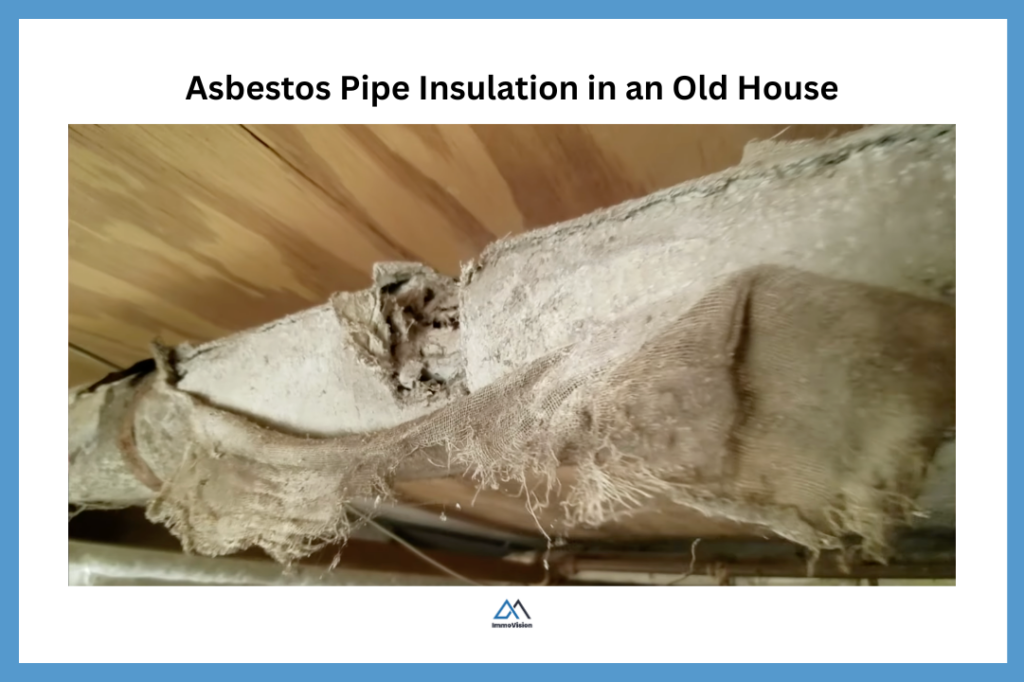
This type of insulation is commonly found in basements, boiler rooms, and mechanical spaces near HVAC systems. If fibres are released and drawn into your HVAC system, they can be blown through the building via ductwork. This increases the risk of inhalation exposure for people living in the house.
What does asbestos in tiles look like?
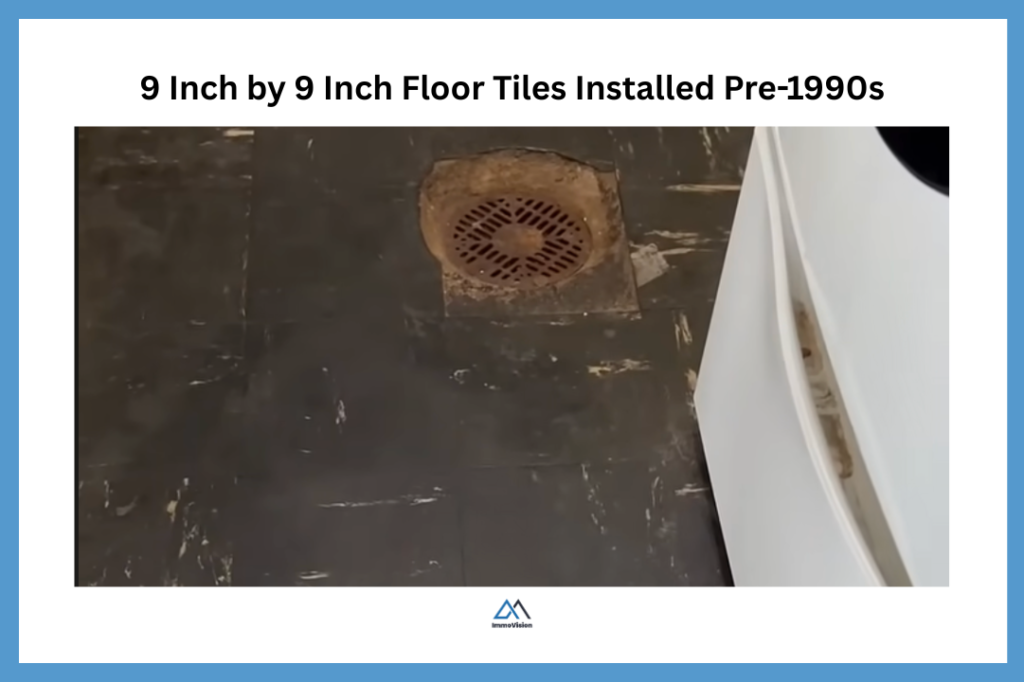
From roughly the 1950s through the late 1980s, manufacturers widely produced vinyl asbestos tile, often referred to as VAT. These tiles were most commonly made in 9 by 9 inch or 12 by 12 inch formats, which became a standard size for both residential and commercial flooring. In older buildings, tiles of this size can be a strong indicator that asbestos may be present.
In asbestos floor tiles, the asbestos is not visible on the surface. Instead, it is mixed throughout the vinyl material during manufacturing and compressed under heat and pressure. This process locks the asbestos fibres inside the tile, allowing it to act as a reinforcing material. As long as the tiles remain intact, they are generally considered stable. The risk arises when the tiles are cut, sanded, or broken, which can release fibres into the air.
Asbestos tiles are most commonly found in basements and kitchens, but they may also be hidden beneath newer flooring such as carpet, laminate, or vinyl. Sometimes, they will only become visible during renovations when existing floor coverings are removed.
What does asbestos in popcorn ceilings look like?
Popcorn ceilings, also known as acoustic or stippled ceilings, are textured ceiling finishes that were widely used from the 1950s through the 1980s to improve sound absorption and hide surface imperfections. Some of these products contain asbestos, particularly those installed before the mid-1980s.
Visually, there is no reliable way to determine whether a popcorn ceiling contains asbestos. Both asbestos-containing and non-asbestos versions can look identical. The most important indicator is the age of the building or the date the ceiling was installed.
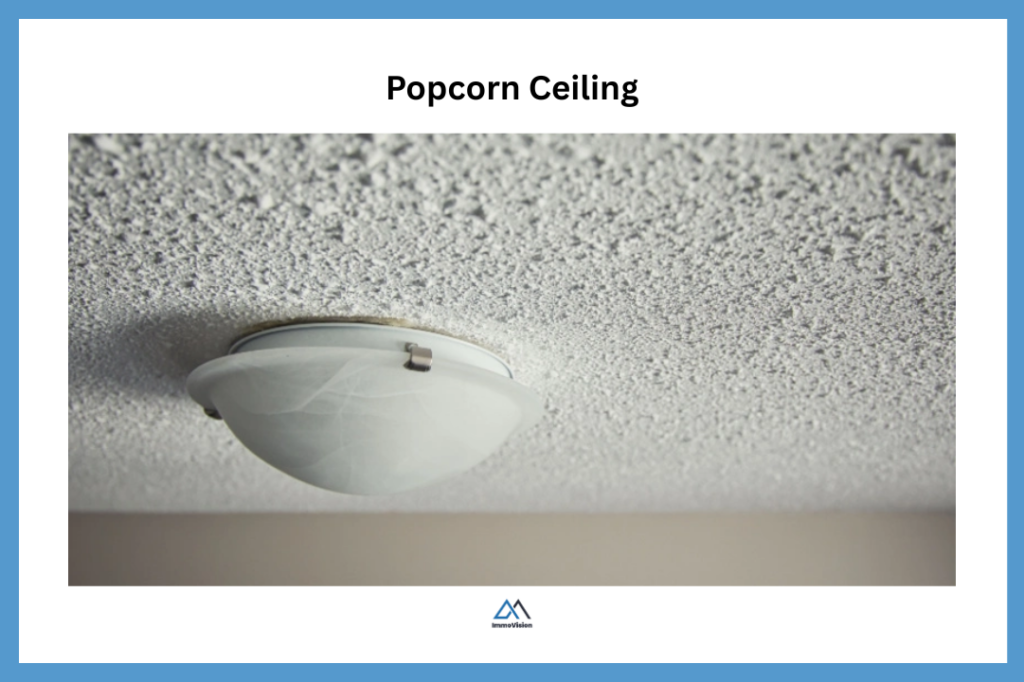
If the ceiling does have asbestos, activities such as scraping, sanding, or drilling into the ceiling can release fibres. If there is any uncertainty, especially in older homes, it is advisable to have the material tested before carrying out any work.
What Can I Do About Asbestos in My Home?
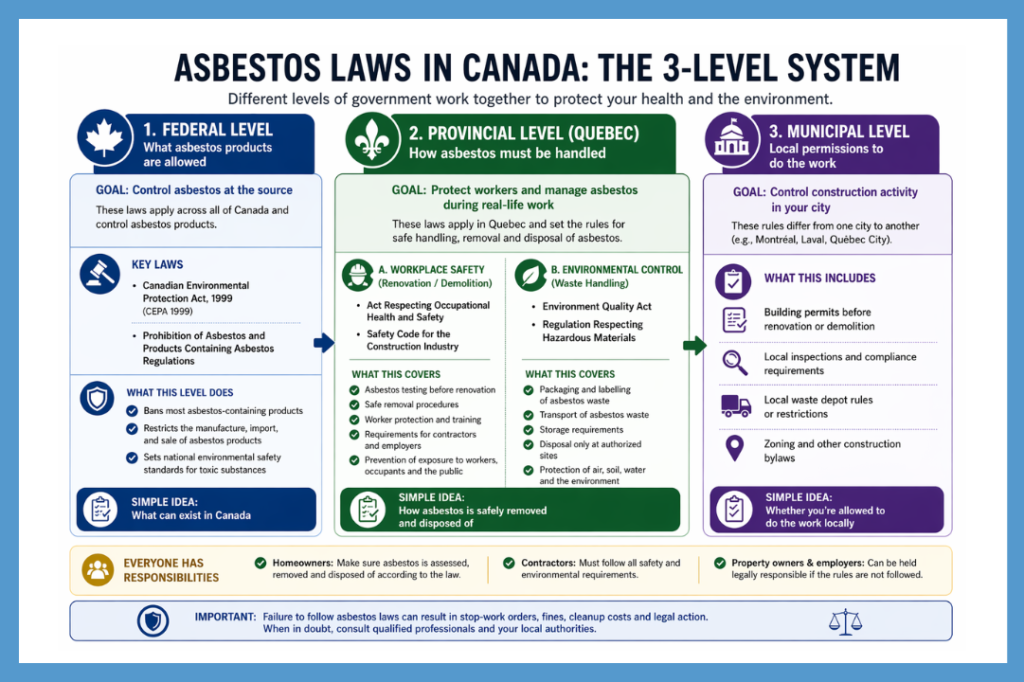
Asbestos regulation in Canada works in three layers:
- Federal laws control asbestos products;
- Provincial laws control safe handling and disposal;
- Municipal rules control permits and local construction requirements.
These laws have implications for if you are going to do light DIY projects, or #heavy-renovations-around-asbestos, or if you are planning to remove asbestos.
Light DIY Renovations Around Asbestos
If you are doing light DIY work in a home that may contain asbestos (especially pre-1990 construction), such as mounting a TV bracket, installing shelves, or repairing minor wall damage, follow these precautions:
- Assume materials may contain asbestos if the building is pre-1990
- Avoid disturbing walls, ceilings, textured coatings, or old flooring wherever possible
- Use existing structural points such as studs or pre-existing holes rather than creating new openings
- Wear a well-fitting dust mask or respirator rated for fine particles (not a simple cloth mask)
- Keep other people and pets away from the work area
- Lay down plastic sheeting to reduce dust spread and make cleanup easier
When finished:
- Carefully remove outer clothing before leaving the work area
- Wash clothes separately from other laundry
- Shower thoroughly to remove any dust from skin and hair
⚠️ Key safety reminder
The risk is the microscopic asbestos fibres. These can spread to clothing, furniture, or shared spaces and be unknowingly carried to other people in the home.
If there is any chance that asbestos-containing material is being drilled, cut, or broken, the safest step is to stop and have the material assessed before continuing.
Heavy Renovations or Removal of Asbestos
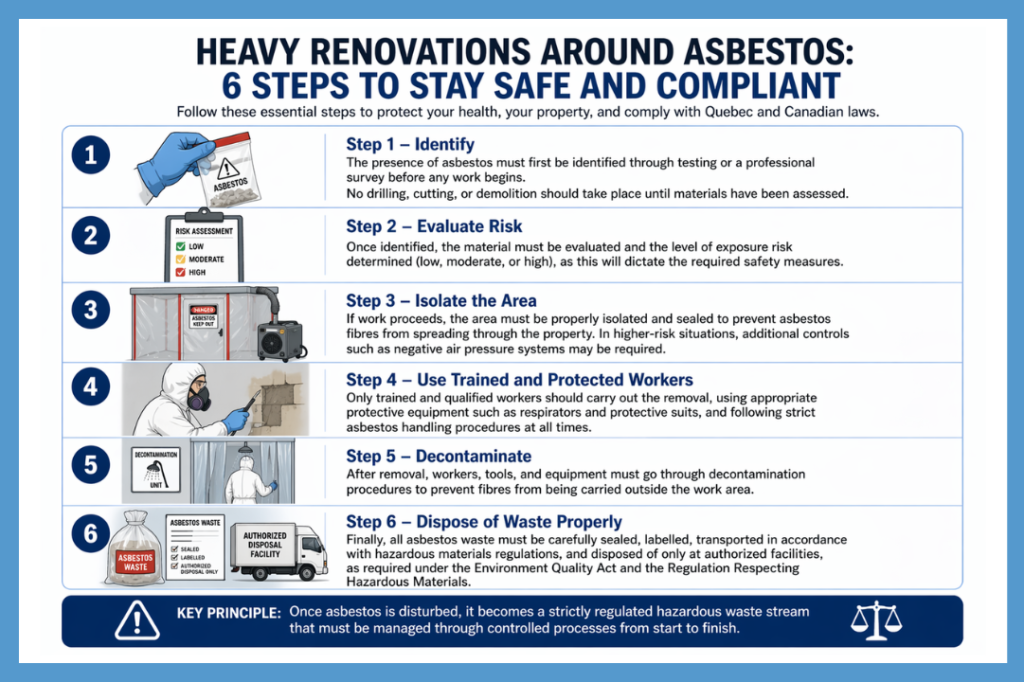
If you need to carry out heavy renovations in an area that may contain asbestos, or remove significant amounts of asbestos (for example, old insulation or demolition work), extra caution is required.
In most cases, it is strongly recommended not to manage this type of work yourself. Instead, you should use a qualified contractor experienced in asbestos handling, who will follow the required safety procedures for worker protection, containment, and disposal. This is known as an asbestos abatement service.
Under Quebec occupational and environmental regulations, responsibility for compliance is shared between the property owner and the contractor, depending on how the project is structured and who is directing the work. This is why using properly qualified professionals is the safest and most legally secure approach.
That being said, so that you understand the process below are the steps that you must follow.
 Immovision
Find Verified Asbestos Contractors
Connect with a experiences asbestos contractors in minutes.
How Can I Tell if a Material in My House Is Asbestos?
It is extremely difficult to tell if a material has asbestos in it, just by looking at it. Unless the material is clearly marked as containing asbestos, you will most likely need to send samples to a lab for testing.
It is generally not advisable to touch the material, or to take a sample yourself. It is far safer to hire a trained qualified contractor who has experience working with asbestos. This contractor will know how to safely take a sample of material that may contain asbestos, and send this to a specialized laboratory for testing.
Note
In Québec, there is no special asbestos-specific licence that contractors must hold. However, a contractor must hold a valid construction licence from the Régie du bâtiment du Québec.
This licence includes categories (called subclasses) that define what kind of work they are allowed to do. For asbestos-related work, the relevant subclasses depend on the job: for example, 7 is often needed for insulation, roofing, siding, or waterproofing work where asbestos may be present, 2.7 applies to excavation or soil work, and 1.2 or 1.3 apply if the contractor is managing full residential or building renovations.
Buyers: How to Protect Yourself in a Real-Estate Transaction
If you are considering buying a home that may contain asbestos, the OACIQ recommends first reviewing the seller’s declaration to see whether any testing or information about asbestos has been disclosed. Sellers must disclose known information honestly and to the best of their knowledge, and may be liable for misrepresentation.
Before making an offer, the buyer should include a condition in the promise to purchase for an asbestos test with satisfactory results. This allows the buyer to confirm the presence of asbestos before finalizing the purchase. Without this condition, if the buyer discovers asbestos later in the transaction, it may limit the buyer’s ability to renegotiate, withdraw from the transaction, or seek financial compensation from the seller for a latent defect.
Finally, asbestos is not dangerous when undisturbed, but it becomes a health risk when fibres are released into the air. A property with asbestos can often still be lived in safely, but insurance may be more expensive or harder to obtain due to risks during fire or renovations, which can release fibres and require costly remediation. Buyers should understand these risks, as difficulty obtaining insurance or high insurance costs may impact their ability to secure financing.
Note
If you are working with a buyer’s broker they have a professional duty to verify all relevant facts.
If they fail to properly check information such as relying on an invalid or incomplete asbestos test, and you suffer financial loss, you can file a complaint with the OACIQ and may be eligible for compensation through the FARCIQ.
Sellers: How to Protect Yourself in a Real-Estate Transaction
If you are selling a home and know it contains asbestos, your listing broker will advise you to disclose this information in the seller’s declaration. If you fail to do so, you could be held liable for failing to disclose a known latent defect. In such a case, the buyer may seek remedies under the Civil Code of Québec, which can include a price reduction, damages, or cancellation of the sale.
If the seller is unsure whether asbestos is present, the listing broker may suggest a pre-listing inspection, so that both buyers and sellers have clearer information about the property’s condition before the transaction begins. This will help the listing agent price the home more accurately and reduces the risk of unexpected issues or renegotiations once an offer to purchase is made.
For example, if you suspect asbestos in your attic and a prospect buyer makes an offer conditional on an asbestos inspection, the buyer can test the property before finalizing the purchase. If asbestos is found, they may renegotiate the price or withdraw from the offer, and the property would go back on the market. And, you will have to disclose the results of this test to future buyers.
How Much Does Asbestos Testing Cost?
Most asbestos testing companies charge a fixed base fee for the inspection, sampling, and report, plus a variable fee per sample analyzed by the lab. In Quebec, the base fee typically falls between $200–$400, while the cost per sample analyzed is usually between $50–$100.
For instance, let’s say you have a detached house in Montreal and suspect asbestos in your attic, you could pay $300 for the base fee plus $75 per sample. Most attics require 4 samples, so your total price will be $600.
You can also collect samples yourself and send them directly to a laboratory for testing, in which case you would only pay the lab fees; however, you must ensure proper handling procedures are followed to avoid contamination and to ensure the results are valid. You can find a list of labs in Quebec on the Institut de recherche Robert-Sauvé en santé et en sécurité du travail website.
What Happens if I Violate Asbestos Laws?
When asbestos is handled incorrectly, it’s not just a safety issue for you, it can also put others at risk. That’s why Canada has strict federal and provincial laws designed to protect people and the environment, often enforced through financial penalties and liability.
Most violations don’t come from intentional wrongdoing, but from homeowners taking shortcuts. Common examples include:
- Renovating without testing for asbestos
- Drilling or demolishing materials without containment
- Hiring unqualified contractors
- Improper disposal (e.g. regular garbage)
- Damage from fires or floods that spreads contamination
These situations can trigger labor enforcement laws like the Act Respecting Occupational Health and Safety. In this case, work can be stopped immediately, and fines can range from a few thousand to tens of thousands of dollars.
The biggest cost, however, is cleanup. If asbestos fibres are released in the home, or the wider environment, then this triggers enforcement laws and remedies that are set out in the Environment Quality Act. In this case you may be responsible for full remediation, including decontamination, air testing, and hazardous waste disposal. Costs can quickly reach $50,000+ depending on the severity.
This risk is also why insurance companies treat asbestos cautiously, since it can turn a standard claim into a complex environmental cleanup.
Finally, if others are exposed (such as neighbours or contractors), you may face civil liability, including lawsuits and compensation claims.
Frequently Asked Questions
Although the official ban came much later, asbestos use in residential construction had already declined sharply by the late 1980s. This was due to a combination of factors. Scientific evidence increasingly linked asbestos to serious diseases such as mesothelioma and asbestosis. At the same time, there were rising lawsuits from workers and consumers, along with increasing insurance and liability costs. Governments also introduced stricter regulations and workplace safety standards, which made continued use of asbestos more difficult and expensive.
This is why homes built before 1990 have a higher likelihood of containing asbestos materials, while homes built after 1990 generally carry a much lower risk, though not zero.
For a list of trusted asbestos testing companies in your area, see Immovision’s Asbestos Testing Company Finder.
For a list of trusted asbestos abatement contractors in your area, see our Asbestos Abatement Contractor Finder.
Final Remarks
Asbestos is still present in many homes across Quebec, especially those built before the 1990s. While it is not inherently dangerous when left undisturbed, it becomes a serious risk when handled improperly.
Whether you are buying, selling, or renovating, understanding where asbestos may be found, and when to involve qualified professionals, can help you avoid costly mistakes and protect your health. When in doubt, test first and proceed with caution.