

According to the Canadian Real Estate Association (CREA) house prices across Montreal have on average more than doubled over the last 10 years. This means that if you had purchased a home 10 years ago in Montreal for $250,000, today you could sell today and cash in as much as a quarter of a million dollars of profit.
However, with house prices still expected to rise further in 2026, we look at the pros and cons of selling now vs. waiting. We will also look at some alternative ways to get cash out of your home without selling it immediately.
Should I sell my house now? (At a glance)
– Strong buyer demand: Many people delayed buying a home in 2025 because the Canada’s central bank signalled rate cuts. Interest rates are now at a historically low level of 2.25% for the Bank of Canada’s policy rate, giving buyers the opportunity to secure relatively cheap financing for homes.
– Homes are selling: The APCIQ recorded that the number of residential sales in Quebec reached 97,214 at the end of 2025, an increase of 8 per cent over 2024. This marks the third-best year on record for sales after 2020 and 2021. Many analysts expect home sales to increase in 2026.
– House prices are relative: If you’re delaying the sale of your home in hopes of further price increases, it may not make much difference. This is because the price of your next home will likely increase in proportion to your existing home (if of the same type) which will potentially increase your land transfer tax and result in higher closing costs.
– Personal circumstances matter more than timing: People move for many reasons, from job relocations to changes in family circumstances, and making the right decision for your situation matters more than trying to time the market.
– Use Immovision’s instant valuation tool to find out how much your house is worth.
Should I sell my house now?
Yes. If you need or want to sell your home, you should do so. People move for all sorts of personal reasons, regardless of the housing market. Common reasons include:
- Death, debt, or divorce, which are consistent drivers of home sales
- Relocating for a job
- Downsizing for retirement
- Expanding families that need more space
- Selling an inherited property or a second home
Unlike investors who focus on profits and market timing, homeowners usually prioritize what’s best for their personal circumstances.
That said, a home is often a person’s largest financial asset, so it’s still important to understand market trends when deciding whether to sell now.
What is happening in the property market right now?
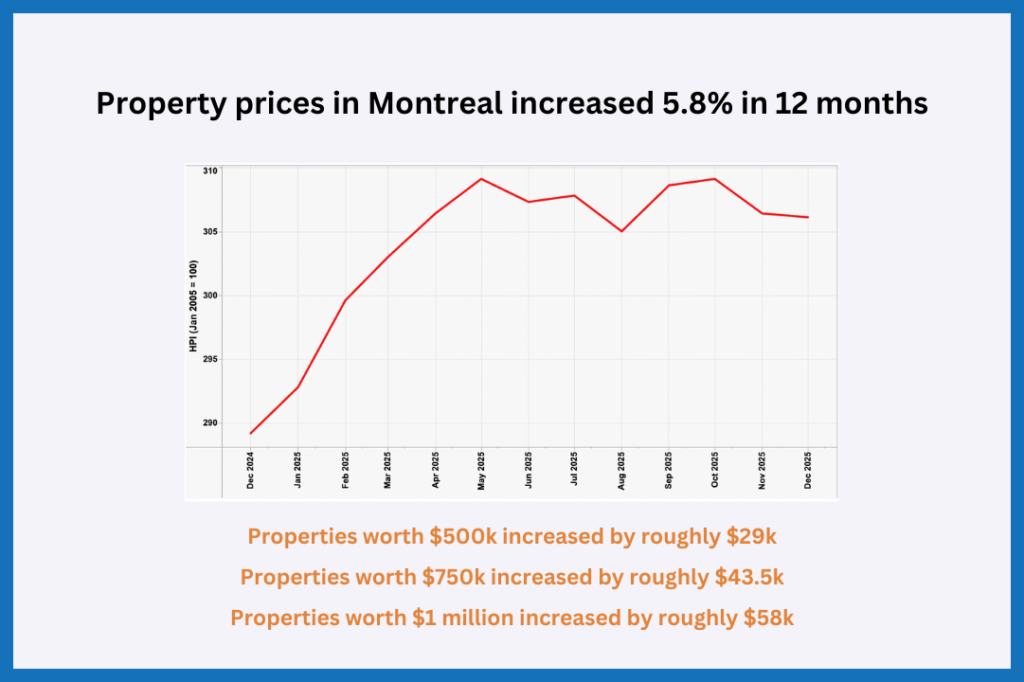
According to the MLS® Home Price Index (HPI) property prices in Montreal have decreased by 0.1% over the past month. However, annual house price growth has increased by 5.8% in the last 12 months.
 Immovision
Free Instant Valuation
Find out how much your house is worth with our online tool.
What is happening to house prices in your area?
Here’s how average house prices have changed across the Montreal, over the last four quarters. The data is based on Transactions Recorded through Centris.
| Sector | Single-Family Home | Condos | ||
|---|---|---|---|---|
| Avg Cost | Change | Avg Cost | Change | |
| Ahuntsic-Cartierville | $845,560 | -6.60% | $451,121 | 8.40% |
| Anjou | – | – | $391,304 | 8.60% |
| Baie-d’Urfé | – | – | – | – |
| Beaconsfield | $985,532 | -1.20% | – | – |
| Côte-Saint-Luc | – | – | $535,844 | 2.90% |
| Côte-des-Neiges / Notre-Dame-de-Grâce | $1,239,486 | 6.30% | $625,987 | 16.60% |
| Dollard-des-Ormeaux | $883,157 | 13.70% | $512,166 | 16.80% |
| Dorval | – | – | – | – |
| Hampstead | – | – | – | – |
| Kirkland | $1,007,679 | 7.60% | – | – |
| L’Île-Bizard / Sainte-Geneviève | $715,587 | 14.30% | – | – |
| L’Île-Dorval | – | – | – | – |
| LaSalle | – | – | $492,963 | 1.50% |
| Lachine | $687,972 | 4.70% | $453,514 | 5.70% |
| Le Plateau-Mont-Royal | – | – | $605,386 | 0.30% |
| Le Sud-Ouest | – | – | $558,876 | -1.80% |
| Mercier / Hochelaga-Maisonneuve | $603,418 | -6.60% | $426,524 | 7.00% |
| Mont-Royal | $2,024,550 | 14.50% | – | – |
What are house price predictions for 2026?
Quebec house prices are expected to continue to rise in 2026, with experts’ early forecasts in the 7.0% range. Read more in our guide House price predictions: How much are properties expected to go up by.
Are houses selling?
- Yes. The APCIQ recorded that the number of residential sales in Quebec reached 97,214 at the end of 2025, an increase of 8 per cent over 2024. This marks the third-best year on record for sales after 2020 and 2021.
- If you want to sell your house, the list price strategy that you choose is really important. Price too high and your property will not get the attention or interest from buyers that you need to sell. For more information on this, read about 8 of the most common pricing strategies currently used by Montreal agents.
- It is important to remember that there is not one housing market in Montreal, the demand for properties varies greatly by property type, condition and the specific neighbourhood that you are selling in.
How long does it take to sell?
The table below shows how average days on market have changed across Montreal over the last 4 quarters. The data is based on Transactions Recorded through Centris.
| Sector | Single-Family Home | Condos | ||
|---|---|---|---|---|
| Avg Days On Market | Change | Avg Days On Market | Change | |
| Ahuntsic-Cartierville | 52 | -8 | 52 | -1 |
| Anjou | 28 | -14 | 41 | 3 |
| Baie-d’Urfé | 68 | -23 | – | – |
| Beaconsfield | 42 | -17 | – | – |
| Côte-Saint-Luc | 56 | -20 | 70 | -1 |
| Côte-des-Neiges / Notre-Dame-de-Grâce | 57 | -9 | 60 | -5 |
| Dollard-des-Ormeaux | 36 | -20 | 50 | -5 |
| Dorval | 44 | 1 | 42 | -18 |
| Hampstead | 102 | 6 | – | – |
| Kirkland | 49 | 0 | – | – |
| L’Île-Bizard / Sainte-Geneviève | 45 | -18 | – | – |
| L’Île-Dorval | – | – | – | – |
| LaSalle | 55 | -14 | 59 | -21 |
| Lachine | 43 | -5 | 48 | -3 |
| Le Plateau-Mont-Royal | 45 | -33 | 41 | -11 |
| Le Sud-Ouest | 44 | 4 | 60 | 0 |
| Mercier / Hochelaga-Maisonneuve | 34 | -8 | 34 | -14 |
| Mont-Royal | 61 | -35 | 80 | -20 |
Should I sell now or wait?
If you need to sell now for a personal reason such as relocation, then don’t let speculation over property prices hold you back. It’s nearly impossible to predict exactly how the market will move and so, even though many people will have opinions, the reality is that no one really knows what will happen in the future.
If you’re selling to upgrade your home, then you are selling and then immediately buying a new home. This means that any increase in your current home’s value is effectively absorbed into the cost of buying a new home. Therefore, unless you are selling to cash in some equity either by downsizing or getting out of property all together, any gains you make are only relative.
That said, property investors often advocate for long-term strategies. They emphasize that building wealth in real estate comes from holding and managing assets over a long time, rather than trying to profit from short-term market swings. If your goal is to free up cash or upgrade without losing your home, there are alternatives to selling. For example, a Home Equity Line Of Credit (HELOC) lets you access your home’s equity while staying in ownership.
How do you know if now is the right time to sell?
From a purely financial perspective, it makes sense to sell when the expected sale price, minus the costs of selling (realtor commissions, legal fees, and capital gains tax) and your monthly carrying costs (mortgage payments, property taxes, and utilities), maximizes your net profit. This is illustrated in the chart below.
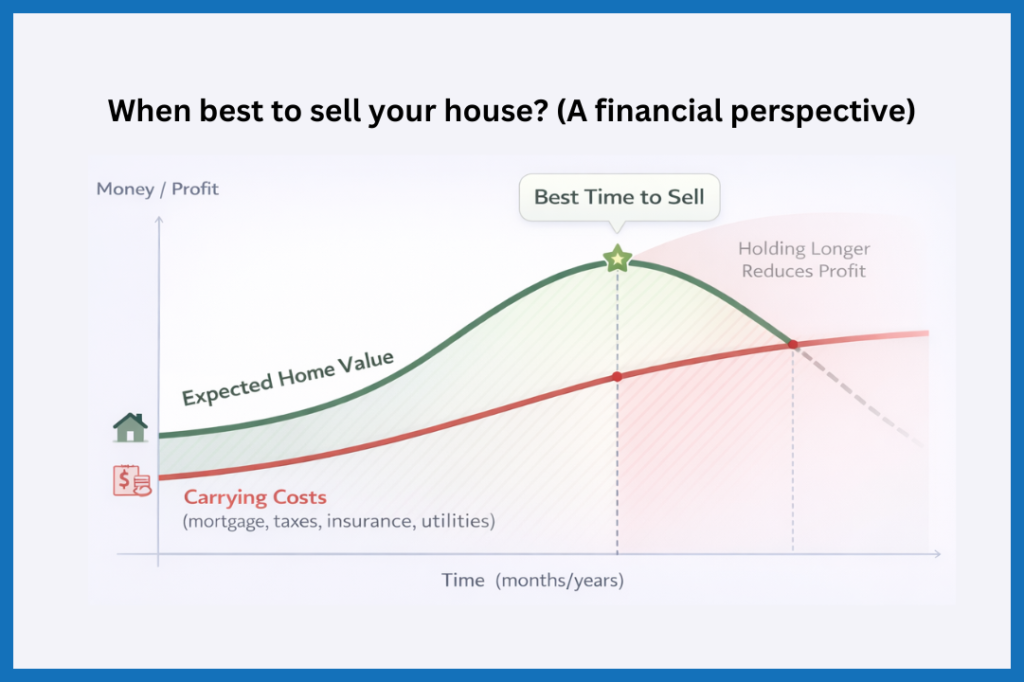
If you expect that the value of your home will rise faster than the carrying costs of owning your home, then it makes sense to hold onto your property for longer. Alternatively, if property prices are growing slower than your carrying costs, selling sooner may maximize your net profit.
How long should you stay in a house before selling?
Based on an analysis of property transactions recorded in the Quebec Land Register, more than half of homeowners in the province sell their property within about 12 years of purchase, with median holding periods around 9 – 10 years depending on property type.
While home ownership in Quebec generally falls between 9–12 years, many real-estate investors and advisors suggest planning for at least 5 – 7 years if your goal is a solid financial return. A longer horizon of 7 – 10+ years is often recommended to capture appreciation and mitigate selling and transaction costs over time.
When is the best time of year to sell a house?
Although many real-estate agents will tell you that the best time of the year to sell your home is Spring, that advice is overly simplistic. Spring is the busiest season but, just because it is a period of high activity does not guarantee the best outcome for every seller.
In actual fact, the best time to sell is when demand for your specific property type is high and competing supply of similar properties is low. To this extent, you can broadly categorize properties into three strategic groups: A++ Properties, B Properties and C Properties.
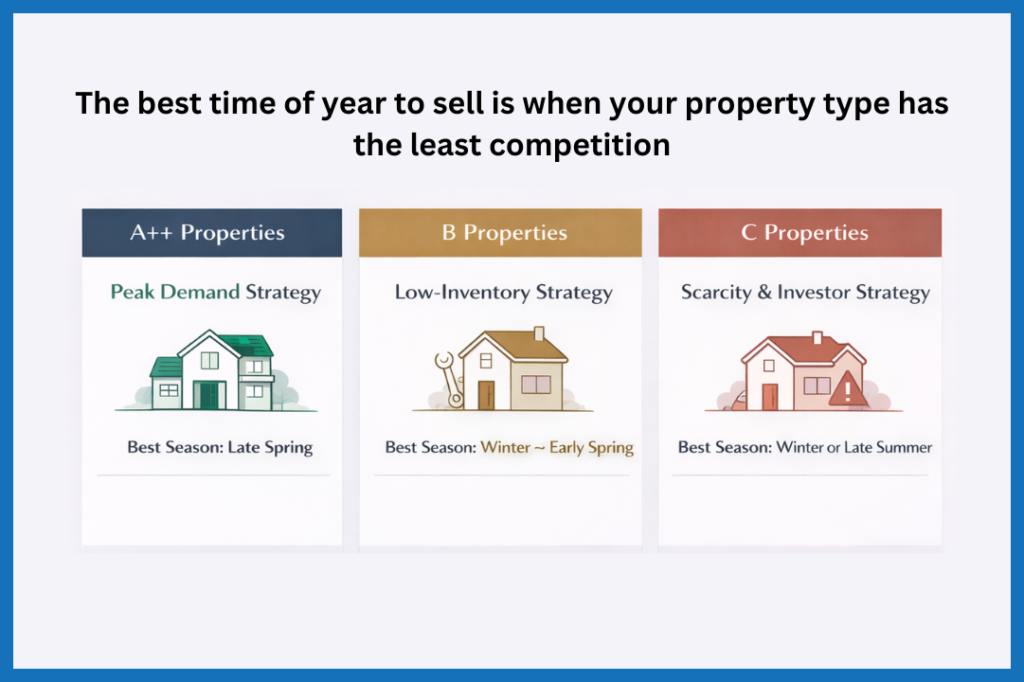
- A++ Properties – These are the best quality properties on the market. They are fully renovated, move-in ready homes in strong neighbourhoods with high emotional appeal. These types of property do best in peak demand seasons (typically Spring), when buyer traffic is highest and bidding wars are most likely.
- B Properties – These are solid homes with minor drawbacks such as dated finishes, less ideal orientation, small layout compromises and so on. These homes often perform best in lower-inventory periods (Winter to early Spring), when they aren’t competing directly against a flood of polished A++ listings.
- C Properties – Homes with more significant negatives (busy roads, proximity to noise, major deferred maintenance). These tend to perform best during short inventory windows (Winter or late Summer), when scarcity pushes buyers to compromise or when property investors dominate the market and are looking for good deals.
What is the worst month to sell a house in Montreal?
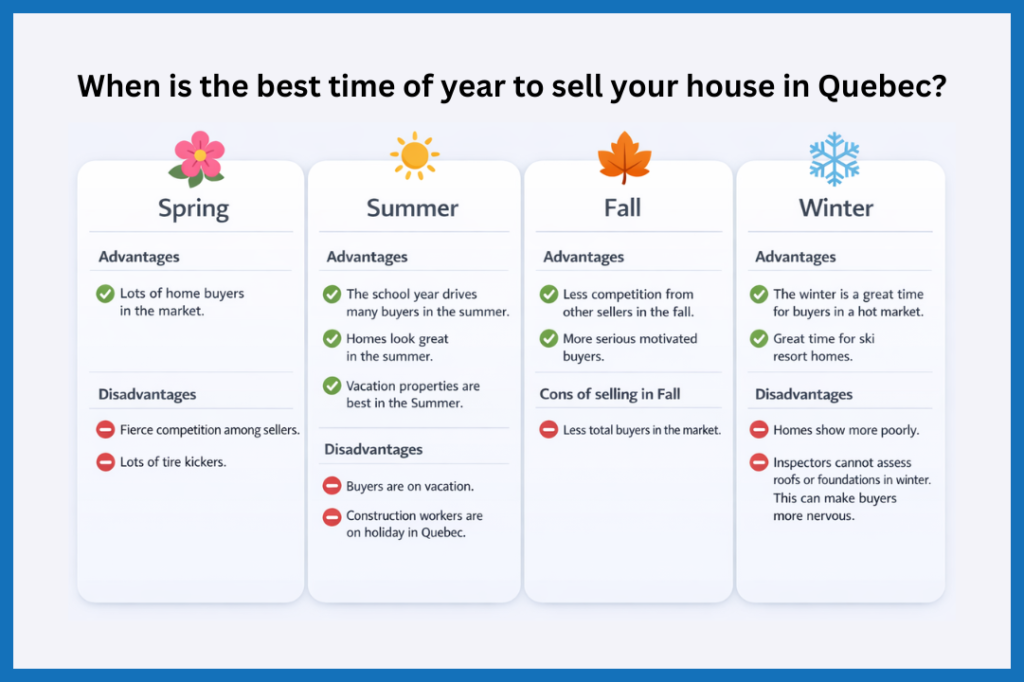
The worst month to sell a house is when competing inventory is high and buyers have a lot of similar properties to choose from. For instance, if you are selling a B-type property during Spring, buyers will have their attention pulled to A++ properties, which means your home may get less interest, longer days on market, and potentially lower offers.
In addition to this, you might want to consider the following pros and cons of selling in different months of the year in Montreal.
Should I sell my house or add an extension to it?
If you can avoid moving by adding an extension to your home, it’s worth considering. The costs you save by staying put can include both the cost of selling your house and the cost of buying a new property.
On average, you should expect to pay roughly 5% – 7% of the price of your home in a sale. The table below provides examples of the cost of selling a house.
| Sale Price | 5% Costs | 5.5% Costs | 6% Costs | 7% Costs |
|---|---|---|---|---|
| $350,000 | $17,500 | $19,250 | $21,000 | $24,500 |
| $400,000 | $20,000 | $22,000 | $24,000 | $28,000 |
| $500,000 | $25,000 | $27,500 | $30,000 | $35,000 |
| $750,000 | $37,500 | $41,250 | $45,000 | $52,500 |
The costs you will incur include both relatively standard costs, such as ordering a new certificate of location, inspection fee, and notary fees. You will also incur costs that depend on your sale price, such as realtor commissions, prepayment penalties, other mortgage fees, and potential capital gains tax.
Money you save by staying in the same location can be re-directed to building a high value extension to your existing home. However, there are several things you need to consider do before building an extension in Quebec. These include:
- Get a construction permit
- Know you local bylaws
- Build a budget
- Gather any other documents e.g. certificate of location, site plan, architectural plans and so on.
Should I sell my house or rent it out?
Right now it is a great time to be renting out a house in Montreal. The average rent in Montreal is around $1,850 – $1,930 per month, and average asking rents for a two-bedroom apartment were roughly $1,930 in early 2025 according to Statistics Canada. If you can afford to move into a new house while holding onto your existing home, you could benefit from monthly rental income that helps cover both the mortgage and carrying costs while still building long-term equity and, potentially giving you some monthly cash flow.
For instance, let’s assume that you own a property purchased for $420,000 with a 35% paid off on the mortgage. This means that you will pay roughly $17,556 in annual mortgage payments. Let’s assume that your other carrying costs are $3,500 in property taxes, $3,600 in condo fees, and $3,600 in utilities during the first year. However, if you rent out your home for $24,000 per year and build $6,244 in home equity in that same year, your gains vs losses will be something like the following.
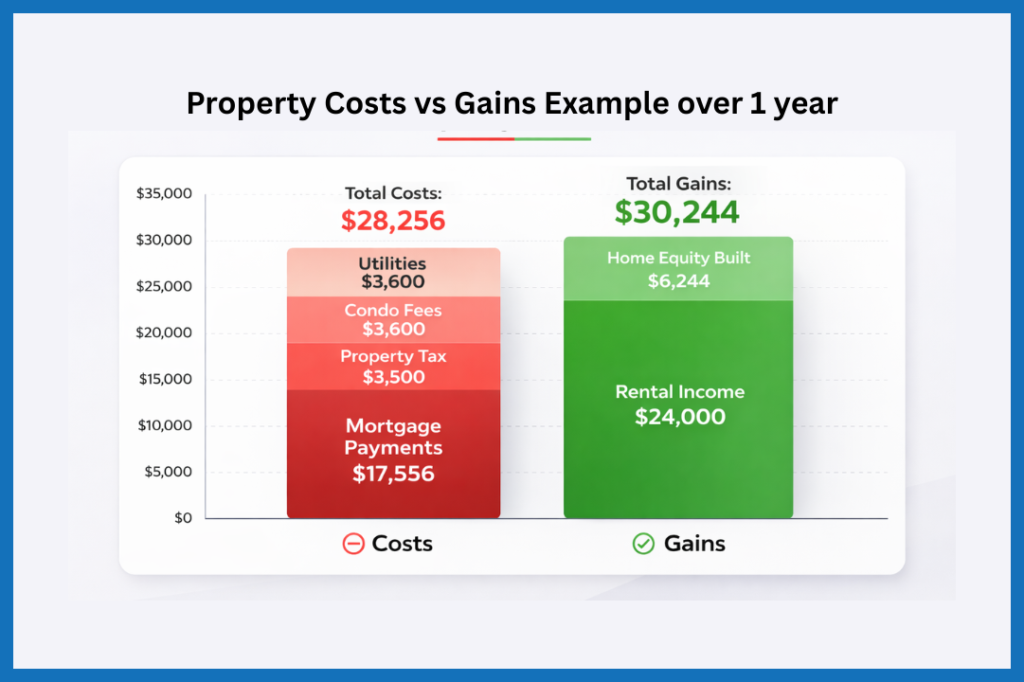
This is just the year 1 comparison. Over time, the cost of the mortgage decrease while the equity gain will increase. Over a 10-year period, these gains are magnified and you will build roughly $552,000 in value in the home, assuming property prices continue to rise at 5.8% per year.
Note
Should I sell my house now and rent?
You may want to sell your house, invest the cash from the sale into the stock market or another asset and then go back to renting. This strategy can make financial sense if the returns you earn from your investments exceed the property price appreciation and equity growth that you can get out of your existing home. To evaluate this properly, you need to compare the ongoing costs of owning your home with the costs and benefits of selling and investing elsewhere.
How to speed up your house sale
If you have decided to sell your house, here are some quick tips on how to do it as fast as possible.
- Work with a top performing realtor
- Use professional stagers
- Consider all buyer conditions carefully
- Set a fair price for your home
Work with a top performing realtor
Top performing realtors specilize in selling homes. They know how to price, market and sell your home in such a way as to maximize your profit. Realtors also know how to make sure that the transaction if properly documented so that you you are legally protected. This includes making the appropriate seller’s declarations, as well as ordering pre-listing inspections to make sure any potential issues are disclosed to buyer’s upfront so that the transaction can move ahead quickly and uninterupted and, to protect against the risks of latent defects.
To find a top performing realtor in Montreal use the Immovision Find An Agent tool for free.
Use professional stagers
According to the Canadian Real Estate Association (CREA), home staging can shortern the time that your home sits on the market by between 30% and 50%. The National Association of Realtors (NAR) also note that home staging can add as much as 10% onto your sales price. Given that the market rate of home staging is roughly $2,500–$5,000 for a 3‑bedroom home, this makes home staging one of the highest-value return-on-investment strategies you can use to sell your home fast and for top dollar.
Consider all buyer conditions carefully
In Quebec, prospective buyers make an offer using a Promise to Purchase. This is a standardized form provided by the OACIQ. Each offer is contingent on the buyer fulfilling certain conditions such as securing financing approval, a satisfactory home inspection, and verification of the property’s legal status and certificate of location. It will also include the closing date (when the deed of sale is to be signed) and occupancy date.
An experienced realtor will help you distinguish a solid offer from a risky one. A solid offer is structured so that the deal is likely to close. This means that the buyer’s financing is realistic, contingencies are reasonable, and their financial situation is stable. A risky offer, on the other hand, can fall apart at the last minute. For example, if a buyer has a low down payment and then takes on new debt like buying a car, this it can affect their cause their financing to fall through at the last minute. A good realtor brings will be able to use their experience to spot red flags that may prevent the deal from closing and force you back onto the market a month or two later.
Set a fair price for your home
If you set a fair list price for your home, you will not only attract qualified buyers, but you will also ensure that you don’t run into problems when the lender runs a home appraisal.
This is important because lenders base their mortgage approval on the appraised value of your home. If your list price is set too high and the home appraises for less, the lender may only approve a buyer’s mortgage based on the lower appraised value. This can create financing issues for the buyer, potentially causing the deal to fall through, delaying the sale, or forcing renegotiation. By setting a fair list price, you reduce the risk of appraisal problems and make it easier for qualified buyers to secure financing, helping the sale close smoothly.
Frequently asked questions
In some cases, it may be possible to make your offer to purchase a new property contingent on the sale of your old home. However, this will likely only work if the in a strong buyer’s market and, where the seller’s have strong pressure to sell and their home is has been sitting on the market for significantly longer than similar homes in the neighborhood.
It’s a good idea to make quick repairs, repaint, clean, and stage your home to make it appealing and attract a higher selling price. For major issues, you can either fix them or disclose them in your seller’s declaration, allowing buyers to adjust their offer fairly. While pointing out defects may feel uncomfortable, it is essential to avoid legal liability or disputes, and most major problems will be revealed during a pre-purchase inspection anyway.