
The difference between paying 4% commission and 3% commission on a $500,000 home is about $5,000. Whereas the difference between hiring a mediocre realtor and an exceptional one can be tens of thousands of dollars.
I know because I overpaid for my condo by roughly $70,000 after relying on a friend’s realtor recommendation instead of choosing an agent with expertise in my local market.
To help you avoid paying your agent more commission than they are worth, this guide explains:
- How realtors and their agencies earn commission in Quebec
- How buyer’s agents earn their commission in Quebec
- How seller’s agents earn their commission in Quebec
- What is the average commission that realtors make in Quebec?
- How to negotiate a realtors commission?
- What is a fair commission for a real-estate agent?
- How can you avoid paying realtor fees?
 Immovision
Find A Realtor Worth Their Commission
Use Immovision AI to analyze more than 27 million data points in seconds and find the realtors who consistently outperform in your local market.
How realtors and their agencies earn commission in Quebec
Under Quebec’s Real Estate Brokerage Act, a real estate broker cannot operate independently. A licensed real estate agency must supervise every broker. This is why you’ll often see a broker’s name on a sign branded RE/MAX, Royal LePage, and so on. The agency is the licensed entity that supervises the broker.
However, while the agency supervises the broker, it does not pay them a salary or provide benefits. Instead, most brokers operate as independent contractors and earn income purely on commission. The broker must then pay a portion of their commission to the agency.
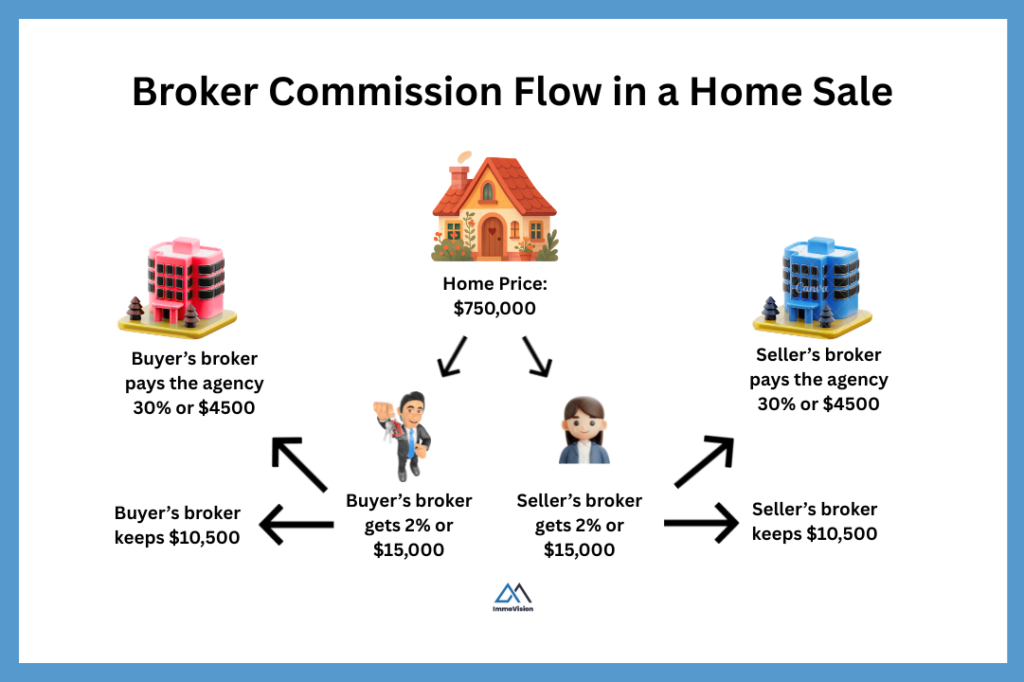
For example, if you work with a realtor to buy a home, you will usually pay nothing upfront. However, once the transaction closes, the seller’s agent shares their commission with the buyer’s broker, often on a 50/50 basis. Both the seller’s broker and the buyer’s broker then pay a portion of their commission to their respective agencies.
The graphic below demonstrates how the seller’s broker, the buyer’s broker, and their agencies typically split the total commission.
ℹ️ Insider Tip
Because brokerages earn a share of each realtor’s commission, their business model often depends on maintaining a large network of active agents. As a result, initial vetting standards can vary significantly between brokerages.
In Quebec, the OACIQ regulates real estate brokers. They can issue fines or disciplinary measures when a realtor violates their rules. However, they will rarely remove an agents license entirely.
This means that there are many agents who have broken the rules who still in Quebec and so it is very important to independently evaluate the realtor you choose to work with.
You can use our new Immoision Agent Finder AI to find and compare agents based on their historical transactions, verified reviews, and disciplinary history, so you can find a top-rated local expert.
How buyer’s agents earn their commission in Quebec
When you hire a realtor to help you buy a property, you sign an Exclusive Brokerage Contract – Purchase. This legal agreement outlines (among other things) how much you will pay the buyer’s agent.
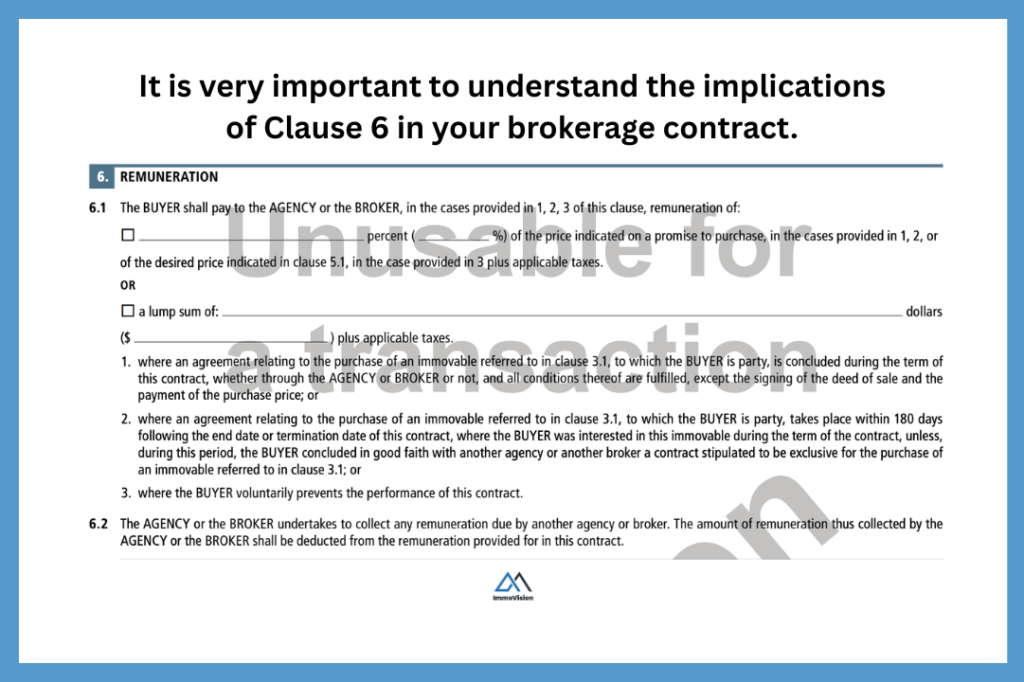
There is one very important Clause in this contract that many buyers miss, and unless you read the fine print, you run the risk of paying your agent much more than you expect.
It is Clause 6—and what you’ll find is that many agents gloss over this clause with a generic phrase: “the seller’s broker pays my fees”.
However, in this clause YOU commit to pay the realtor either a commission or a lump-sum fee. Then, in the fine print it says that your agent must first attempt to collect their commission payment from the seller’s broker before asking you to pay anything directly.
That may sound reassuring, but, the seller’s agent does not agree to pay the buyer’s agent full fee, which means you could be responsible for paying the difference in cash at closing.
For example, if you agree to pay your agent a 2% commission, but the seller’s broker only offers 1%, you are personally responsible to pay your agent the remaining 1%. This can easily add tens of thousands of dollars to your closing costs, that you must pay in cash. Often times buyers only discover this at the last minute, after they have already paid for the property.
ℹ️ Note
Because you are paying your broker non trivial amounts of money, it’s critical to work with a broker who clearly explains their compensation structure.
The reality is that not all agents handle this the same way.
Some will clearly walk you through Clause 6, explain exactly how they get paid, and identify any potential shortfall before you ever submit an offer.
Others won’t bring it up until much later, when you’re already committed and your options are limited.
That’s why understanding how to properly interview a real estate agent isn’t just helpful, it’s essential.
For more information on how to interview agents, read 28 Questions to Ask a Real Estate Agent Before You Hire One in Montreal.
How seller’s agents earn their commission in Quebec
When you hire a broker to help you sell your property, you must first decide whether to sign a Exclusive or Non-exclusive brokerage contract for sale.
If you sign an exclusive contract, the broker has the right to act as your sole representative. In this case you must pay the agent even if you find the buyer yourself. Alternatively, if you sign a non-exclusive contract, the realtor will be paid only if their efforts directly lead to the sale.
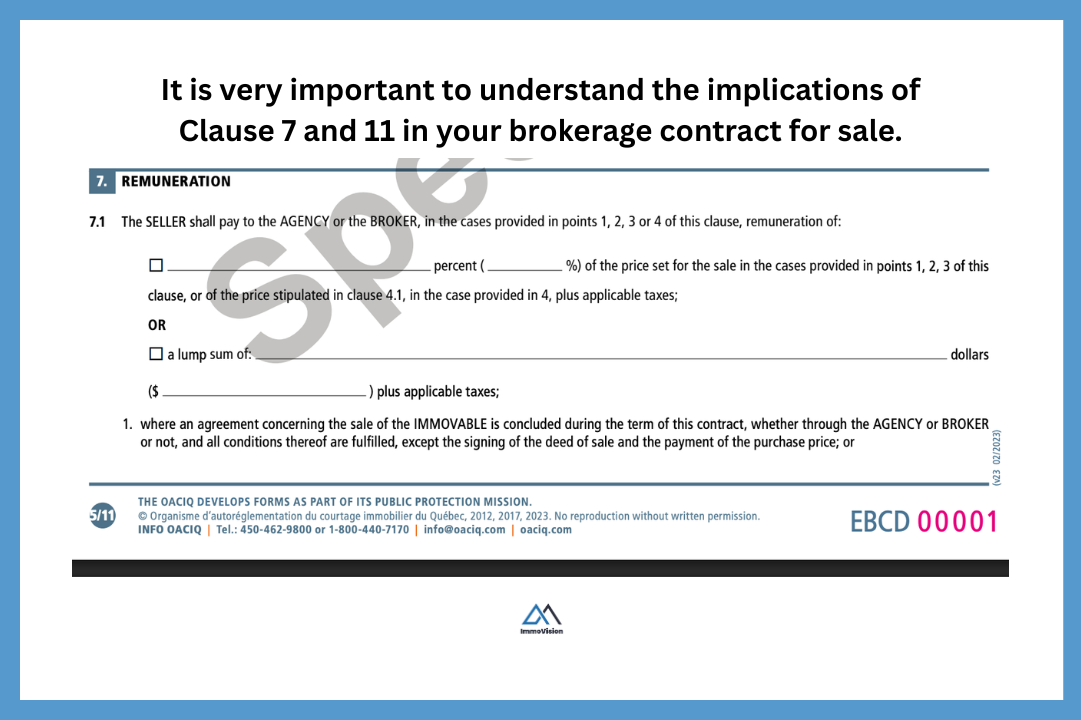
After this, you must decide how much money you will pay your agent. This is defined in Clause 7 of your brokerage contract. Here you can specify if you will pay your broker a commission, or lump-sum payment. Clause 11 highlights any other additional fees for example, if the agent wants to charge for home staging, photography, marketing or anything else that good listing agents do to prepare your home for sale.
An important point to consider is Clause 7.3. This is where the listing agent writes down how much of their commission they will split with a buyer’s agent. The listing agent can also offer a fixed fee, however generally the broker will offer a 50/50 split with the buyer’s agent.
ℹ️ Note
An unreasonable commission or sharing arrangement can discourage the buyer brokers from showing your property to their clients. This is a practice known as “steering” where the buyer’s broker will actively steer their clients away from your property.
What is the average commission that realtors make in Quebec?
Real-estate agents do not charge a standard commission. In fact, commissions are fully negotiable and vary based on the brokerage, the services provided, years of experience, and the complexity of the transaction. That said, if you’re looking for a general sense of realtor fees in Quebec, these statistics can give you a helpful benchmark.
In 2025, agents in the top cities in Quebec charged on average the following average commission:
| City | Average Commission (%) |
|---|---|
| Montreal | 1.84% |
| Quebec | 1.75% |
| Gatineau | 1.93% |
| Laval | 2.25% |
The table below shows how these commission translate into actual money that you can pay to your realtor for homes of different prices:
| City | Average Commission (%) | Sale Price of $500,000 | Sale Price of $750,000 | Sale Price of $1,000,000 |
|---|---|---|---|---|
| Montreal | 1.84% | $9,200 | $13,800 | $18,400 |
| Quebec | 1.75% | $8,750 | $13,125 | $17,500 |
| Gatineau | 1.93% | $9,650 | $14,475 | $19,300 |
| Laval | 2.25% | $11,250 | $16,875 | $22,500 |
⚠️ Warning
Whilst these numbers can give you a ballpark idea of the commission charged by realtors in Quebec, they do not take into account the services offered by the realtor, the complexity of the transaction or experience of the realtor.
Before you sign a brokerage contract with an agent, you must understand what services are included and compare their fees with other realtors.
It is also helpful to understand what your home is actually worth, because sometimes percentages can seem abstract. For a quick, free online valuation of your home, use Immovision’s Free Online Home Valuation Estimator.
How to negotiate a realtors commission?
Realtors do not charge a fixed or average commission when representing clients. Commissions are fully negotiable and depend on the brokerage, the services offered, years of experience, and the complexity of the transaction.
In this section, we share three practical tips for negotiating your realtor’s commission.
Tip 1: Interview multiple agents
In order to negotiate realtor commissions, you must first get a sense of what services are available in your local market. To do this, you should contact at least three local realtors, who specialize in your type of project and ask them a series of questions about the services they offer and at what price.
Typically listing agents will offer things like professional pricing (aka. a Comparative Market Analysis (CMA)), staging services, professional photography, floor plans, pre-listing inspections and at least one open house. Buyer’s brokers meanwhile will tend to offer things like attending viewings, conducting a CMA to establish a fair purchase price prior to negotiation, and advising on offers.
Each realtor will offer a slightly different set of services and pricing. You should compare each offer and assess which services you really need for your particular property. For instance, if you are selling a one bedroom divided condo, do you need drone footage, or are you okay with only professional photographs. Similarly, if the agent offers a lockbox vs private viewings, this can be totally fine, but then the price should be lower.
Once you have interviewed three agents and have a good understanding of what each offers and what the local market value is for each of the services.
Immovision
Find Three Local Experts
To find three realtors, you in your area, you can use Immovision Agent Finder. This is a free AI search tool that will search and find top-rated realtors in your area based on their historical transactions.
Tip 2: Experience matters
In real-estate, the number of years experience matters. If the realtor does not have any prior experience, then they should reduce the commission that they charge. This is because there is a higher probability of a junior realtor putting you, as a client, into a bad situation.
Realtors that have not seen many transactions, may not fully appreciate the long term financial risk of skipping a pre-listing inspection, make mistakes when negotiating, or know how spot red flags in construction quality such as faulty sump pumps, poor drainage, foundational issues, or aging heating systems. Inexperience can easily translate into you either overpaying for, or underselling your home.
⚠️ Important
It is hard to overstate the importance of working with a realtor who has local, property-specific experience. Markets vary significantly by neighbourhood, property type, and even building age. And an experienced agent can help you to get a significantly better deal.
Tip 3: Use pricing tiers
Some realtors will pitch you a very aspirational value for your home. For example, they might say that your home is worth $1 million when in reality it is closer to $850,000. What you might want to consider is to offer the realtor a higher commission if they are able to sell your home for a higher price. For instance, you can offer them:
- 4% commission if they sell your home for more than $1 million
- 3% commission if they sell your home for between $900,000 – $999,999
- 2% commission for anything lower than $900,000
💡 Insider Tip
Before negotiating on price, line up the three realtors you’ve met, consider each of their pricing strategies, and compare the services they offer to determine which provides the best value for you.
What is a fair commission for a real-estate agent?
A fair commission for a real-estate agent depends on the services they provide and how these services compare to what other agents in your local market offer. Consider the following two options for two different listing agents.
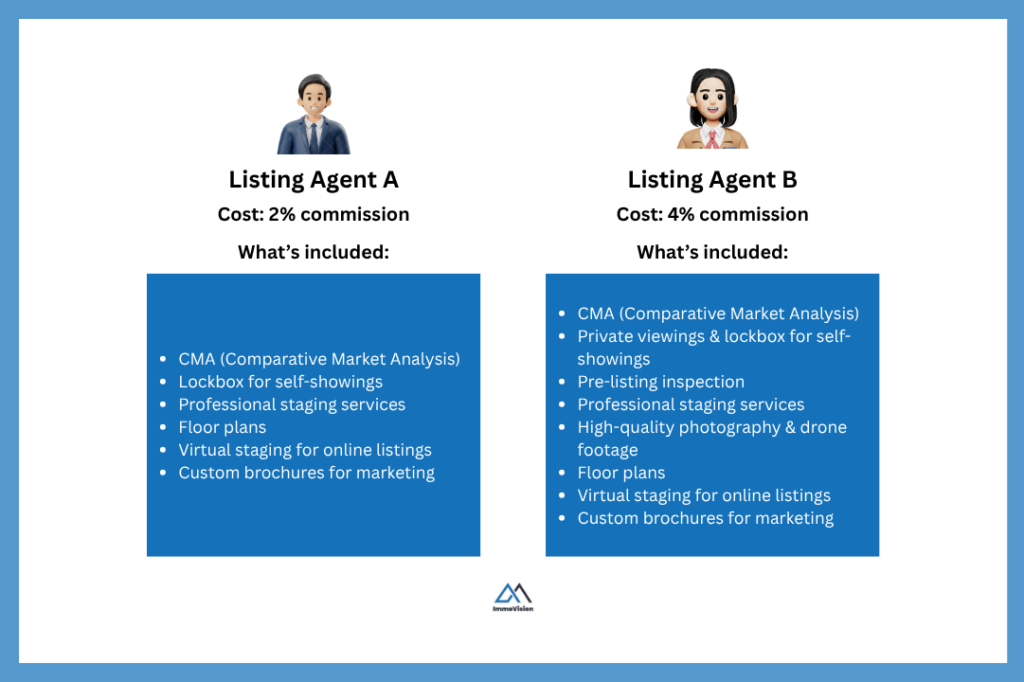
Listing Agent A is asking for 2% commission whereas Listing Agent B is asking for 4% commission. For the extra commission, Agent B includes a lot more services with this higher price however, do you need all of the extra services offered by Listing Agent B?
Ultimately, this will depend on the type of property that you are selling. For a multi-million dollar luxury detached home in the country, you might need a drone and custom brochures. In contrast, if you are listing a one bedroom condo in low-rise property in downtown Montreal, you probably do not need all of these services.
ℹ️ Note
A 2% difference in commission on a $500,000 property is $10,000 + tax. Ask yourself if you need everything that the realtor is selling you. A good realtor will be realistic about what services you actually need to sell your home.
How can you avoid paying realtor fees?
There are three main ways that you can avoid paying realtor fees in Quebec. You can either buy without a broker, sell your home as a for-sale-by-owner (FSBO), or you can sell your home directly to a cash buyer.
Buy without a broker
One in four buyer’s choose to work without a broker. Instead, they will start their property search by going onto platforms like Centris, Duopropio, and Realtor.ca. From there they will schedule viewings directly with the seller’s agent.
It is extremely risky to buy a home without any representation for several reasons. The main one is that you are going to be negotiating with a listing agent who is significantly more experienced than you are, and there are plenty of ways that you can get caught out. From making an unconditional offer to purchase, through to missing opportunities to negotiate down the price of a property, or get inclusions such as valuable inclusions such as appliances, or fixtures.
For-Sale-By-Owner
A FSBO, is essentially when the seller sells their home without hiring a listing agent. In this case, you are responsible the entire process of selling your home. This means that you must prepare your home for sale (declutter, clean and stage), ensure legal compliance (fill in the seller’s deceleration and make sure you have an up to date certificate of location), and then, price, list and market your home for sale.
Whilst this is entirely doable, statistically FSBO seller’s sell for on average 5.5% lower than when they work with a realtor. FSBO seller’s also take on a lot more financial and legal risks, since one of the key benefits of working with a realtor is that the agent assumes legal responsibility for the transaction and has professional liability insurance if they make a mistake.
Lastly, you may still have to offer commission to the buyer’s agent, to attract quality agents to your home. This is because buyer’s agents are most motivated to show homes where they know they will be properly compensated.
Sell directly to a cash buyer
The fastest, and easiest way to sell your home is to a cash buyer. Whilst the average days on market for a property in Montreal is between 50 – 60 days, cash buyers typically buy your home within 7 – 21 days. Cash buyers offer speed but, they also have very standardized processes, meaning that you can get an offer within 24 hours for your home and without needing to pay expensive realtor commission.
However, there are several pros and cons to selling your home for cash, the main downside being that cash buyers typically offer lower prices than selling with a realtor.
Immovision
Find A Realtor Worth Their Commission
Use Immovision to find the realtors who consistently outperform in your local market based on their historical transactions, verified reviews, and disciplinary history.
Frequently asked questions
– By mutual agreement: You and the broker can agree in writing to terminate the contract early.
– At expiry: The contract automatically ends on the stated end date.
– For serious breach: If the broker fails to meet their legal or contractual obligations, you may be able to cancel the contract without penalty.
– Through the agency: You can ask the agency to assign a different broker or release you from the contract.
Always check whether the contract includes a protection (holdover) period, which may still entitle the broker to remuneration after the contract ends.
1. Document the issue (emails, messages, missed obligations).
2. Raise the issue with the broker’s agency, which is legally responsible for supervising the broker.
3. Request termination or reassignment if the problem isn’t resolved.
4. File a complaint with the OACIQ if the conduct breaches professional obligations.
In serious cases, a broker’s failure to perform may justify terminating the contract without paying remuneration.
Final remarks
In Quebec, realtor commission adds tens of thousands of dollars to the cost of buying or selling a home. However, a skilled broker can also help you sell for well above market value, or secure great deals on properties, and minimize financial risks from issues such as latent (“hidden”) defects.
In fact, industry data shows that top-ranked brokers can achieve sale prices up to 10% higher than homeowners selling on their own. However, not all realtors deliver that level of performance. And while some consistently outperform the market, others charge similar commissions yet undersell properties or overpay on purchases.
The difference comes down to experience, local expertise, and the services they provide.
That’s why it’s critical to compare multiple agents before choosing who to work with.
With Immovision’s Agent Finder, you quickly find the top-rated realtors in your area based on historical transactions, customer reviews, and disciplinary history.
✔ Free to use – no login required
✔ Takes less than 2 minutes
✔ Compare realtors side-by-side
👉 Find the right broker for your project