
Urban Agglomeration Definition
What are Urban Agglomerations in Quebec?
In Quebec, several neighbouring municipalities form an urban agglomeration, which jointly organizes and funds essential public services such as police, fire protection, water, and waste management. In this setup, one central municipality (or City) is responsible for coordinating, managing and maintaining these shared services on behalf of the entire group. At the same time smaller municipalities within the agglomeration keep their own local councils for community-level matters like parks, permits and local roads.
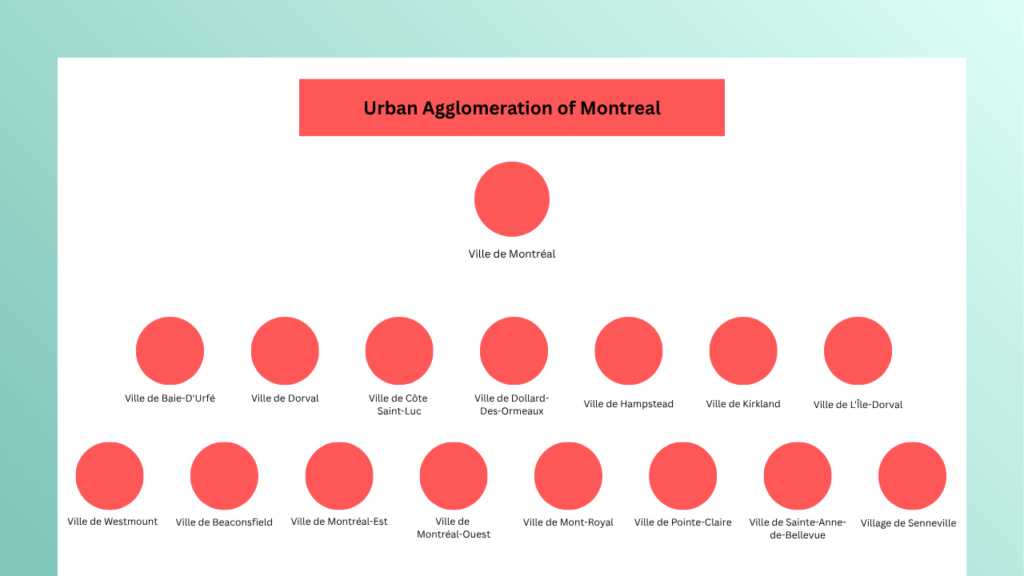
The largest urban agglomeration in Quebec is the City of Montreal. The Ville de Montréal manages the City of Montreal and its 15 municipalities.
Why Urban Agglomerations Exist in Quebec?
The story of why urban agglomerations exist in Quebec starts with the situation before the early 2000’s.
Before the early 2000s
Before the early 2000s, most municipalities operated independently and had full control over their own property taxes, zoning rules and local services such as water, fire protection, and waste collection.
For homeowners, this meant that your property tax rate was by the local municipality. Buying a house one street over, in a different municipality, could mean a totally different tax bill or service level. As a result of this independence, large differences between rich and poor municipalities materialized.
For instance, in Montreal, Westmount collected some of the highest property tax revenues in Quebec and could afford premium local services like frequent snow removal and well-maintained parks, while neighbouring areas such as Montreal-Nord, Le Sud-Ouest Montreal or Hochelaga-Maisonneuve struggled with lower tax bases and aging infrastructure.
2002 and the creation of Quebec’s “mega cities”
In 2002, the Government of Quebec under Premier Bernard Landry, tried to consolidate the fragmented municipalities in Quebec. Landry did this by merging several hundred small municipalities across Quebec into large “megacities.” For example, Montreal swallowed up cities like Westmount, Beaconsfield, and Dorval. Longueuil absorbed Boucherville, Brossard, and others.
Over time, the city standardized municipal and school taxes across all municipalities within the megacity. The city pooled money collected from wealthier areas into a common fund and redistributed it to support city-wide services and infrastructure, including in less affluent neighbourhoods. The idea behind this initiative was to build a more balanced region where property prices would gradually equalized across neighbourhoods.
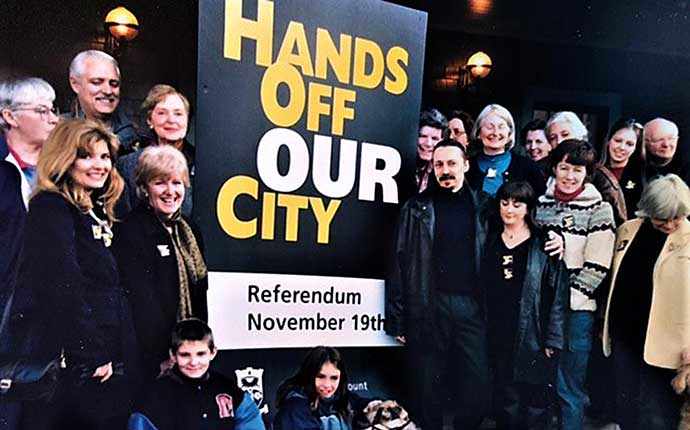
However, wealthy homeowners in suburbs such as Westmount and Beaconsfield in Montreal strongly resisted. They argued that because their property prices were significantly higher than the rest of the agglomeration, this meant that they paid higher property taxes. As such, residents of these neighbourhoods felt that their contribution to the city was higher than it should be. And that the agglomeration was using their money to subsidize other areas. Campaigns like the “Hands Off My City” movement, led by Westmount’s mayor Peter Trent, became a rallying point for residents who opposed the mergers and fought to regain municipal independence.
2006 demerger and a partial re-merger
After a change in government, residents of many former cities gained the right to vote on de-merging. Fifteen municipalities on the Island of Montreal chose to regain independence (e.g., Westmount, Beaconsfield, Côte-Saint-Luc, and Dollard-des-Ormeaux).
However, de-merging created a new problem around who should pay for shared services like police, fire, water, and waste that everyone still depended on?
To fix this problem, Quebec passed Bill 75 in 2006 (otherwise known as the Act Respecting the Exercise of Certain Municipal Powers in Certain Urban Agglomerations). This is the law that created the current day Urban Agglomerations in Quebec. This means that municipalities collect taxes from their residents, and send part to this money to the Urban Agglomeration and keep the rest for local services. The result is a system that blends local independence with shared financial responsibility across the region.
Which municipality contributes most to the urban agglomeration?
The amount that each municipality in the urban agglomeration pays depends on three factors:
- Property wealth (total property value within that municipality)
- Population (number of residents)
- Usage of shared services
The inter-university research centre CIRANO found that property wealth determines 90% of the contribution quotas (payments). For example, in the Urban Agglomeration of Montreal, Beaconsfield has fewer residents but higher property values than say Montreal-Nord. Therefore, even though it’s smaller, Beaconsfield pays a higher share per person toward the agglomeration. This is why Beaconsfield and other de-merged cities continue to complain because Montreal charges them more than other areas while giving them limited influence over how it spends the money.
List of Quebec’s Urban Agglomerations and their constituent municipalities
- Urban agglomeration of Montreal (administered by the Montreal Agglomeration Council)
- Ville de Montréal
- Ville de Baie-D’Urfé
- Ville de Beaconsfield
- Ville de Côte Saint-Luc
- Ville de Dollard-Des-Ormeaux
- Ville de Dorval
- Ville de Hampstead
- Ville de Kirkland
- Ville de L’Île-Dorval
- Ville de Montréal-Est
- Ville de Montréal-Ouest
- Ville de Mont-Royal
- Ville de Pointe-Claire
- Ville de Sainte-Anne-de-Bellevue
- Village de Senneville
- Ville de Westmount
- Urban agglomeration of Quebec City
- Ville de Québec
- Ville de L’Ancienne-Lorette
- Ville de Saint-Augustin-de-Desmaures
- Urban agglomeration of Longueuil
- Ville de Longueuil
- Ville de Boucherville
- Ville de Brossard
- Ville de Saint-Bruno-de-Montarville
- Ville de Saint-Lambert
- Urban agglomeration of Mont-Laurier
- Ville de Mont-Laurier
- Municipalité de Saint-Aimé-du-Lac-des-Îles
- Urban agglomeration of La Tuque
- Ville de La Tuque
- Municipalité de La Bostonnais
- Municipalité de Lac-Édouard
- Urban agglomeration of Les Îles-de-la-Madeleine
- Municipalité des Îles-de-la-Madeleine
- Municipalité de Grosse-Île
- Urban agglomeration of Sainte-Agathe-des-Monts
- Ville de Sainte-Agathe-des-Monts
- Municipalité d’Ivry-sur-le-Lac
- Urban agglomeration of Mont-Tremblant
- Ville de Mont-Tremblant
- Municipalité de Lac-Tremblant-Nord
- Urban agglomeration of Cookshire-Eaton
- Ville de Cookshire-Eaton
- Municipalité de Newport
- Urban agglomeration of Rivière-Rouge
- Ville de Rivière-Rouge
- Municipalité de La Macaza
- Urban agglomeration of Sainte-Marguerite–Estérel
- Ville de Sainte-Marguerite-du-Lac-Masson
- Ville d’Estérel