
Top-performing real estate agents don’t just help you buy or sell, they directly impact how much money you walk away with.
The difference isn’t small. In many cases, it can mean tens of thousands of dollars in your final outcome.
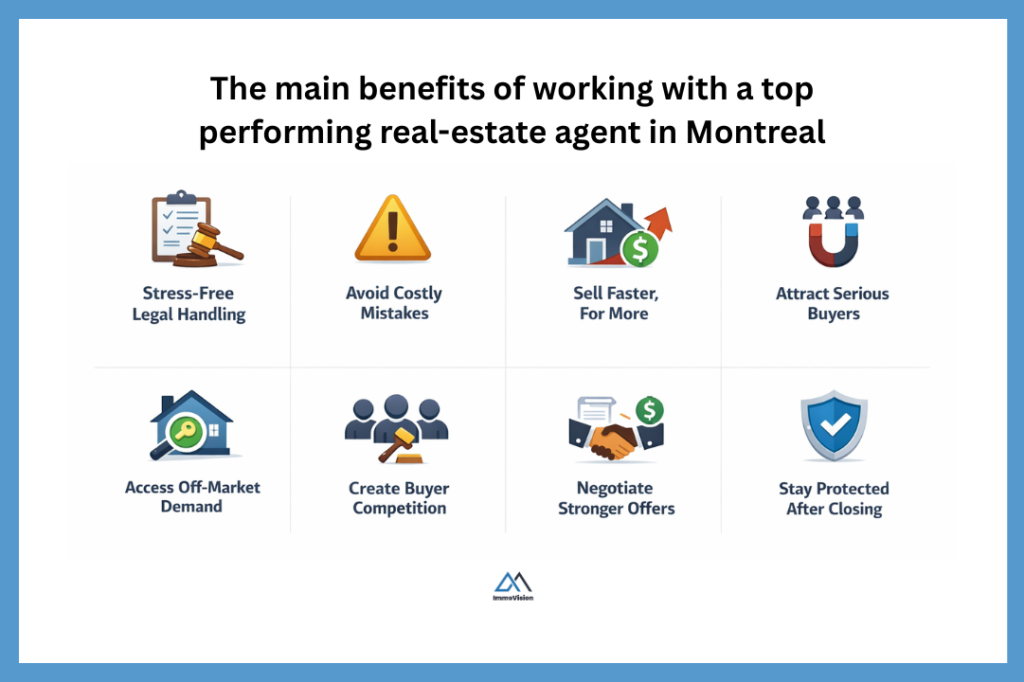
They create that edge by attracting more qualified buyers, positioning properties strategically, negotiating more effectively, and avoiding costly legal or transactional mistakes.
When you choose to go it alone, you’re not just saving commission. You’re taking on all of these responsibilities yourself, with little room for error.
This article breaks down what top-performing agents actually do, so that you can recognize the difference, and make sure you have the right representation for one of the most financially important decisions that you’ll make in your life.
 Immovision
The Right Agent Can Mean More Money—Find Yours in Minutes
Not all agents perform the same, and the difference can directly impact your final sale price and time on market.
We analyze over 27 million real estate data points to identify agents who consistently deliver strong results for properties like yours.
Why hire a real-estate agent if you are selling
A listing agent is a real estate professional who helps you sell your property. Their role is to advise you, so that you can sell your home legally, at the highest price and in a time frame that works for you. To do this effectively the listing agent will:
- Handle all legal paperwork for the sale accurately
- Keep the sale compliant and avoid costly legal mistakes
- Price your home to attract the right kind of buyers
- Market you home to draw in buyers
- Tap into a network of industry professionals
- Meet and sell to buyers at the open house
- Navigate offers to secure the best deal
- Protect you with insurance even after the sale
Seller's Note
To operate legally, they must carry professional liability insurance.
Why this matters:
Real estate transactions involve contracts, deadlines, disclosures, and large sums of money. Even small mistakes can have serious financial consequences.
When you work with a licensed broker, there is insurance behind their work. If something goes wrong due to an error or oversight, there is a clear path to compensation.
When you sell on your own, that protection isn’t there.
If a mistake happens, the only option is to pursue the other party personally.
And in many cases, even if you win, the person responsible may not have the financial means to cover the damages—leaving you to absorb the loss.
This is where having the right agent makes a real difference. This is an important and often overlooked benefit of working with a real-estate agent.
If you want to see which agent we recommend based on your situation, you can do that here.
Handle all legal paperwork for the sale accurately
A listing agent starts by guiding you through the seller’s declaration.
This is a mandatory document in Quebec that outlines the condition of your property. It covers known defects, past renovations, and any legal restrictions. It forms the foundation of your entire transaction.
Your agent will also help you gather supporting documents such as the certificate of location, permits, warranty reports, and any inspection reports.
This step is critical.
If your documentation is incomplete, inaccurate, or poorly presented, it can:
- give buyers a reason to walk away late in the process
- weaken your negotiating position
- or expose you to latent (hidden) defect claims after the sale
Therefore, it is very important to choose an agent who knows how to present your home in the best possible light, whilst not misrepresenting or exposing you to future liability. So that, you get the highest possible price without taking on unnecessary risk.
Beyond the seller’s declaration, there are dozens of other forms used throughout the process. For instance, the promise to purchase, amendments, and condo-related documents. In total, there are roughly 50 standardized forms that may be required depending on your situation.
Keep the sale compliant and avoid costly legal mistakes
In Quebec, the provincial government sets real-estate laws, municipalities enforce zoning and permit rules, and SROs like the OACIQ monitor brokers and uphold professional standards.
It is the job or the listing agent navigate all of this legal complexity, and translate this into actionable advise that is specific to your property type, location, and financial objectives. This is so that, you don’t have to worry about hidden legal pitfalls that could complicate or jeopardize your sale at the last minute.
For example, if you are selling a plex, buyers who check the certificate of location may uncover illegal renovations (even those done before you owned the property). In this case, the buyer could either demand that you remove the renovation, reduce the sale price, or even back out of the deal entirely.
In all of these case, you would face extra costs and delays in completing the sale. A good listing agent can help you avoid this kind of headache.
Price your home to attract the right kind of buyers
Before determining the pricing strategy your listing agent will do a professional Comparative Market Analysis (CMA). This is allows them to work out the market value of your home.
A good agent will give you a range of values. This is because you can either price high to find the one buyer who will pay a premium for your property’s standout features, or price more competitively to attract a wave of buyers all at once.
The agent will therefore choose a price for your home, based on the range of values, so that it creates the most interest and draws in the right kind of crowd.
There are three primary pricing strategies that Montreal realtors use. These are:
- List low with a set offer date strategy
- List at or slightly above market value and negotiate strategy
- List at market value with a time window to submit offers
List low with a set offer date strategy
To run this strategy, you choose a list price at the bottom of your price range. The idea is that the low price will attract more buyers and spark competitive offers that push the final sale price above where it would have been with a higher list price. This strategy works particularly well when there is high demand for certain types of properties, in specific locations, and at particular times of the year.
List at or slightly above market value and negotiate strategy
In this strategy, you will choose a list price at the top of your price range. This value should reflect a price that is slightly higher than you are comfortable with. Prospective buyers will show up, and your agent will allow the buyer to negotiate the price slightly down.
This strategy works particularly well when there is less buyer demand for the property, and it is unlikely to get into a multiple offer scenario. For instance, luxury properties, generic properties (like condos), investor properties (like a plex), unique properties that might not have much demand and in slower moving, buyer’s markets.
List at market value with a time window to submit offers
In this last strategy, you choose a list price that is in the middle, or upper part of your price range.
Then, when a buyer is considering a offer to purchase, your agent will tell them, that there is a time window of 48 – 72 hours before you will review all offers. Once the agent gets an offer, a top agent will then call their network to generate a second offer and (potentially) to create a bidding war.
For this strategy to work, you need a very experienced agent with a deep network and strong negotiation skills because, the buyer is under no actual obligation to stick to your time window. As such, the buyer could give you only 3 – 4 hours to respond, in which case, you will either have to accept their offer or reject it and hold out for something better.
Tap into a network of industry professionals
Throughout the transaction you will rely on different professionals, to help you close the deal. This includes building inspectors, home appraisers, prospective buyers and their agents, condo syndicates, building managers and so on.
The conversations between these professionals can move fast, and they’re full of technical “shop talk.” For instance, they might ask you about foundation types, french drains, sump pumps, or how a past renovation affects zoning by-laws, and so on.
A good real-estate agent will have their own network of professionals to work with. They will bring in the appropriate specialist at the right moment, and help translate any complex details and technical language that you don’t understand.
Market you home to draw in buyers
Today’s home buyers shop predominantly online. Because of this, you must know how to showcase your home effectively on the web. Essentially, listing agents will help you do this using four skills:
1. Positioning & Pricing – The agent must position your home online so that interested buyers can easily find it. For example, when selling an investment property, the agent will make rental income, yield, expenses, and growth potential visible. While selling a single-family home, the agent will highlight lifestyle factors such as neighbourhood, schools, layout, and day-to-day livability.
2. Visual Presentation – The agent will help you to prepare your home for sale, and create strong visuals that stop buyers from scrolling and gets them to click on your listing. To do this, listing agents in Montreal use home staging, professional photography, video, floor plans, and listing descriptions that highlight value while setting accurate expectations.
3. Distribution & Exposure – Once you have approved the visuals of the listing, the agent must distribute your listing. The primary tool that Montreal agents use is the Multi-Listing Service (i.e. Centris). Once on Centris, the listing will get syndicated to other platforms like Realtor.ca, Ubee and so on. These platforms get millions of views each month and so this is an essential place to list. Listing agents may also run paid ad campaigns, and promote the listing on their own social media.
4. Demand Management & Conversion – Once your listing reaches a wide audience, your agent will convert interest into real-world action: they book showings, manage open houses, and follow up with buyers. A best agents will be able to solicit multiple offers at the same time, which ultimately means you’ll get multiple offers to choose.
Meet and sell to buyers at the open house
The listing agents job is to cast the widest net when marketing a property, and open houses serve as a powerful tool to reach more potential buyers.
In Montreal, agents typically host open houses on weekends. They will arrive to the open house early and, it is their job to ensure that the home is clean, staged, and welcoming. Some agents also run midweek open houses to attract busy young professionals on their way home from work.
Open houses also provide a great way to showcase the property and interact directly with buyers, so as to get real-time feedback, build rapport and create a positive impression. All of this can make it easier for buyers to feel confident, so that they are more likely to submit an offer when the time comes.
Navigate offers to secure the best deal
Throughout the sales process, listing agents track interested buyers and actively encourage them to submit offers.
The agent then reviews all offers individually, and explains the buyer’s terms and conditions to you, so that they you can be sure that all sale contingencies work in your favour and for your situation. For example, you might not want to accept and offer for $10,000 above asking, if the buyer wants you to make $50,000 worth of repairs before closing.
Protect you with insurance even after the sale
Technically, a listing agent finishes their work once the buyer and seller complete all contingencies in the promise to purchase.
This happens even before they sign the deed of sale which is the official closing. However, top‑performing agents go beyond this and offer services that extend past the close. This might include accompanying the seller to the notary to make sure that all paperwork is understood and the signing goes smoothly, or by offering after‑sales care through latent (or hidden) defect insurance.
For example, both RE/MAX and Royal LePage brokers often provide a program that can offer sellers and buyers financial protection in the event latent defects are discovered after the sale. The coverage is up to tens of thousands of dollars and support through conciliation services. This can help protect you from costly surprises after the sale, so that you don’t have to worry about being dragged back into a stressful situation, which ultimately means that you can move on with peace of mind.
Immovision
Find the Right Agent to Maximize Your Sale Price
Our data shows that the top 5% of agents sell at higher prices than 94% of brokers in Montreal.
We analyze over 27 million real estate data points across Montreal —including pricing strategies, days on market, and historical performance—to identify which local agents consistently outperform.
Why hire a real-estate agent if you are buying
A buyer’s agent is a real estate professional who helps you find and secure the right property. This is one that fits your budget, goals, and long-term plans.
Whether you’re looking for an investment property with strong returns, or a family home in a great neighbourhood that won’t require costly repairs, a strong buyer’s agent helps you filter out the wrong properties and focus only on the ones that truly make sense.
This matters more than most people realize.
In a market like Montreal, the difference between a good purchase and a poor one isn’t always obvious. Buyers often overpay, overlook structural or legal issues, or miss better opportunities simply because they don’t have access to the right information.
A top-performing buyer’s agent helps you avoid those mistakes, by understanding true property value, identifying risks early, and negotiating effectively on your behalf.
(If you’re not sure what a strong agent looks like for your situation, you can see who we recommend based on your criteria here.)
To do this effectively, a top-performing buyer’s agent will:
- Check and verify paperwork
- Look for red flags (legal, structural & financial)
- Help you make an offer
- Negotiate with the seller
- Navigate contingencies
Check and verify paperwork
The OACIQ requires that real estate brokers in Quebec must independently verify any information they receive during a negotiation. For instance, if the seller advertises that they have a metal roof with a lifetime guarantee, the broker must verify the claim by reviewing documentation that confirms the warranty. The realtor is not allowed to simply taking the seller’s word for it.
Look for red flags (legal, structural, & financial)
Buyer’s agents help you avoid properties that look good on the surface but have underlying legal, structural, or financial issues.
Legal red flags to watch out for
In Montreal real-estate, potential legal issues tend to show up in zoning and permit compliance, non-conforming renovations, undivided co-ownership rules, servitudes, and mismatches between the building and the certificate of location. This could be a plex in Mont Royal that has undergone an illegal conversion to a single-family townhouse or a semi-detached house on the West Island that may include an unpermitted extension.
Structural red flags to watch out for
To spot potential structural issues, a good buyer’s agent accompanies you to the property and looks for telltale signs of structural or system-related issues. This typically includes reviewing the electrical system, heating, plumbing, foundation, roof, and any visible signs of water infiltration or poor workmanship. Although your agent is not a substitute for a pre-purchase inspection, they draw on experience from hundreds of showings to spot potential repairs and maintenance issues. Your agent will then factor those costs into what the property is actually worth and use them to discount the final purchase price.
Financial red flags to watch out for
Lastly, buyer’s agents assess the financial risks (the monthly operating costs) for owning the home. These often appear in property taxes, condo fees, special assessments, insurance costs, and underestimated maintenance budgets. For income properties, financial issues may include inflated rental income, non-compliant leases, unpaid rent, or upcoming capital expenses such as roof or façade work. Identifying these risks early allows the buyer’s agent to adjust the offer price or walk away before getting into a contract with the seller.
Help you make an offer
Before making a offer to purchase, buyer’s agents will run a Comparative Market Analysis (CMA) to check that the list price is a reasonable. To do this, they analyze recent comparable sales in the neighbourhood to see how the property stacks up on price, condition, and features, and to identify where the buyer can negotiate. This helps ensure that you do not overpay for the property and, starts a negotiation with the seller based on facts.
If you want to know the price of a property, you can also bookmark our free market valuation estimator. Simply enter the address of a property that you are interested in to check the value of the home.
Negotiate with the seller
Buyer’s agents take responsibility for negotiating with the seller. They start by identifying factors that can influence the deal, such as how long the property has been on the market, the seller’s motivations, or property-specific issues that may affect value. Once the background research is complete, your agent will call you and recommend strategies based on your goals and their experience.
Once you have chosen a strategy, your agent will submit a promise to purchase to the seller, clearly explaining the rationale behind your offer. The seller will often respond with a counteroffer, and your agent will guide you on how to respond. This is where all of the agent’s research and expertise come together to help you achieve the best possible outcome from the negotiation.
It is very important to understand the promise to purchase because it legally commits you to the transaction. Backing out of a promise to purchase is not always possible and in many cases, doing so can result in financial loss or legal action.
Navigate contingencies
After the promise to purchase is accepted, your transaction enters a contingency period. During this time, both the buyer and seller must complete the tasks they agreed to in order to close the transaction. This typically includes completing inspections, arranging financing, reviewing condo or co-ownership documents, and obtaining required municipal approvals or certificates.
At this stage, your realtor keeps the process on track. They will recommend scheduling inspections, following up with lenders or notaries, and ensuring all deadlines are met so the transaction progresses smoothly toward closing.
Final remarks
Whether you are buying or selling, a skilled real‑estate agent can add significant value to your transaction. For sellers, this means selling faster, achieving a higher price, and completing the sale in full legal compliance. For buyers, this means identifying the right property, negotiating the best terms, and avoiding costly mistakes.
However, not all agents are a good fit for every transaction. In fact, our data shows that, whilst the top 5% of agents have completed extensive professional training and, sell at higher prices than 94% of brokers in Montreal, the rest of the brokers do no more than a couple of transactions each year.
To find an active, and top performing agent in your area, use Immovision’s Agent Finder. Simply answer a couple of short questions, and we will connect you with a top performing agent, who is the best fit for your project, so that you can get the best possible price and terms for your real-estate deal
Read more about real-estate agents in Montreal
- 28 Questions to Ask a Real Estate Agent Before You Hire One in Montreal
- How to Choose a Real Estate Agent in Montreal (2026)
- How much commission does your realtor make in Quebec (2026)
- 8 Real Estate Pricing Strategies, Montreal (2026)
- 11 Clear Signs of a Bad Real Estate Agent in Montreal and What You Can Do About It