
Welcome Tax Calculator (2026)
Enter the purchase price, or the purchase price that you estimate, and choose your municipality.
 Immovision
Claim Your Welcome Tax Back
Planning to buy soon? The right real estate agent will help you calculate your total closing costs and identify rebate programs so that you can avoid overpaying for your home.
What is Welcome Tax?
The Welcome Tax is a one-time municipal land transfer tax that is collected when a property changes ownership. The Welcome Tax is paid by the buyer and, it is charged on the higher of the two following amounts: the purchase price or municipal evaluation of the property (also known as the assessed value).
For example, if you buy a house in Montreal for $500,000 and the municipal assessment is $450,000, the Welcome Tax will be calculated on the $500,000 purchase price, since it is higher than the assessed value. In this scenario, you can expect to pay approximately $5,653.50 in Welcome Tax, which works out to about 1.13% of the purchase price.
This money is sent to your municipality, which uses it to help fund local services and infrastructure such as roads, parks, public transit, water and sewer systems, libraries, and other community programs.
When do you have to pay the welcome tax?
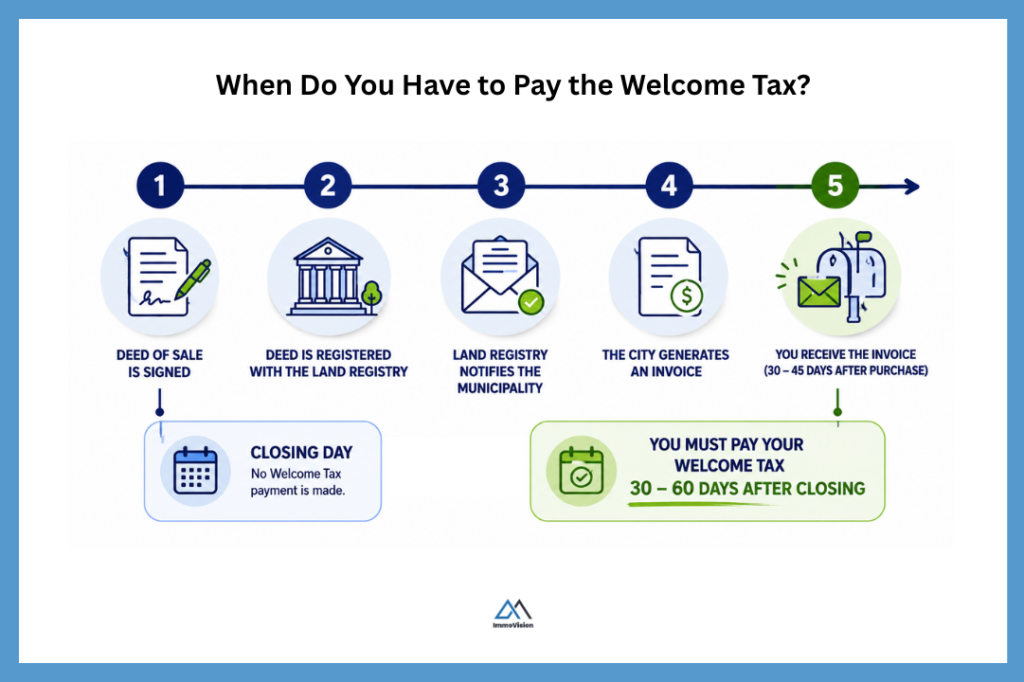
The Welcome Tax must be paid as part of your closing costs. However, you don’t pay the Welcome Tax on the day that you officially close your real-estate transaction.
The way it works is, after the deed of sale is signed, your notary will register the deed with the Québec Land Registry. The Land Registry then sends a copy of the deed to the municipality to notify the city that you have bought a property in their municipal boundaries. The city will then generate an invoice and you will receive in the mail at your new address 30 to 45 days after the purchase. Once you receive it, you generally have 30 days to pay the full amount.
❓Can you pay in instalments?
Yes – you can call the city and make a request to pay in instalments. However, you should expect to pay interest on top of what you owe.
How is the welcome tax calculated?
Québec calculates the welcome tax on a progressive basis, meaning the marginal rate increases as the property price rises.
With the exception of urban agglomerations, each municipality sets its own marginal tax rates, as long as those rates fall within the tax brackets established by Québec’s provincial framework.
The provincial framework refers to Quebec’s Act Respecting Duties on Transfers of Immovables (L.R.Q., c. D-15.1). This states that every municipality in Quebec is legally required to charge the welcome tax using at least three marginal brackets. These are commonly referred to as “base provincial rates”:
- 0.5% of the portion not exceeding $61,500;
- 1% of the portion exceeding $61,500 but not exceeding $307,800;
- 1.5% of the portion exceeding $307,800.
In addition to the base provincial rates, the province also gives each city permission to charge a more on expensive properties. For instance, if a city wants to, it can pass its own by-law to add higher rates (up to 3%) for homes over $500,000.
Generally speaking, smaller cities like Hudson (might charge only the base of 1.5%). However, big cities like Laval or Brossard, may choose to pass a by-law that allows them to add extra brackets (2%, 2.5%, 3%) for more expensive homes. Montréal is the only city in Quebec that’s allowed to go above 3%. It has extra brackets for high value properties and can go up to 4% on luxury homes worth over $3 million.
Below, we list out the welcome tax rates in 2026 for:
Welcome Tax Rates for the City of Montreal (2026)
- 0.5% of the portion not exceeding $61,500
- 1% of the portion exceeding $61,500 but not exceeding $307,800
- 1.5% of the portion exceeding $307,800 but not exceeding $552,300
- 2% of the portion exceeding $552,300 but not exceeding $1,104,700
- 2.5% of the portion exceeding $1,104,700 but not exceeding $2,136,500
- 3.5% of the portion exceeding $2,136,500 but not exceeding $3,113,000
- 4% of the portion exceeding $3,113,000
Source: montreal.ca
Welcome Tax Rates for Longueuil (2026)
- 0.5% of the portion not exceeding $61,500
- 1% of the portion exceeding $61,500 but not exceeding $307,800
- 1.5% of the portion exceeding $307,800 but not exceeding $615,700
- 3% of the portion exceeding $615,700
Source: longueuil.quebec
Welcome Tax Rates for Brossard (2026)
- 0.5% on the portion not exceeding $61,500
- 1% of the portion exceeding $61,500 but not exceeding $307,800
- 1.5% of the portion exceeding $307,800 but not exceeding $500,000
- 3.0% of the portion exceeding $500,000
Source: brossard.ca
Welcome Tax Rates for Laval (2026)
- 0.5% on the portion not exceeding $61,500
- 1% of the portion exceeding $61,500 but not exceeding $307,800
- 1.5% of the portion exceeding $307,800 but not exceeding $611,500
- 2% of the portion exceeding $611,500 but not exceeding $1,223,100
- 3% of the portion exceeding $1,223,100
Source: laval.ca
Welcome Tax Rates for Quebec City (2026)
- 0.5% on the portion not exceeding $61,500
- 1% of the portion exceeding $61,500 but not exceeding $307,800
- 1.5% of the portion exceeding $307,800 but not exceeding $500,000
- 2% of the portion exceeding $500,000 but not exceeding $750,000
- 3% of the portion exceeding $750,000
Source: ville.quebec.qc.ca
Welcome Tax Rates for Gatineau (2026)
- 0.5% on the portion not exceeding $61,500
- 1% of the portion exceeding $61,500 but not exceeding $307,800
- 1.5% of the portion exceeding $307,800 but not exceeding $750,000
- 2.5% of the portion exceeding $750,000 but not exceeding $1,000,000
- 3% of the portion exceeding $1,000,000
Source: gatineau.ca
For more information on Quebec’s Welcome Tax, read What is the welcome tax: Understanding Quebec’s Land Transfer tax.
Need an expert?
The rules around these government incentives can be confusing, and many buyers miss out simply because they don’t know they exist.
However, the right local real-estate broker will help you calculate your closing costs, and identify available rebates and incentive programs so that you can avoid overpaying for your home.
Better yet, buyers typically don’t pay their broker directly—the broker’s compensation is usually shared from the commission paid as part of the transaction.
You can browse thousands of verified Quebec brokers and compare their experience, transaction history, training and local expertise using our broker AI search engine.
➡️ Try Our Broker AI Search Engine For Free