

Most people use the terms condo and apartment interchangeably. However, this can lead to confusion, especially if you are in the middle of a real-estate transaction. For instance, there are actually several different categories of “condo”, and each attracts different types of buyers, has very different financing requirements, and re-sale values.
In this article we will explain the differences between condo and apartments including:
- What is a condo?
- What is an apartment?
- What are the differences between apartments vs condos
- Condos vs apartments, which is best for me?
 Immovision
Find A Realtor Who Knows How To Value Condos
Condos can be difficult to value due to differences in co-ownership structure, financing requirements, and local market conditions. Use our AI search to find and compare top-rated agents in your area.
What is a condo?
A condo, otherwise known as a condominium, is a type of property ownership where you own your individual unit but you share ownership of common areas (e.g. the lobby, hallways, roof, gym, garden, or parking) with the other unit owners. Officially, the Civil Code of Quebec calls this type of ownership a “co-ownership”.
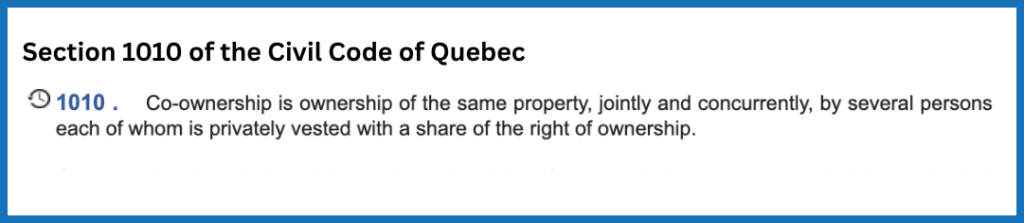
Since, the term “condo” refers to a type of ownership, you can have condo apartments, condo townhouses or even detached condo homes. What makes it a condo is that each owner owns a private portion (their unit) and shares common portions (like the land, walls, or amenities).
However, when people say “Condo” in Quebec, they are normally referring to a specific type of condo called a “divided co-ownership”.
Different types of Condo
The OACIQ (the real-estate regulator) identifies three different types of co-ownership in Quebec: divided co-ownerships, undivided co-ownerships, and co-ownership by shares.
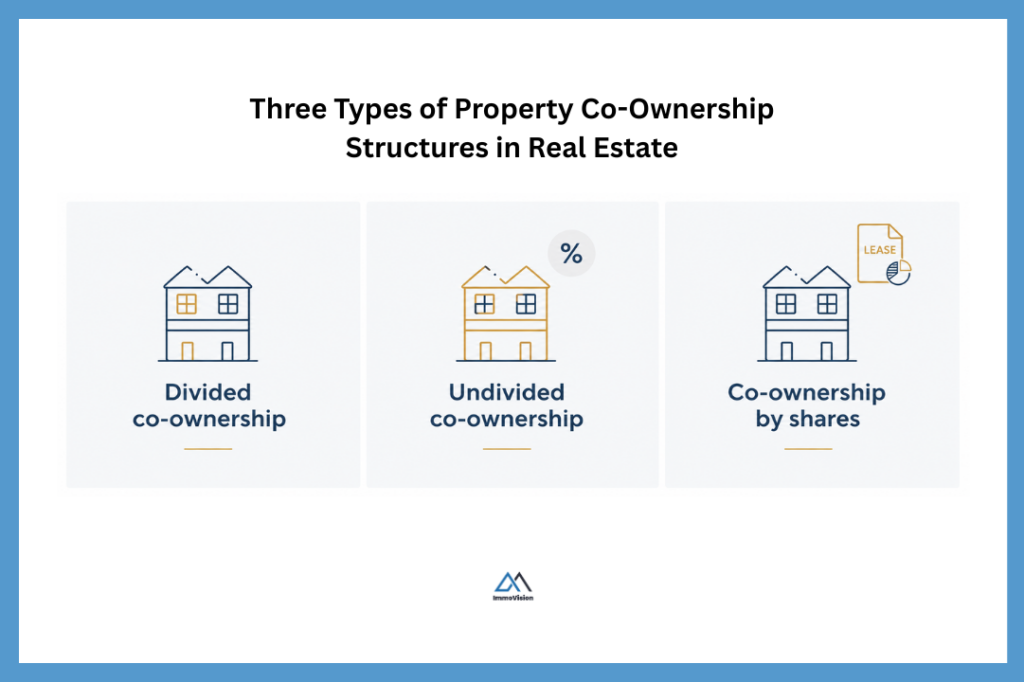
What is a divided co-ownership?
A divided co-ownership (or condo) is a property where you own your individual unit and jointly own the building’s common areas with the other owners.
When you purchase a divided co-ownership unit, you acquire exclusive ownership of a private portion, such as an apartment, townhouse, storage locker, or parking space, while also owning a percentage of the building’s common portions, such as hallways, elevators, lobbies, roofs, and recreational facilities. Your unit has its own cadastral designation (lot number), municipal tax bill, and school tax bill, and you can generally sell or mortgage your fraction without obtaining the consent of the other co-owners. A syndicate of co-owners is responsible for managing and maintaining the common portions of the property.
Quebec law states that every divided co-ownership must have a declaration of co-ownership. This is a legal document that a notary will publish in the Quebec Land Register. This document establishes the rights and obligations of the co-owners. It also defines the private and common portions of the building, sets out the rules governing the use of the property, and determines how expenses are shared among owners.
As a result, purchasing a divided co-ownership involves more than simply evaluating the unit itself; buyers should also review the declaration of co-ownership, the syndicate’s financial health, meeting minutes, contingency fund, and other co-ownership documents to understand the condition and management of the building.
What is an undivided co-ownership?
Unlike a divided co-ownership, an undivided co-ownership is not divided into separate legal lots. Instead, each co-owner owns a percentage of the entire property. A legal document called an “indivision agreement” then grants each owner exclusive use of a particular unit. As a result, no owner has separate property title to their unit, and the property typically has a single cadastral designation and a single municipal tax account. In this set up, co-owners generally share common expenses, property taxes, and other obligations according to their ownership percentages.
Since multiple owners collectively own the same immovable, an undivided co-ownership requires a higher degree of cooperation than a divided co-ownership. Buyers should carefully review the indivision agreement, as it establishes the rights and obligations of the co-owners, the allocation of expenses, restrictions on the sale of ownership interests, and the rules governing the use and administration of the property. Financing can also be more complex, as fewer lenders offer mortgages for undivided co-ownerships, which may affect both the pool of potential buyers and the property’s market value.
🎓 Learn More About Divided Vs Undivided Condos
For a more detailed explanation of the legal differences between divided and undivided co-ownership, see our guide: Divided Vs Undivided Co-Ownership: What Are the Differences?
What is a co-ownership by shares?
A co-ownership by shares is when a corporation owns the building, and buyers acquire shares in that corporation rather than ownership of a specific unit. These shares are linked to a lease that grants the shareholder the exclusive right to occupy a particular apartment. As a result, the buyer does not become the legal owner of the unit itself, but rather a shareholder of the corporation with the right to use a designated dwelling.
Since the transaction involves the purchase of shares rather than real property, co-ownership by shares operates differently from a traditional condo. Buyers should therefore carefully review the corporation’s bylaws, shareholder agreements, financial statements, lease agreement, and other governing documents to understand their rights, obligations, and the overall management of the building before proceeding with a purchase.
ℹ️ Note
Since most people use the term “condo” to describe a divided co-ownership, that’s how we’ll use the term throughout this article.
What is an apartment?
In Quebec, the law does not define the term “apartment.” Instead, housing legislation generally refers to “dwellings” (logements). By apartment, Quebecers usually mean a residential unit in a multi-unit building that a tenant rents from a landlord under a renters lease agreement.
In this case, you do not own the apartment, you sign a lease for its use and pay monthly rent to the landlord. An individual or company own the building and they are responsible for maintenance, insurance, property taxes, and so on. This could be duplex, triplex or an apartment tower owned by a single landlord.
What is the difference between apartment vs condo at a glance
The table below shows the difference between condos and apartments at a glance.
| Feature | Apartment | Condo |
| Monthly payment | Lower – in the form of rent | Higher – in the form of mortgage + condo fees |
| Ownership | You rent | You own |
| Legal structure | Lease agreement | Divided co-ownership |
| Who maintains the building? | Landlord | Syndicate of co-ownership |
| Monthly payment | Rent | Mortgage + condo fees |
| Flexibility | Easier to move | Can sell or rent out |
| Governed by | Rental laws (TAL) | Civil Code, Articles 1038–1109 |
Let’s break down each of these differences between condos vs apartments now.
Monthly payment
Owning a condo usually comes with higher ongoing costs than renting an apartment. In addition to mortgage payments, owners must pay monthly condo fees, property taxes and contribute to the contingency fund reserve (Bill 16) and maintenance log (Bill 141). On top of that, there are often mandatory renovations or replacements required by the syndicate or by law. For example, replacing your water heater every 10 years for insurance and safety reasons.
While these costs can make ownership more expensive month to month, part of each mortgage payment builds equity, and the condo itself may appreciate in value over time. This will help offset the higher expenses. Apartment renters, by contrast, pay less upfront and have fewer responsibilities, but their payments do not build ownership or long-term value.
Ownership
In a condo, ownership comes with shared legal duties. Every owner is responsible for maintaining their private unit, paying condo fees and taxes, and contributing to the upkeep and proper management of the common areas. Articles 1063 to 1077 of the Civil Code of Québec describe these responsibilities. Therefore, in addition to higher costs, owners will need to dedicate a couple of hours per month to fulfilling their duties.
Together, the owners form the syndicate of co-ownership, which elects a board of directors to manage the building on their behalf. The owners generally sit on the board of directors and they are responsible for the day to day operations of the condo. And although they often appoint a property management company to execute operations, they remain personally liable.
The directors are legally bound to act in the best interests of all co-owners. They oversee budgets, enforce by-laws, maintain the property and ensure compliance with provincial laws such as Bill 16 and Bill 141. If they act negligently or fail to fulfill these duties, the syndicate or effected owners can hold them personally liable under the Civil Code of Québec. For example, if a director loses their job, and decides to cut condo fees, this could be a breach of their fiduciary duty and a form of mismanagement.
By contrast, apartment tenants have very few responsibilities. The landlord manages and maintains the building, while tenants are simply pay rent, follow their lease and keep their unit in good condition.
Flexibility
When it comes to flexibility, apartments generally offer more freedom than condos.
Tenants can usually move out by giving proper notice (normally three months), or under Articles 1870 to 1871 of the Civil Code of Québec, tenants also have the right to sublease or assign their lease, provided they notify the landlord in writing.
By contrast, condo owners tend to have less flexibility to move. This is because they will have long term commitments such as mortgages and, co-ownership rules often prohibit renting out apartments. Most syndicates either prohibit rentals entirely or limit the total number of units that the co-owners can lease at one time. Co-ownership rules like this exit to preserve building security, community stability and insurance eligibility.
ℹ️ Note
Most municipalities in places like Quebec City or Montreal limit short-term rentals such as Airbnb are especially to certain zones, specifically authorized for tourist accommodation. These properties must comply with provincial registration requirements under the Act Respecting Tourist Accommodation Establishments. In many condo buildings, the by-laws outright ban Airbnb-style rentals.
Legal structure
The Civil Code of Quebec defines the legal structure of divided co-ownership. In this case, each owner holds title to their private unit and a share of the common areas, managed collectively through a syndicate of co-ownership.
In an apartment, there is no ownership structure for the tenants, the entire building belongs to one landlord, and occupancy is based on a lease agreement governed by the Civil Code’s residential lease provisions and the Tribunal administratif du logement (TAL).
Who maintains the building?
In a condo, the syndicate of co-ownership handles maintenance of the building’s common areas such as the roof, structure and hallways. To do this they use funds collected from owners through monthly condo fees and special assessments. Meanwhile each owner is responsible for maintaining their own private unit.
By contrast, in an apartment, the landlord is responsible for all building maintenance, including common areas and major repairs. The landlord typically only expects that tents keep their individual units clean and in good condition.
Governed by
In a condo, disputes and governance issues fall under the Civil Code of Québec. Generally owners file complaints through through the civil courts. Owners can also request access to financial records, call meetings or take legal action if they believe that the syndicate or its directors fail to meet their obligations.
In an apartment, all rental relationships between landlords and tenants are governed by the Tribunal administratif du logement (TAL), which handles disputes related to leases, rent, maintenance, and tenant rights.
ℹ️ Renters Tip
In Montreal, tenants who need help dealing with a landlord or understanding their rights can contact free support organizations such as the RIL du Sud-Ouest de Montréal (rilpsc.org), which assists renters in navigating TAL procedures.
Conclusion: Condos vs Apartments, which is better for me?
Whether a condo or an apartment is the better choice really depends on your goals, budget and what lifestyle you desire.
If you want stability, long-term investment and a sense of ownership, a condo can be rewarding but it comes with shared legal and financial responsibilities. You’ll need to stay involved in decisions about the building, follow provincial laws like Bill 16 and Bill 141, and budget for fees, repairs and reserve fund contributions.
If you value flexibility, lower short term monthly costs and fewer obligations, an apartment may suit you better.
Renters avoid maintenance headaches and legal risks, though their payments don’t build equity or ownership. Furthermore, rent typically increases by 2–4% per year on average in Quebec, depending on market conditions and TAL guidelines, whereas a mortgage rate can remain fixed for up to five years, providing more payment stability.
Immovision
Need help buying or renting?
We scan more than 27 million records to find experienced local experts.