

For many of us, the family house is one of the most valuable assets in our lives. This is in terms of financial worth, emotional significance, and family stability. For many couples, deciding what happens to the house becomes the central and, often the most difficult issue in the divorce process.
This article explains who gets the house in a divorce in Canada, with special attention to the rules in Quebec. More specifically we will cover:
- What are the marriage and divorce laws in Canada?
- What are my rights to the family home after divorce in Canada?
- What are my rights to the family home after a divorce in Quebec?
- How the court divides the family home in a divorce
- Frequently asked questions
- Final remarks
What are the marriage and divorce laws in Canada?
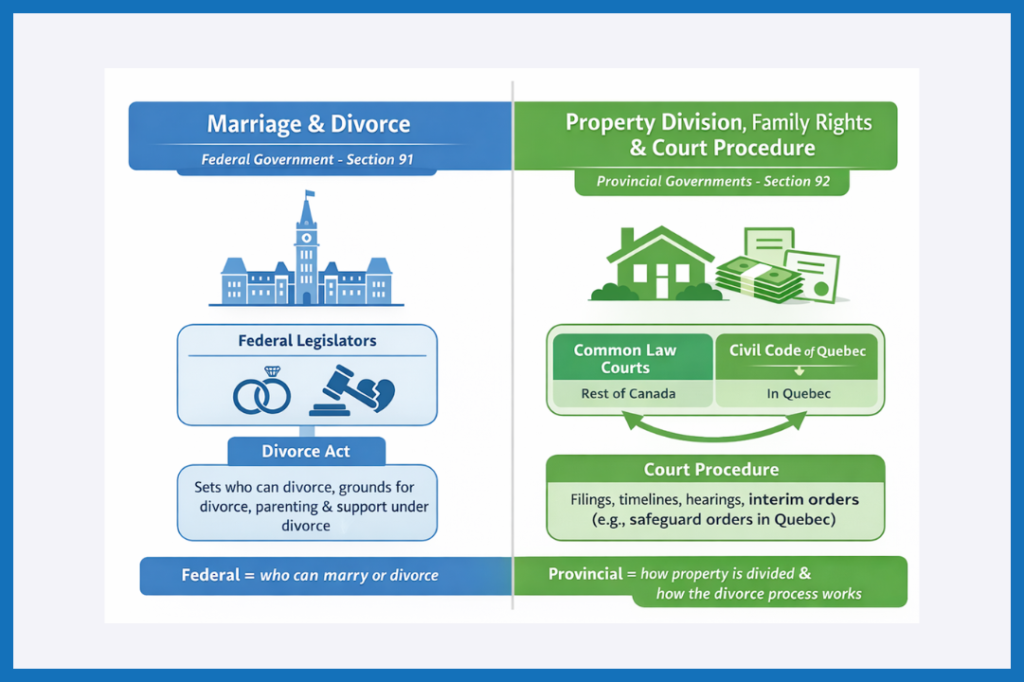
The Constitution of Canada divides legislative authority (the power to make laws) between the federal and provincial governments. Federal lawmakers determine who may marry, establish the legal grounds for divorce through the Divorce Act, which sets the framework for ending a marriage. Meanwhile, provincial governments regulate property division, define rights in the family home, and control court procedures within their jurisdictions.
Provincial lawmakers create the written rules for property division. In most provinces, courts interpret and develop those rules through past decisions that future judges follow (the common law system). Quebec differs because it relies primarily on a comprehensive Civil Code rather than judge-made precedent.
Provincial governments also control court procedure — the steps required to bring a divorce case before a judge. In Quebec, the Code of Civil Procedure sets out the required filings, timelines, hearings, and interim applications, such as safeguard orders.
What are my rights to the family home after divorce in Canada?
In Canada, the rules for who gets the house in a divorce varies by province. For instance, in Alberta the law that determines who gets the house are in the Family Property Act, whereas in Ontario the law is in the contained in the Family Law Act. Whilst there are some general similarities between systems, the law is very different depending on which province you are in.
The rules that govern your specific case depend on where at least one spouse ordinarily resides when you separate, not on where you were married or where your assets are located. For example, if you married in Alberta but lived in Quebec at the time of the divorce, Quebec courts apply the Civil Code of Québec (CCQ) to your case. Federal law, through the Divorce Act sections 3(1), 3(2), and 3(3), empowers the courts to use these rules.
What the Divorce Act says
1. If one proceeding is started before the other, the court where the first application was filed has exclusive jurisdiction. The later proceeding is deemed discontinued.
2. If both proceedings are started on the same day and a parenting order is sought, the Federal Court determines which province has jurisdiction. Priority is generally given to the province where the child is habitually resident.
3. If both proceedings are started on the same day and no parenting order is involved, the Federal Court decides which court will retain jurisdiction. It will typically consider where the spouses last lived together and, if necessary, determine which court is most appropriate to hear the matter.
What are my rights to the family home after a divorce in Quebec?
The Civil Code of Quebec, Articles 401–415, set out your rights to the family residence during marriage and up to the point of divorce. You get these rights automatically by law, even if your marriage contract contains different provisions.
According to the law, both spouses are have rights to all residences used by the family (e.g. primary and secondary) regardless of whose name appears on the property title. Your rights to the family home include:
- Financial rights to the family home
- Protection against unilateral sale of the family residence
- Temporary occupancy after separation
- Court-granted use or ownership
Let’s take a look at what this means now.
Financial rights to the family home
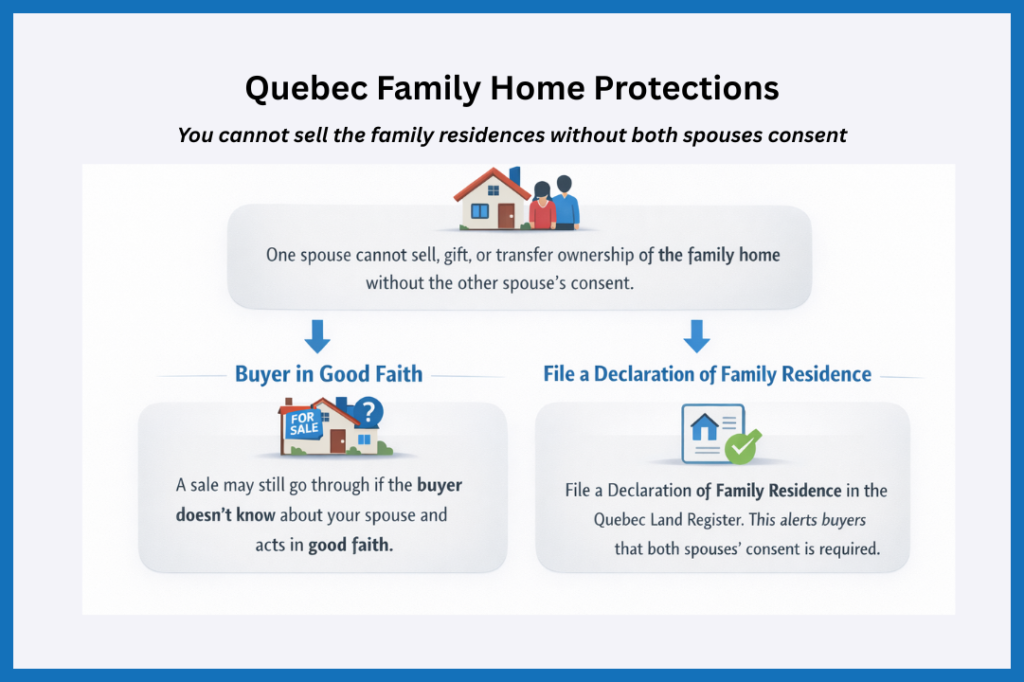
In Quebec, the law provides that one spouse cannot sell, gift, or otherwise transfer ownership of the family residence without the other spouse’s consent or without authorization from the court. In this way, the law protects each spouse’s financial interest in the family home.
If one spouse acts without the consent of the other spouse, then you may apply to have the transaction annulled, provided the legal conditions are met. Alternatively, the spouse may claim financial compensation for damages incurred as a result of the unauthorized transaction.
The law also provides that neither spouse may lease the family residence, hypothecate it (place a mortgage on it), or otherwise interfere with rights in the residence without the other spouse’s consent, unless authorized by the court.
Protection against unilateral sale of the family residence
As we have see, the law says that one spouse cannot sell, gift or transfer ownership of the family home without the other spouse’s consent.
However, even though this is the law, sometimes a sale can still go through if the buyer doesn’t know about your spouse and acts in “good faith.” To protect yourself against this, you can ask a real estate agent or notary to file a declaration of family residence in the Quebec Land Register. This alerts potential buyers that the property is a family home and that both spouses’ consent is required before it can be sold.
Temporary occupancy after separation
The court grants you the right to temporarily occupy your family residence after a divorce in three specific situations.
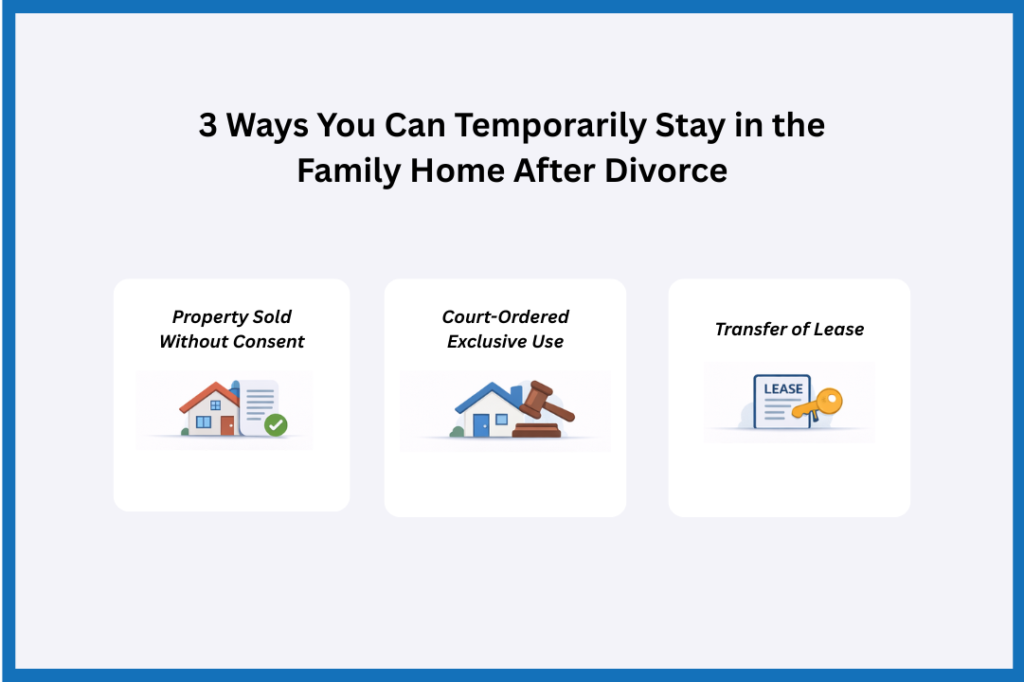
First, if you file a declaration of family residence and a buyer purchases the home anyway, the law allows you to continue living there as a tenant under standard rental rules until the court decides how to divide the property.
Second, the court can temporarily award exclusive use of the family residence to one spouse. This is often the parent who has primary care of the children while the divorce is pending. To obtain this protection, a spouse must file an application for a safeguard order or for provisional measures within the divorce proceeding. If one spouse has already left the residence, the court will often preserve the status quo by granting temporary exclusive occupancy to the spouse who remains in the home, especially where this promotes stability for the children.
Third, if the family home is rented rather than owned, the court can transfer the lease from one spouse to the other during separation, divorce, or annulment proceedings. This allows the non-lessee spouse to continue occupying the residence while the legal process is ongoing.
Court-granted use or ownership
The divorce process in Quebec does not take place in a single hearing. After you file and serve an application for divorce, several months often pass before the court holds the final trial. During this time, either spouse may apply to the court for temporary protections through a safeguard order (in urgent situations) or provisional measures (temporary orders that remain in effect until the final judgment).
At this interim stage, you can ask the court to decide important issues such as:
- Who will have temporary parenting time or decision-making responsibility for the children
- Temporary child support or spousal support
- Who may remain in the family residence
- Who must pay the mortgage, rent, or household expenses
- Whether the court should prevent one spouse from selling, mortgaging, or otherwise dealing with property
Lawyers typically ask the court to issue a safeguard order when they need immediate action to prevent harm or instability within the family. The court may grant temporary safeguard orders to create a structured arrangement that keeps the family stable until the divorce is finalized.
How the court divides the family home in a divorce
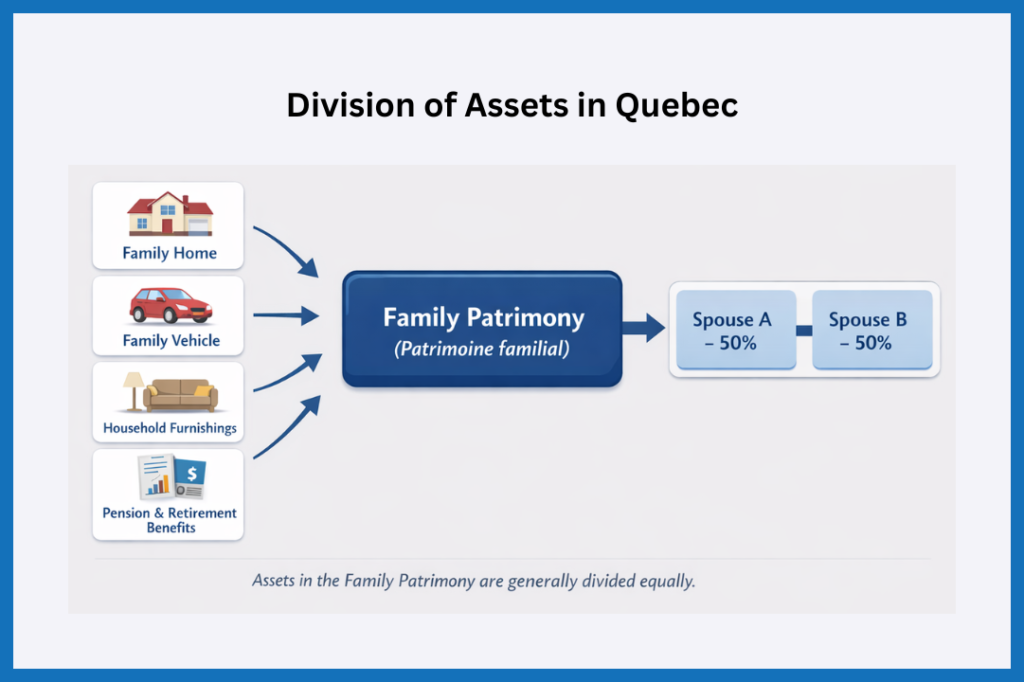
In Quebec, the CCQ groups certain assets, including the family home, into what it calls the family patrimony. It then requires spouses to divide these assets equally (50/50) upon divorce, subject to limited exceptions. There are certain common edge cases to this that include:
- What happens to a home I owned before marriage?
- What happens to a home I bought during marriage?
- What happens if I inherit a home during my marriage?
- What about a vacation or secondary home?
- What if the home is co-owned with someone else?
- How are mortgages or debts handled?
- What if I made major renovations to the home?
- What if the home is held in a trust or company?
Let’s take a look at each of these now.
Frequently asked questions about who gets a house in a divorce in Canada
In this section, we answer some frequently asked questions about who gets a house in a divorce in Canada. The answers are based on system in Quebec. For information about what happens in your province, contact a local law firm in the province where you were living at the time time of your divorce.
What happens to a home I owned before marriage?
If one of the spouses bought the house before the marriage and fully paid off the mortgage, the law still includes the home in the family patrimony and the law subjects the house to a 50/50 division. However, the CCQ allows a spouse to deduct the value of property that he or she owned at the time of marriage from the total value before the spouses divide the family patrimony equally.
For example, if you bought a house for $300,000 before marriage and now the value of the property is $500,000, the net patrimony calculation will start be:
Market value at separation
Value of the home at the date of marriage
Increase in value during the marriage
Alternatively, if either spouse bought the house before marriage, but there was still a mortgage on the property at the time of marriage, the law includes the increase in the home’s net value during the marriage in the family patrimony partition. To calculate this, you:
- Determine the net value at the date of marriage (market value minus the mortgage balance at that time).
- Determine the net value at the date of separation or divorce (market value minus the remaining mortgage balance).
- Subtract the net value at marriage from the net value at separation.
The spouses then partition only the increase in value that occurred during the marriage, and they generally divide that increase equally between them.
Market value $500,000 minus mortgage $300,000
Market value $700,000 minus mortgage $100,000
Net value at separation minus net value at marriage
Free Instant Valuation
What happens to the house that I bought during marriage?
Family patrimony includes every residence the family uses, including the primary home and any secondary residences. For example, if you own a detached house in Montreal and a condo in Florida that you use to escape during the winter, the considered a family home if your family lives in it for at least 30 days within a 12-month period.
The law will include both the net value of the primary residence and any secondary residences in the family patrimony. To calculate the net value, you subtract the mortgage and any related debts from the home’s market value. The spouses then divide that net value equally when they separate or divorce.
Unlike a home owned before marriage, there’s no deduction for prior ownership, because the home didn’t exist before the marriage.
Price paid during marriage
Outstanding balance at divorce/separation
Market value minus mortgage
Note
What happens if I inherit a home during my marriage?
Quebec law generally excludes inherited property from the family patrimony, so the inheriting spouse owns the home solely. This is unless:
- The home qualifies as a family residence. Generally speaking, if any family member lives in the home for more than 30 days within a 12-month period, the law may treat it as a family residence and include it in the family patrimony.
- The spouses use marital funds to pay the mortgage. If the home has a mortgage and the spouses use marital funds to pay it down, the law may include the home in the family patrimony.
- The spouses use marital funds to renovate the home. If the spouses complete renovations using marital funds and those renovations increase the home’s market value, the law may include the increase in value in the family patrimony.
What about a vacation or secondary home?
Article 415 of the CCQ includes all residences used by the family in the family patrimony, not just the main home. This can include secondary homes such as cottages, condos, or chalets, that the family uses for part of the year. The key factor here is that the property must be regularly use by either spouse or children. Regular use generally means that either spouse or the children must live in the home for at least 30 days within a 12-month period.
Note
What if the home is co-owned with someone else?
If you co-own your home with someone outside the marriage, such as a sibling, friend, or parent, Quebec applies the family patrimony rules only to your share of the property. For example, if you own 50% of a condo with a sibling and your spouse lives there, the court includes only your 50% in the family patrimony calculation.
If both spouses co-own the property, the court considers the full value of the home as part of the family patrimony.
How are mortgages or debts handled?
Article 416 of the CCQ states that when dividing the family patrimony, the court will subtract debts and any other encumbrances from the value of the assets. This includes mortgages, loans, and other debts tied to the family residence e.g. a hypothec of construction.
If the home has lost value, for instance the market value minus the oustanding debt is negative, then any creditors (for instance the mortgage lender) has the first claim on the property under the terms of their individual contracts. Although in this situation, there will be no equity to share, the spouses may still be jointly liable for the mortgage debt, if both are co-signers.
What if I made major renovations to the home?
In Quebec, spouses who complete major renovations to the family home during their marriage can affect the family patrimony. The impact depends on whose money paid for the work and whether the home forms part of the patrimony.
If the spouses use marital funds such as income earned during the marriage or money from a joint account to pay for renovations, and those renovations increase or decrease the home’s net value, the law includes that change in value in the family patrimony.
However, if you pay for renovations using your own personal funds such as an inheritance, savings you accumulated before the marriage, or a monetary gift, the law does not include the resulting increase or decrease in value in the family patrimony.
To prove the source of funds for the renovations, you must keep clear records. Always keep receipts, invoices, and proof of payment so you can show exactly how you funded the renovations. Without proper documentation, you may struggle to prove that you used personal funds.
What if the home is held in a trust or owned by a company?
If you hold the property in a trust or a company, the law does not automatically place the property itself in the family patrimony. Instead, the law considers only the beneficial interest you hold in the trust or company as part of the family patrimony.
The court determines the value of your beneficial interest for the purpose of dividing the patrimony. If your spouse also holds a beneficial interest, the court adds your spouse’s interest to the family patrimony before dividing it.
Final remarks
While the federal government sets the rules for divorce in Canada, the provincial governments create the laws that govern property division. These laws vary significantly from one province to another. If you want to know who gets the house in a divorce in Canada, you must review the laws in your province.
When the court decides who gets the house in a divorce in Canada, it requires clear evidence. You must provide documents such as the deed of sale or title to the property, mortgage statements, bank records, proof of payments, and any relevant agreements (such as a marriage contract or separation agreement) to support your claim. The court will not rely solely on your version of events, you must prove your position with proper documentation.