
Every summer, Quebec homeowners find a school tax bill in their mailbox.
This is a single payment that covers a full 12 months of public education funding and is something that all Quebec homeowners must pay. In this article, we’ll explain everything you need to know about the Montreal school tax, including:
- How does Quebec calculate school tax?
- What is the school tax rate for 2026?
- Who collects school tax?
- How municipalities use school taxes
- Does your school tax fund English or French schools?
- How much school tax do new homeowners pay?
- Frequently asked questions
- Final remarks
How does Quebec calculate school tax?
Your municipality charges school tax by applying a set rate to the assessed value of your property. The calculation is as follows:
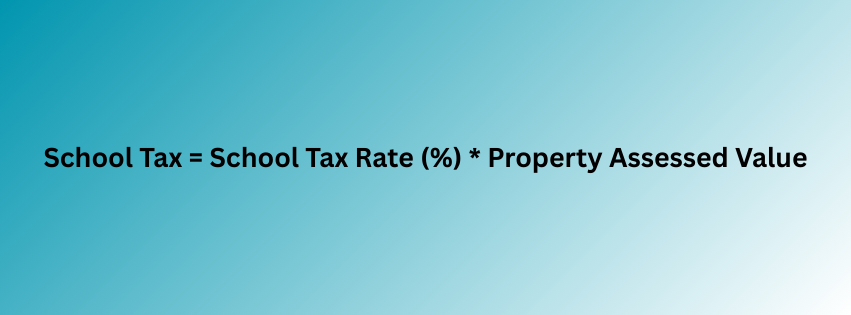
The municipality determines your assessed value by looking at the assessment roll that it updates every three years. Since 2020, Quebec has standardized the school tax rate across the entire province. This means everyone pays the same rate, no matter where you live in Quebec.
What is the school tax rate for 2026?
The school tax rate for 2026 is $0.08423 per $100 of your properties assessment value. This is equivalent to 0.08423% of your properties assessed value. For example, if your home’s assessed value is $500,000, your municipality charges $421.15 in school tax, calculated as:
School Tax = $500,000 * 0.08423% = $421.15
To estimate your specific school tax payment, you will need to find your property’s assessed value on your city’s official assessment roll. You can do this by entering your property address or cadastral number on your city’s website. Links below.
Select your municipality below to access your assessment roll:
- Montreal – Find your property’s assessed value
- Laval – Find your property’s assessed value
- Brossard & Longueuil – Find your property’s assessed value
- Westmount – Find your property’s assessed value
- Quebec City – Find your property’s assessed value
Who collects school tax?
Each municipality collects the school tax as part of your property tax bill. The municipality then forwards the collected funds to the local school service centre (CSS) or the local English school board responsible for that area.
The CSS manages French-speaking schools, and the English school board manages English-speaking public schools in the same territory. For example, CSS Marguerite-Bourgeoys (CSSMB) oversees French public schools in Montreal’s West Island and South West, while Lester B. Pearson School Board oversees English speaking schools in the region.
How municipalities use school taxes
Municipalities use the Quebec school tax to fund the public school system within the city’s boundaries. This includes the different school service centre and local English school boards. For example, the Centre de services scolaire de Montréal (CSSDM) is one example of a CSS and the Lester B. Pearson School Board is an example of and English school board in Quebec.
The local CSS and school boards use the money they recieve for:
- Maintaining and repairing school buildings
- Paying administrative and support staff
- Covering about half of student transportation costs
- Providing equipment, supplies, and basic infrastructure upgrades
Municipalities do not use school tax revenue to fund private schools. It only supports the public education network.
Does your school tax fund English or French schools?
The Charter of the French Language (Bill 101) states that your school tax funds the public schools you are eligible to attend. Your children can attend an English public school only if they meet the legal criteria for English instruction under Bill 101. Namely, that you or your children have received a significant portion of your education in English in Canada, or you hold a certificate of eligibility for English instruction issued under Bill 101.
If you have no children at school, your school tax goes by default to French public schools (CSS). Once a child is eligible and enrolls in an English public school, your municipality directs your property’s school tax to the English school board instead.
How much school tax do new homeowners pay?
Quebec municipalities bill homeowners for school tax annually in either July or August. If you just bought a home, the previous owner will usually have already paid that year’s school tax. However, typically the previous homeowner will be responsible for their share only up until the date that you take official ownership of the property (this is the date you sign the deed of sale).
To take account of this, the notary usually adjusts the school tax between buyer and seller so each pays only for the period they own the property. For example, if the school tax year runs from July 1 to June 30 and you buy your home on January 1, 2026, the seller has already paid the full year. Your notary will tell you that you need to reimburse the seller for the six months from January to June, since you will benefit from that portion of the year.
Your notary will include this adjustment in your mémoire des répartitions (also known as the statement of adjustments) at closing. In this statement you will find details not only of school tax adjustments, but also your property taxes, and other prepaid expenses that form part of your closing costs.
After closing, there’s nothing more for you to do until the next school tax billing cycle, when you’ll receive your own invoice directly from your municipality.
Frequently asked questions
1. Online through your bank
To pay online, log into your financial institution’s website or app and look for option to make a payment. Search for the school board name (e.g., Taxe scolaire de l’île de Montréal – CGTSIM or your board’s name). Enter the 20-digit reference number on your school tax bill.
2. At a bank or ATM
You can pay in person at a bank branch or at an ATM if your institution supports it. To do this, you need to physically go to the bank and then use the detachable coupon on your tax bill. The bank staff will likely be able to help you. Make sure that you keep your receipt somewhere safe.
3. By mail
You can mail a cheque or money order to the address on your school tax bill. When you do this, you should include the detachable payment slip with your cheque. If you send with Canada post, we recommend that you pay extra for tracking so that you know when the school tax payment has been recieved.
4. Through your mortgage lender
Some lenders can pay the school tax on your behalf if set up in your mortgage arrangements (check with your bank or lender).
Final remarks
All property owners in Quebec must pay school tax annually. Whilst this annual bill contributes to the carrying costs of owning a home in Quebec, it can also boost your property value by supporting and maintaining the public school system that makes neighbourhoods more attractive to families and long-term buyers.