

Sellers Declaration Definition
When prospective buyers fall in love with a home, they usually focus on what they can see: the layout, the kitchen, the neighbourhood.
But many of the most important details about a home listed for sale never appear during a visit. They appear in the seller’s declaration.
Buried in this document are disclosures about past water infiltration, electrical systems that may concern insurers, foundation types that affect long-term maintenance, or repairs that hint at recurring problems.
To an experienced reader, these notes can completely change how a property is evaluated. The challenge is that most buyers (and many sellers) don’t know what these disclosures really mean, or which ones matter.
In this article, we’ll show you how to both complete and read a seller’s declaration so you can understand what these disclosures actually mean for a property. We’ve also developed a free tool that you can use to analyze your seller’s declaration, and flag questions that you absolutely must ask your real-estate agent.
Let’s start by understanding exactly what the seller’s declaration is, and why it matters to buyers and sellers.
Upload Your Seller’s Declaration
We’ll highlight disclosures that could point to future maintenance costs or repairs.
What is the seller’s declaration?
The seller’s declaration is a standardized form that homeowners must fill out when selling a property in Quebec. In residential real estate, there are two different forms and your choice of form will depend on the type of property that you are selling. The forms are:
You must use the DS form if you are selling a residential dwelling containing less than 5 units. This includes properties held in undivided co-ownership. Examples are: detached houses, semi-detached houses, townhouses, plexes, and movable houses. In contrast, you must use the DSD form for all transactions that involve a divided co-ownership with more than 4 dwellings. This will include condos in low rise, mid rise and high rise buildings.
Each of these different forms includes a series of questions about the property’s condition, systems and history such as any past damage, renovations or known defects. The OACIQ (the province’s real estate regulator) developed these questions in collaboration with the Quebec Association of Building Inspectors (AIBQ). Buyers, sellers, and their agents use these questions to evaluate the property’s condition and quality and accurately determine its value.
Is the seller’s declaration mandatory?
If you choose to sell your property work with a listing agent, the seller’s declaration is mandatory. The OACIQ requires sellers to complete the declaration before signing the listing contract. Brokers then attach it as an annex to the listing contract. Completing this form gives the broker an accurate understanding of the property’s condition early on, so that they can correctly advise you on the best strategy to price your home.
If you sell your house without a real-estate agent, completing a seller’s declaration is not mandatory. However, if a buyer’s broker approaches you, they must ask you to complete one so they can properly inform their client about the property’s condition and any factors that could affect the transaction. You may refuse, but the broker must then inform the buyer that you declined to complete the declaration, that important information may be unavailable, and advise them to proceed with caution and obtain the details needed to make an informed decision.

Why is the seller’s declaration important?
Although it might feel strange to list out all known problems in your home, especially since you are trying to sell it, a seller’s declaration is important. This is because legally, as a seller, if you do not reasonably disclose any defects that you are aware of, the buyer can take legal action against you either during or after the sale.
During the sale, buyers typically order a pre-purchase inspection to uncover potential issues before closing. If the inspection identifies a problem you should have disclosed, the buyer can seek compensation for related costs, negotiate a price reduction, or cancel the sale. If the inspection causes the transaction to fall through, you must legally disclose those findings to future buyers.
Meanwhile, after the sale, the seller remains legally responsible for any latent defects in the property. If the seller failed to disclose something that they knew or should have reasonably known about, the seller is not only responsible for covering the buyer’s losses, but also for any additional damages incurred as a result. Overall, the seller’s declaration helps demonstrate that they acted in good faith and can serve as evidence of transparency in the event of a dispute or legal claim.
Seller's Note
How buyers and sellers use the seller’s declaration
Once the seller has completed the seller’s declaration, the listing agent will make the seller’s declaration available to any buyer interested in making a offer to purchase.
The buyer will then sign your seller’s declaration to confirm that they have read it. They will then attach the seller’s declaration to their promise to purchase. This ensures the buyer formally acknowledges the property’s disclosed condition and cannot later claim they were unaware of known issues.
Lastly, your listing agent will make the seller’s declaration available to any prospective buyer or their agent, to the building inspector or any other person involved in the transaction, such as a home appraiser.

What information is included in the declaration by the seller?
The OACIQ provide a two templated lists of questions that the seller must answer. The seller’s answers to these questions are the declarations by the seller. The questions differ based on the actual form that you use.
Form DS – Sellers Declaration: Building
Used for houses, plexes (fewer than 5 dwellings), semi-detached homes, townhouses, and undivided co-ownerships. The DS form focuses on the physical condition of the building and land-related issues, including:
- Year of construction, year of purchase, and current financing;
- Structural condition (foundation, roof, walls, plumbing, heating, electrical);
- Past problems (water infiltration, vermin, contamination, pyrite, radon, etc.);
- Any work or renovations done, with documentation;
- Municipal or environmental issues;
- Income and expenses (if it’s an income property).
The official DS form can be found at Declarations by the seller of the immovable – DS. This document is available in English or French.
Form DSD – Sellers Declaration: Divided Co-ownership
Used for condos (divided co-ownerships). It still includes some of the same building questions (since condo owners are responsible for their unit), but it also adds sections about the condominium corporation, such as:
- The name of the syndicate of co-ownership;
- Management of common areas and contingency fund;
- Minutes of recent meetings and any ongoing disputes;
- Insurance coverage for the building and the co-owners;
- Planned special assessments or major work.
So, while you still disclose things like water damage or asbestos in your unit, you must also disclose information that affects the entire condo building.
The official DSD form can be found at Declarations by the seller of the immovable – Divided co-ownership (DSD). This document is available in English or French.
Note
How to fill out the sellers declaration
The law (and OACIQ rules) require you to answer to the best of your knowledge and in good faith. If you don’t know certain details, such as the contingency (reserve) fund amount or whether the reserve fund study (Bill 16) or Maintenance Log (Bill 141) is complete, indicate “unknown” or “to be confirmed by the syndicate.”
Whilst you are not legally penalized for not knowing, lack of knowledge can slow down the transaction. For instance, let’s say that the notary requests the latest reserve fund study and no one, including you, can confirm whether it exists. The notary may delay the closing day until the information is obtained.
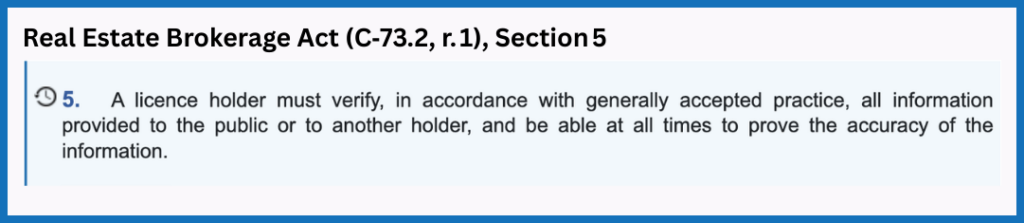
Your broker has a legal duty of verification. This means they must make reasonable efforts to confirm important details about the property. With your permission, they can contact the property manager or syndicate directly to obtain recent financial statements, meeting minutes, the reserve fund study, and management reports.
What to look out for as a buyer?
As a buyer, the seller’s declaration is one of the most valuable tools you have to uncover hidden risks before you commit to purchasing a property. It’s your chance to spot warning signs early. These are things that could later turn into expensive repairs, legal issues or insurance problems.
Below is a short summary of what you should watch out for in the sellers deceleration:
- Water or moisture damage – past leaks or flooding often come back.
- Structural issues – cracks, uneven floors, or foundation movement.
- Hazardous materials – pyrite, radon, asbestos, or soil contamination.
- Unpermitted renovations – work done without municipal approval.
- Old systems – aging roof, wiring, plumbing, or heating.
- Condo red flags – low contingency fund, lawsuits, or special assessments.
- Legal or neighbour issues – servitudes, shared driveways, or disputes.
- Too many “unknowns” – may signal missing records or poor transparency.
Frequently asked questions
Final remarks
Whether you’re a seller completing the declaration or a buyer reviewing it, your realtor plays a crucial role in protecting your interests.
For sellers, your realtor will guide you through the form, ensure your answers are accurate and help you gather any missing information from the notary or condo syndicate. Your realtor will then upload this information to your property listing so that other brokers can easily review it. This added transparency builds buyer confidence, speeds up offers and helps your property stand out as well-managed and trustworthy.
For buyers, a good realtor knows how to read between the lines. They will be able to spot red flags, verifying details and coordinate with your notary before you make an offer. Working with an experienced, transparent realtor can make the difference between a smooth sale and an extremely costly and nightmare purchase.