Zoning By-Laws
For many property owners, zoning rules are something they rarely think about — until the municipality claims there is a zoning violation on their property.
What begins as a routine construction project, or renovation such as converting a plex, finishing a basement, adding an extension, can suddenly turn into a dispute with the city with the threat of significant fines, sometimes months or even years after work was completed.
However, municipalities do not always get it right. Zoning by-laws can be improperly adopted, applied inconsistently, or enforced in ways that exceed a municipality’s legal authority. In some cases, property owners may have legal grounds to challenge the validity of a by-law or the way it is being enforced.
In this article, we help you understand everything that you need to know about zoning laws so that you can spot potential violations before they become expensive problems and take control if a by-law is being misapplied.
What are zoning by laws?
Zoning by laws are government regulations that control how land and buildings can be used in specific areas. They control things like what type of propery is allowed, how many homes can be on a property, and what changes you’re allowed to make to a building, such as turning a plex into a single-family house.
The reason why the government controls this kind of thing is so that cities grow in a safe, organized and harmonious way, and so that activities that violate federal law or that may bother neighbours, like a loud factory next to homes, are kept in separate areas.
How does zoning work in Quebec?
At the top of the hierarchy, you have the federal government of Canada. They influence local zoning rules by assigning these rules to provinces. The Quebec provincial government then sets the framework for how municipalities can plan and control land use.
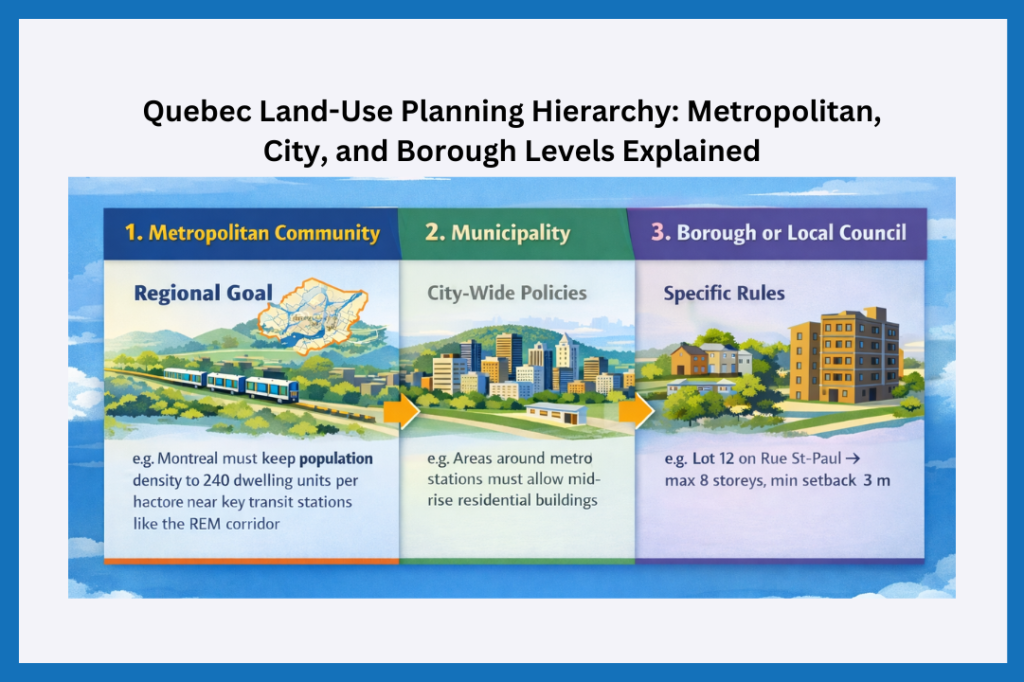
Within this framework, planning happens at multiple levels: the metropolitan community (in regions like Montreal and Quebec City), the municipality, and the borough or local council. Each level creates its own plan, with the metropolitan community setting broad regional goals, the municipality translating those goals into city-wide policies, and the borough or local council turning those policies into detailed rules for individual properties. Each lower-level plan must follow the guidelines set by the level above it.
Note
How to read zoning by laws in Quebec
To read the zoning by laws in Quebec, you need to understand three things:
Let’s check how each of these work.
Zoning districts
Zoning maps are official municipal maps that show how land is divided into zoning districts, with each district linked to a specific set of permitted land uses and development rules. The zoning map below shows how zoning districts are overlayed on top of a zoning map.
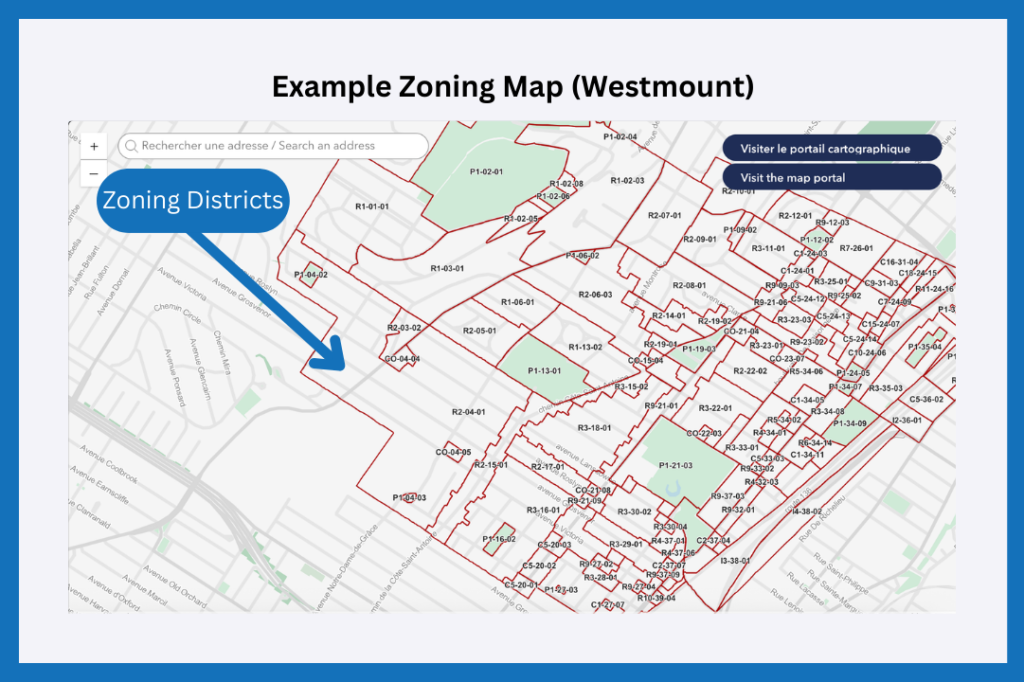
To find out what you can do with a specific property, locate the property address (or lot number) on the zoning map. You will then see a unique alphanumeric code associated with that property — this is the zoning code, which determines the permitted uses and development rules for the lot.
Zoning codes
Each municipality assigns a unique alphanumeric code to each zoning district, such as R1-01-01, as shown below.
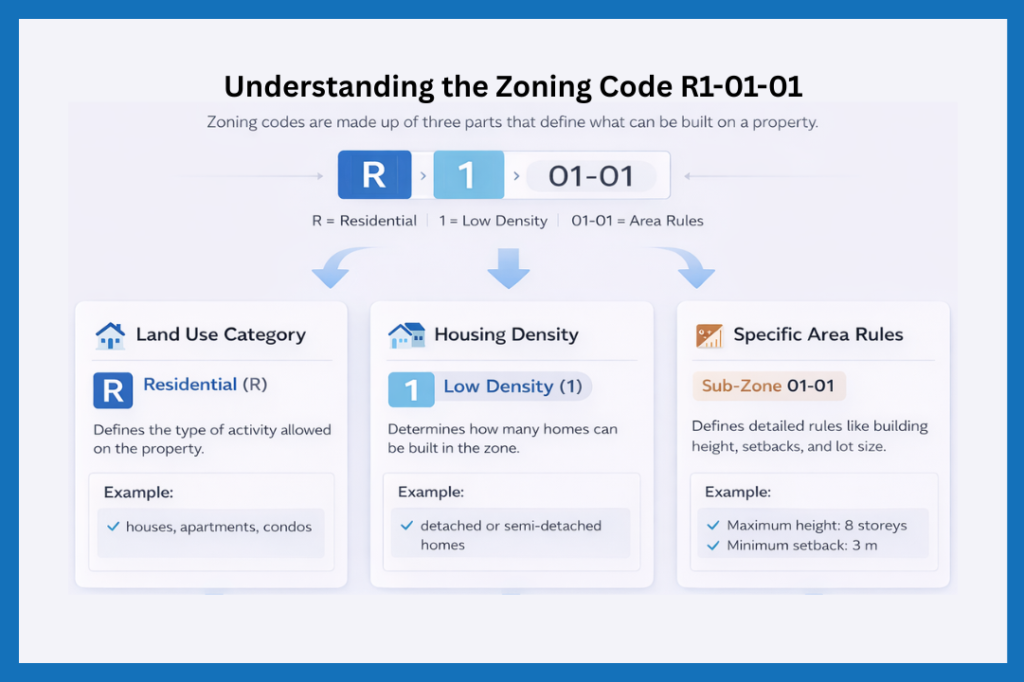
The first letter of a zoning code shows the general use case of the land. For example, R = residential, C -= commercial, or I = industrial and so on. The number that follows (like the “1” in R1-01-01) identifies a specific type of district within that category, such as low-, medium- or high-density housing. Additional numbers further define sub-zones and specific rules, like building height, lot coverage, setbacks, density and any other requirements such as parking, floor area ratio, or heritage protections.
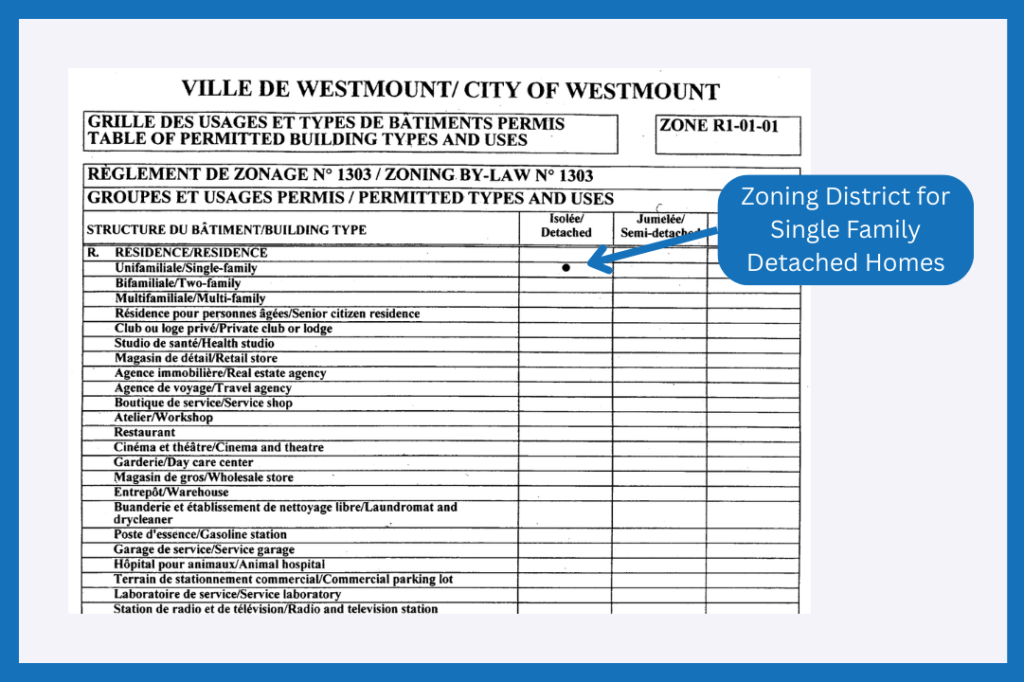
You can use the zoning code to look up the legal by-law text that applies to that zone. For example, below is the by-law text for zoning code R1-01-01 in Westmount. This document shows what the municipality allows you to do with on the land. For instance, you can see below that single-family detached homes can be built on this land. However, you cannot turn the land into multi-family units, senior citizen homes and so on.
Note
Overlays
Overlays are additional planning rules that apply to certain areas on top of the base zoning regulations. They allow municipalities to regulate specific issues in targeted locations without rewriting the underlying zoning. For instance, overlays can apply to a single property, an entire neighborhood, or a linear corridor, such as a street, riverfront, or transit route.
There are several common types of overlays, including heritage protection, flood zones, environmental safeguards, view preservation, and transit-oriented development areas. While these types may appear throughout a city, the exact rules are usually tailored to the specific location.
Overlay maps
How are zoning by-laws enforced?
In most Quebec municipalities, zoning by-laws are enforced by municipal inspectors or by-law enforcement officers who investigate complaints and inspect properties.
If a violation is discovered, the municipality can issue a formal notice requiring the owner to correct the problem. Failure to comply can result in fines, and in many cases the offence is considered continuous. This means that the municipality can issue penalties for every day the violation persists.
Importantly, the municipality may pursue penalties for the period during which the property was not in compliance, even if a formal notice had not yet been issued and even if you, (as the owner) are unaware of the violation. For example, if a daily fine is $300 and a violation existed for two years before it was discovered, the theoretical maximum penalties could exceed $200,000.
All that being said, the municipality will normally send a notice ordering the owner to correct the problem (for example: remove an illegal use or modify a structure). You would need to do this at your own expense.
How to change zoning codes in Quebec
Changing the zoning of a property means officially modifying the by-law that governs what uses and developments are allowed on that lot. This process may be initiated in one of two main ways:
- By the municipality
- By a private citizen or property owner
A municipality may update an entire zoning by law to reflect new urban development goals. For instance, the municipality may create overlay zones for heritage protection, environmental concerns, or transit corridors. These add extra rules on top of the base zoning, such as limiting building heights to preserve views of Mount Royal, protecting historic streetscapes, or restricting the conversion of duplexes and triplexes into single-family homes to maintain rental housing supply. Municipalities may also rezone entire districts to allow new land uses, such as converting former industrial areas to residential or mixed-use development, or expanding urban zones into agricultural land.
A private citizen or property owner can also apply to change the rules that apply to their property. This may involve a rezoning application to allow a new type of land use, or a variance request for a small deviation from existing rules, such as building height, setbacks, or lot coverage. Citizen-initiated changes normally require a formal application, fees, review by planning staff, and often a public consultation. Approval is not guaranteed.
Note
How to appeal a zoning by-law decision?
Courts generally allow municipalities to change zoning for planning reasons, even if it negatively affects individual property owners. However, municipalities do not have unlimited authority and their decisions must still comply with the law. To challenge a decision, you must take the following steps
Let’s take a quick look at each of these now.
Note
Establish the basis of claim
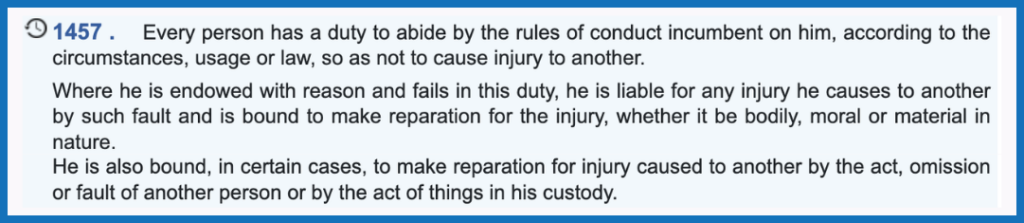
Article 1457 of the CCQ states that every person has a duty to follow rules of conduct so as not to cause injury to another. This duty extends to the municipality who, for the purpose of law, is classified as an independent person. In practice, this means that the municipality can be held liable for taking any action (including updating a zoning by-law) that causes injury to another and, that the municipality will need to pay compensation to the person who they injure by their actions.
All claims against a municipality must begin by identifying the legal basis of the claim — in other words, how the municipality acted unlawfully or committed a civil fault. For example, the city may make a procedural error when changing a by-law, resulting in a regulation being adopted without giving you proper notice or an opportunity to be heard. Other common grounds for challenging municipal actions include disguised expropriation, abuse of regulatory power, bad faith, or negligence causing damages.
It is also important to remember that municipalities can also infringe on federal jurisdiction. For instance, telecommunications services, postal services, defence, nuclear energy, shipping, fishing, banks, criminal law, prisons, agriculture, and immigration all fall under the remit of federal law. In this case, the basis of claim will be with regard to a federal infraction.
Note
Determine remedy and procedure
Once you have established the legal basis of your claim, the next step is to determine the appropriate remedy and procedure. In Quebec, municipal decisions can be challenged before the courts through an application for judicial review or an action seeking annulment of an unlawful by-law or administrative decision.
Annulment
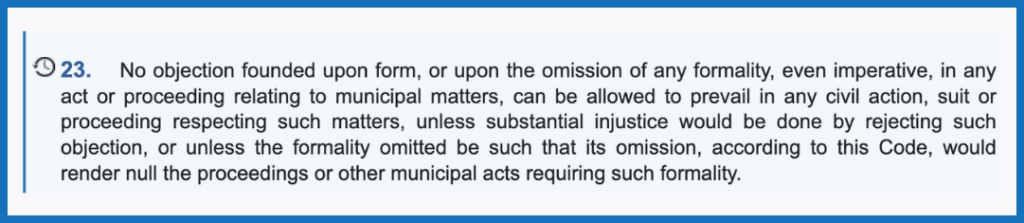
Annulment seeks to reverse any actions of the municipality, and in some cases to obtain compensation for the prejudice caused. However, Article 23 of the CCQ sets the bar for annulment to be very high in that if the court were to reject the claim the court would cause “substantial injustice” to be done. In other words, if the municipality made a procedural mistake (for example, failing to follow a formal step perfectly), the court will not annul the decision unless the mistake actually harmed someone in a meaningful way.
**WARNING**
Judicial review
Judicial review is a legal process where a court examines whether a decision made by a government body, such as a municipality, was lawful, reasonable, and made within its legal authority. Importantly, the court will not consider if the decision by the municipality is a good idea or not. Instead, they will focus on if the municipality respected the law. As such, the court will consider things like: Did the municipality misunderstand the zoning by-law? Has the municipality implemented the zoning by-law correctly? If the court finds that the municipality is at fault, they will normally amend the municipalities decision to bring it in line with the law.
**WARNING**
Frequently asked questions
What are the main urban zoning categories in Quebec
Zoning categories are the basic land-use classifications used by municipalities. These categories determine what types of activities are permitted on a property, such as housing, retail, industry, or public services. These categories differ depending on the municipality, since zoning by-laws are adopted locally. However, most municipalities in Quebec use broadly similar categories such as the following:
R – Residential Zone
Residential zones are areas where the primary permitted use is housing. These zones typically allow buildings such as:
- Single-family homes (detached houses, semi-detached houses, townhouses etc.)
- Plexes (duplexes, triplexes, etc.)
- Apartment buildings or condominiums
Municipal zoning by-laws may further divide residential zones into subcategories (for example low-density or high-density housing).
C – Commercial Zone
Commercial zones permit business and retail activities. These areas are intended for economic activity accessible to the public. Typical uses include:
- Shops and retail stores
- Restaurants and cafés
- Offices and professional services
- Hotels and entertainment venues
Some municipalities also distinguish between local commercial areas and major commercial corridors.
I – Industrial Zone
Industrial zones are intended for manufacturing, processing, logistics, and other industrial activities. Typical uses may include:
- Factories and manufacturing plants
- Warehouses and distribution centres
- Workshops and repair facilities
- Transportation or logistics operations
Industrial zones are often located away from residential areas to reduce noise, pollution, or heavy traffic impacts.
P or I – Institutional Zone
Institutional zones are used for public or community institutions that provide services to the public. Typical uses include:
- Schools and universities
- Hospitals and healthcare facilities
- Government buildings
- Libraries, cultural centres, and places of worship
The specific letter used varies by municipality (often P for “public” or I for “institutional”).
MU – Mixed Use Zone
Mixed-use zones allow multiple types of uses within the same area, and sometimes within the same building. Typical examples include:
- Retail or restaurants on the ground floor
- Offices or residential apartments above
- Developments combining residential, commercial, and sometimes institutional uses
These zones are common in downtowns and transit corridors, where municipalities aim to create dense, walkable neighbourhoods.
What is an agricultural zone (green zone) in Quebec?
Agricultural zones (or “green zones”) were created in 1978 by the Act respecting the preservation of agricultural land and agricultural activities. This law identifies certain land as having high agricultural potential and, has officially designated it as protected agricultural territory. The law puts this land under the protection of the Commission de protection du territoire agricole du Québec (CPTAQ), a provincial body that controls how land in the agricultural zone can be used.
Municipalities cannot freely rezone this land. Any non-agricultural use usually requires approval from the CPTAQ.
Where to find zoning information and interactive maps?
Zoning information in Montreal is published through official zoning by-laws and planning maps maintained by each municipality. Many cities also provide interactive GIS maps (Geographical Information Systems) that allow you to search an address and visualize zoning rules directly on a map.
You can find this information in one of two places.
- City of Montreal Website
For properties located in boroughs e.g. Outremont, Ville-Marie, Verdun etc. that are part of the City of Montreal, zoning maps and planning information can be accessed through the city’s online tools. Interactive GIS map. - Municipality Websites
Some municipalities on the island reconstituted themselves after the municipal mergers and maintain their own zoning by-laws and planning maps. If a property is located in one of these municipalities, zoning information must be consulted on the municipality’s own website. Examples include:
Westmount – Interactive GIS map
Pointe-Claire – Zoning Map PDF
Beaconsfield – Zoning Map PDF
Dorval – Zoning Map Annexed to By-Laws
Kirkland – Zoning Map in By-Laws
Dollard-des-Ormeaux – Zoning By-Laws
Côte-Saint-Luc – Zoning By-Laws
Baie-D’Urfé – Zoning By-Laws
Hampstead – Zoning By-Laws
Mont-Royal – Zoning By-Laws
Sainte-Anne-de-Bellevue – Zoning By-Laws
Senneville – Zoning By-Laws
Montréal-Est – Zoning By-Laws
What are setbacks?
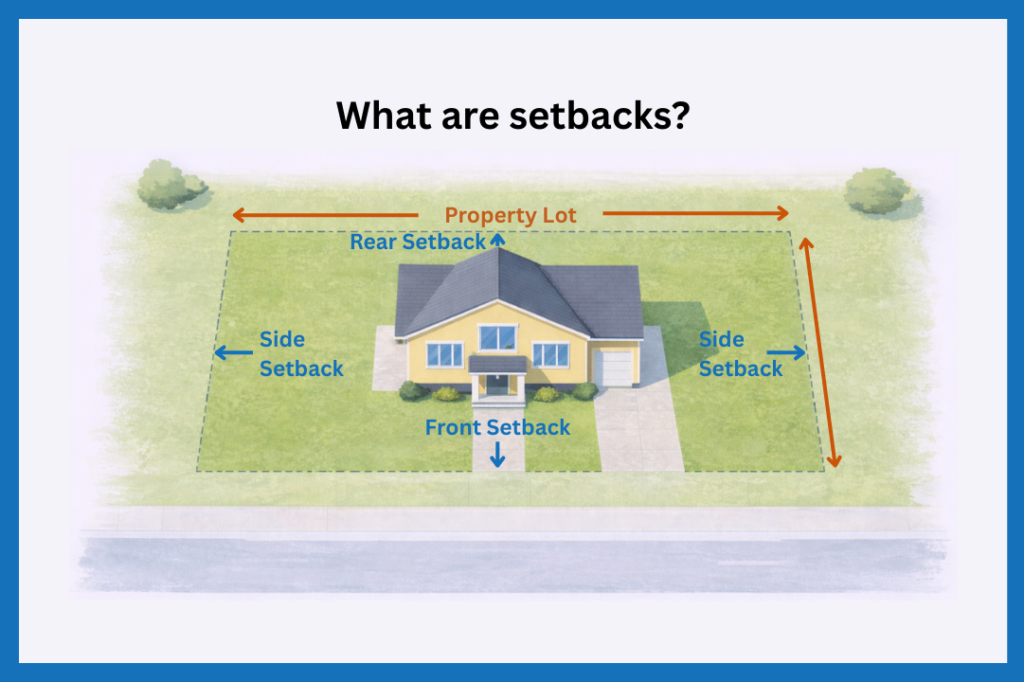
Setbacks are the minimum distance a building must be placed from the boundaries of a property lot. There are several different types of setbacks such as front, rear, side and corner setbacks.
Will I end up on black list if I appeal a zoning decision?
Before you speak with a municipality or borough about their zoning decision, make sure that you have done your research. Be polite and respectful and, if you are all of these things, then there is no reason for them to put you on a “black list”. These are professionals who are paid to do a job and, the municipality is required to stick to the law. If you are unsure of how best to proceed, it is a good idea to try first to understand your basis of claim and, then contact a lawyer who would be able to help you further.
Final remarks
Zoning laws shape how every neighbourhood develops and what property owners are allowed to do with their land. Because these rules are set by municipalities and can change over time, they are often complex and sometimes difficult for property owners to navigate.
Most of the time, zoning rules work as intended in that they help cities grow in a safe, organized, and compatible way. But disputes can arise when a property owner unknowingly violates a by-law, when a rule is interpreted incorrectly, or when a municipality adopts or applies regulations improperly.
For this reason, it is important for property owners to understand the zoning rules that apply to their property before beginning construction, renovations, or changes of use. Checking the zoning code, reviewing overlays, and confirming permitted uses can prevent costly surprises later.