

In Quebec, the deed of sale is the official legal document that transfers ownership of a property from the seller to the buyer.
It is the last step in the transaction, signed by both parties and officially transferring the property to the buyer. While it may seem like just a formality, the deed actually contains key details about the property, the rights you’re buying, and important obligations. In this article, we’ll explain:
- What actually is the deed of sale?
- What does the deed of sale include?
- Who prepares the deed of sale? The role of the notary
- When is the deed of sale signed?
- How the deed of sale connects to your property title
What is the deed of sale?
In Quebec, the deed of sale is the final legal document that officially transfers ownership of a property from the seller to the buyer.
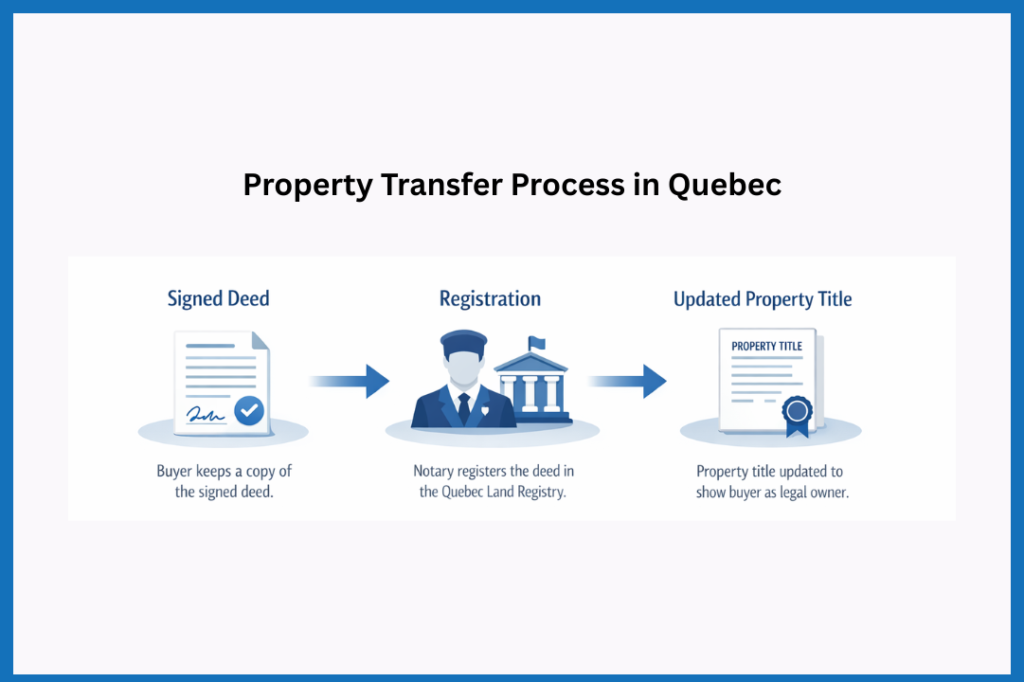
Whilst the seller transfers ownership to the buyer as soon as they sign the deed, the notary is responsible for updating the official public records. The notary submits the deed to the Quebec land registry, which updates the property title to reflect the new owner, officially recording the transfer in the public records.
What does the deed of sale include?
The deed of sale formalizes exactly what the parties agreed upon when they accepted the promise to purchase. It includes the following key details:
- Identification of the seller, the buyer and their address.
- A description of the immovable, this includes the cadastral number and the address.
- The sale price and payment terms.
- A history of the sellers ownership rights.
- The land transfer tax (“welcome tax”).
- Declaration of delivery and possession date.
- The signatures of both parties, in front of the designated notary.
Who prepares the deed of sale? The role of the notary
The notary drafts the deed of sale as a custom notarial act. In Quebec, it is mandatory to use a notary for the deed of sale.
The notary is responsible for guaranteeing the legal validity of the transaction. To do this they will request a list of documents from the buyer and seller, and will do their own research to:
- Verify the property title (check the seller legally owns what they’re selling)
- Confirm that no hidden debts or legal defects (like unpaid taxes, hypothecs, servitudes or rights of way)
- Draft, execute and register the deed with the Quebec Land Registry
- Protect both parties’ rights, especially around ownership transfer, payment and legal capacity.
Either the buyer, the seller or the Chambre des notaires du Quebec can hold a notary professionally liable if they make an error or omission in performing their legal duties. However, the notary is responsible only for the accuracy of the deed of sale. They are not responsible for any of the commercials in the deed itself. For example, if the buyer overpays or does not do an inspection, the notary is not responsible.
When is the deed of sale signed?
The buyer and seller sign the deed of sale at the end of the transaction (on closing day). The flow chart below shows the typical stages in the transaction.
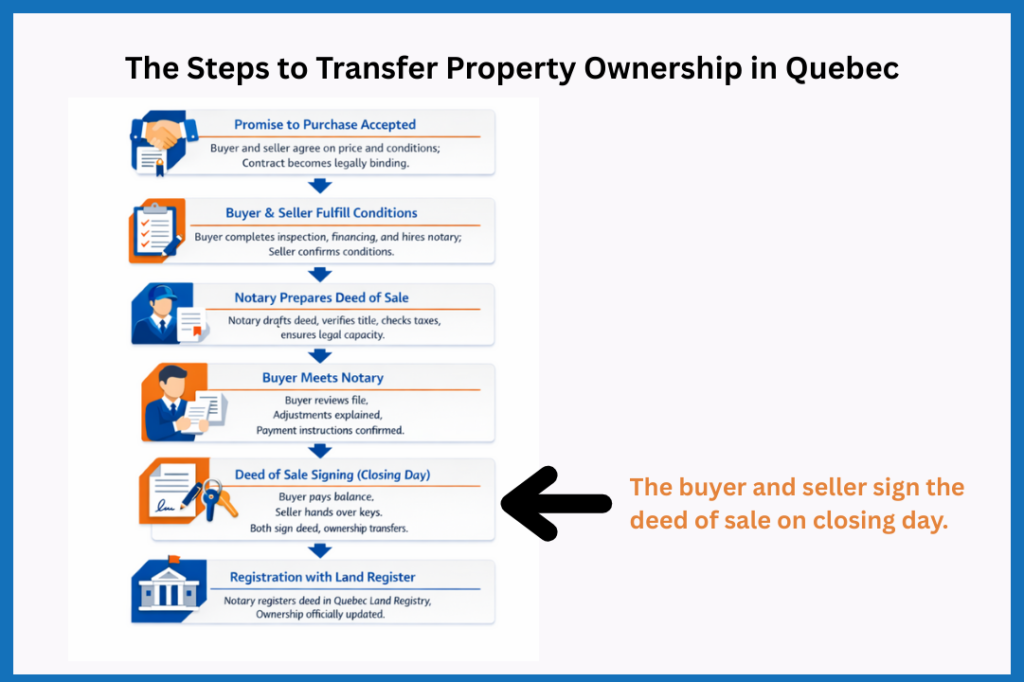
As you can see, the steps include:
1. Promise to Purchase accepted – The buyer and seller agree on the price and conditions of the sale. At this stage, the promise to purchase becomes a legally binding contract, subject to any conditions listed (like financing or inspection).
2. Buyer and Seller fulfill their conditions – The buyer completes all required steps to fulfill the conditions of the such as the inspection, financing approval and hire a notary. After the buyer completes the conditions and the seller confirms them, they move forward to close the transaction.
3. The notary prepares the deed of sale – Once the buyer and seller fulfill all conditions, the notary receives the file, drafts the deed of sale, and prepares the final documents needed to complete the transaction. The notary verifies the property title, checks for unpaid taxes or legal defects, and confirms that both parties have legal capacity to sign.
4. Buyer meets with the notary – Before closing day, the buyer meets with the notary to review the file and ensure all details are in order. At this meeting, the notary will:
- Explain the adjustments (taxes, condo fees, notary disbursements, etc.).
- Confirm the payment instructions.
- The notary provides the buyer with the trust account details, often using a void cheque, so the buyer can transfer the down payment from their bank.
It’s very common for the buyer to visit their bank immediately after this meeting to authorize the transfer.
5. Deed of sale signing (closing day) – The buyer, seller, and notary meet in person (or sometimes virtually). Both parties sign the deed of sale before the notary.
6. Registration with the Land Register – After the signing, the notary registers the deed of sale in the Quebec Land Register. This step makes the transfer of ownership public and legally official. The notary will pay the seller and distribute any remaining funds, such as adjustments, realtor commissions and any other fees, according to the transaction.
Note
Which is more important, the title or deed?
In Quebec, buyers and sellers often confuse the role of the property title with that of the deed of sale.
Whilst the deed of sale is the legal contract that transfers ownership from the seller to the buyer, the property title is the legal proof that the buyer now owns the property. Put another way, the deed is like the receipt for a car you buy, whereas the title is the car’s official registration that proves you own it. The Land Register creates the title when the notary registers the deed.
If the buyer loses the deed of sale, they can request a duplicate or certified copy from the local land registry. Losing the original does not void the sale, as long as the notary correctly updates the land registry. This registration is crucial because it allows the Land Registry to create the property title, officially recognizing the buyer as the legal owner.
Frequently asked questions
Tip: On closing day everything happens really quickly and there is no time to review documents properly. You should ask the notary to send you a copy of the deed before closing day, read it carefully in advance and clarify adjustments, conditions, or special agreements with your notary ahead of time.
– If the notary fails to register the deed correctly, or misses legal steps, you can hold them accountable.
– The notary’s professional liability insurance usually covers such mistakes.
Tip: Notaries do can make mistakes so, it is important to choose one that is experienced and has good reviews. You must also verify that your deed is correctly drafted and check the Land Registry after registration. Do not just rely on notary’s word to get you through one of the largest transactions in your life.
– The notary’s submission speed
– The Land Registry’s workload
– Any complexities with the property (e.g., liens, easements, or corrections)
Once the title is updated, you can confirm ownership online using your cadastral number. This number is shown on your deed of sale.
Tip: Keep a copy of the registered deed and check the Land Registry to ensure your name appears as the legal owner.
Final remarks
Once the notary registers the deed of sale, they send the buyer an official copy, either digitally as a PDF with a notarial seal or in paper form.
The deed of sale is more than just paperwork, it’s the bridge between promise to purchase and property ownership. For this reason, the buyer should keep the deed safe and verify that the notary has registered it correctly. This ensures that the buyer has lasting proof of ownership for mortgages, renovations and resale.
Many buyers will store physical copies in a dry place such as a fire-proof home safe or safety-deposit box. For digital copies, the buyer should organize the documents into a secure cloud folder (Google Drive, Dropbox, etc.) and clearly label it (e.g., ‘Deed of Sale – [Address] – [Year]’).
Lastly, it is definitely worth verifying that the Land Registery has correctly updated your property title. This will allow you to order a replacement deed of sale, should anything go wrong. You may also want to consider title insurance, since cases of fraud or errors in property titles are on the rise. Title insurance can protect you from financial loss if someone challenges your ownership or a mistake occurs in the Land Registry.