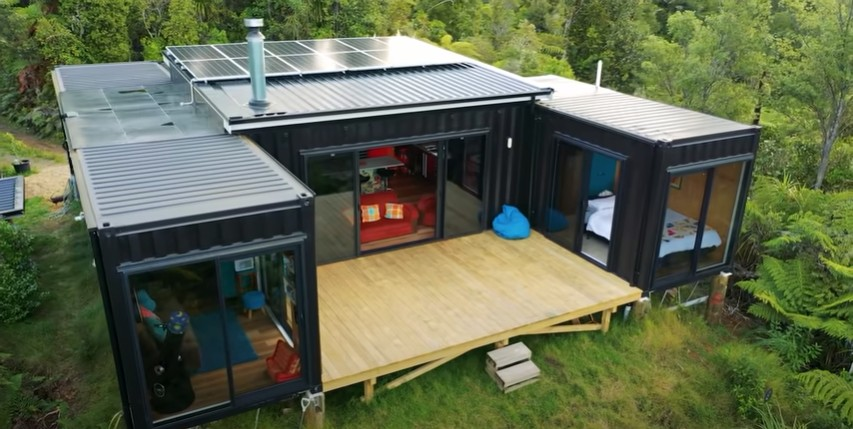

For a growing number of people in Quebec, container homes aren’t a trend. They’re a strategy: buy affordable land, build small and efficient structures, and turn that land into either a primary residence, a rental property, or a small hospitality business surrounded by Quebec’s green forests and mountains.
The idea has gained traction quickly. Installations of container-based housing in Quebec increased by more than 160% between 2020 and 2023, as more people discovered containers as a way to turn raw land into a livable and sometimes income-producing property. And, in many cases, it is possible realize this dream for less than a downpayment on a condo.
But the container itself is often the easy part. The real complexity lies in zoning laws, permits, utilities, engineering, and delivery logistics. These details can quickly derail a project if they’re not understood early.
In this article, we break down what you need to know, so that you can know if this strategy is the right for you. Specifically we will cover:
- What is a container home?
- How much does it cost to build a container home?
- The steps to build a container home
- How long does it take to build a container home?
- What are the costs of running a container home?
- Where can I build a container home in Quebec?
- Popular places to build a container home in Quebec
- Pros and cons of container homes
- Container home ideas
- Frequently asked questions
- Final remarks
 Immovision
From Dream to Reality
Step-by-step training + budget planning video included.
What is a container home?
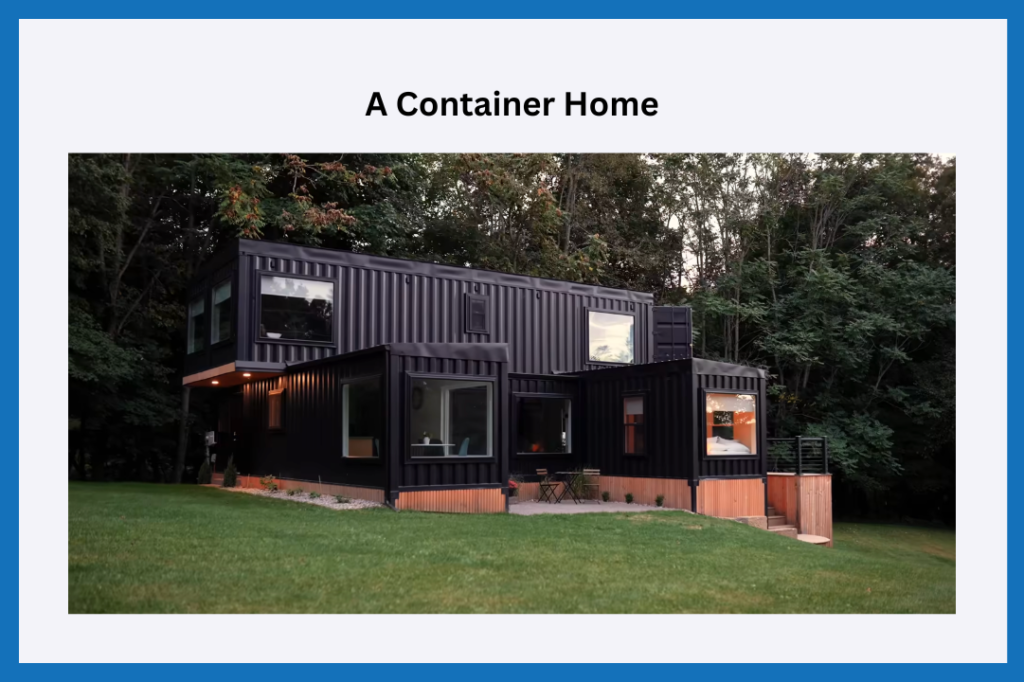
A container home is a home that is built out of a shipping containers. Essentially, the way that this works is that you stack one, or multiple shipping containers on top of a concrete foundation, frame the interior of the container, cut out windows and doors, add plumbing and electricity and decorate inside the container.
Although shipping container homes are often presented as a low cost housing solution. The argument is that shipping containers are cheap, and easy to stack. However, the reality is a more nuanced than this simple idea. To find out more, read how much does it cost to build a container home.
How much does it cost to build a container home?
In Canada, shipping container homes tend to cost more than in many other countries because of insulation requirements, labour costs, and building code compliance. Below are some examples of costs that you may expect to incur.
| Container Home Type | Typical Size | Average Cost (CAD) | Description |
|---|---|---|---|
| Single Container Home | 20–40 ft (160–320 sq ft) | $60,000 – $90,000 | Studio-style living space often used for cabins, guest houses, or ADUs. |
| Two Container Home | 400–600 sq ft | $120,000 – $160,000 | Small home layout with room for 1–2 bedrooms and a separate living area. |
| Three Container Home | 700–1,000 sq ft | $150,000 – $250,000+ | Larger residential layout suitable for small families with multiple rooms. |
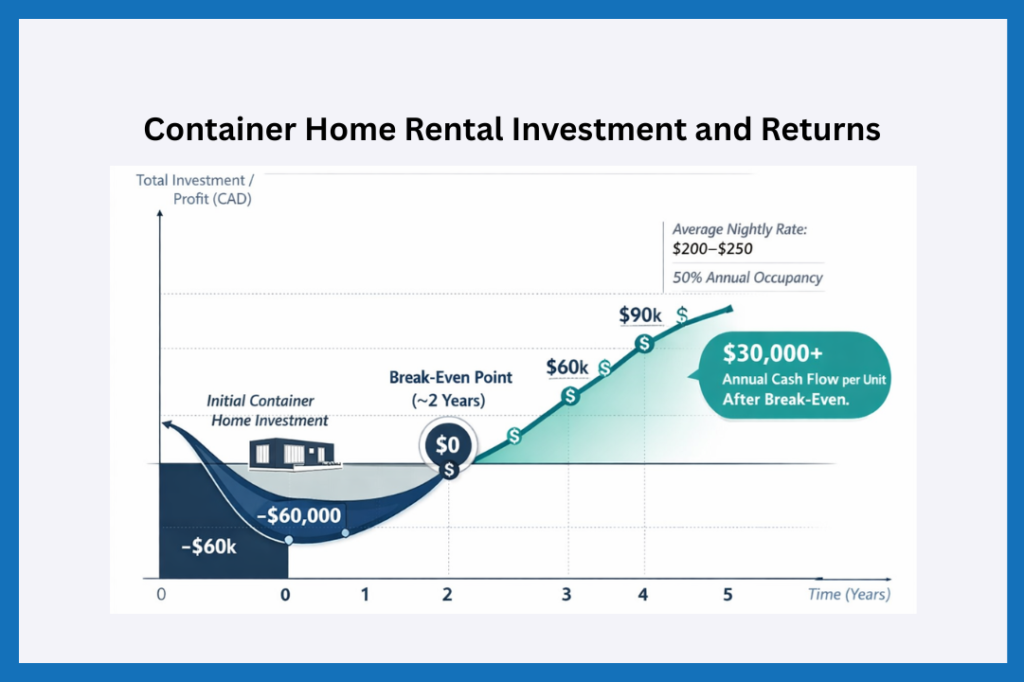
These properties are especially popular with young property investors because, relative to building apartments or single-family homes, of they offer a relatively low cost to build and relatively high short term rent.
The typical short term rent on these homes is around $200 – $250 per night on a single container home. If we assume only 50% occupancy, this is still between $36,500 – $45,625 per year. This means that with a investment of as little as $60,000, you can technically make your money back within 2 years, after which you will be able to enjoy regular cash flow of more than $30,000 per year. From this point, it easy to see a path from $30,000 per year with one unit, to $60,000 per year with two units and so on.
** IMPORTANT **
The steps to build a shipping container home?
Unless you are a licenced builder, designer, architect and real-estate agent, it is unlikely that you will be able to do all of this yourself. However, your role will be to finance and oversee the project. As such, you will need to have a clear idea of some of the architectural, design, and material choices since, there are different risks and returns associated with each decision you make. The main parts of the project that you will need to oversee are:
- Project planning and design
- Permit application process
- Prepare the site and install the foundation
- Prepare and treat the shipping container
- Position and Secure the Containers
- Frame the Interior Structure
- Install Insulation and Wall Systems
- Install Plumbing Systems
- Install Electrical Systems
- Install Fixtures, Doors, and Finishes
- Interior Finishing and Decoration
Immovision
Find your team
From our experience, on construction projects, it is best to build a team on projects like this.
How long does it take to build a container home?
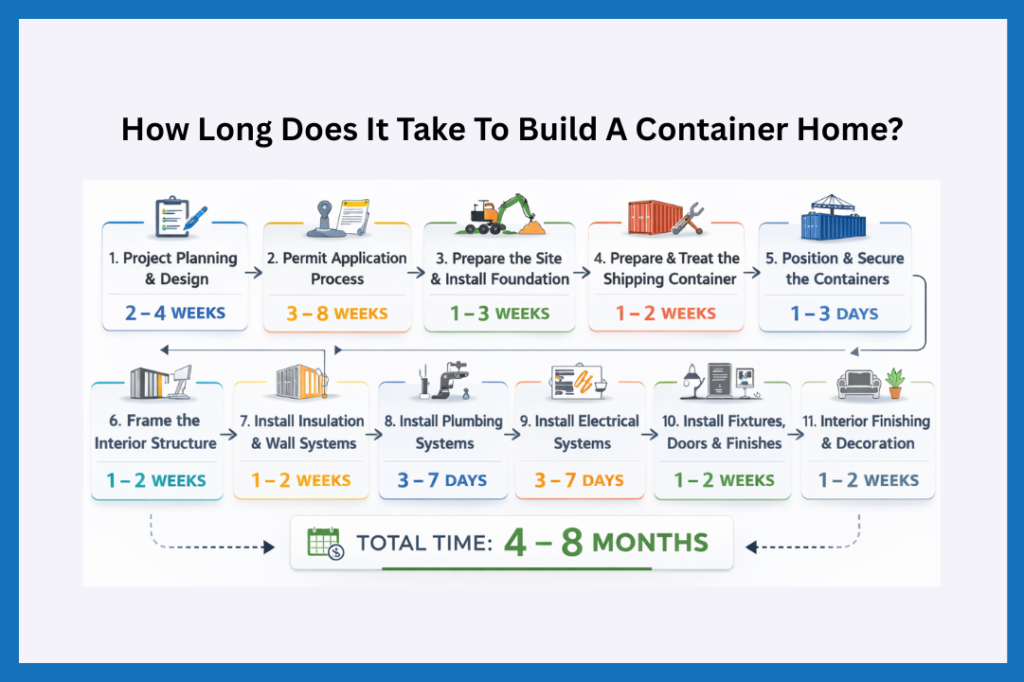
The time that it takes to build a container home depends on several factors including project design complexity, zoning laws, weather conditions, site location and so on. In the best-case scenario, construction may be completed in as little as 4–6 weeks. However, traditional on-site container home construction typically takes 4–8 months.
During this time you will need to be involved on daily or weekly site visits to ensure that the development is going according to plan. This is especially important if it is your first build with a new team.
Note
What are the costs of running a container home?
The cost of running a container home can be lower than traditional brick and mortar homes. For instance, you will often read studies that suggest that the energy efficiency is superior in container homes. However, in reality the cost will depend on exactly how the property is built, the types of insulation used, the environment that you are building in and the use case of your home. A property that is lived in full time has different running costs compared to a vacation home that is only occupied periodically.
Below are a list of costs that you should consider when planning:
| Type of Expense |
|---|
| Property Tax |
| Home Insurance |
| Electricity / Heating |
| Water and Sewage |
| Internet (Wi-Fi) |
| Property Maintenance |
| Exterior Upkeep (painting or rust protection) |
| Snow Removal and Landscaping |
Note
Where can I build a container home in Quebec?
There is no single city or region in Quebec that universally allows or prohibits container homes. Whether you can build one depends on the zoning by-laws of the municipality where the property is located. These by-laws regulate how land can be used and determine the types of buildings permitted in a given area, such as residential, commercial, or industrial uses. They also establish rules regarding building size, lot coverage, height, setbacks, and any applicable heritage or environmental restrictions.
Because zoning rules vary from one municipality to another, it is important to review the zoning by-laws that apply to the specific property before purchasing land or beginning construction.
At this stage, it is often advisable to conduct a preliminary feasibility study with a professional, such as an architect or designer. This study can help determine whether the land you are considering can realistically support your project by reviewing zoning regulations, site conditions, and other applicable restrictions. Doing this before purchasing the land is important because if the project later proves impossible under local regulations, you may be left with property that cannot be used as intended.
Once you have identified a suitable property and confirmed that your project is feasible, you can proceed with purchasing the land. Before construction can begin, you must submit a building permit application to the municipality. The municipality will review your plans to ensure that the proposed container home complies with the Quebec Construction Code and all applicable local regulations.
Popular places to build container homes in Quebec
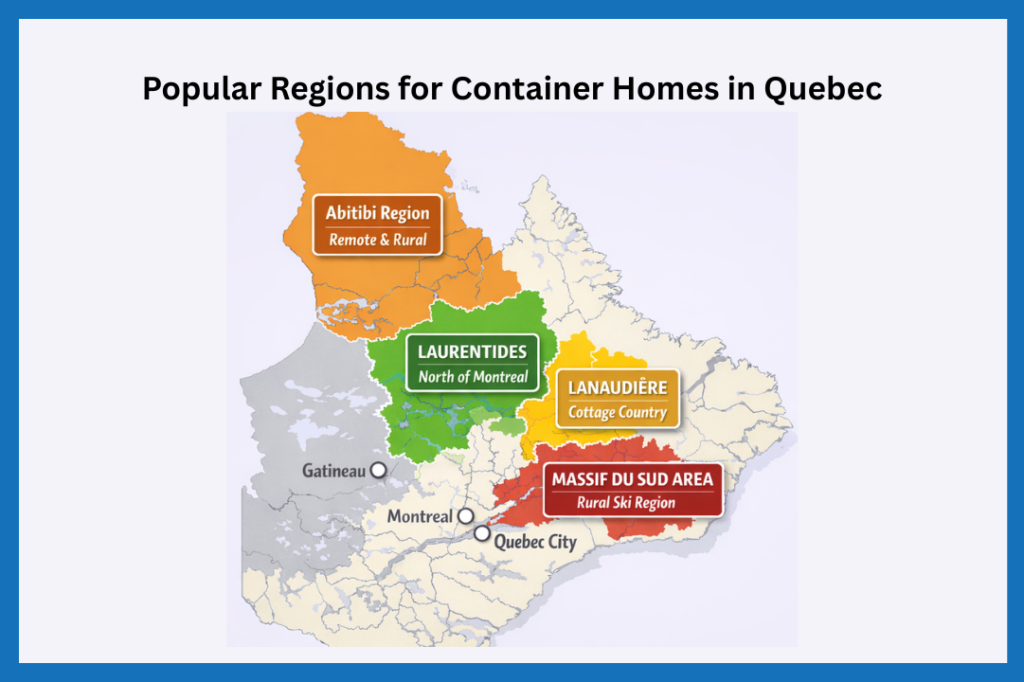
In Quebec, container homes are not concentrated in specific “container-home cities.” Instead, they tend to appear in rural, forested, or recreational regions where land is cheaper and zoning is less restrictive. Typically these are marketed as short term rental properties for tourists who want to ***. Through our research, we found out that the following areas show up most frequently:
- Laurentides (north of Montreal)
- Lanaudière / Laurentian cottage country
- Rural ski regions (Massif du Sud, etc.)
- Remote regions like Abitibi
Pros and cons of container homes?
Public sentiment on container homes is mixed. On one hand, you’ll find skeptics who believe these homes are impractical or too experimental. On the other, there are optimistic realists who see them as a fast, flexible, and cost-effective housing solution. In this section, we provide an unbiased overview of the real pros and cons.
| Pros | Cons |
|---|---|
| Low cost | Hard to stack |
| Fast build | Thermal challenges |
| Modular | Reinforcement required |
| Unique design | Niche resale market |
| Eco-friendly | Insulation & ventilation needed |
| Off-grid potential | Contractors scarce |
Upfront cost
As we’ve already seen, buying land and building a container home can be significantly cheaper than purchasing a traditional brick-and-mortar house. A large part of this cost advantage comes from the location: many container homes are built as off-grid retreats, wilderness getaways, or short-term eco-friendly rental properties, where land is more affordable. However, the cost savings are also driven by the structure itself.
Containers can be bought for as little as $1000 and do not normally exceed $5000. This is far cheaper than framing a house. That said, there are some features that can cause costs to jump up. For instance, once you start to cross-stack units, expenses increase significantly: containers weren’t designed as permanent multi-level homes, so additional structural reinforcement are required. Municipal approvals and inspections for multi-level designs can also add time and budget. Lastly, even if you do not cross stack units, you will still need to lay a proper concrete foundation to safely support the containers. This in and of itself is an expensive task.
Time to build
Whilst it typically takes 6–12 months to build a traditional brick-and-mortar house, a container home of equivalent size can often be completed in 2–3 months. Much of the time savings come from the fact that shipping containers are pre-fabricated structural units, eliminating large portions of the framing and masonry work required in conventional construction. Containers can also be modified off-site while the foundation is being prepared, allowing different parts of the project to progress in parallel.
That said, container homes still require structural reinforcement once containers are cut and stacked, which can slow the process somewhat. Even so, the overall construction timeline is typically significantly shorter than a traditional build.
Re-sale value
Resale value is a crucial consideration for buyers who may sell their property in the future. Traditional brick-and-mortar homes in Quebec have historically appreciated at an average rate of 3–5% per year, though this varies depending on location, construction quality, and market conditions.
Container homes, on the other hand, tend to appreciate slightly more slowly, at roughly 2–4% per year. However, their lower upfront cost often allows buyers to achieve a return on investment within 5–10 years, compared to traditional homes, which typically require a longer period to recoup initial expenses.
The value of traditional homes is largely tied to their broad market acceptance and perceived permanence in the housing market. Container homes derive value differently: buyers are often drawn to their unique design, high-end features, and sustainability credentials. This makes them especially appealing to a niche market willing to pay a premium for a one-of-a-kind home.
Eco-friendly construction
A study from the University of Calgary shows that if you use a shipping container, instead of re-cycling it or re-manufacturing it, you will save about 46 t CO₂‑eq (or carbon). This is because reusing steel containers avoids the huge energy cost of melting and remaking steel. However, the same study shows that when comparing shipping container homes with with traditional homes over a 50 year lifespan, the total environmental impacts of the container and traditional light‑wood homes differed by only about 3 %.
This means that the way the container home is built vs a traditional home is a big driver of long‑term impact. As such, you should consider things like insulation, energy performance, and how the home will be used.
Finding trade partners
One major downside of container homes is that it can be difficult to find trade partners who are familiar with this type of construction. Although interest in container homes is growing in Quebec, many builders and contractors still have limited experience working with modified shipping containers. For this reason, it is important to work with professionals who understand the structural and regulatory requirements.
In addition to this, you should look for architects licensed by the Ordre des architectes du Québec (OAQ), engineers registered with the Ordre des ingénieurs du Québec (OIQ), and contractors holding a valid RBQ licence.
Note
If this is your first build, good construction companies will be checking up on your credentials as much as you are checking them. If you fail to pay them, they can take out a hypothetic of construction against your property which gives them the rights to sell the property to reclaim on their debt.
Heat Transfer and Ventilation
One of the main technical challenges with container homes is heat transfer through the steel structure. Steel is highly conductive, meaning it passes heat and cold very quickly compared to traditional building materials like wood framing or brick.
In Quebec’s climate, this can create two issues. In winter, heat from inside the home can escape quickly through the steel walls if the home is not properly insulated. In summer, the steel shell can absorb heat from the sun and transfer it inside, causing the interior to warm up rapidly.
Because of this, container homes usually require high-quality insulation systems and good ventilation design to regulate indoor temperatures. Builders often install spray foam insulation, thermal breaks, and mechanical ventilation systems to reduce condensation and maintain comfortable air quality inside the home.
Without these systems, container homes can experience temperature swings, moisture buildup, and condensation on interior surfaces, particularly during cold Quebec winters.
Modular and stackable
There is a common myth that container homes can simply be stacked like Lego blocks. In reality, the process is far more complex. Once openings are cut for windows, doors, and interior spaces, the structural strength of the container changes and additional reinforcement is often required. For this reason, architects and engineers typically need to design the stacking and supports carefully rather than simply placing containers on top of one another.
Container home ideas
To get an idea of what you can build, where, and what the estimated costs are, take a look at the following projects in Quebec.
1. Claudie Dubreuil Container House (Sainte-Adèle, Quebec)
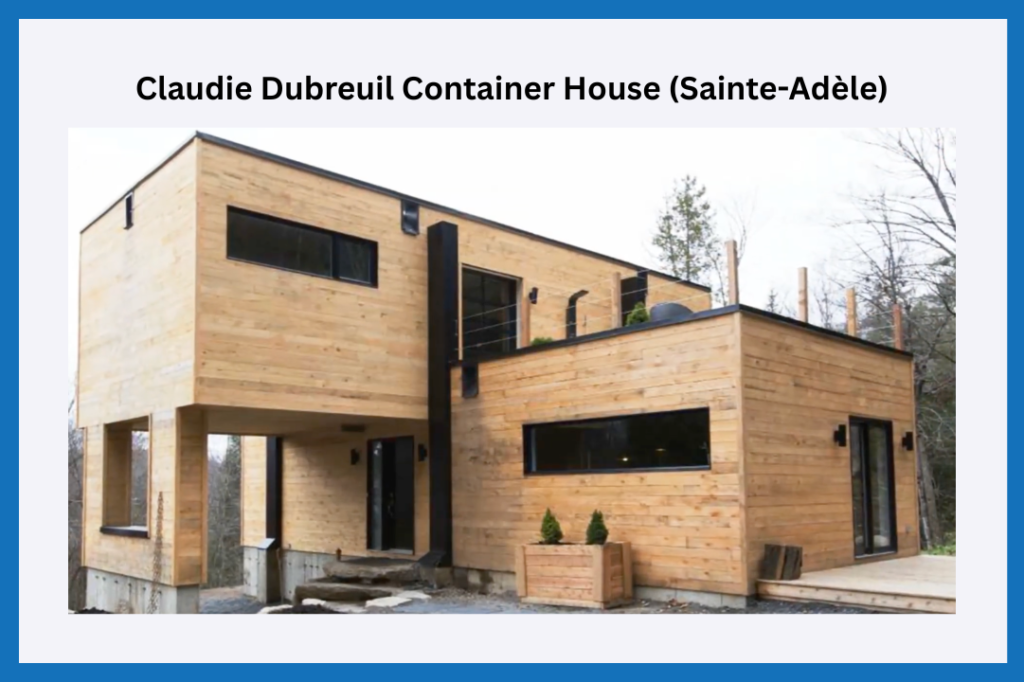
The home is constructed from four 40-foot shipping containers, creating approximately 178 m² of living space. Two containers are placed on each floor, with the upper containers cross-cut and cantilevered toward the front to form a covered entrance porch.
The structure rests on a concrete foundation that also serves as the basement floor. Externally, the house is clad in unstained Eastern Hemlock, giving it a natural appearance that conceals its container-based construction.
Total cost: $330,000 CAD (including the lot, excavation, labour and materials).
2. Bernard Morin Container House (Sainte-Adèle, Quebec)
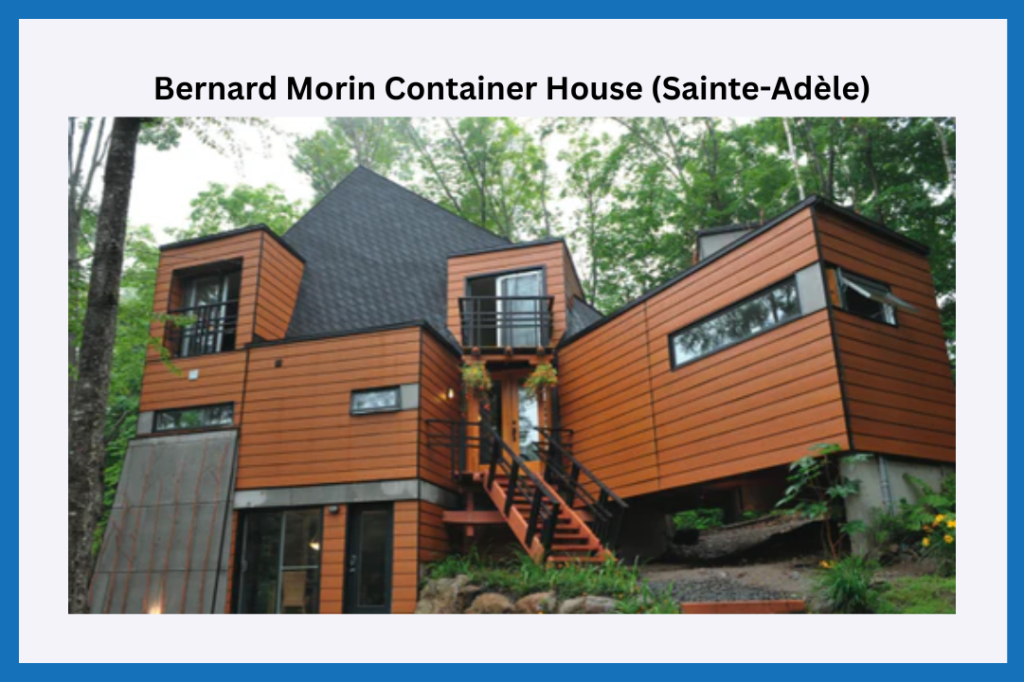
This contemporary home in St-Adèle, Quebec is constructed using seven ISO shipping containers, creating approximately 3,000 sq ft of living space across multiple levels.
The containers are arranged to respond to the sloped site, forming cantilevered sections, balconies, and large openings that frame views of the surrounding forest. The structure sits on a concrete foundation and is finished with continuous external insulation and timber cladding, improving energy performance while giving the home a warm, natural appearance that conceals its container-based construction.
Total cost: ~$600,000 CAD (including the lot, excavation, labour and materials).
3. Columbus Container Chalet (Laurentians)
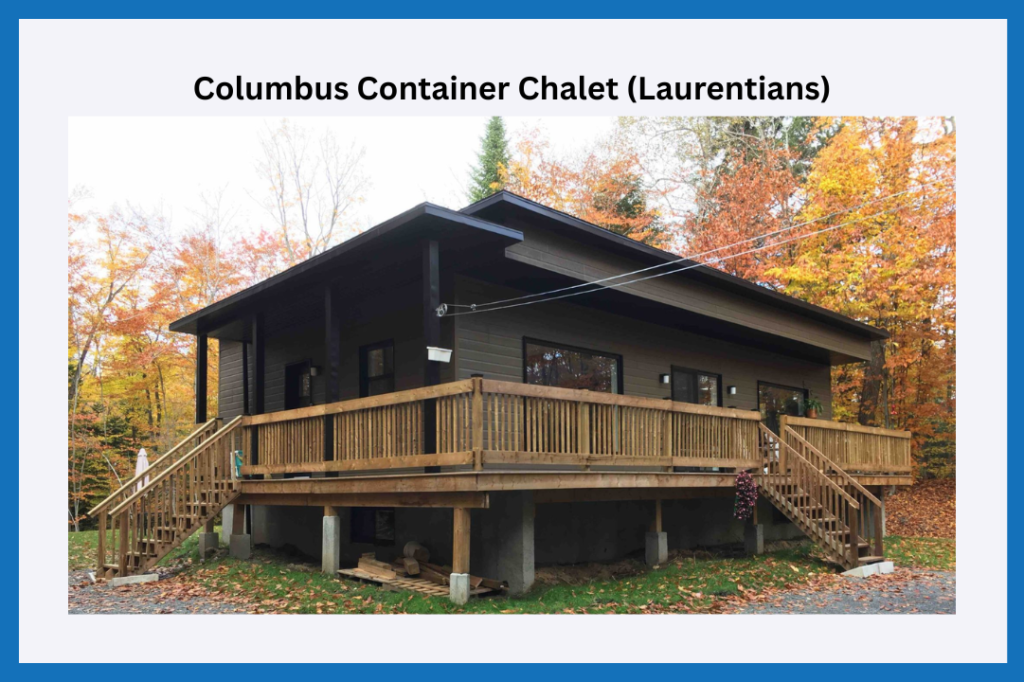
This contemporary chalet in Saint‑Hippolyte, Quebec is constructed using three recycled 40‑foot shipping containers, creating approximately 960 sq ft of living space with efficient and open floor planning.
The containers are placed side by side on a raised concrete foundation, forming a spacious living area and with bedrooms in the basement. The shipping containers have generaous openings in the side of them, fitted with large glass windows that bring a lot of natural light into the interior, while framing views of the surrounding forest.
Inside, thoughtful insulation and high‑quality windows ensure year‑round comfort in the Laurentians, and the use of timber and other natural finishes adds warmth that balances the industrial character of the container structure.
Total cost: ~$175,000 CAD (significantly less than a comparable conventional chalet build).
4. Evolution Architecture Container House
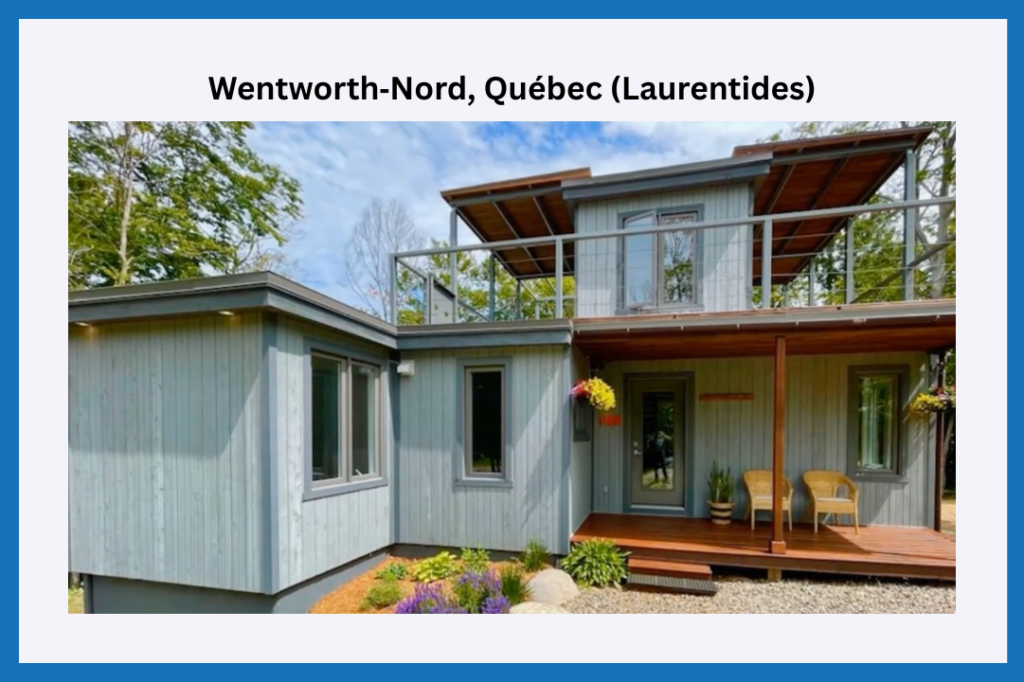
This modern home in Wentworth‑Nord, Québec is built using five recycled shipping containers, creating approximately 1,200 sq ft of living space designed for comfortable year‑round habitation.
The containers are arranged to maximize open-plan living, with generous window openings that allow natural light to flood the interior and frame views of the surrounding forested property. A wood‑burning stove, heated concrete floors, and high-performance insulation ensure comfort even in Québec’s cold winters.
Inside, natural finishes and exposed steel elements balance the industrial character of the container structure with a warm, contemporary aesthetic. The home includes two bedrooms and modern bathroom facilities, making it a functional primary residence rather than a secondary or tiny home.
Total cost: estimated ~$450,000 CAD (reflecting full installation, insulation, and finishing for a durable, energy-efficient family home).
5. Micro Container Houses (HighCube Models)
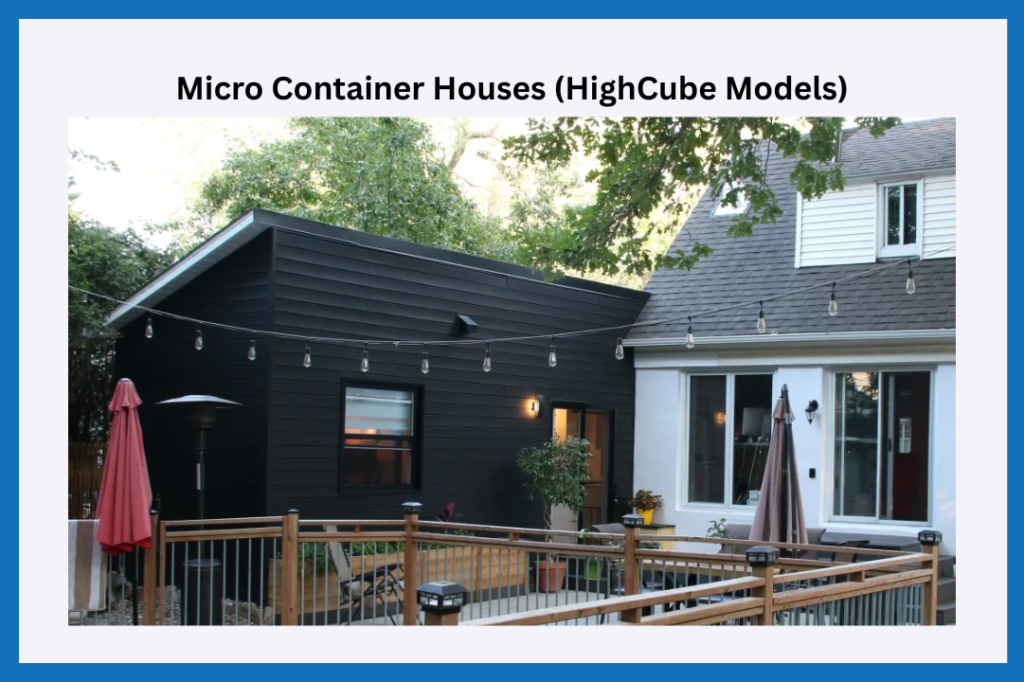
This is modern accessory dwelling in Québec. It is built from a single 40-foot shipping container, attached to an existing detached home to provide additional living space. The container module creates approximately 320 sq ft of functional interior, designed with an efficient layout that includes a small kitchenette, bathroom, and living area.
The container is clad in dark siding with generous openings fitted with frosted and clear glass windows, allowing natural light to fill the space while maintaining privacy from the main house and neighboring lots. The unit sits on a level concrete pad, with a small entry step and integrated decking that connects to the existing yard.
Estimated cost: ~$80,000–$100,000 CAD, depending on custom finishes and installation requirements.
Frequently asked questions
However, the property taxes on container homes are tend to be significantly lower than on traditional housing in downtown or urban areas. This is because property taxes are based on your properties assessed value. This is the value that the municipality sets for your land and property value. Because many container homes are built in rural regions, where land values are generally lower, assessed value is normally significantly lower.
If you don’t meet these requirements, alternative financing like personal loans, HELOCs, or private lenders may be necessary.
Final remarks
Container houses are growing in popularity because they let people in Quebec unlock land value, build quickly and affordably, and create unique homes or income-producing properties without the costs of a traditional house.
That being said, as with all construction projects, building a container house is complex and, you absolutely must choose the correct team if you are to budget correctly and get the project off the ground.