
As house prices and the cost of living rise faster than wages, more people are turning to semi-detached homes. These properties often provide the perfect middle ground between condos or townhouses and fully detached homes. In this article we look at some of the pros and cons of semi-detached houses, so that you can understand if it is the right type of house for you.
- What exactly is a semi-detached house?
- The advantages of owning a semi-detached house
- The disadvantages of owning a semi-detached house
- Which is better semi-detached vs detached house vs row house?
What is a semi-detached house?
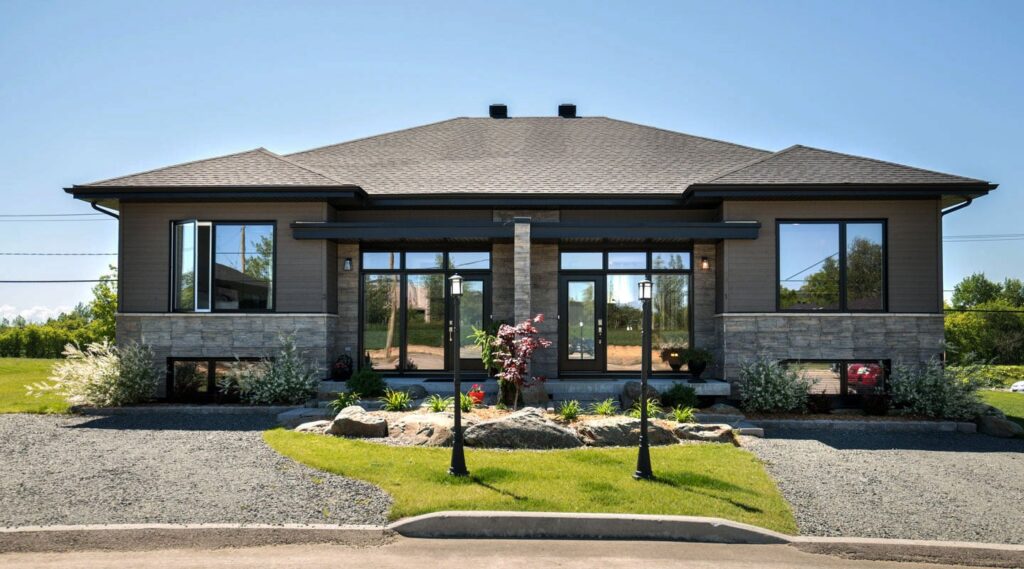
A semi-detached house is a single-family home that shares one common wall with another house. Each unit has its own entrance, yard, and utilities, but the shared wall connects you directly to your neighbour on one side.
In Canada, you typically own the land on which your semi‑detached house sits. This includes the right to use, modify, and enjoy the land, subject to local zoning and municipal regulations. In addition, you are solely responsible for the maintenance of the property. This is with the exception of the shared wall and roof.
The Civil Code of Quebec calls the shared wall that separates two buildings a “party wall.” The owners of the adjoining properties must share the maintenance, repair, and reconstruction of a party wall (or shared fence) proportionally. The full set of rules related to party walls is available on the Government of Quebec’s website.
The advantages of owning a semi-detached house
In this section we look at the advantages of owning a semi-detached house in Quebec.
Lower cost than a fully detached home
Semi-detached houses are usually cheaper to buy than a detached house.
Of course, the price depends on a range of factors however in general, semi-detached homes are ~10% – 15% lower than detached homes in the same neighbourhood. This makes semi-detached homes more affordable while still giving you many of the same advantages of a detached home. The lower price also means that buyers will also pay less land transfer tax and less property tax each year.
All that being said, it is worth noting that semi-detached homes cost less because they cost less to build and they use less land. This means that there is ultimately a greater supply of them and therefore a relatively lower demand. As such, when it comes time to sell semi-detached homes the re-sell value will be lower than a detached house. Again, this depends on the neighbourhood. For instance, some semi-detached homes in downtown Montreal, in neighbourhoods like Little Burgundy, are among the most in-demand properties in the city.
More space and privacy than a townhouse or condo
Semi-detached homes will generally offer more space than townhouses or condos. They often provide more living space, a private yard or outdoor area, and greater privacy. This makes them a very strong middle ground between compact urban dwellings and large detached homes.
In addition, while you share one wall, the other side of the house is completely separate. This provides more privacy than living in a townhouse or row house. It can also mean more windows which allows more natural light into the home compared with a townhouse or row house. And of course, even with a shared wall, you usually still get your own private yard or patio. This allows for gardening, entertaining, or family activities.
Lower maintenance costs than a detached house
It is generally cheaper to maintain a semi-detached house compared to a detached house. This is because the lot size tends to be smaller. This means that there will be lower expenses for exterior maintenance, landscaping, and repairs.
In addition, many semi-detached homeowners often choose to split the costs of common maintenance with their neighbour. This cans include things such as snow removal or hedge trimming. Research shows that sharing these expenses can reduce annual outdoor maintenance expenses by about 30 to 50%. These long-term savings provide significant financial relief for owners while also reducing the time spent on these tasks. Neighbours also split the cost of maintaince for the party wall. For example, if you have to replace or repair the roof, you are not required to shoulder the entire cost yourself.
The shared wall will also reduces heating and cooling costs since there are fewer external walls overall. On average, a semi-detached home can lower heating costs by 10 to 20% compared to a detached home. This increased energy efficiency is particularly advantageous in Quebec which (as we also know) has extremely cold winters.
More freedom than a condo
Unlike a condo, a semi-detached house has few, if any, shared common areas. Owners can manage their property as they choose, except for issues related to the shared wall or property line. Semi-detached homes have no condominium fees and do not require owners’ association meetings. In addition, there are no building rules limiting how you live in your home.
Good investment potential (depending on the neighbourhood)
Generally speaking houses (detached and semi-detached) tend to appreciate faster in value than condos. For example, according to a recent 2025 report, the median price for a single‑family home in Québec rose by 9.1% year‑over‑year, while condo prices increased by ~6.0% over the same period.
As such, semi-detached homes can offer strong investment potential however, it does depend heavily on the neighbourhood that you buy in. Since they are generally more affordable than detached houses, yet provide more space and privacy than condos or townhouses, this makes them attractive to a wide range of buyers. This is the semi-detached homes middle-ground appeal.
However, potential appreciation depends on a range of factors such as location, local market trends, and the condition of the home.
The disadvantages of owning a semi-detached house
While semi-detached homes offer a number of significant advantages, they also come with drawbacks and risks. If not correctly managed, these can turn home ownership into a difficult and expensive experience.
In this section we look at some of the downsides of owning a semi-detached house so that you can be fully informed.
Neighbour relations
Before buying a co-owned property, buyers can review historical meeting minutes. This lets them understand the community and the people who live in the syndicate. For example, you can see if there have been noise complaints, ongoing disputes, or legal actions involving the property. In contrast, when buying a semi-detached house, you won’t know your neighbours until after you move in. This means you have less visibility into who you will be living with and you will have to navigate relationships and potential conflicts on your own.
There is also dependence on your neighbour to maintain shared structures, such as the party wall or roof. If they delay repairs or refuse to contribute their share of costs, it can create inconvenience and unexpected expenses for you. For example, one seller discovered a mice infestation in their home. Their neighbour refused to allow or pay for an exterminator to access their side of the shared wall. This caused the mice to return repeatedly.
Noise or lifestyle conflicts
Another point of contention with neighbours is noise and lifestyle.
Living in a semi‑detached home means that you share a wall with your neighbour. This can lead to noise or lifestyle conflicts. For example, differences in schedules, hobbies (especially the musical kind), pets, or household habits may affect your comfort and privacy. Unlike a detached home, resolving these issues often requires communication and compromise with the neighbour.
The quality of the party wall plays a key role in noise control in a semi-detached home. Modern walls reduce sound transmission using double or staggered studs, mineral wool or fiberglass insulation, and sometimes a second layer of drywall with damping compounds. Older walls, however, often lack these noise-reducing features. If you are buying a semi-detached home built before the 1980s, you should inspect the party wall carefully.
Unequal maintenance needs
On the one hand, maintenance costs for a semi-detached home can be shared between neighbours. However, neighbours do not always agree, and it isn’t always possible to split fixes evenly.
For example, if one side of a semi-detached home needs a new roof because their shingles are more exposed to the sun, the other side does not have to replace theirs. However, mismatched roofs can look awkward and can reduce the resell value. Similar unforeseen expenses can arise anywhere neighbours share space, from landscaping to windows, fences, or roofing.
Furthermore, in older semi-detached homes, one side often houses the main plumbing stack or electrical panel. If the other side needs access, they must enter your home, which can create inconvenience. Moreover, repairs, flooding, or damage may disproportionately affect the side with the main access. Modern semi-detached homes are generally designed to minimize these issues.
Finally, you should ensure that your insurance covers events that originate from your neighbour’s property, such as floods or fires. This means that you are are protected if their problems impact your home.
Lack of privacy
By this point we know that there is dependency on our neighbour. If you share a wall with another household you naturally lose some privacy. However this is especially pronounced in the backyard or outdoor space. These areas often feel less private especially if you have a low fence.
Which is better semi-detached vs detached house vs row house?
Living in a semi-detached house is generally a good middle ground between a row house and a detached house.
They offer a more affordable entry point, lower maintenance costs, and reduced running costs compared with a detached houses. This is all while providing more space, privacy, and flexibility than a row house. Semi-detached homes therefore give you the benefits of a larger home without the full expense and upkeep of a detached property. This makes them an appealing choice for many buyers.
To help make the decision between semi-detached vs detached vs row houses, the table below summarizes some of the pros and cons of each.
| Property Type | Pros | Cons |
|---|---|---|
| Semi-Detached | – More affordable than detached houses – Lower maintenance and running costs – More space and privacy than a row house – Yard and flexibility for modifications | – One shared wall can transmit noise – Dependence on neighbour for shared repairs – Smaller lot than detached homes |
| Detached House | – Complete privacy – Largest living space and yard – High flexibility for renovations – Strong resale and investment potential | – Highest purchase cost – Higher maintenance and running costs |
| Row House / Townhouse | – Lower purchase cost – Moderate maintenance – Compact, easier to manage – Often in urban, convenient locations | – Shared walls on both sides (less privacy) – Smaller outdoor space – Less flexibility for modifications |
Need a realtor?
When choosing a realtor, local expertise and knowledge of the property type are crucial. While Quebec has over 17,000+ realtors, only a small number are truly active and knowledgeable within specific neighbourhoods.
Immovision has developed a free Broker Matching Tool, that uses a human in the loop AI system to find the agents who are active in your area and who consistently outperform the local market by as much as 20% across key metrics.
Click the link below to get your personalized list of top-performing realtors in minutes now — completely free.
Try out our Broker Matching Tool now – no credit card required.