

When a couple who lives in Quebec divorces, the law pools the property they accumulated during the marriage into the family patrimony. Under the Civil Code of Quebec (CCQ), the law then divides the net value of the family patrimony equally between the spouses.
However, in some cases, an equal division would create serious unfairness. In those situations, a spouse may apply to the court and ask for an unequal partition of the family patrimony.
When can you ask for unequal partition of family patrimony?
Whilst it is unusual for the court to award unequal partition of family patrimony, article 422 of the CCQ does allow for unequal partition under exceptional circumstances.
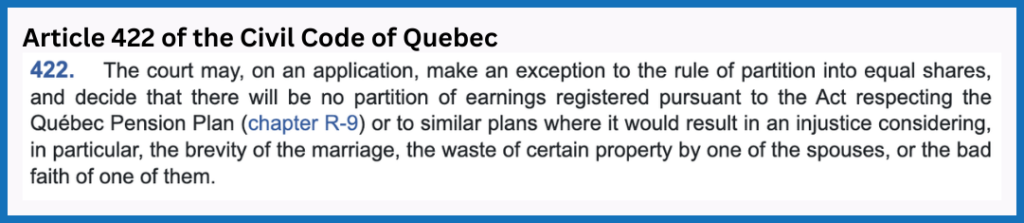
Article 422 states that there are three cases where you can ask for unequal partition of family patrimony. These are:
Note
Brevity of marriage
Brevity of marriage refers to a very short marriage where the spouses did not meaningfully build or integrate assets together. In some cases, if the marriage lasted only a short time and one spouse brought most of the property into the relationship, an equal 50/50 division of the family patrimony may create an injustice. However, a short marriage does not automatically justify unequal partition. The court will only depart from equal division if the spouse requesting it can show that equal sharing would be seriously unfair in the circumstances.
Bad faith by one spouse
There is no exact definition of what is “bad faith”. However, courts and legal scholars normally interpret it as a spouse who intentionally acts dishonestly or unfairly to deprive the other spouse of their rightful share of the family patrimony. It usually involves intentional misconduct, not simple mistakes or poor financial decisions. For instance, one spouse may sell the family house without the consent of a trusted family member, in order to prevent the other spouse from claiming their share of its value.
Dissipation or waste of property
Dissipation occurs when a spouse deliberately or recklessly reduces the value of family property, especially when the relationship is breaking down. For example, let’s say that one of the spouse intentionally spends, transfers, hides, or squanders assets to prevent the other spouse from receiving their fair share. This could be draining joint bank accounts before separation or selling property for far below market value.
What is the procedure to ask for unequal partition of family patrimony?
Quebec’s Code of Civil Procedure sets out the procedure for how to ask the court for an unequal partition of family patrimony. Under Article 321, the court cannot award was not asked for. Therefore, you must formally ask for unequal partition of the family patrimony. To do this you can either, include your request in your application for divorce, your answer (if you are responding to a divorce proceeding) or an amended application (if needed).
You can access the divorce forms on the website for the Superior Court of Quebec.
What can a judge decide to do?
If the judge decides on the balance of the evidence presented that dividing the family property equally would be unfair, the judge can either:
- Divide the family property unequally.
- Decide not to divide some property.
- Decide not to divide the family property at all.
Frequently asked questions
For example, if one spouse were to intentionally hide assets, sell property below its value, or transfer money to prevent the other spouse from receiving their fair share, that could be considered bad faith. In this case, you would need to provide evidence that your spouse intentionally did these things.
Final remarks
When a couple applies for a divorce in Quebec, the court calculates the net value of the family patrimony and divides it equally between the spouses. However, in certain cases, the spouse may ask for unequal division of family patrimony. To do this, you must include your request for unequal partition on in your court in your Application for Divorce, Answer, or Amended Application.
To learn more about how assets are split during divorce in Quebec, read more about family patrimony below.