
If you are buying or selling property in Quebec you need to know the difference between deeds and titles.
This article provides a clear, comprehensive and easy-to-understand introduction to these concepts. You will read get step-by-step explanations and helpful visuals so that you can quickly see how titles are different from deeds and how they work together to protect your property rights. Specifically we will cover:
- What is a property title in real estate?
- Different types of title in real estate in Quebec
- What is a deed in real estate?
- Different types of deed in real estate in Quebec
- The role of the notary in deeds
- Title vs Deed: What is the difference? (At a glance)
- Deed requirements and registration
- What to do if you lose your deeds?
What is a property title in real estate?
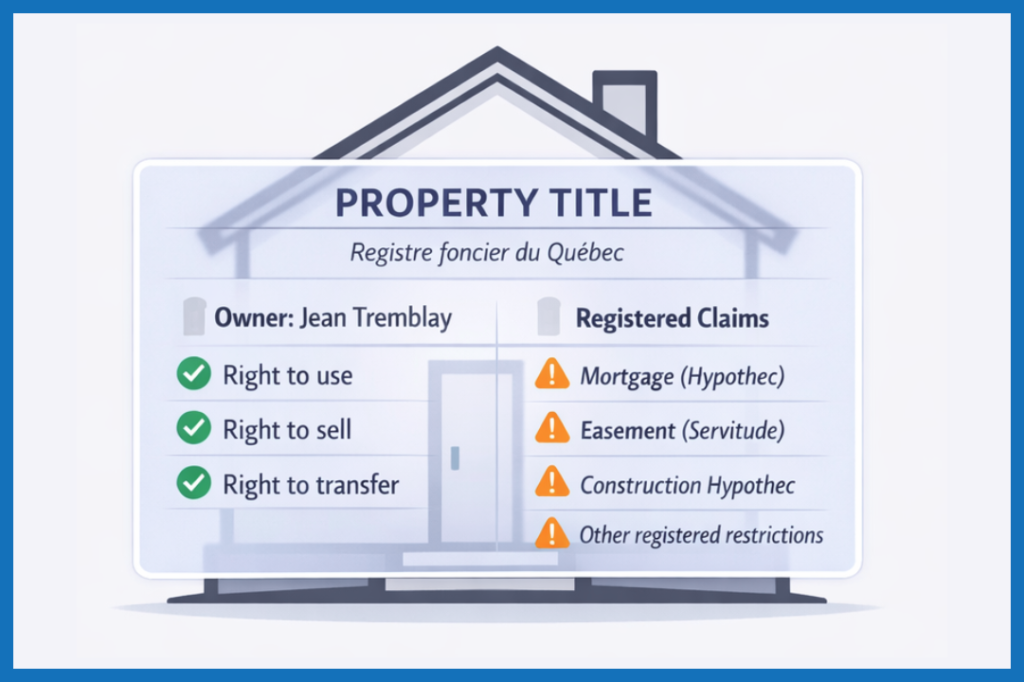
A property title is a legal record that proves who owns a property and lists out any rights or claims attached to the property. These property rights define exactly what the owner can do with the property. For instance, does the owner have the right to use, sell, lease, or transfer the property? Claims registered against the property title, such as mortgages, easements, or construction hypothecs, place restrictions on these rights.
Note
Different types of title in real estate in Quebec
In Quebec real estate, there are has five types of property titles. These define exactly what rights an owner has and how long they last. The graphic below lists out the different types of title and gives a brief description about what rights these give the owner.
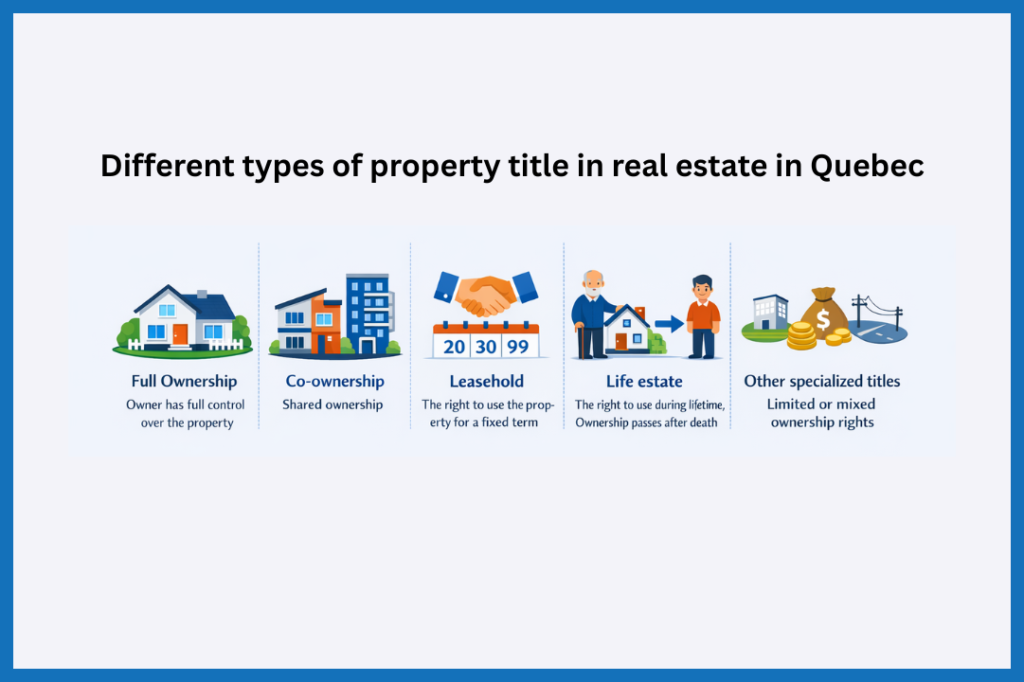
The different types of property titles
As you can see, not all property ownership is the same. The type of title you buy determines what you can do with your property and who shares responsibility for it.
- Full Ownership (Pleine propriété / Fee simple) – This is the most common form of ownership. The owner has full and indefinite rights over the property and the land it sits on. If you own this type of title, you can sell, transfer, mortgage or bequeath your property freely, subject only to municipal and provincial laws.
- Co-ownership – This is where two or more people share legal ownership of the same immovable property. There are two types of co-ownership, divided vs undivided co-ownerships.
- Leasehold – This grants the right to use and occupy a property for a fixed term (often 20 to 99 years). However, in this case, ownership of the land remains with another party (often a municipality or institution). When the lease expires, ownership of any improvements or buildings reverts to the landowner. This is common for certain institutional or heritage lands.
- Life Estate – This gives a owner the right to use and benefit from a property during their lifetime. The holder of this right may not sell the property outright. After their death, ownership passes to another person, often an heir. People often use this arrangement for re-marriage or estate planning.
- Other Specialized Titles – Quebec’s Civil Code also recognizes other limited or mixed forms of ownership, including:
- Right of Superficies – The right to own a building on land owned by someone else (often seen in commercial or municipal developments).
- Usufruct – The temporary right to use another’s property and receive income from it.
- Servitudes – Legal rights to use part of another’s property (e.g. for access or utilities).
Note
What is the deed in real estate?
A deed is the legal document that transfers ownership of a property from one person to another. While the property title is the official government record showing who currently owns a property and what rights or claims attach to it, the deed is the tool that changes that record.
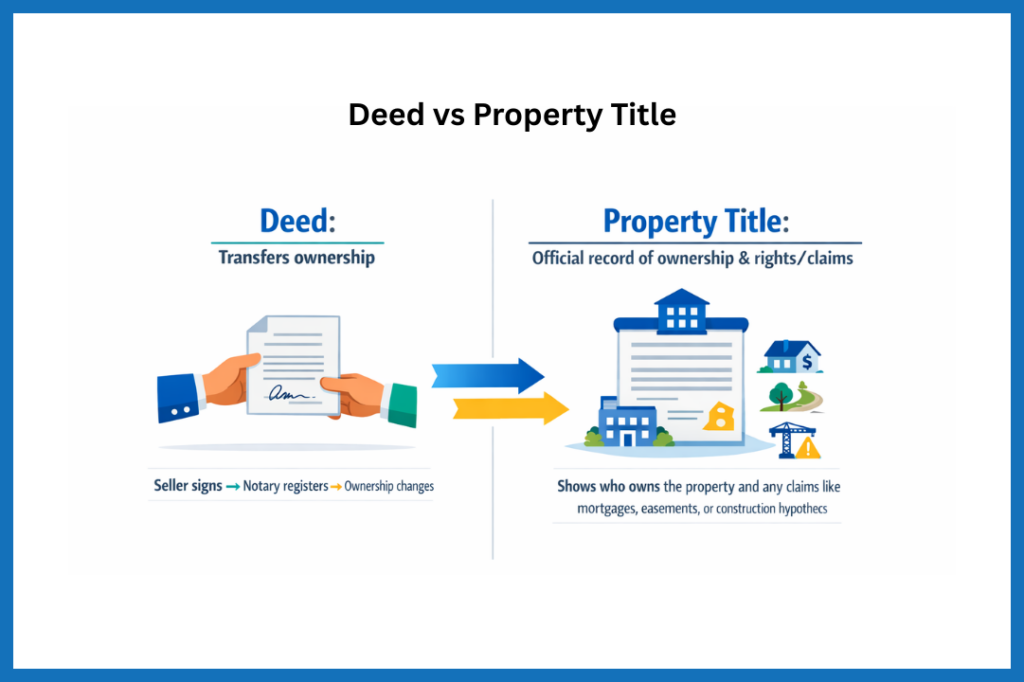
When a seller sells a property, they sign the deed, and the notary registers it in the Quebec Land Register. This updates the property title and makes the new ownership public and legally recognized.
Different types of deed in real estate in Quebec
As with property titles, different types of deeds exist. The notary will select the appropriate deed based on the property’s ownership structure and the type of transaction. Quebec’s Civil Code recognizes seven main types of deeds, each suited to different transactions and ownership arrangements:
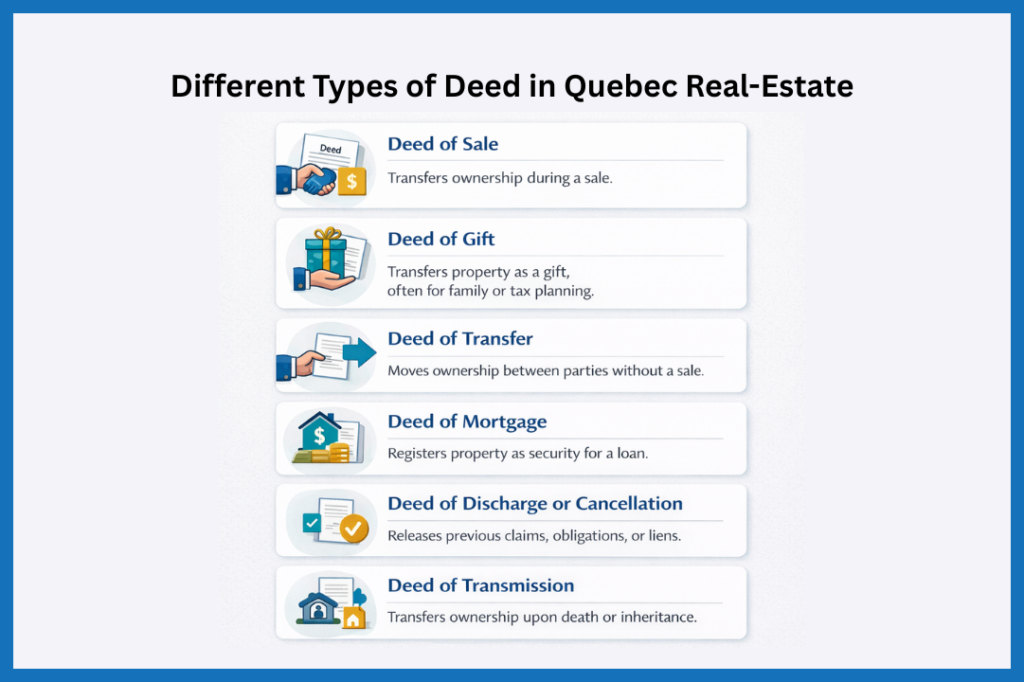
The different types of deed
As you can see, each deed serves a specific purpose, and not all are suitable for every type of transaction.
- Deed of Sale – This is the most common type of deed. It officially transfers ownership of a property from the seller to the buyer once signed before a notary and registered in the Land Register. Sellers and buyers use the deed of sale to complete residential, commercial, or land transactions.
- Deed of Gift –This deed transfers ownership of a property as a gift, without financial compensation. Family members often use this to transfer property for example, parents giving a property to their children.
- Deed of Transfer – Used when transferring ownership rights from one person to another without a sale, such as between business partners, in a merger, or to correct a previous registration.
- Deed of Mortgage – This deed registers a hypothec (the Quebec civil law equivalent of a mortgage) against a property. It grants the lender a legal right to claim the property if the borrower defaults.
- Deed of Discharge or Cancellation – After the borrower fully repays a mortgage or hypothec, the notary prepares this deed to cancel the lender’s rights and clear the property title. The notary then registers it in the Land Register to officially remove the mortgage from the property record.”
- Deed of Transmission (Acte de transmission) – This type of deed transfers ownership of a property after the owner’s death to the heir or estate, according to the will or succession rules.
- Deed of Servitude (Acte de servitude) – This deed establishes a legal right of use on someone else’s land for example, a shared driveway, utility line, or right-of-way. Once registered, the servitude becomes binding on future owners of both properties.
The role of the notary in deeds and tiles
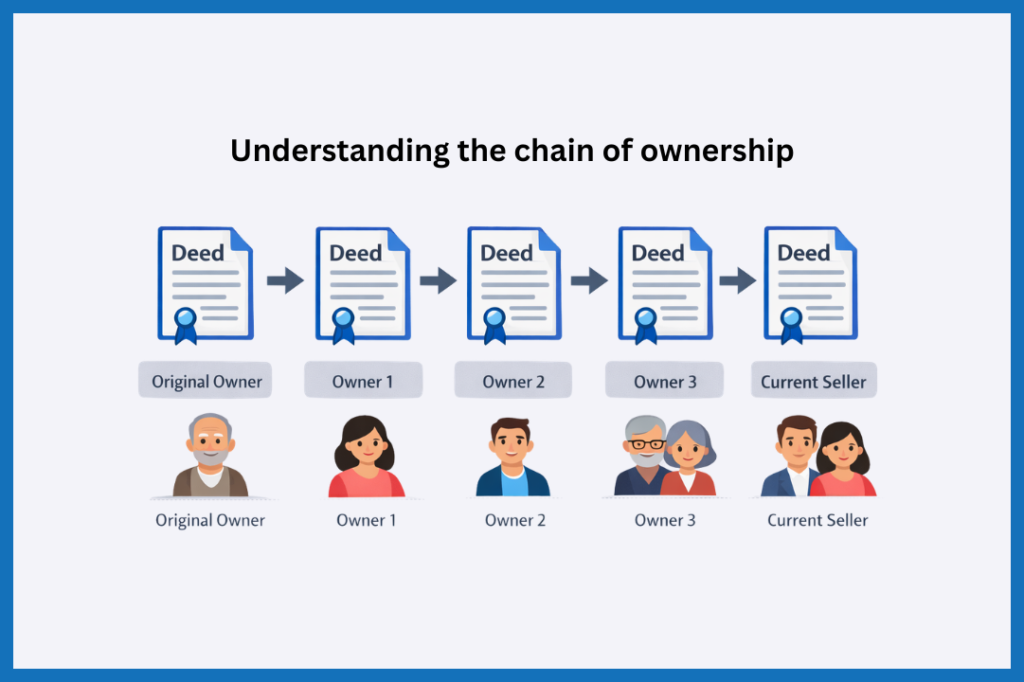
Unlike other provinces, where deeds can be prepared by a lawyer or even privately, Quebec law requires that all property transfers be executed by a notary. Before preparing the deed, the notary performs a title search, which involves examining the chain of ownership to ensure the seller has the legal right to transfer the property. This involves reviewing all past deeds, as well as checking for mortgages, liens, easements, or other restrictions that could affect the transfer.
After the notary has completed the title search and any title restrictions are resolved, they will then draft the deed for the current transaction. Finally, the notary will register the deed in the Quebec Land Register, allowing the municipality to update its property tax records, and then this will officially update the property title. The notary keeps the original (“minute”) deed in their notarial archives and issues certified copies to the parties for their records.
Title vs Deed: What is the difference? (At a glance)
As we have seen, the title is the legal document that proves who owns a property, whereas the deed of sale is a legal document that enables the property title to be transferred from one owner to the next. In the table below
| Title | Deed | |
| What is it | The official summary record showing who currently owns the property and under what conditions. | Acts as proof that a specific transaction or event affecting the property took place e.g. sale, mortgage, inheritance etc. |
| Purpose | Confirms the current legal owner. | Executes and records property transactions, creating a permanent legal history of ownership changes. |
| Number per property | One active title at any given time. | Many, one for every major transaction. |
| Where is it registered | In the Quebec Land Register. | In the Quebec Land Register. |
| Used by | Buyers, lenders and government to verify who currently owns the property and under what conditions. | Buyers, sellers, notaries, and lenders to transfer, finance, or otherwise transact on a property. Also used by notaries, lawyers and courts to prove ownership history. |
| Legal weight | Titles show who currently owns the property. | Deeds prove how ownership was acquired. |
Deed requirements and registration
For a deed to be legally valid in Quebec, it must meet specific requirements outlined by the Civil Code of Québec and the Registre foncier du Québec (Land Register). These typically include:
- Proper identification of the parties — The deed must clearly identify the counterparties in the transaction by their full legal names and addresses.
- A precise description of the immovable — The property must be described using its cadastral identification number, address and any servitudes (rights of way, easements, etc.).
- A notarial act — The deed must be drafted and executed by a notary in authentic form. The notary’s signature acts as that of witnesses and confirms the identity, consent and legal capacity of both parties.
- Payment of applicable taxes and fees — This includes the land transfer tax (welcome tax) in the case of the deed of sale, and registry fees required for registration.
- Registration in the Land Register — The deed must be officially registered in the Quebec Land Register, which makes the transfer of ownership legally effective and publicly visible. This is typically done by the notary however, it is best to check this yourself immediately after the transaction has been completed.
What to do if you lose your deeds?
If you lose your copy of a deed (for example, your deed of sale, mortgage or discharge), your ownership rights are not lost. This is because in Quebec, all authentic deeds drafted by notaries are permanently stored in two places:
- The notary’s official archive (minute book): Every notary must keep the original signed deed (“minute”) safely stored in their professional records for at least 100 years.
- The Registre foncier du Québec (Land Register): A digital record of every deed that affects a property. Once registered, it becomes part of the public record and serves as the official proof of the transaction.
So if you lose your copy, you should do the following:
- First, contact the notary who handled your transaction. The notary will be able to issue a certified true copy from their records. This copy has the same legal value as the original.
- Second, if the notary has retired or died, contract the Chambre des notaires du Quebec. They maintain a directory of successor notaries who hold the old archives.
- Third, you can look up your deed online in the Registre foncier du Québec by entering your property’s cadastral number. From there, you can order an official copy directly.
Final remarks
In Quebec, both the title and the deed play essential but distinct roles in proving and protecting property ownership. The deed records each legal transaction (every sale, mortgage, or transfer) that affects the property and the rights associated with it. In contrast, the title establishes who currently owns the property and confirms their legal rights, as reflected in the Quebec Land Register.
Keeping your documents organized matters. Always store your notarial deeds (both physical and digital copies) in a safe place and verify that your title is correctly registered in the Registre foncier du Québec. If anything ever goes missing, a notary can retrieve certified copies directly from the Land Register.