

Many people use the term “common-law” without fully understanding its legal consequences. When a common-law relationship ends, the law applies clear and sometimes strict rules — particularly about who has rights to the family home.
In this article, we clarify who must leave the house and who can stay in a common-law separation, how courts handle co-owned property, and what rights each partner has in the family home. More specifically we will cover:
- What are the marriage and divorce laws in Quebec
- What is a parental union regime?
- Common law separation Quebec: who gets the house?
- Common law separation Quebec: No parental union exists
- Common law separation Quebec: Parental union regime exists
- Frequently asked questions
- Final remarks
What are the marriage and divorce laws in Quebec?
In Canada, the federal government controls the legislative framework for divorce, including who may divorce and on what grounds. The Constitution of Canada assigns authority over property division and other civil consequences of divorce to the provinces. In Quebec, these civil rules appear primarily in the Civil Code of Quebec.
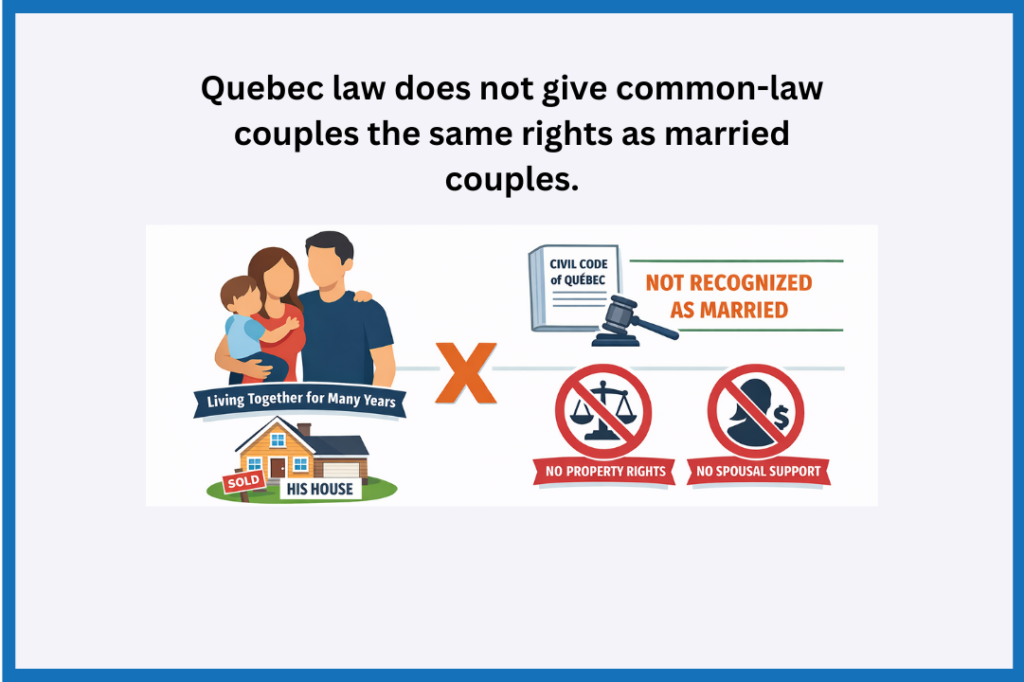
When it comes to marriage and divorce, the Civil Code creates a series of legal concepts including Family Patrimony (the mandatory 50/50 division of certain property between spouses), spousal support obligations and protective rules around the family residence. However, these rules apply only married or civil union spouses. The rules do not apply to common law spouses.
What is a parental union regime?
A parental union regime is a legal framework for certain common-law partners that grants them some of the rights and protections traditionally available to married couples. The framework pools family property, including the family home, and sets clear rules for dividing it if the union ends.
Not all common-law partners are automatically subject to a parental union regime. The law provides that only common-law partners who have a child together may fall within this regime. If you have a child with your common-law partner after June 30, 2025, the law automatically places you under the parental union regime. If your child was born before that date, you must apply to formally opt into the regime.
Note
Common law separation Quebec: Who gets the house?
The rights to the family home in a common law relationship depend on if you have established a parental union regime, or not. Let’s take a look at each of these cases now.
Common law separation Quebec: No parental union exists
In this scenario, you have been living with your partner in a de facto (common-law) relationship and you did not have a child together after June 30, 2025. As a result, the parental union regime does not apply to you.
In this scenario, if you and your partner decide to separate, your rights to remain in the family home will depend primarily on ownership and any agreements between you and your partner. The key question becomes: who owns the property, and does the non-owner have any legal basis to stay? The most common cases are:
- One owner who has the right to stay
- Co-owners must decide who will stay
- Forcing an owner to leave after separation
One owner who has the right to stay
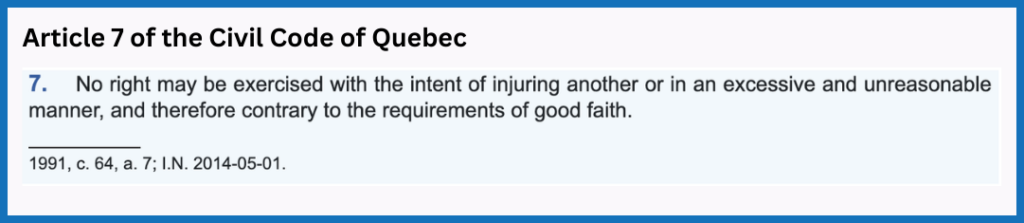
After common-law separation, the homeowner decides whether the other person can stay or must leave. The name on the property title determines who owns the property. Article 7 of the CCQ creates some responsibility for the homeowner here, in that the homeowner cannot just throw out the person in such a way that is malicious, excessive, or unreasonable in the circumstances, or intended to cause harm.
So for instance, if the homeowner got angry and forced locked their partner out in the middle of winter without any money or a jacket, with the sole intention of causing harm to them, this would make the homeowner liable under Article 7 of the CCQ.
Co-owners must decide who will stay
Two or more people co-own a property when their names appear on the property title. In this case, the co-owners must decide who stays and who leaves. As co-owners, they both have a right to stay and one co-owner cannot force the other person to leave. If the co-owners cannot agree on use or management of the property, then a court may intervene.
Normally what happens in this case is that the co-owners either decide to sell the property or one co-owner will agree to remain and pay some form of compensation to the other, since they are no longer able to enjoy use of the property.
Forcing an owner to leave after separation
If there are children involved, a non-owner or a co-owner can try to force the other person who owns or co-owns the house to leave it temporarily. However, the person who wants the other one to leave must meet two conditions:
- Have custody of the children
- Prove that it is in the child’s best interest to remain in the house
A judge has the discretion here to accept or not accept the request for spousal support or the claim for property division.
Common law separation Quebec: Parental union regime exists
In this scenario, you are living in a common-law relationship and either had a child together on or after June 30, 2025, or you formally opted into the parental union regime.
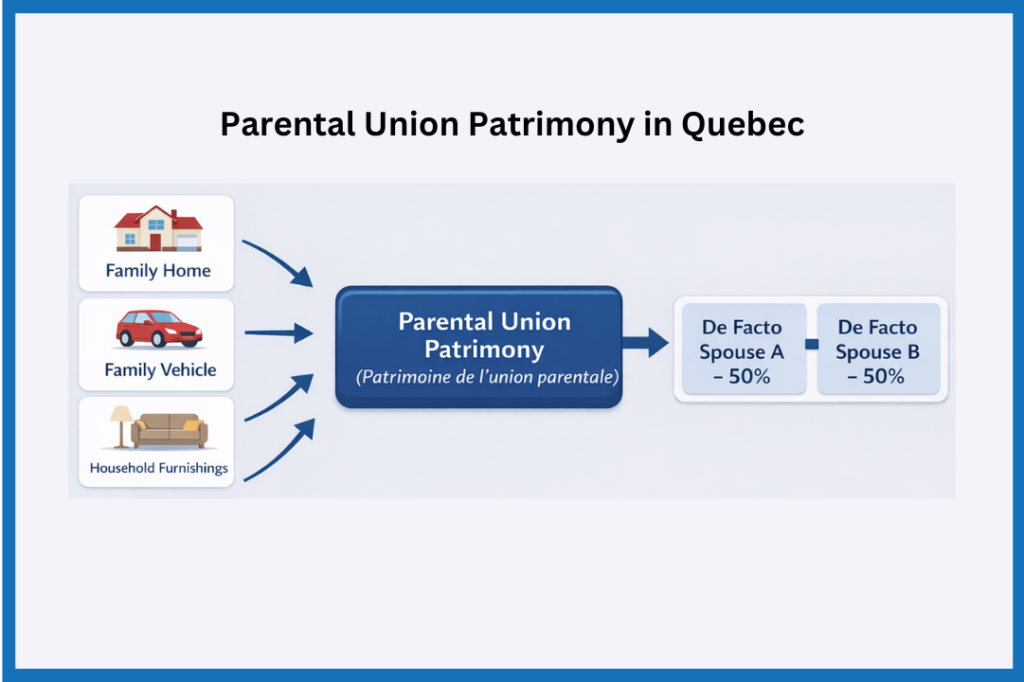
In this scenario, the law automatically pools certain property into something called a partenal union patrimony. When the union ends (through separation, death, or another terminating event), the partners divide the property’s value. The parental union patrimony includes property the family uses, such as primary and secondary residences, family vehicles, and household furnishings, but it does not automatically include other property, like benefits accrued under retirement plans or RRSPs.
Your rights to the parental union patrimony
If you and your common-law partner decide to separate, and the law determines that you have established a parental union patrimony, then both partners in the common-law relationship will have rights to the family residence regardless of whose name is on the property title. These rights include:
- One party cannot unilaterally sell the property
- Both parties have financial rights to the family home
- Temporary occupancy after separation
- Court-granted use or ownership
One party cannot unilaterally sell the property
If the parental union exists, one spouse cannot sell, gift, or otherwise transfer ownership of the family home without the other spouse’s consent or court approval.
If one spouse does sell the family house without consent, the other spouse can apply to have the transaction annulled, provided other legal conditions are met. The spouse may also claim financial compensation for damages incurred as a result of the unauthorized transaction.
If you are concerned that your spouse may sell the house without your knowledge, you can ask a real estate agent or notary to file a declaration of family residence in the Quebec Land Register. This alerts prospective buyers to the fact that the property is designated as the family residence and that the owner cannot validly sell, transfer, or hypothecate it without the other spouse’s consent.
Note
Both parties have financial rights to the family home
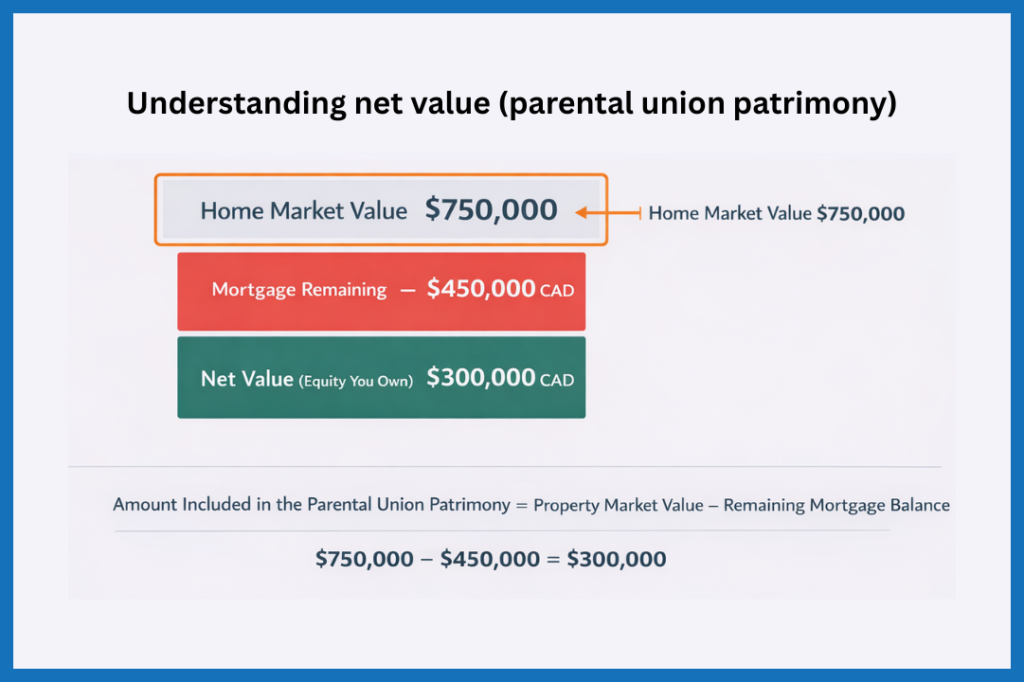
If the union ends, each spouse has a right to an equal share of the net value of the family home included in the patrimony. This is a financial right to the net value of the property and not automatically a right to keep or own the property itself.
Net value is the difference between the current market value of your home and any outstanding debts secured against it, such as a mortgage or home equity line of credit. For instance, let’s say that a your home has a current market value of $750,000, and the outstanding mortgage on the home is $450,000. This means that the net value of the home is $300,000 ($750k minus $450k). In this instance, the law may entitle each spouse to $150,000.
Important
Temporary occupancy after separation
If you are in a parental union, you do not necessarily have to leave the home after the common-law separation. This is the case even if you were not the person in the relationship who purchased the property. This can happen in the following situations:
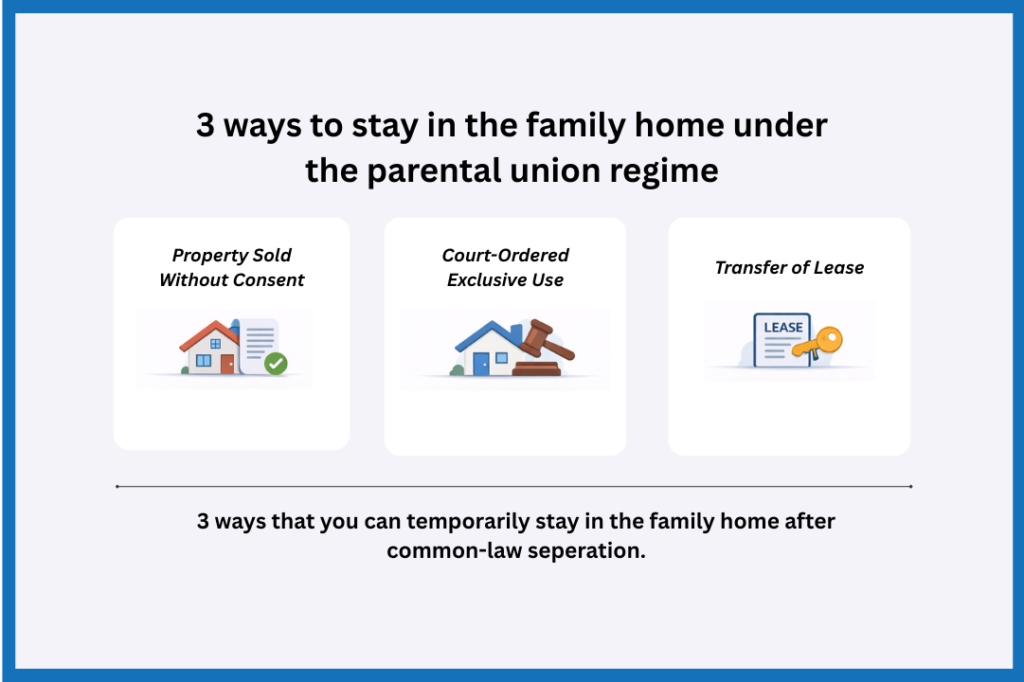
First, if you register a declaration of family residence and your partner attempts to sell the home without your consent, the law may protect your right to remain in the residence. Even if a sale occurs, you may be able to continue occupying the home temporarily under conditions determined by the court, while the parental union patrimony is being settled.
Second, the court can temporarily grant exclusive use of the family residence to one partner following separation. This is often the parent who has primary care of the children. To obtain this protection, a partner must apply to the court for provisional measures or a safeguard order. Courts frequently maintain the status quo by allowing the parent who remains in the home during the time when the common-law couple is separating to continue living there temporarily in order to promote stability for the child.
Third, if the family home is rented rather than owned, the court may transfer the lease from one partner to the other upon separation. This allows the partner who is not the named lessee to continue occupying the residence during the legal process and, in some cases, beyond it.
Court-granted use or ownership
When a parental union breaks down, there is no formal “divorce” process. However, if the partners cannot agree on parenting arrangements, support, or the division of the parental union patrimony, either partner may apply to the court.
At that stage, the court can issue temporary orders, including safeguard orders in urgent situations or provisional measures pending a final judgment. These interim decisions may address:
- Temporary parenting time and decision-making responsibility
- Child support
- Temporary use of the family residence
- Payment of the mortgage, rent, or household expenses
- Protection preventing one partner from selling or encumbering family property
These temporary measures are designed to preserve stability for children, until the court renders a final decision.
Frequently asked questions
– If you live together in a common-law (de facto) relationship and have a child together, the parental union regime applies.
– If you live together but do not have a child together, you are not in a parental union regime.
– You cannot “apply” to enter the regime without a shared child.
There is a limited transitional option for couples who already had a child before the law’s coming into force to opt in by agreement. But even in this case, the parents must be the parents of the same child.
You do not “apply” to the government in the usual sense. If the parental union does not apply to you automatically, you and your partner may choose to join the regime by mutual agreement, provided you meet the legal requirements.
To opt in, you must:
– Be de facto spouses (living together in a conjugal relationship);
– Be the parents of the same child;
– Not be married, in a civil union, or already in a parental union (together or with someone else);
– Not be related in a way prohibited by law;
– Not have become the parents of a new common child since June 30, 2025 (because in that case the regime would apply automatically).
If you meet these conditions, you can form a parental union in one of two ways:
– By notarial act (an agreement prepared and signed before a notary); or
– By written contract signed in the presence of two witnesses.
The Quebec government provides an online tool to help you draft the agreement.
Once properly signed, your parental union is valid.
Final remarks
When common-law couples separate in Quebec, they must first determine whether the law places them under a parental union regime. If it applies, the law automatically includes the family home in the parental union patrimony, and neither spouse may sell, transfer, or hypothecate it without the other’s consent or court authorization, regardless of who holds title. If the regime does not apply, the law does not automatically protect the family home.
The Quebec government designed the parental union regime is to protect children within a relationship. And, the law binds you to this regime only if your child was born after June 30, 2025. However, if both partners contribute through childcare, financial support, or maintaining the household, you may wish to formally establish the regime to secure legal protection for both partners and the family home.