
Your homes foundation is the anchor of your home. It keeps walls straight, floors level, and your structure safe from shifting over time.
By contrast, if you choose the wrong type of foundation, or construct one poorly, this can cause your home to sink unevenly. This can make your house tilt, cause cracks to appear in walls and floors, and let water in, leading to structural damage, and even unsafe living conditions.
In this article, we examine what is a block foundation and how this compares to a poured concrete foundation in terms of both upfront costs and maintenance. More specifically we will cover:
- What is a concrete block foundation?
- The pros and cons of a block foundation (at a glance)
- Advantages of a concrete block foundation
- Disadvantages of a concrete block foundation
- How to prevent leaks in your block foundation
- What is a poured concrete foundation?
- Concrete block foundation vs poured concrete foundation
- Frequently asked questions
- Final remarks
What is a concrete block foundation?
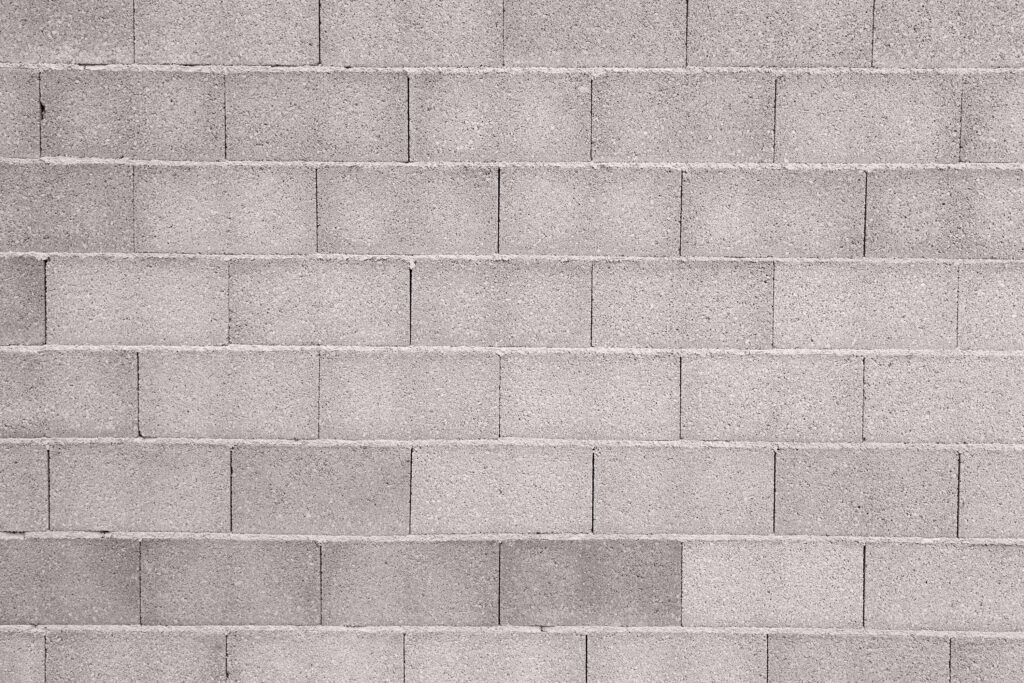
A concrete block foundation is a structural base that your home sits on. It is made from lots of individual concrete blocks that are stacked on top of each other. The image below shows an example of what these blocks (also known as concrete masonry units, CMUs) look like.
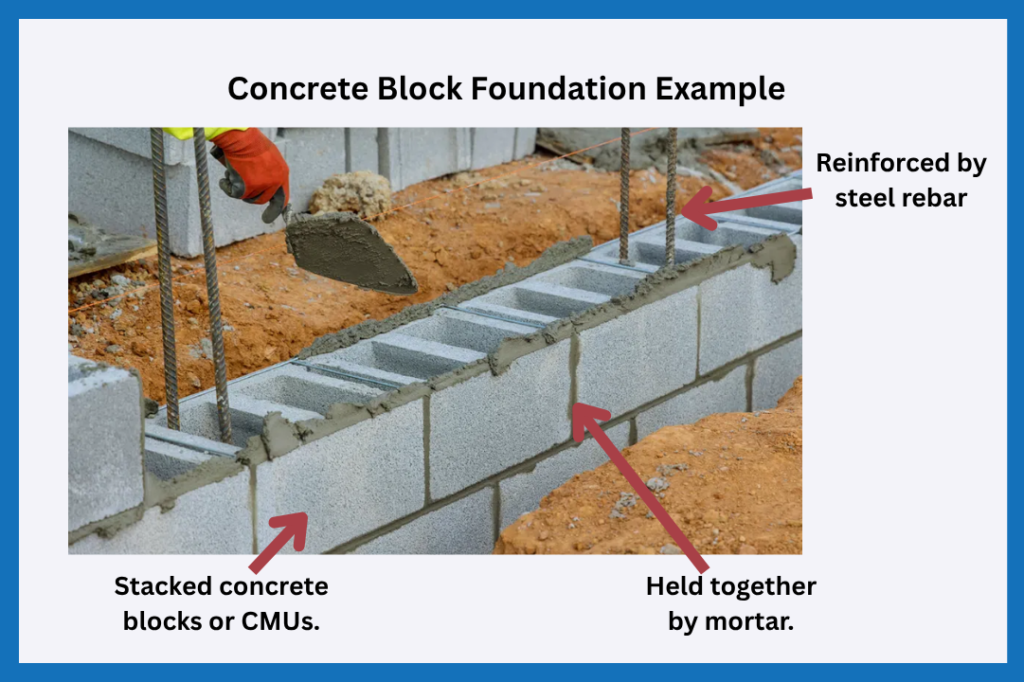
Each of the individual concrete blocks is held together by mortar which is a thick paste made of cement, sand, and water that hardens over time.
Note
By contrast a concrete block is made from cement mixed with sand and gravel, making it stronger and more durable.
In houses built in Quebec, homes built with cinder block foundations are typically from the mid-20th century, especially the 1940s to 1970s. Nowadays, people rarely use cinder block foundations, much more common are poured concrete foundations or reinforced cinder block foundations.
The pros and cons of a block foundation (at a glance)
The table highlights the pros and cons of a block foundation at a glance.
| Advantages of a Concrete Block Foundation | Disadvantages of a Concrete Block Foundation |
|---|---|
| More affordable than poured concrete | More prone to water leaks through joints |
| Easier to repair individual sections | Requires more maintenance over time |
| High vertical compression strength | |
| Can be strong when properly reinforced | |
| Widely available materials and methods |
Let’s take a deeper look at each of these points now.
Advantages of a concrete block foundation
There are five main advantages of a concrete block foundation, compared to other types of foundation. These are:
More affordable that poured concrete
In Quebec, the average cost of a block foundation is roughly $15,000–$25,000, compared to $22,000–$35,000+ for poured concrete. These estimates assume a typical 1,200–1,500 sq ft home with an 8–9 ft basement, excavated below the region’s 4–5 ft (1.2 – 1.5 m) frost line. Shallower, frost-protected foundations follow a different design and pricing structure.
Easier to repair individual sections
Concrete block foundations are built from individual units. This means that if one section is damaged, the area can often be removed and rebuilt without disturbing the entire wall. This means that if you need to make localized repairs, you can do so in a much easier and more cost-effective way compared to poured concrete.
High vertical compression strength
Concrete block foundations perform well under vertical loads, with individual blocks designed to handle significant compressive force. When properly installed on a level footing, they provide reliable support for the structure above.
Can be strong when properly reinforced
While block foundations aren’t as inherently strong as poured concrete, they can be reinforced with steel rebar and concrete-filled cores to significantly improve their strength and resistance to soil pressure. This added reinforcement increases cost, but typically still keeps block foundations more affordable overall.
Widely available materials and methods
Concrete blocks are mass-produced and readily available, and many contractors are experienced in block construction. This makes it easier to source materials, find qualified labor, and obtain competitive pricing compared to more specialized foundation systems.
Disadvantages of a concrete block foundation
Concrete block foundations have five main disadvantages. These are:
More prone to water leaks through the joints
When it rains, water doesn’t just disappear, it seeps into the ground and begins moving through the soil. As water travels underground, it naturally follows the path of least resistance, which can sometimes direct it toward your home.
When water accumulates around the foundation, it creates what’s known as hydrostatic pressure. This is a force that pushes against the walls from the outside. Block foundations are more vulnerable in these conditions compared to other types of foundation such as poured concrete. This is because they are made up of multiple units joined by mortar. Each of the joins represents a potential weak point to pressure that comes at it from the side.
As such, whilst block foundations can perform well under vertical loads, they are less resistant to lateral pressure which can crack the foundation. Water can then penetrate through small gaps in the joints, leading to moisture intrusion, leaks, and in some cases, gradual deterioration of the wall. Most of the time water comes in through the cold joint. This is the point where the basement floor and the wall meet.
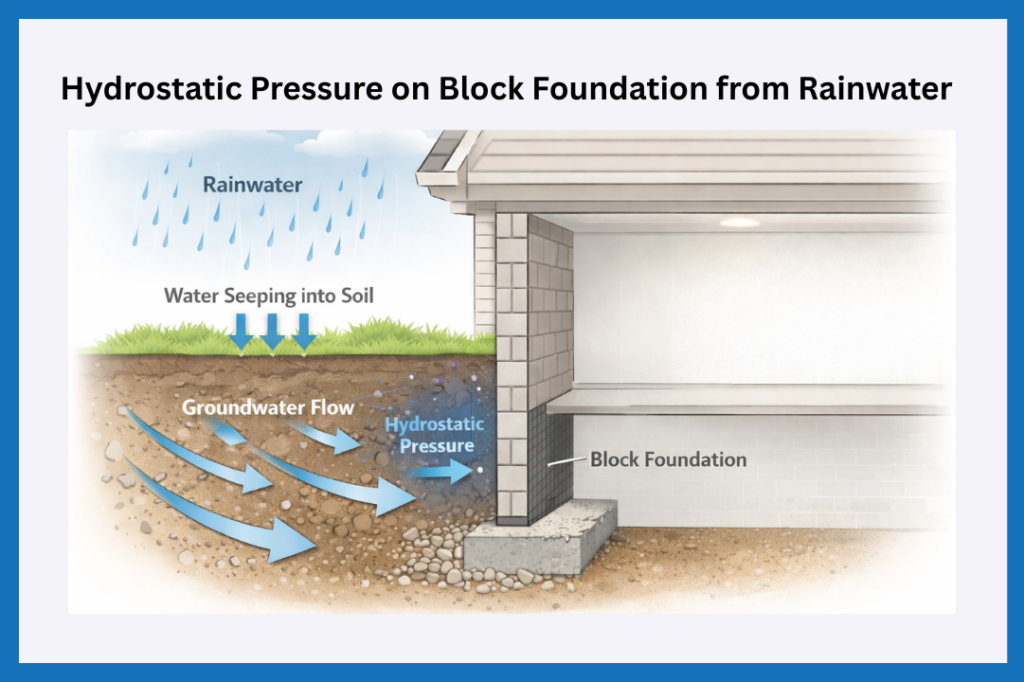
Weak lateral pressure from soil and water
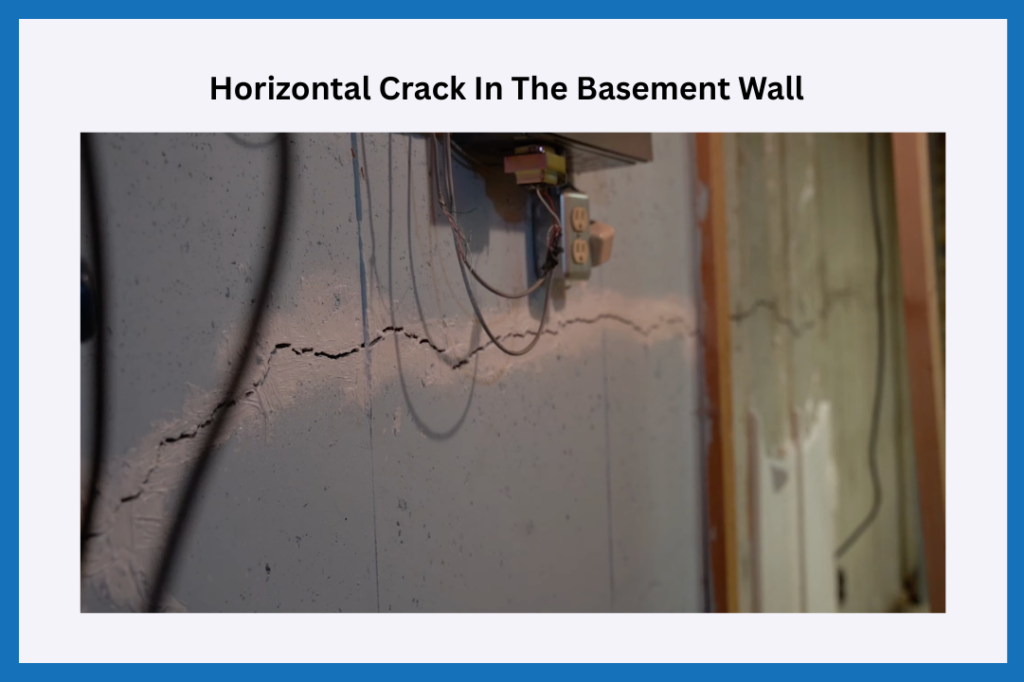
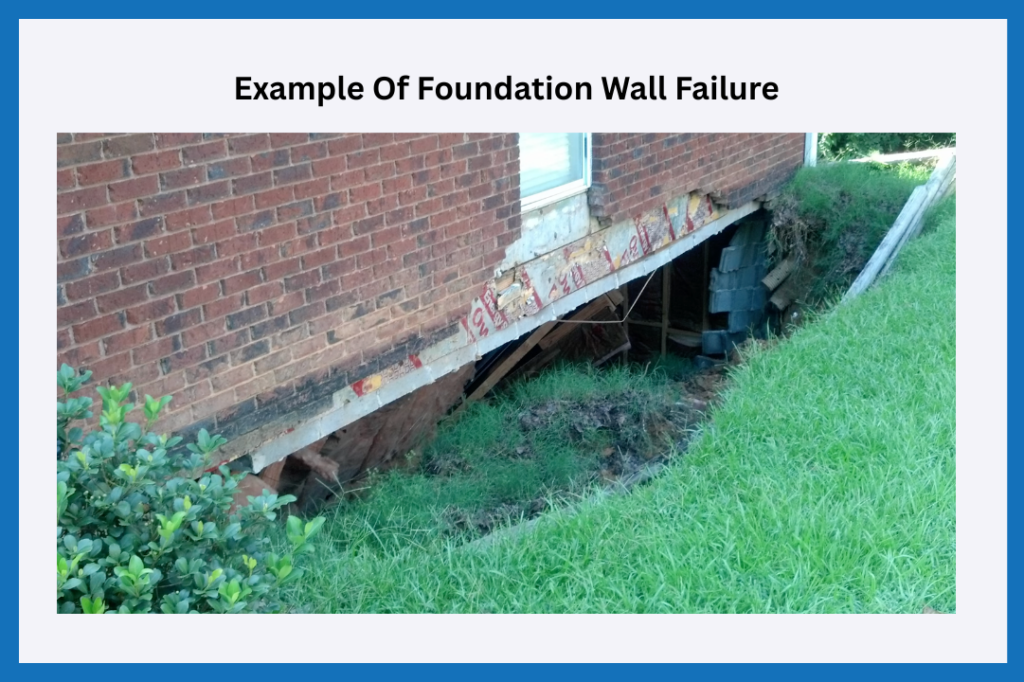
As mentioned above, block foundations are weak to lateral pressure from water and soil. This can lead to cracks showing up in the walls of your foundation. If you have a basement in your home, you will be able to see these cracks that, normally start off as horizontal cracks. This is normally an early sign that the foundation is failing under lateral pressure.
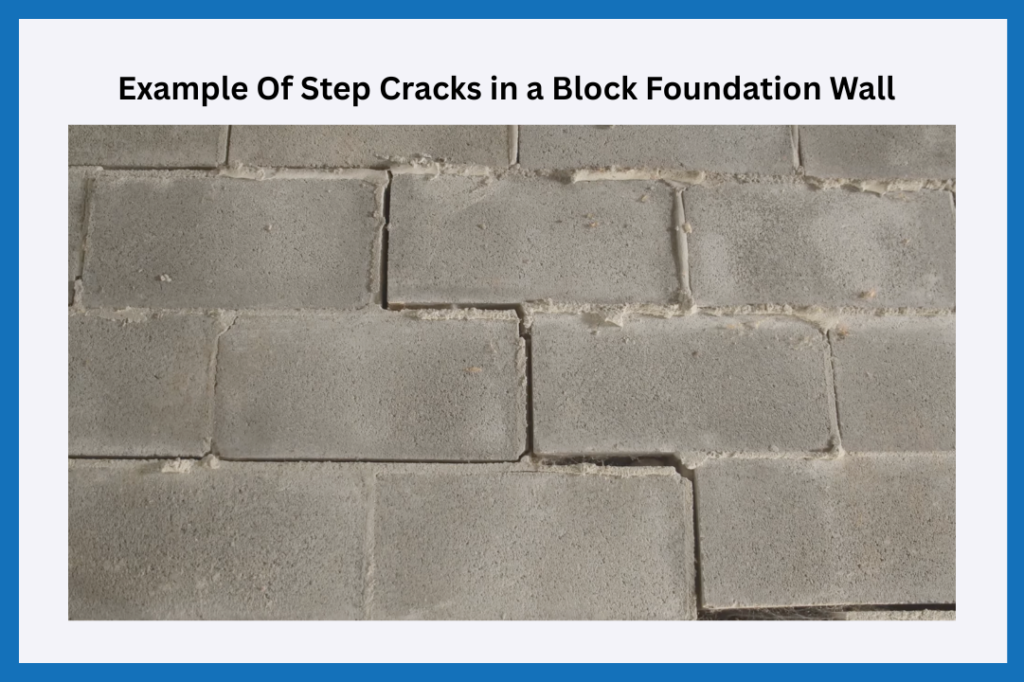
If these cracks are left unchecked, you might start to see “stair step” cracks materialize. These are especially common in block foundations. These cracks follow the mortar joints in a zig-zag pattern, which is a sign that the situation is getting worse.
If the pressure keeps up, then the foundation walls can actually start to bow inwards. This is a major warning sign that structural failure could be on the horizon. Ultimately, if nothing is done about this, then this can lead to a complete collapse of the wall. This final stage poses sever saftey risks and often results in substantial property damage.
How to prevent leaks and cracks in your block foundation
Leaks tend to materialize when hydrostatic pressure builds up in the soil that surrounds your foundation. In this section, we cover some of the things that you can do to avoid hydrostatic pressure and prevent leaks in your foundation.
1. Grading and perimeter drainage
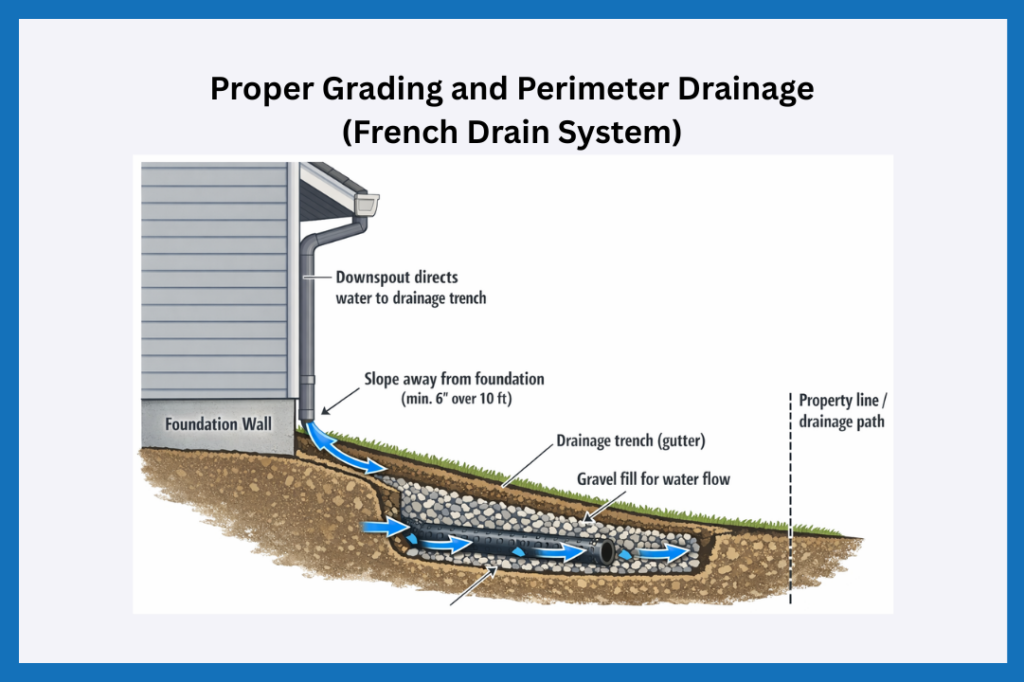
Grading is the process of leveling (or sloping) the ground around your property so that it allows water to run away from the property. This can be done by digging an deep trench around your property, filling that trench with gravel and then placing a French drain inside the gravel.
When you do this, the water from rain and melting snow is collected in the trench and directed through the drain away from the foundation. This will reduce the risk of pooling, soil saturation, and water intrusion into the home. This helps protect the foundation from the build up of hydrostatic pressure.
2. Gutter drainage system
A gutter drainage system moves rainwater away from your home, protecting your foundation, roof, and landscaping from water damage. It collects rainwater from your roof and channels it safely through gutters, downspouts, and drainage extensions.
If gutters become clogged, are poorly placed, or slope too flat, water can overflow and spill next to the foundation. This creates a pool around the foundation that can overwhelm the grading and drainage system. The pooling water increases hydrostatic pressure against the foundation.
3. Waterproof your foundation
A dimple membrane is a plastic sheet with raised dimples that wraps around the exterior of your foundation and can also be installed along the basement floor, then covered with concrete. It is designed to relieve hydrostatic pressure by creating a small air gap that allows water to flow downward and away from the structure instead of pushing directly against the wall.
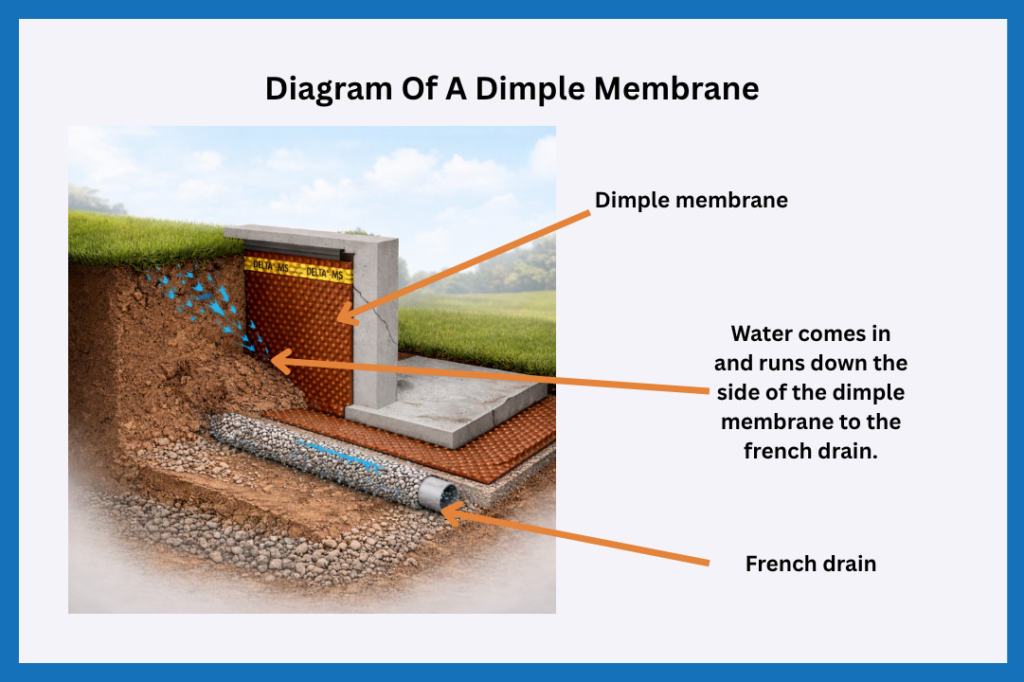
The dimple membrane should be paired with a French drain, since the membrane directs water downward along the foundation, but the drain is what actually carries that water away from the home.
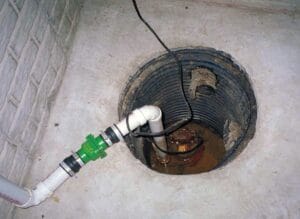
You can also include a sump pump, which plays a key role in actively removing water from the system. Water collected by the drain flows into a sump pit, and when the water level rises, the pump automatically turns on and discharges it safely away from the property. This is especially important in areas with high groundwater or heavy rainfall, where gravity drainage alone may not be enough.
The dimple membrane was developed in the 1960s but did not become widely used in residential construction until the 1990s. For this reason, many older homes, especially those with block foundations, were built without a dimple membrane. Homes without a dimple membrane are more susceptible to moisture intrusion and water pressure over time. The product can be retrofitted; however, this requires excavating around the foundation, which can be a significant cost to homeowners due to the labour, equipment, and restoration involved.
Note
What is a poured concrete foundation?
There are various configurations of the poured concrete foundation; however, the most common is a slab-on-grade, or monolithic slab. This is when the foundation and floor are poured at the same time as a single continuous piece of concrete. there are several advantages and disadvantages of a block foundation vs a poured foundation.
| Advantages of a Poured Concrete Foundation | Disadvantages of a Poured Concrete Foundation |
|---|---|
| Lack of gaps or joints | Requires specialized equipment |
| Lower chance of leaks | Premade forms may be difficult to maneuver |
| Faster, less labor-intensive installation | Can be more expensive |
Block foundation vs poured concrete foundation
Let’s take a look at which is better, a block foundation or a poured concrete foundation.
| Foundation Comparison |
|---|
| Strength ⚖️ (Tie) Concrete block foundations provide strong vertical compression for heavy loads. Poured concrete foundations resist lateral pressure from soil and water more effectively because they lack joints. Both types become stronger and more durable when reinforced with steel, so confirm the reinforcement method before building. |
| Weather Resistance 🏆 (Poured Foundation) Site conditions influence foundation performance. In areas prone to flooding or severe weather, poured concrete offers better protection because it has no gaps. Its solid design helps prevent water intrusion and limits pest entry. |
| Longevity 🏆 (Poured Foundation) Concrete foundations can last more than 100 years when built correctly. Poured foundations often perform better over time because their seamless structure resists pressure and moisture. Both options use durable materials and can outlast the home’s occupants. |
| Price ⚖️ (Tie) Costs vary based on size, site conditions, and region. Block foundations typically cost $9 to $15 per square foot. Poured concrete with a short wall ranges from $6 to $12, while full basement foundations range from $20 to $37. Overall, costs remain comparable depending on the project. |
| Ease of Installation 🚫 (Neither) Foundation installation requires professional expertise and proper equipment. Contractors must manage grading, drainage, and structural integrity. Block systems require more labor, while poured systems require forms and machinery, making both unsuitable for DIY work. |
| Maintenance 🏆 (Poured Foundation) Block foundations contain multiple joints that can deteriorate over time. Mortar and fillers may crack and cause leaks. Poured foundations reduce these risks because their solid structure better resists water intrusion and soil movement. |
| Appearance ⚖️ (Tie) Poured foundations create a smooth, modern look. Block foundations offer a more traditional style often found in older homes. Most homeowners choose based on personal preference. |
Frequently asked questions
– Poured concrete: Smooth, continuous surface with no visible joints
– Block (CMU) foundation: Made of stacked rectangular blocks with visible mortar lines
– Stone foundation: Irregularly shaped stones, common in older homes
– Brick foundation: Smaller, uniform bricks (less common structurally today)
If you’re unsure, a home inspector or structural professional can confirm it quickly.
Pros:
– Durable and widely used
– Easier and often cheaper to repair in sections
– Good compressive strength
Cons:
– More vulnerable to water penetration (because of mortar joints)
– Can bow or crack under pressure if not reinforced properly
– Typically require more maintenance than poured concrete
Overall, a well-built and well-maintained block foundation can perform perfectly fine. However, you will want to ensure that you have a working french drain and that the foundation is treated with a dimple membrane.
Its lifespan depends on:
– Drainage and waterproofing
– Soil conditions
– Quality of construction
– Ongoing maintenance
Poor drainage is the biggest factor that shortens its life.
– Block foundation: Lower initial cost, more maintainance required over time.
– Poured concrete: Higher upfront cost, faster installation and often better long-term performance.
– Concrete blocks (CMUs): Made with cement, sand, and gravel (modern standard).
– Cinder blocks: Traditionally made with coal cinders (lighter, less strong, rarely used today).
In modern construction, what people call “cinder blocks” are almost always concrete masonry units (CMUs). If you are unsure, you should ask your real-estate agent to clarify this information.
Final remarks
When you are deciding on a home to buy, or you are constructing a new home, the type of foundation you choose is critical.
Whilst each type of foundation has its place, you need to also consider how the foundation was built. A poorly constructed poured concrete foundation can still fail under hydrostatic pressure, and a well built block foundation that has been treated with a dimple membrane, and that has a working French drain can be highly effective.
In Quebec, it’s also important to be aware of region-specific risks. For example, pyrite contamination in the backfill can cause the concrete to expand and crack over time. You should also consider whether the property is located in a flood-prone area or has a high water table, both of which can increase the risk of moisture intrusion and long-term foundation damage.
When in doubt about the quality of your foundation, you should order a get a home inspection before committing since, foundation it can save you thousands in future repairs.