

Title insurance protects you against losses caused by problems related to the title of your property. You can purchase it through your notary when you either buy or refinance commercial or residential property.
There are several types of title insurance, the most common type is title insurance that owners purchase when buying a property. This type of title insurance offers you coverage up to the purchase price of the property. Some title insurance even offers higher coverage amounts to reflect the increase in the property’s value over time.
In this article we cover:
- What is title insurance?
- What does title insurance cover?
- What is not covered by title insurance?
- How to get a good title insurance policy
- Frequently asked questions
- Final remarks
What is title insurance?
Title insurance is a type of insurance that protects property owners and lenders against financial loss caused by title defects. These defects arise when something goes wrong in the chain of property ownership. This is the legal paper trail that shows who owned the property over time. A break in the chain can raise doubts about the current owner’s legal title to the property. The image below illustrates how one weak link can affect today’s owner.
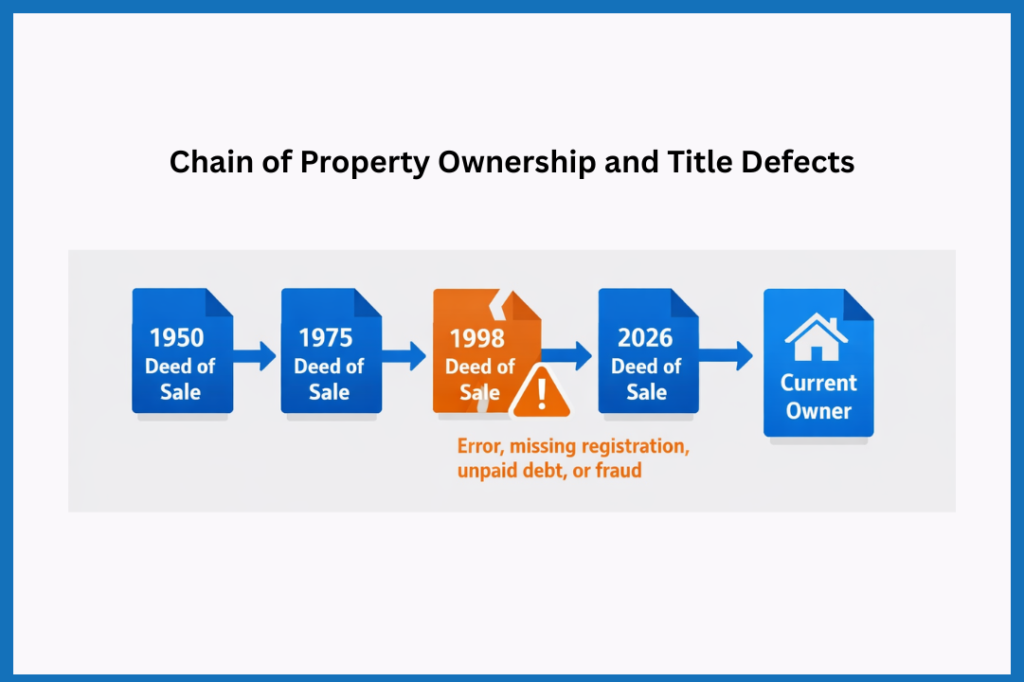
Specialized title insurance companies such as First Canadian Title and Stewart Title Canada offer title insurance, often through your notary or your lender at the time of purchase. Each insurance company spells out precisely what risks their title insurance actually covers in their title insurance policy.
What type of risks does title insurance cover?
Title insurance companies define exactly which risks they cover in their insurance policies, and coverage can vary from one insurer to another. However, the most common risks they protect against include:
- Forged documents and fraud
- Liens against the property
- Easements or encroachments
- Disputes over property boundaries
- Pre-existing violations of subdivision laws or zoning ordinances
Forged documents and fraud
Title fraud happens when someone illegally transfers your home to themselves or takes out a mortgage on your property. To do this, criminals will create fake deeds, impersonate the true owners and even take out a new mortgage on the property without the owners knowledge.
Title insurance protects you by covering legal costs and losses resulting from fraud or forgery. For example, if a fake deed or fraudulent mortgage appears on your title after purchase, the insurer will pay a lawyer to defend your ownership, restore clear title in your name, and, if necessary, discharge the fraudulent mortgage.
Liens against the property
A lien is a legal claim that a creditor registers against a property to secure payment of a debt. Unlike a mortgage, which the borrower agrees to voluntarily, a government authority, court, or creditor can impose a lien on the property to secure payment of a debt. For example, let’s say that you have not paid your property taxes. In this case, the municipality may place a lien on your home until you pay the outstanding taxes.
Liens can come from many sources such as unpaid property taxes (municipal or school), outstanding condo fees, unpaid utility bills, construction or renovation work (a hypothec of construction), or other unpaid loans secured against the property. Once a court confirms the debt, the creditor registers the lien in the Quebec Land Register and makes it official and enforceable against the property.
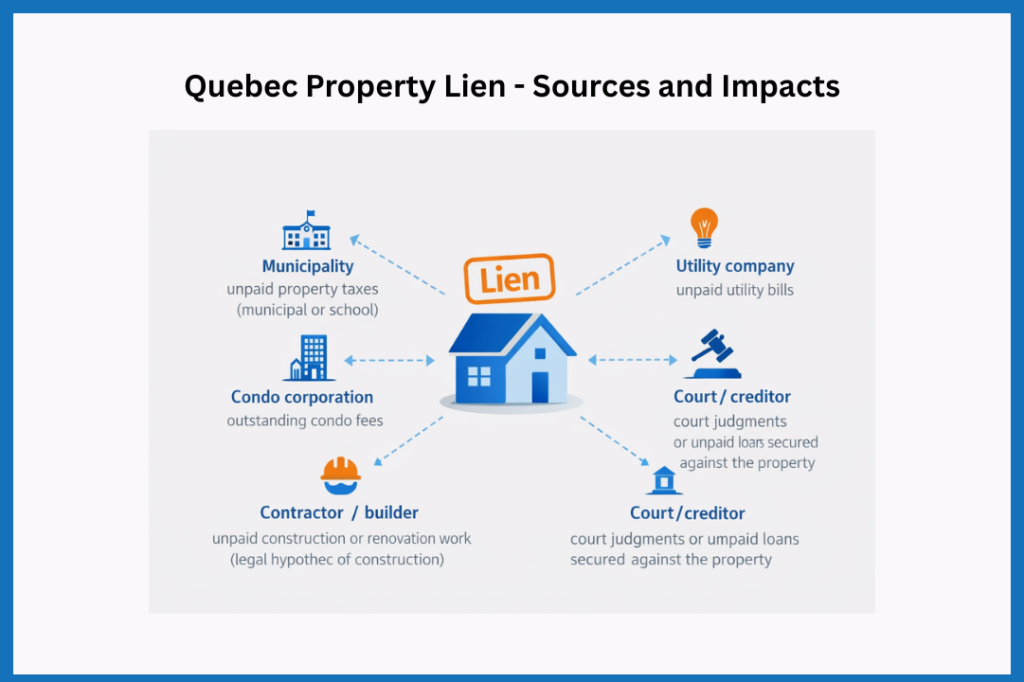
When you buy a home, your notary checks the Quebec Land Register for any recorded liens. However, a lien that hasn’t yet been registered can still arise. For example, under Article 2726 of the Civil Code of Quebec, a construction company can create a lien (legal hypothec of construction) as soon as they supply materials or complete work. The company then has 30 days to register the lien in the Land Register, which means a new lien could appear after your purchase, potentially affecting your mortgage or ownership.
Easements or encroachments
Easements are legal rights that allow someone else to use a portion of your property for a specific purpose. For example, Hydro-Québec might have access to maintain underground cables. Encroachments occur when a property owner places a structure or part of a structure onto a neighbor’s land without permission. For example a balcony that crosses the property line without permission.
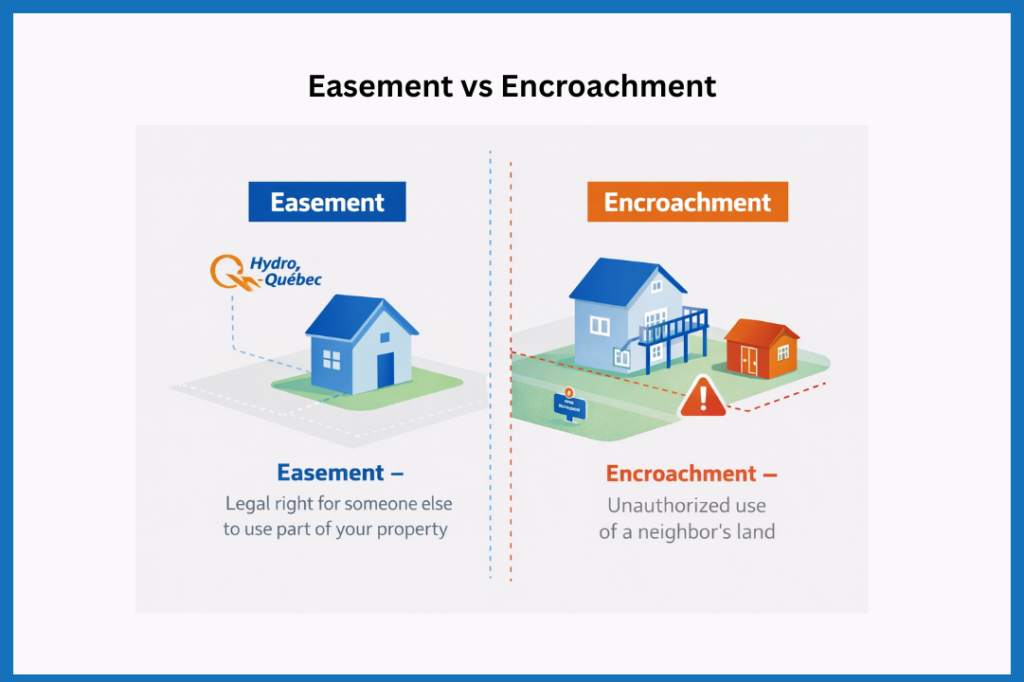
Your certificate of location records both easements and encroachments. However, surveyors or property owners sometimes register them incorrectly. An unknown legal easement or an encroachment can lead to disputes with neighbors, unexpected costs to move or demolish structures, or a reduction in your property’s value. Title insurance protects you by covering the legal fees and financial losses that result from these errors, helping you resolve the issue without out-of-pocket expense.
Disputes over property boundaries
A boundary dispute arises when there is a disagreement over where the legal property line actually is. For example, two neighbours both believe a strip of grass belongs to them based on different survey plans. Survey errors, outdated cadastral plans, or unclear title descriptions can cause these disputes. Title insurance covers the cost of defending property boundaries and compensates for any losses that arise from such disputes.
Pre-existing violations of subdivision laws or zoning ordinances
In Quebec, every property must comply with municipal zoning laws and subdivision regulations. These rules determine how you can use the property (residential, commercial, or mixed-use), how tall you can build, the minimum lot size, and the required setbacks and distances between structures.
There may be pre-existing violations of zoning or subdivision laws that mean the property was already non-compliant before you bought it, but no one knew. For example, the owner illegally converted an duplex into a single family townhouse without obtaining permits. These are regulatory violations that can lead to fines, restrictions on renovations or even demolition orders. Title insurance can cover the cost of resolving these problems or compensate you for loss in property value if the city forces you to correct or remove the offending structure.
What is not covered by title insurance?
While title insurance protects against hidden legal problems with ownership, it does not cover everything that can go wrong with a property. Common exclusions include:
- Most problems created after you buy the property
- Physical or structural defects
- Zoning changes made after purchase
- Environmental contamination
- Rights of parties in possession
- Native land claims
- Known title defects or problems disclosed before purchase
- Government expropriation
Most problems created after you buy the property
With a few exceptions title insurance is backward looking. This means that it will include hidden liens, registration errors or past fraud. It will generally not include “post policy” protection. For example, if you buy a home and then unkowningly carry out an illegal renovation, the policy will most likely not cover you for this.
There are some exceptions to this, for instance if after purchase someone steals your identity and sells your mortgage without your knowledge title insurance will likely pay to restore your ownership and cover legal costs.
Physical or structural defects
Title insurance will not cover physical and structural defects. This is because they do not affect your legal ownership, they affect your property’s condition. To cover yourself against physical or structural defects you should consider getting:
- Home inspection before buying – A home inspection will help identify existing or potential structural issues.
- Home insurance after buying – Home insurance protects you against future damage or loss caused by events like fire, water infiltration or natural disasters.
- Latent defect insurance – Latent defect insurance pays for legal fees, repairs or compensates you for loss of value if latent (or hidden) defects are discovered after the sale.
Zoning changes made after purchase
When you buy a property, title insurance guarantees that your ownership and use of the land complies with the zoning regulations in effect at that time. If the municipality later changes its zoning by-laws for example, restricting short-term rentals or banning basement apartments, that’s a new legal situation, not a defect in your original title.
Environmental contamination
Title insurance does not cover environmental contamination. This is because environmental contamination affects the land’s physical condition, not your legal ownership rights. Soil pollution, buried oil tanks, and hazardous materials fall under environmental laws, and you must conduct separate inspections or obtain environmental liability insurance. For example, if you buy a home and later discover an underground oil tank leaking, you must pay the cleanup costs yourself, because the problem relates to the land’s condition, not its title.
Rights of parties in possession
“Rights of parties in possession” means someone else’s right to occupy or use your property, such as a tenant or long-term occupant. Title insurance does not cover problems caused by parties who have these rights.
For example, let’s say you buy a property and there is a person living in the property under an unrecorded lease. In this case, to remove the person, you would need to file an eviction request at the Tribunal administratif du logement (TAL), obtain a judgement ordering the tenant to pay or vacate and potentially even pay a bailiff to enforce the order.
Native land claims
In Canada, all private land ultimately originates from the Crown (federal or provincial government). When you own a property, you hold title granted by the Crown and not by an Indigenous Nation.
If after purchasing a property, an Indigenous group files a land claim, it is usually against the Crown’s original grant of title and not against individual property owners. Since these claims question whether the Crown validly transferred the land, experts classify them as sovereignty or treaty issues rather than private title defects. Title insurance companies can’t cover that risk because they are constitutional in nature and it’s beyond the insurer’s control or ability to resolve (only courts or governments can settle such claims).
Known title defects or problems disclosed before purchase
In Quebec, your notary must inform you of any title defects discovered during the title search before the sale closes. They record this disclosure in their official notarial file, and it may also appear in the deed of sale or title report. Once the notary has disclosed a defect, the title insurance company assumes that you know about it and will not cover it if you proceed with the purchase. Before buying, you should therefore review the deed of sale and title report and, if necessary, adjust the purchase price to reflect any identified risks.
Government expropriation
If the government decides to expropriate your land (for example, to build a road, metro line, or park), the law entitles you to compensation, but title insurance does not cover this situation. This is because expropriation doesn’t mean your title was defective. It’s simply the state exercising its legal right to take land for public use. In Quebec the Act Respecting Expropriation grants the government this right.
How to get a good title insurance policy
Getting the right title insurance protects you from costly surprises after buying a property. However, not all policies are the same, so it’s important to understand what coverage you need and how to choose a reputable provider. Follow these steps to make sure your title insurance gives you real protection.
- Use a licensed provider – Only purchase title insurance from a notary, broker, or insurer authorized by the AMF (Autorité des marchés financiers). You can verify their license on the AMF public registry.
- Compare coverage carefully – Different insurers cover different risks. Check the policy for what’s included, such as fraud, liens, encroachments, or pre-existing zoning violations.
- Check the limits and deductibles – Look at the maximum coverage amount and any deductibles. Make sure it’s sufficient to protect your investment.
- Review exclusions – Understand what the policy does not cover (e.g., environmental issues, future zoning changes, or known defects disclosed by the notary).
- Ask about supplemental protections – Some policies offer extra coverage for legal fees, disputes over easements, or pre-existing violations.
- Discuss with your notary – Your notary can explain how the policy fits with your purchase, what risks are most relevant, and whether the coverage is sufficient for your property type and location.
- Get the policy at closing – Most title insurance is purchased during the property transaction, and your notary can handle issuing it so it takes effect immediately.
How to claim against your title insurance
After the title insurance company issues your policy, you will receive a document that details the covered risks and exclusions. It will also list your property information, including the address, cadastral number, coverage date, and policy number.
If an issue pops up and you believe that it is related to your property’s title, you should contact your title insurer directly. Their legal team will review your claim against the policy’s covered risks and exclusions to determine if it applies. There is no cost to this. Next, if the insurance company accepts your claim, the insurer will appoint a lawyer or legal team from their network to handle the matter. The insurer will pay for all of the associated costs.
Frequently asked questions
The coverage takes effect on the date of purchase and remains valid for as long as you own the property. If the policy is taken out by a lender, it stays in force for the life of the mortgage.
In some cases, insurance companies also offer “existing owner” title insurance, a policy designed for people who did not take out title insurance when they bought their home, but now want protection against potential ownership challenges or hidden title defects discovered later.
– You’re buying an older property with a long ownership history
– You’re buying from an estate sale or foreclosure
– You’re buying a property with unusual features, like shared driveways or subdivided lots
– You want protection against title fraud or registry errors
Generally speaking, for properties with a purchase price under $1,000,000, you should be able to find title insurance for between $150 – $500. This will depend if your take out lenders title insurance or buyers title insurance. Unlike life or house insurance, purchasing title insurance is a one time cost, with no annual premium. For a direct quote, contact Quebec title insurance providers such as First Canadian Title and Stewart Title Canada.
Final remarks
Title insurance protects you against hidden any costs that you incur as a result of a title defect. This includes will typically include liens, fraud, registration errors and so on. These types of problems can be expensive to resolve, often costing thousands in legal fees.
To find out whether or not you need title insurance, consult with your notary. Because insurers offer many types of title insurance, review and compare policies carefully before you purchase to ensure they actually cover the risks you want protected. Remember that only a licensed professional can give advice on your specific situation or coverage needs (this includes notaries).