I lived in Le Sud-Ouest Borough of Montreal for six years.
During this time, I would regularly walk through the different neighbourhoods. This included Ville-Émard where I have several friends that I still visit to this day. In this article I will cover everything you need to know about what it is like to live in Ville-Émard. More specifically I will cover:
- Where is Ville-Émard located?
- What is the history of Ville-Émard?
- What is it like to live in Ville-Émard today?
- Ville-Émard demographics
- Ville-Émard commute
- Is Ville-Émard safe?
- What are the schools like in Ville-Émard?
- What is the Ville-Émard real-estate market like? (Q4 2025)
- Final thoughts
Where is Ville-Émard located?
Ville-Émard is located in the borough sud-ouest of Montreal. It is a quiet, largely residential neighbourhood situated just west of Côte-Saint-Paul and Boluvard Monk and east of LaSalle. It is bounded to the north by the Lachine Canal and to the South by LaSalle and the Canal de L’Aqueduc.
What is the history of Ville-Émard?
Ville-Émard was originally part of Côte-Saint-Paul. As such, it was farm land, occupied by one or two farm houses. The development of the Lachine Canal in 1825 did three things to the area. First, it allowed merchant ships to sail in and out of central Canada. When the ships arrived in Montreal, they needed a place to unload and load cargo. This was a very manual task that required a lot of people.
The ships also needed repairs before heading up the canal or out into the great lakes or out across the Atlantic Ocean. This work took place in Griffintown which was purpose built for these activities. The workers would live in the nearby towns of Saint-Henri, Pointe-Saint-Charles and Côte-Saint-Paul.
Second, the Lachine Canal also created a centre of hydro power. The canal drops 13.5 meters. The falling water was used to turn waterwheels inside factories. This meant that beside the canal was a great place to build factories. Once the factories had been developed, they needed more workers and these people came to live in the near by towns.
Thirdly, there was massive demand for a railroad to help transport products across land. This led to Canada’s first railroad being run through Montreal in 1847. As with the other developments, the railroad brought with it a demand for people to man the railroad. These people lived in the surrounding towns.
During the 19th Century, the population of the southwest of Montreal grew dramatically. This turned the small towns and farm land that ran along the banks of the canal into prime real-estate. Property developers bought up the land and built low cost housing in the area. One such business man was Joseph-Ulric Émard.
1899 – The creation of Ville-Émard
On March 3, 1899, the business newspaper Le prix courant (The Current Price) announced, in its Montreal Sales section, a transaction between Ann Ryan, widow of William B. Davidson, and Joseph-Ulric Émard. Émard reportedly purchased a 77.5-acre parcel of land in Côte-Saint-Paul from the Davidson family for $18,919.61.
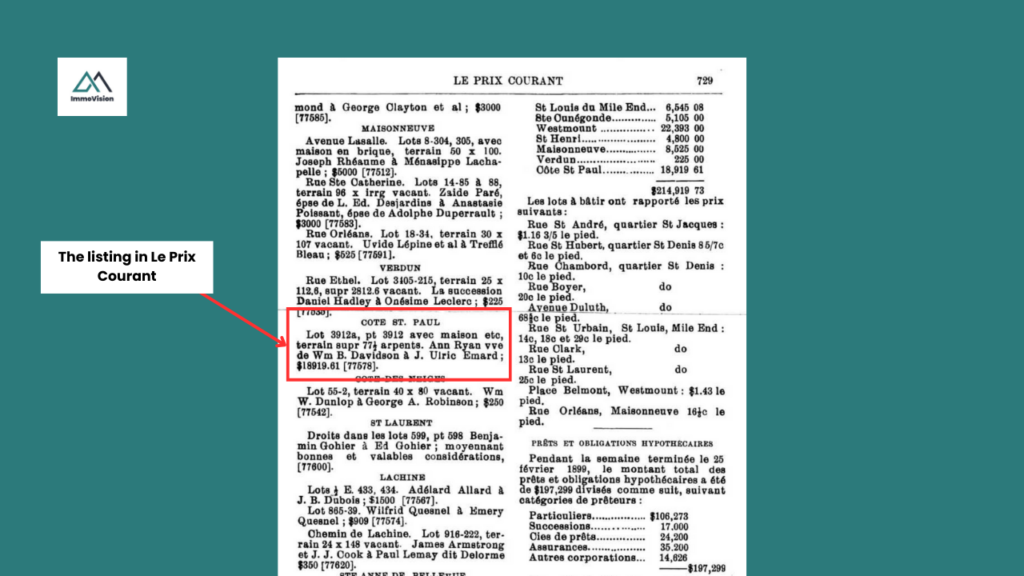
Soon after this, Émard created the Compagnie des terres de la banlieue de Montréal (Montreal Suburb Land Company) with his business partners, including Mr. Monk. Together, partners subdivided the land and laid out new streets.
After 1902, the area owned by Émard became its own independent municipality. This municipality was called Village du Boulevard-Saint-Paul. Émard became mayor of this new municipality and changed its name to Ville-Émard.
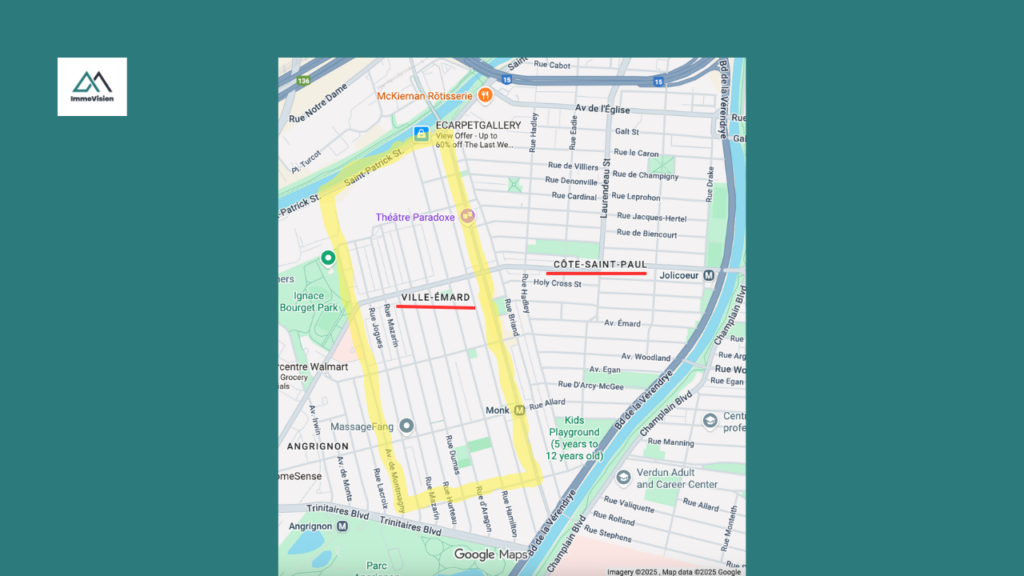
In 1910, as the City of Montreal expanded, smaller neighbourhood struggled to generate the tax revenue from their residents that was required to invest in modernize infrastructure. This led to the City of Montreal annexing Ville-Émard and Côte-Saint-Paul in 1910.
What is it like to live in Ville-Émard today?
Today, Ville-Émard is one of the most quite, residential and stable districts in the Sud-Ouest. Very similar in character to Côte-Saint-Paul, Ville-Émard has escaped the wave of gentrification that has swept through the Le Sud-Ouest Borough. This makes it feel like a stable, middle to lower-middle class area and family orientated area.
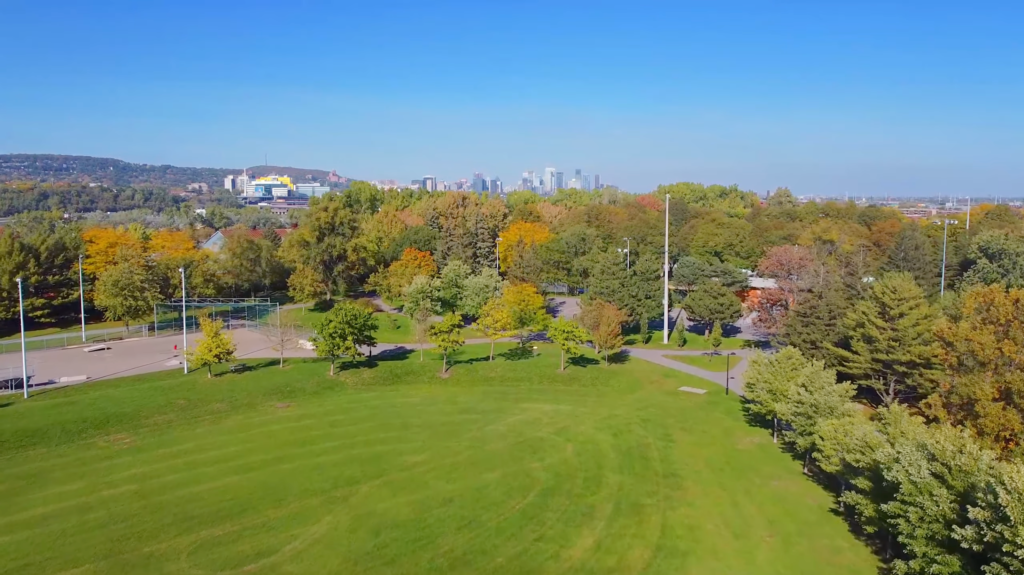
Ville-Émard is incredibly walkable. Most residents are within 10 – 15 minutes walk from either the Monk Metro station or the Angringon Metro (in neighbouring LaSalle). Whilst there are only two parks physically within Ville-Émard, there are several major parks within walking distance for the neighbourhood boundaries. These include Angringon Park (one of the largest and open green spaces in Montreal) and Ignace Bourget Park which includes hills that residents can ski on in Winter. The Lachine Canal is also nearby, giving residents access to a bike trail that runs from Rene Leveque Park, all the way to the historic Old Port of Montreal.
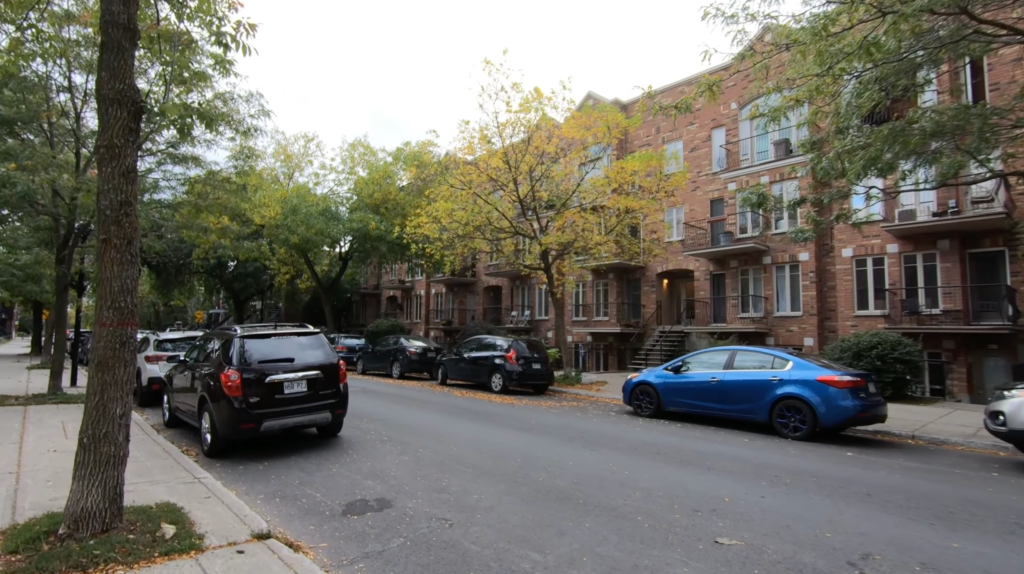
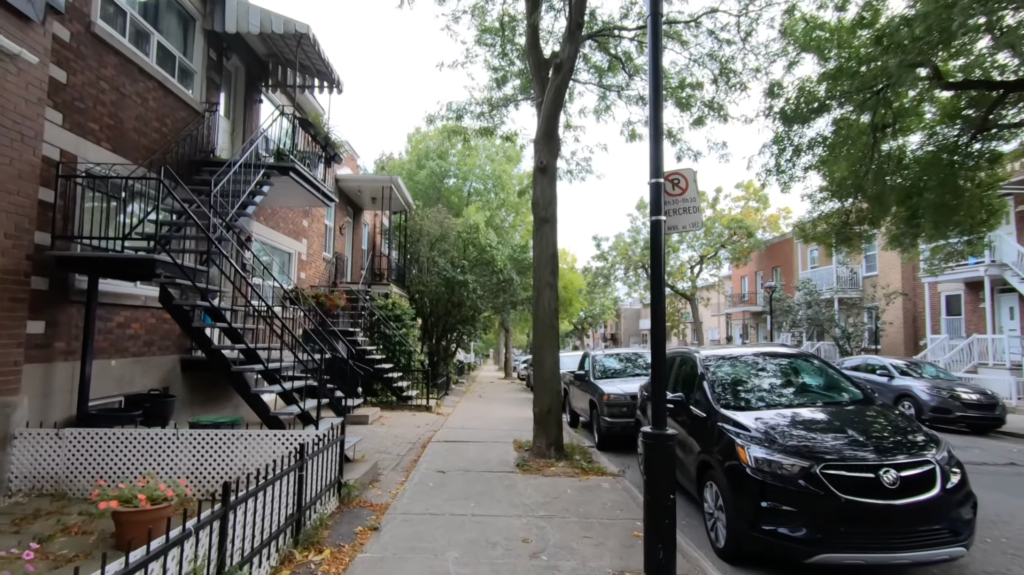
The housing stock is predominantly older duplexes and triplexes (1920s–1960s). Originally built to house factory workers, the apartments look distinctly “Montreal”, with their iron staircases out front. Because of their age, these properties do come with certain downsides. For example, many have block foundations which if not properly treated can result in the development of mold.
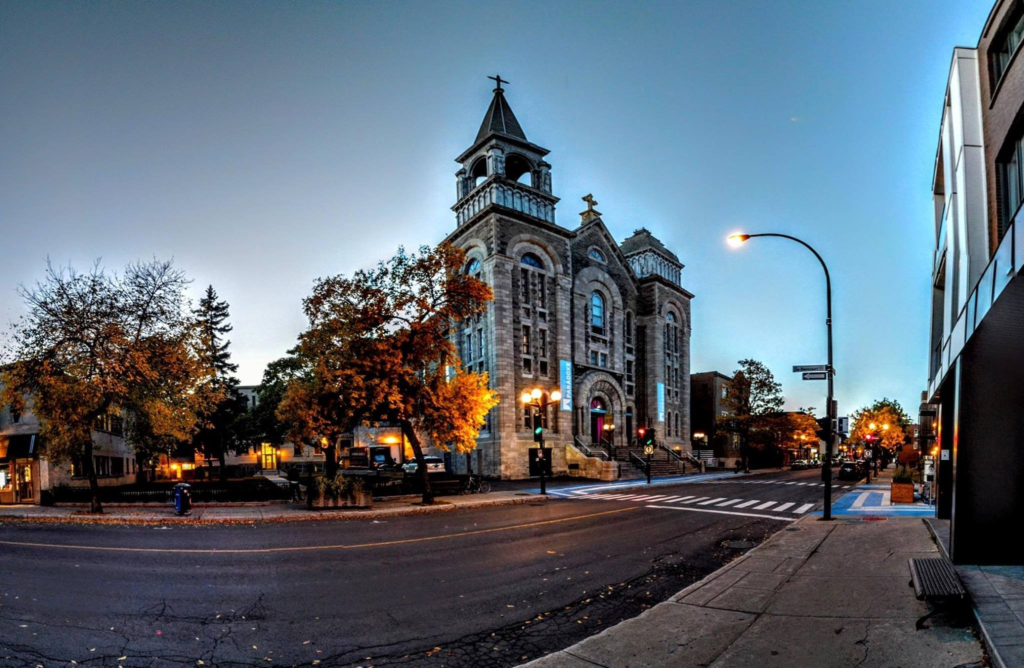
Ville-Émard has also managed to retain many older buildings such as the Notre-Dame-du-Perpétuel-Secours Church (now Théâtre Paradoxe). This is because of its history, zoning, and separation from the canal redevelopment corridor. This allowed it to avoid the urban renweal projects that caused neighbourhoods like Griffintown to be almost entirely demolished. These older buildings, along with the walkability of the area, gives Ville-Émard a feeling of a working class village, located right in the heart of Montreal.
After World War II, tens of thousands of Italian families immigrated to Montréal. Many of these Italians settled in Ville-Émard and stayed. For a period of time, this gave the area an Italian feeling. However this era has largely passed. Nevertheless, it does retains a quiet, blue-collar, family-oriented character with modest prices (compared to others on the Island), older housing, and long-term residents.
Ville-Émard demographics
Ville-Émard is a stable, modest, working-to-lower-middle-class neighbourhood with deep residential roots. According to 2021 Census data, the combined Ville-Émard / Côte-Saint-Paul sector has seen slow, steady growth, with a population of just over 36,000. About 52% of residents have lived at the same address for at least five years, which is high for an inner-city district and reflects a long-term, close-knit community. The age profile is balanced: roughly 14% children, 60% working-age adults, and 17% seniors, giving the neighbourhood a multi-generational character shaped by long-standing families and older residents who never left.
Economically, Ville-Émard reflects its history as a blue-collar residential district developed during Montréal’s industrial era. The median household income sits around $59,000, below the city average, and the neighbourhood has lower university attainment than many neighbouring areas, with only about 20–21% of adults holding a university degree. Many residents work in trades, transportation, retail, and service industries. Combined with an older housing stock and relatively low rents, this produces a grounded, working-class atmosphere rather than a rapidly gentrifying one.
Culturally, Ville-Émard is primarily francophone but notably diverse. About 30% of residents are immigrants and 32% identify as visible minorities, with strong communities of Italian, Latin American, Arabic-speaking, and Vietnamese origin. The housing landscape is dominated by duplexes and triplexes, with about 64% of residents renting and 36% owning, which helps maintain affordability and slows down speculative turnover. Altogether, Ville-Émard’s demographics paint a picture of a quiet, traditional, family-oriented neighbourhood that has seen far less gentrification than Saint-Henri or Griffintown, and retains the steady, lived-in feel of “old Montréal.”
Ville-Émard commute
In this section, we look at what it’s like to commute in Ville-Émard using the three main ways people get around:
Car
Driving in Ville-Émard is generally straightforward. The area is made up of quiet residential streets with light local traffic. On-street parking tends to be easier than in denser neighbourhoods like Saint-Henri or Verdun. Because the streets were laid out in a simple grid during the early 20th century, navigation is easy, and congestion is rare outside of rush hour on Monk Boulevard.
Ville-Émard also sits beside several major roads. These give residents quick, direct connections to:
- Boulevard De La Vérendrye (east–west access across Ville-Émard and Côte-Saint-Paul)
- Highway 15 / Décarie (north toward NDG and the West Island)
- Highway 20 (east to downtown, west to the airport and Dorval)
- Monk Boulevard (north–south connector into Côte-Saint-Paul, Verdun, and the canal)
From Ville-Émard you can reach Lasalle, Verdun, Côte-Saint-Paul, Saint-Henri, the MUHC Glen hospital, and downtown in minutes. There are also a lot of Communauto stations around Monk and Jolicoeur metro. The Communauto is an on street car rental service available to Montreal residents through an app. Many locals choose to use the Communauto rather than owning their own car.
Public transport (metro and bus)
Public transit is one of Ville-Émard’s strongest features. The neighbourhood is served by two Green Line metro stations:
- Monk (central to Ville-Émard)
- Angrignon (in neighbouring LaSalle, but only a short walk or bus ride away)
Most homes are within a 10–15 minute walk of one of these stations, giving residents a fast, no-transfer ride to:
- Downtown Montréal
- Verdun
- Atwater / Westmount
- Berri-UQAM (Central station)
- Angrignon bus terminal (for regional buses and shopping)
From Monk, riders can also get to Lionel-Groulx in just a few stops, which connects to the Orange Line and the 747 airport bus.
The bus network is also excellent. Routes run along:
- Monk Boulevard
- De La Vérendrye Boulevard
- Newman Boulevard
- Crawford Street
These link Ville-Émard directly with Angrignon, Lasalle, Verdun, Saint-Henri, Atwater Market, and the MUHC superhospital. For a suburban-style residential area, transit access is very strong.
Bike
Ville-Émard is a comfortable neighbourhood for cyclists. Residents can access the Lachine Canal easily by heading east toward Monk or Jolicoeur and connecting to the bike network. Once on the canal path, cyclists can reach:
- Atwater Market (10–15 minutes)
- Saint-Henri (10 minutes)
- Old Port (15 minutes)
- Lasalle waterfront (15–20 minutes)
Within Ville-Émard itself, cycling is easy thanks to flat streets, light traffic, and a growing network of bike lanes. BIXI stations are located around Monk metro, Jolicoeur metro, parks, and commercial streets. Many residents choose to cycle for errands or commuting because it is often faster than driving east toward the Atwater area.
Is Ville-Émard safe?
According to SPVM data for Police Station 15, which covers Ville-Émard, Côte-Saint-Paul, and parts of the Sud-Ouest, the area records moderate but generally below-average crime rates compared to more central Montréal neighbourhoods. Annual totals typically fall in the mid-30s crimes per 1,000 residents, placing Ville-Émard in a safer bracket than higher-density districts such as Saint-Henri, Little Burgundy, or downtown-adjacent Griffintown. Property crime occurs but is not unusually high, and crimes against the person remain relatively low for an inner-city environment. As in most of the Sud-Ouest, overall crime in the sector has steadily declined over the past decade.
In practical terms, Ville-Émard feels like a calm, lived-in residential neighbourhood. Its stability is shaped by long-term residents, modest turnover, and a lack of nightlife. This means that most streets stay quiet in the evenings. The areas around typical duplex and triplex blocks between Monk Boulevard and Angrignon feel relaxed and safe for walking, commuting, or raising a family. Daytime activity is light, and the neighbourhood does not experience the kind of late-evening disorder sometimes seen around the bars, restaurants, and busy metro hubs of Saint-Henri or Little Burgundy.
That said, as in any Montréal neighbourhood, safety can vary by micro-area. Monk Boulevard and the blocks immediately surrounding Monk metro can feel busier and occasionally chaotic at night due to heavier foot traffic and nearby commercial activity. Some minor disturbances, noise, or petty theft have been reported around these corridors, but these tend to be situational rather than systemic. Overall, Ville-Émard is considered a generally safe, stable, and predictable neighbourhood with a strong residential character.
What are the schools like in Ville-Émard?
Ville-Émard has a modest but solid selection of public schools. Within the neighbourhood itself, there are two French-language primary schools, one French-language secondary school, no English-language primary schools, and three English-language secondary schools located in nearby districts. As in all of Quebec, school eligibility is based on your home address and Bill 101 rules, so the best way to confirm your child’s options is to check with the relevant school board.
Ville-Émard is primarily served by the Centre de services scolaire Marguerite-Bourgeoys (CSSMB), which operates the main elementary schools in the neighbourhood—École primaire Édouard-Laurin and École primaire Saint-Jean-de-Matha—as well as the local high school, École secondaire Cavelier-De LaSalle, located just over the border in LaSalle but attended by many Ville-Émard students. Portions of the broader area also fall under the Centre de services scolaire de Montréal (CSSDM).
Families who qualify for English-language education under Quebec’s Bill 101 fall under the English Montreal School Board (EMSB). While Ville-Émard does not have an English-language elementary school within its boundaries, English-language secondary schools such as Westmount High School, James Lyng High School, and Lester B. Pearson High School are located in adjacent neighbourhoods and serve local students who meet eligibility requirements.
Overall, Ville-Émard’s school network reflects the neighbourhood’s quiet, residential character—smaller schools, strong French-language coverage, and nearby access to English-language options in neighbouring districts.
What is the Ville-Émard real-estate market like? (Q4 2025)
| Metric | Ville-Émard | Regional (For Comparison) |
|---|---|---|
| Average Asking Price (All Properties) | $456,300 | $770,300 |
| Average Living Area | 899 sq ft | 1,200 sq ft |
| Days on Market | 50 days | 88 days |
Côte-Saint-Paul remains one of the most affordable corners of Le Sud-Ouest, with an average asking price around $456K, condos near $485K, and plexes typically trading in the mid- to high-$600Ks, all turning over faster than the regional average.
Final thoughts
Ville-Émard is one of those Montréal neighbourhoods that offers far more than most people expect. It is close to a lot of desirable locations including, metro access, major roads, the Lachine Canal and downtown Montreal. However, despite this, it has maintained a calm, old-school residential feel that is increasingly rare in the city.
It’s more affordable than Saint-Henri, Verdun, or Griffintown, and while it doesn’t have the same buzz or nightlife, it benefits from the same broader Sud-Ouest conveniences: green spaces, bike paths, local shops, and fast connections to downtown.
What sets Ville-Émard apart is its stability. With long-term residents, modest turnover, and slower gentrification pressures, the neighbourhood has held onto its identity in a way many others haven’t.
For anyone looking for a practical, grounded, and family-friendly part of Montréal and without sacrificing access or convenience, Ville-Émard remains an underrated and genuinely livable option.