

In Quebec, real estate commissions often add tens of thousands of dollars to the cost of buying or selling a home.
For many people, a 1% change in commission can equal at least one full year of mortgage payments. This article explains everything you need to know about how real estate commissions work in Quebec so that you can negotiate a better deal for you and avoid unexpected fees at closing. More specifically we will cover:
- How realtors and their agencies earn commission in Quebec
- How buyer’s agents earn their commission in Quebec
- How seller’s agents earn their commission in Quebec
- What is the average commission that realtors make in Quebec?
- How to negotiate a realtors commission?
- What is a fair commission for a real-estate agent?
- Frequently asked questions
- Final remarks
How realtors and their agencies earn commission in Quebec
Under Quebec’s Real Estate Brokerage Act, a real estate broker cannot operate independently. A licensed real estate agency must supervise every broker, and each broker must operate under that agency. In most cases, the agency does not pay the realtor a salary or benefits; instead, the broker works on commission and shares a portion of their earnings with the agency.
Let’s say work with a realtor to help you buy a home. Generally, the realtor will charge you nothing up front. Instead, once the transaction has closed, seller’s agent will split their commission 50/50 with the buyer’s broker. Both the seller’s and the buyer’s broker will then pay a portion of that commission back to the agency. The graphic below shows how commission and agency splits work for a $750,000 home purchase.
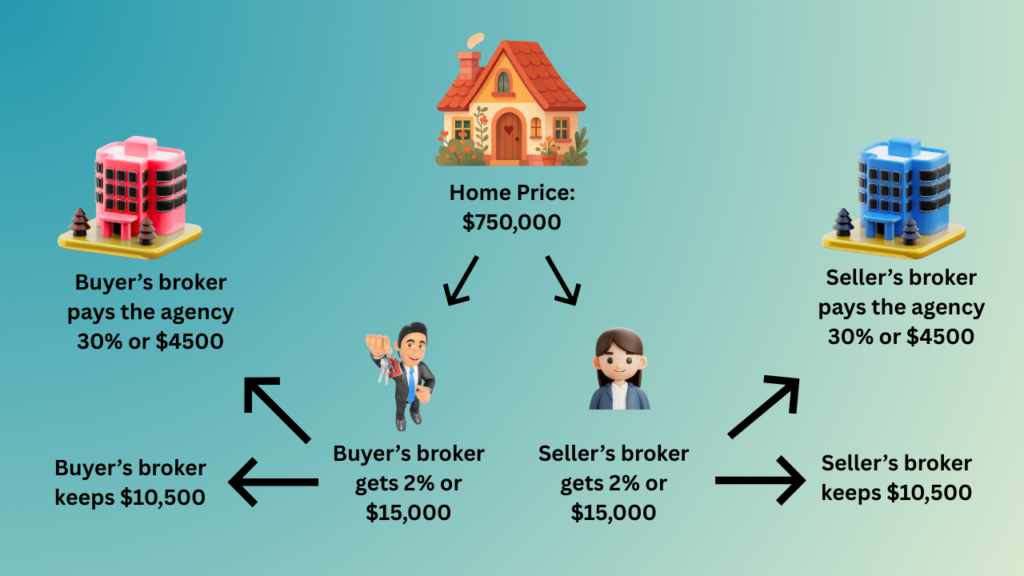
As shown in the graphic, the total commission is 4%, split evenly between the seller’s broker and the buyer’s broker at 2% each. Each broker then pays approximately 30% of their commission to the agency that they work under and keeps the remaining 70%.
The exact details of how you will pay your realtor are set out in the Exclusive Brokerage Contract – Sale or Exclusive Brokerage Contract – Purchase. These are mandatory and template forms from the OACIQ.
How buyer’s agents earn their commission in Quebec
When you hire a realtor to help you buy a property, you sign an Exclusive Brokerage Contract – Purchase. This is a legal agreement that outlines (among other things) how much you will pay the buyer’s agent. In the contract, you agree to pay the realtor either a commission or a lump-sum fee. This is set out in Clause 6 of the Exclusive Brokerage Contract – Purchase.
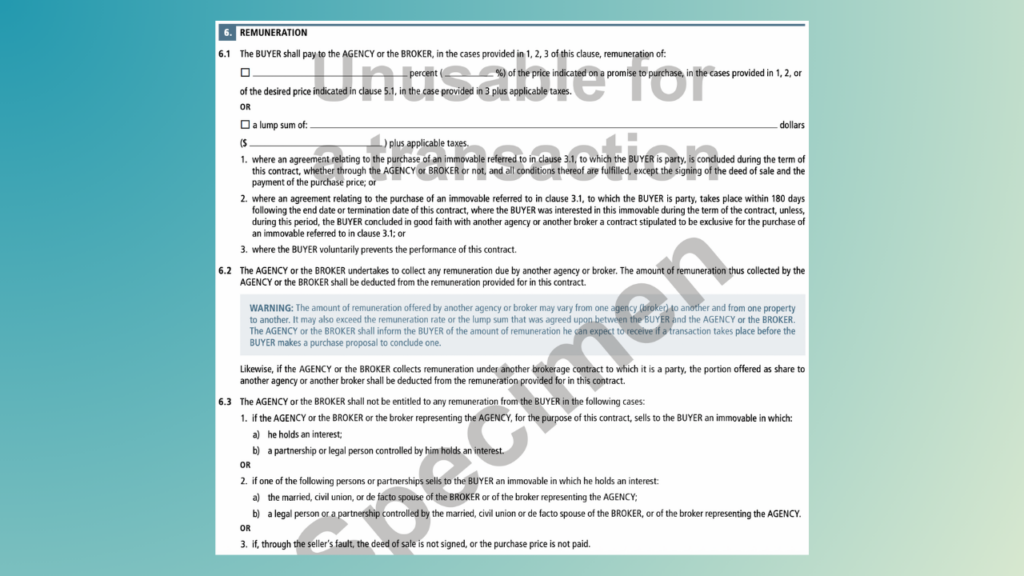
Under the details in Clause 6, the buyer is contractually obligated to pay their agent as soon as all conditions of the promise to purchase are satisfied (even before the deed of sale is signed).
However, in practice, the buyer’s agent will first collect their commission from the seller’s agency through the notary at closing. The buyer’s agent will only ask the buyer for a direct payment if there is a shortfall between the commission offered by the seller’s agency and the amount agreed to in the buyer’s brokerage contract, or if the seller is not represented by a broker.
In these situations, the buyer may either pay the difference directly as a closing cost or include it in their financing. When included in the financing, the broker’s remuneration is added to the purchase price and paid by the notary from the transaction funds at closing.
How seller’s agents earn their commission in Quebec
When you hire a broker to help you sell your property, you must first decide whether to sign an Exclusive or Non-exclusive brokerage contract for sale. If you sign an exclusive contract, the broker has the right to act as your sole representative and earn either a commission or a lump sum payment if the property sells during the contract period, even if you find the buyer yourself. Alternatively, if you sign a non-exclusive contract, the broker earns either a commission or lump sum payment only if their efforts directly lead to the sale.
As with the buyer’s broker, the seller’s agent earns their payment once the parties fulfill the conditions in the signed promise to purchase (even before signing the deed of sale). Clause 7.3 of the brokerage contract for sale is where the listing agent writes down how much of their commission they will split with a buyer’s agent. The listing agent can also offer a fixed fee. Generally however, the broker will offer a 50/50 split with the buyer’s agent.
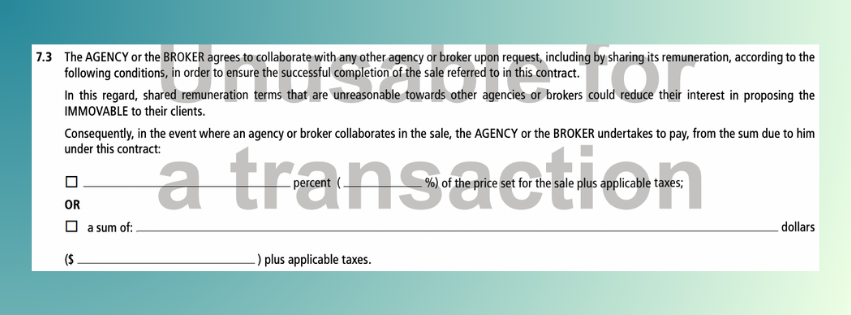
In Quebec, the seller normally pays the listing agent a commission and not a lump sum payment. The seller may also pay for other expenses incurred by the listing agent for example, the cost of staging the home or taking professional photographs. The listing agent will note down any other fees in Clause 11 of the brokerage contract for sale.
What is the average commission that realtors make in Quebec?
Realtors do not charge a standard commission when representing clients in a real estate transaction. In fact, commissions are fully negotiable and vary based on the brokerage, the services provided, years of experience, and the complexity of the transaction. That said, if you’re looking for a general sense of realtor fees in Quebec, these statistics can give you a helpful benchmark.
In 2024, agents in the top cities in Quebec charged on average the following average commission:
| City | Average Commission (%) |
|---|---|
| Montreal | 1.84% |
| Quebec | 1.75% |
| Gatineau | 1.93% |
| Laval | 2.25% |
Before you sign a brokerage contract with an agent, you must understand what services are included and compare their fees with other realtors.
How to negotiate a realtors commission?
Realtors do not charge a fixed or average commission when representing clients. Commissions are fully negotiable and depend on the brokerage, the services offered, and the complexity of the transaction. In this section, we share three practical tips for negotiating your realtor’s commission.
Tip 1: Interview multiple agents
In order to negotiate realtor commissions, you must first get a sense of what services are available in your local market. To do this, you should contact at least three local realtors and ask them a series of questions about the services they offer and at what price.
Typically listing agents will offer things like professional pricing (aka. a Comparative Market Analysis (CMA)), staging services, professional photography, floor plans, pre-listing inspections and at least one house. Buyer’s brokers meanwhile will tend to offer things like attending viewings, conducting a CMA to establish a fair purchase price prior to negotiation, and advising on offers.
Each realtor will offer different services and pricing. You should compare each offer and assess which services you really need for your particular property. For instance, if you are selling a one bedroom condo, do you need drone footage, or are you okay with only professional photographs. Similarly, if the agent offers a lockbox vs private viewings, this can be totally fine, but then the price should be lower.
Once you have interviewed three agents and have a good understanding of what each offers and what the local market value is for each of the services.
Tip 2: Experience matters
In real-estate, the number of years experience matters. If the realtor does not have any prior experience, then they should reduce the commission that they charge. This is because there is a higher probability of a junior realtor putting you, as a client, into a bad situation. For instance, realtors that have not seen many transactions, may not fully appreciate the long term financial risk of skipping a pre-purchase inspection or know how to accurately estimate repair costs. This ultimately means that they cannot properly value the property.
Junior realtors are typically paired with experienced realtors who will mentor them. This is great however, unless you have the full attention of the mentor, the realtor should still reduce their rates if they lack the experience.
Tip 3: Use pricing tiers
Some realtors will pitch you a very aspirational value for your home. For example, they might say that your home is worth $1 million when in reality it is closer to $850,000. What you might want to consider is to offer the realtor a higher commission if they are able to sell your home for a higher price. For instance, you can offer them:
- 4% commission if they sell your home for more than $1 million
- 3% commission if they sell your home for between $900,000 – $999,999
- 2% commission for anything lower than $900,000
What is a fair commission for a real-estate agent?
A fair commission for a real-estate agent depends on the services they provide and how these services compare to what other agents in your local market offer. Consider the following two options for two different listing agents.
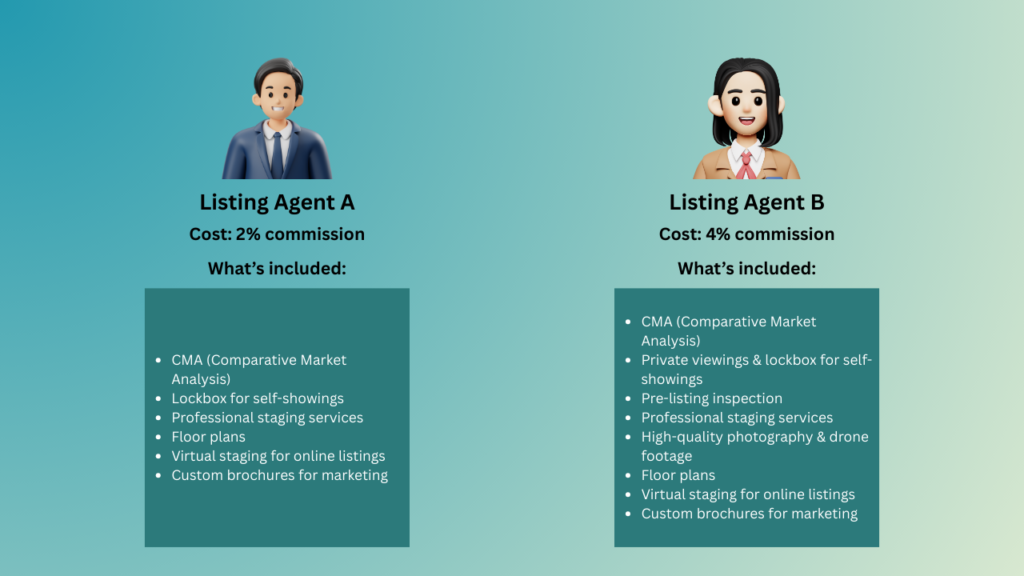
Listing Agent A is asking for 2% commission whereas Listing Agent B is asking for 4% commission. For the extra commission, Agent B includes a lot more services with this higher price however, do you need all of the extra services offered by Listing Agent B?
Ultimately, this will depend on the type of property that you are selling. For a multi-million dollar luxury detached home in the country, you might need a drone and custom brochures. In contrast, if you are listing a one bedroom condo in low-rise property in downtown Montreal, you probably do not need all of these services.
Frequently asked questions
– By mutual agreement: You and the broker can agree in writing to terminate the contract early.
– At expiry: The contract automatically ends on the stated end date.
– For serious breach: If the broker fails to meet their legal or contractual obligations, you may be able to cancel the contract without penalty.
– Through the agency: You can ask the agency to assign a different broker or release you from the contract.
Always check whether the contract includes a protection (holdover) period, which may still entitle the broker to remuneration after the contract ends.
1. Document the issue (emails, messages, missed obligations).
2. Raise the issue with the broker’s agency, which is legally responsible for supervising the broker.
3. Request termination or reassignment if the problem isn’t resolved.
4. File a complaint with the OACIQ if the conduct breaches professional obligations.
In serious cases, a broker’s failure to perform may justify terminating the contract without paying remuneration.
Final remarks
In Quebec, hiring a real estate agent can add tens of thousands of dollars to the cost of buying or selling a home. However, a skilled broker can also help you sell for well above market value, secure great deals on properties, and minimize financial risks from issues such as latent defects.
The key thing to remember is that you only get your money’s worth from a realtor if the services they provide match the commission you pay. For instance, if you are an experience buyer or seller then you can hire a junior realtor at a low commission to manage the process and help you with the paperwork. Conversely, if you are a first time buyer or seller, it may make sense to hire a realtor with more experience and pay a little extra commission.
Read more about realtors commission in Quebec
- Quebec real-estate commission calculator (2026)
- How to Choose a Real Estate Agent in Montreal (2026)
- How to do Comparative Market Analysis (CMA) in Quebec (2026)
Need help finding a realtor?
At Immovision, we interview hundreds of realtors in Quebec to find those who offer the most competitive services at the best rates. We then help you match with a realtor best suited for your needs. Simply click the link below and tell us a little bit about your project, from there we will connect you with the best agent for your specific project.
👉 Get matched with the top Quebec realtor for your project today.