If you are buying or selling a home in Quebec built between the 1960s and 1980s, pyrite is something you need to know about. This mineral, once used in foundation backfill, can react with air and moisture, causing cracks to appear in your foundation, floors to lift, walls to bulge and door frames to crack.
In this guide, we’ll explain how to spot warning signs, confirm its presence and protect yourself during a real estate transaction.
What is Pyrite?
Pyrite, also known as “Fool’s Gold,” is a sulphide mineral commonly found in sedimentary rock. In Quebec between the 1960s and 1980s it was commonly used to make crushed stone for backfill, that goes under your foundation or garage floor.
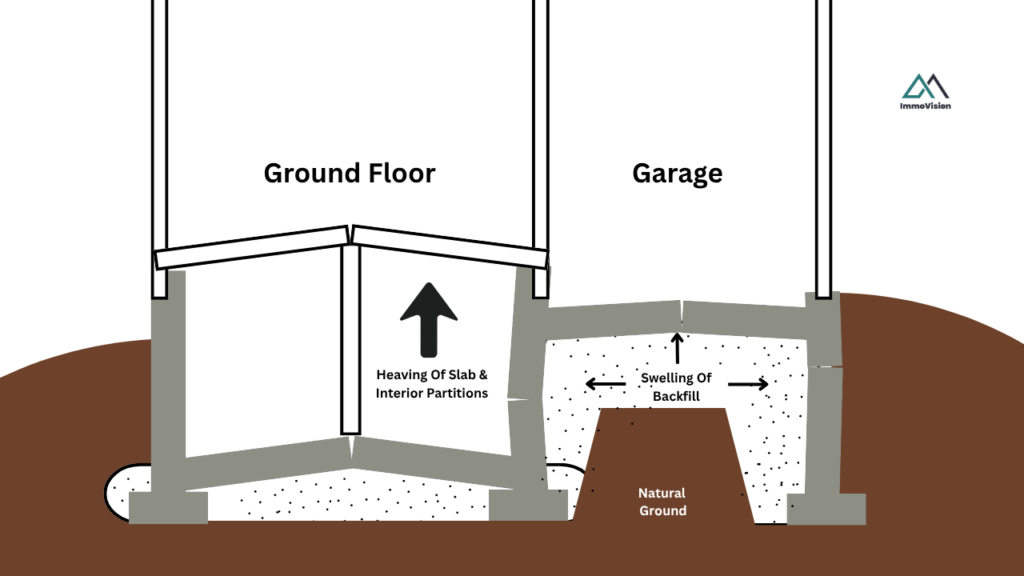
When pyrite in the backfill reacts with oxygen and humidity, it can expand and push upward on the concrete slab (the flat concrete floor that sits on top of the backfill). This can cause the slab to crack and lift, damaging foundations, warping floors and even stressing load-bearing walls over time. The process happens slowly, often taking a decade or more before the first signs, such as uneven floors or spider-web cracks, begin to appear.
The image below shows what this can look like:
When is Pyrite a problem?
Pyrite only becomes a problem in construction when three conditions come together:
- There is pyrite present in the backfill
- The backfill is exposed to oxygen
- There is enough humidity for a chemical reaction to occur
When these three elements (pyrite, oxygen and moisture) interact, the pyrite oxidizes, producing sulfuric acid and expanding minerals. The effect of which is to slowly lift and crack the concrete slab above.
Which areas are most at risk of Pyrite
In Quebec during the 1960s and 1980s, some quarries unknowingly supplied crushed stone contaminated with pyrite to nearby construction sites. This crushed stone was then used in backfill.
Since builders typically sourced backfill locally, entire neighborhoods could be affected depending on which quarry they drew from. As such, if your home was built near a quarry that contained pyrite-infected rubble between 1960 – 1980, there is a real chance that the backfill beneath your foundation or garage slab contains pyrite.
The OACIQ lists 91 municipalities in the Greater Montreal area where pyrite issues have been identified. It highlights the South Shore (from Châteauguay to Varennes), the East End of Montréal (Rivière-des-Prairies, Pointe-aux-Trembles, Repentigny) and the West Island (Lachine, Dorval, DDO, Pointe-Claire, Kirkland, Pierrefonds-Roxboro, Beaconsfield) as particularly high-risk.
Free Pyrite Risk Check
Instantly know if your property is located in a pyrite risk zone.
Swelling Potential Petrographic Index, or SPPI
To understand which areas are most at risk, experts analyzed samples from quarries that supplied crushed stone (backfill) to housing developments across Quebec in the 1960s–1980s.
Each quarry’s material was tested in a laboratory using the Swelling Potential Petrographic Index or SPPI (in French, Indice Pétrographique Potentiel Gonflant – IPPG)). This test assigns a score to each quarry that tells us how likely the stone is to expand when exposed to air and humidity. Based on these results, risk levels were then assigned to neighborhoods built with backfill from those quarries. The risk scores are shown below:
| IPPG / SPPI Score | Risk Level | Meaning |
| 0 – 10 | None | No pyrite problem expected |
| 11 – 20 | Low | Minor risk – monitor only |
| 21 – 40 | Medium | Potential for future swelling |
| > 40 | High | Pyrite likely to cause heaving and cracking |
Whilst risk scores are not made publicly available, homeowners are able to request SPPI tests on their property. Homeowners can then compare the results of the test to the SPPI score to determine the risk of pyrite causing an issue in their backfill.
What are the consequences of Pyrite in backfill?
The presence of pyrite in the backfill that surrounds your foundation can cause the ground beneath your concrete slab to swell as the mineral oxidizes and expands. This gradual movement exerts upward pressure on the slab and foundation walls, leading to cracks in the concrete, uneven or heaved floors, doors and windows that no longer close properly, and damage to finishes or floor coverings.
Over time, this can evolve into a serious structural issue that reduces the property’s value. In addition, it will complicate resale since many financial institutions will not provide a mortgage for a property where pyrite is present, thereby reducing the pool of potential buyers. Meanwhile, insurance companies may also refuse to insure pyrite related damages.
As we will see later on, pyrite can be removed, and even though this is costly, municipalities do provide assistance programs. However, it is very important to be informed about pyrite testing options and understand related costs prior to any real estate transaction.
What are the visual indicators of pyrite in a house
Although it is impossible to be certain of the existence of pyrite, there are three main visual indicators to watch out for.
These are:
- Cracking and Lifting of Concrete Slabs
- Structural or Finishing Deformations
- Efflorescence and Moisture Traces
Let’s take a look at each of these points now.
Buyers Tip
1. Cracking and Lifting of Concrete Slabs
When pyrite expands in the backfill surrounding a foundation, it creates two very distinct effects.
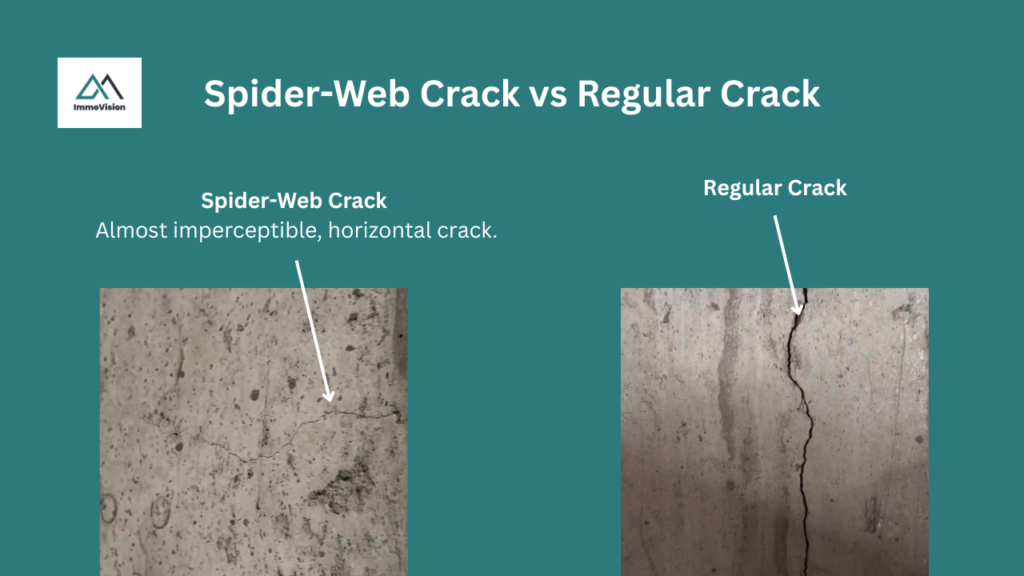
First are star-shaped or spider-web cracks (very thin horizontal cracks) in the floors and walls of the basement and garage. This type of crack is an early warning sign of expanding backfill. The image below gives an example of a normal crack that can easily be fixed vs a spider-web crack caused by pyrite expansion in the backfill.
Second, expanding pyrite can cause the concrete slab that the house is built on to “heave” upwards. This when the expanding backfill reaches a much more advanced stage. It can be most easily identified by the floor of the basement visibly sloped or higher in the middle rather than the edges. You will be able to notice this by paying attention as you walk through the basement of the house.
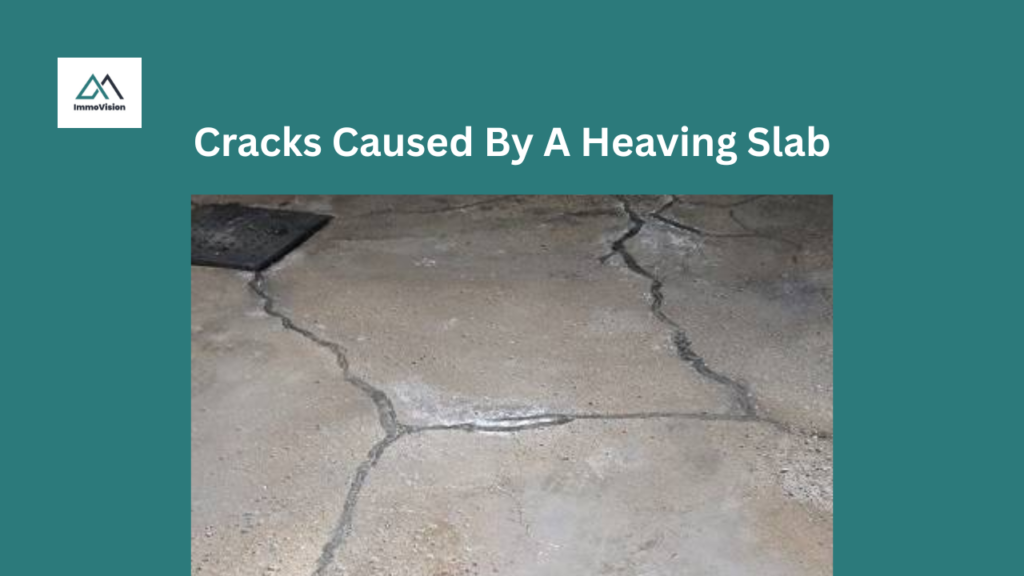
In addition to sloped floors, as the slab heaves upwards, this can create cracks wide enough to fit a coin in horizontally. These cracks can be vertical in foundation walls or radiate and join together in loops or points on the slab.
The image below shows a real-life example of a slab uplift caused by backfill expansion. Notice how several cracks radiate outward in loop-shaped patterns and how the slab appears domed upward at the centre. These patterns differ sharply from the fine, spider-web type cracks seen in early-stage damage.
2. Structural or Finishing Deformations
As the concrete slab or foundation slowly lifts, it doesn’t just affect the basement. The movement can travel through the entire structure. Doors and windows may start to stick or no longer close properly. Floors can become uneven or slope toward the edges of rooms. You might also see cracks forming in drywall, ceramic tiles or around door frames as the house shifts and materials above try to adjust to the movement below.
You will be able to spot these sloping floors when walking through the upper floors. If you try closing doors on higher floors, you will also notice if doors do not close properly. Lastly, check both the interior and exterior walls of the property for the spider-web cracks.
3. Efflorescence and Moisture Traces
When pyrite reacts with air and humidity, it produces sulfuric acid and expanding minerals such as gypsum. This chemical reaction can leave behind white, powdery deposits on the surface of cracks or along the edges of the concrete slab. The image below shows what this can look like.
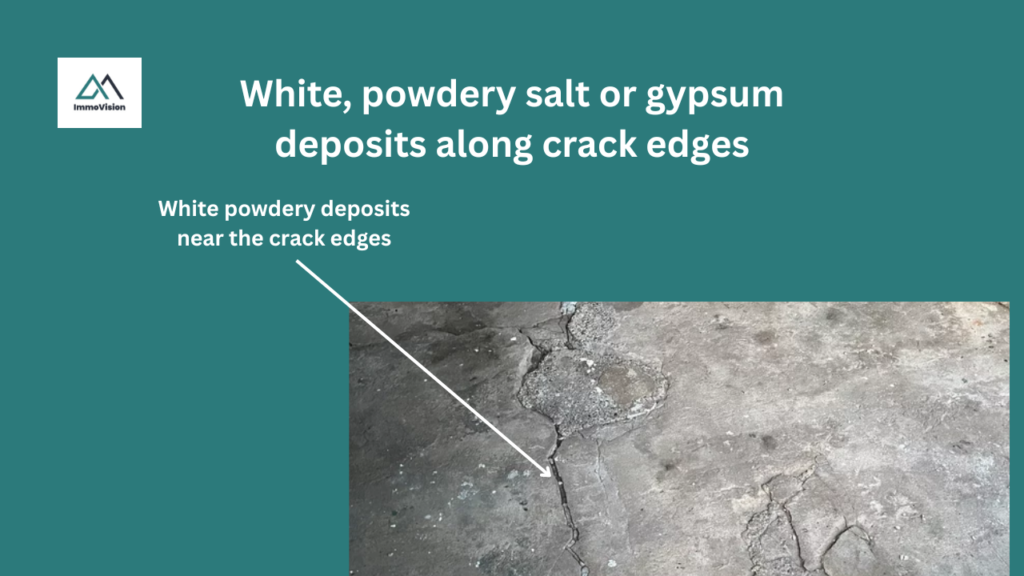
The OACIQ notes that this type of residue is often mistaken for simple dust or mineral salts. However, it is a telltale sign that the backfill is swelling beneath the foundation.
You may also notice a musty smell or higher humidity in the basement, even if there’s no visible water leak. That’s because when the pyrite oxidizes it releases moisture. As such, powdery deposits, faint odors, or dampness can be early telltale signs that pyrite in the backfill is expanding.
Buyers Tip
Buyers: How to protect yourself in a real estate transaction
If you’re buying a home in an area known for pyrite, the OACIQ states that your broker must inform you of this fact. The OACIQ also recommends checking whether the seller already has a certified test, called an expertise, confirming if the backfill contains pyrite.
When you ask for this test, there are two possible scenarios:
Scenario 1: A valid test exists
If a valid test exists, your broker must share the report with you and you can even consult your own expert to interpret the results before making a Promise to Purchase.
Consulting with an expert to validate the results of the sellers test is worthwhile if the seller’s report looks questionable. For example, if it’s old, inconclusive or from a non-accredited lab. Your expert can help you decide whether to rely on the report or include a conditional clause in the Promise to Purchase requiring a new test.
Taking this precaution can protect you legally since, once the seller provides a pyrite report, it becomes part of the representations you rely on in your promise to purchase. If the report later proves false or unreliable, withdrawing from the deal can be complicated. This is especially the case if the seller claims you accepted the property “as disclosed”.
Scenario 2: No test exists
The OACIQ recommends making your Promise to Purchase conditional on a new pyrite analysis, usually paid for by the seller. This clause ensures that if pyrite is found, you’re not forced to move forward with the deal. You or your broker must add this condition to the Annex – Expert report, in the promise to purchase.
Please note, buyers are not allowed to make the Promise to Purchase conditional on a pyrite test with a specific percentage limit. This is because there is no fixed threshold that defines when pyrite becomes a problem and only a qualified expert can interpret the results. Instead, buyers should make their offers conditional on being satisfied with the test results.
Buyers Tip
Sellers: How to protect yourself in a real estate transaction
If you’re selling a home in an area known for pyrite, the transaction comes with extra steps and responsibilities. The OACIQ outlines specific precautions that both sellers and the listing brokers must follow to ensure the property’s condition is properly assessed and disclosed before the sale is complete. These include the following:
- Realtors have a responsibility to inform their clients of the existence of pyrite in risk zones and the consequences of selling a house with pyrite in the foundation;
- The listing broker must include the risk of pyrite in the Sellers Declaration whether or not the seller is aware of the presence of pyrite;
- Specialist tests should be ordered to determine if pyrite causes or may cause problems;
- The seller normally bears the cost of the pyrite tests since, it is in the sellers interest to know whether pyrite exists in the backfill that surrounds their property;
- If a pyrite problem is detected, then this should be reflected in the selling price of the property i.e. the price for the property should be adjusted downwards by the amount required to remove the pyrite;
- The seller must share the results of the specialist test with potential buyers, regardless of the result of the analysis.
Sellers Tip
How pyrite can be removed?
Unfortunately, there’s no way to stop pyrite from oxidizing once it starts. The only permanent solution is to remove the contaminated backfill. This involves breaking and removing the concrete slab, excavating the pyritic stone down to the foundation and replacing it with DB- or IS-certified backfill before pouring a new slab.
In really bad cases, where the interiors of the house have been damaged e.g. door frames, kitchen cabinets & cupboards etc., remediation of the issue will require that the entire interior is stripped. However, if caught early and damage is minimal, full excavation may not be necessary. A qualified structural engineer or geotechnical expert should assess the extent of the problem before any work begins.
Note
How much does it cost to remove pyrite from the backfill?
The cost varies depending on the size of the area and the depth of excavation required. For context:
- Garage slab: from $5,000–$10,000
- Basement: from $20,000–$50,000+, sometimes taking 1 to 4 weeks to complete.
Because this work involves heavy excavation and rebuilding, always hire a certified contractor with pyrite remediation experience.
Assistance programs, grants and guarantees
In Canada, financial assistance for homeowners generally falls into three formal categories.
In addition to these formal programs, there are sometimes private or community assistance programs for example, local charities, non-profits, or financial institutions that occasionally fund accessibility or safety renovations (e.g., Habitat for Humanity, Canada Helps Housing Fund, or credit-union-sponsored retrofit programs).
Federal Programs
These are run by the Government of Canada (e.g., CMHC, Natural Resources Canada). They usually target nationwide priorities like energy efficiency or affordable housing. Examples include Canada Greener Homes Grant, CMHC Eco Plus Rebate, First Home Savings Account (FSHA) and so on.
There are currently no federal programs that will help you remove the pyrite from your backfill.
Quebec’s Provincial Programs
These come from the Government of Quebec (through ministries like Transition Énergétique Québec or SHQ). They focus on region-specific issues such as older housing stock or rural repairs for example, Rénoclimat, RénoRégion.
The Programme pour les résidences endommagées par la pyrrhotite is a provincial assistance program administered by the Société d’habitation du Québec (SHQ), for homeowners whose foundations are damaged by Pyrrhotite.
The program covers 75% of the eligable costs, up to the following maximum amounts:
- $75,000 for buildings not covered or no longer covered by the Guarantee Plan for New Residential Buildings;
- $15,000 for buildings covered by the Guarantee Plan, in cases where restoration work on rooms located in the basement is not covered.
IMPORTANT UPDATE
Municipal Programs
These are offered by cities or municipalities (like Montréal’s RénoPlex). They often cover structural or foundation work, safety upgrades, and neighborhood revitalization.
To find out whether or not your municipality offers financial assistance to remove the pyrite from your backfill, you should contact your municipality directly and ask them.