I lived in Le Sud-Ouest Borough of Montreal for 6 years in Pointe-Saint-Charles.
During my time there, I visited different parts of the borough almost every day to do groceries, go to the gym, visit friends and dine out. In this article I will break down everything you need to know about what it is like to live in Le Sud-Ouest, Montreal. Specifically we will look at:
- Where is Le Sud-Ouest Borough of Montreal?
- What are the main cities in the Sud-Ouest?
- What is it like to live in Le Sud-Ouest?
- What is the nicest neighbourhood in Le Sud-Ouest?
- Final thoughts
Where is Le Sud-Ouest Borough of Montreal?
Le Sud-Ouest is located just southwest of downtown Montréal, stretching along the Lachine Canal and bordered by the boroughs of Ville-Marie, Verdun, LaSalle, and Westmount.
What are the main cities in the Sud-Ouest?
The Sud-Ouest Borough is comprised of six different neighbourhoods. These are shown in the map below.
<Insert map>
Of these six neighbourhoods, Griffintown, Little Burgundy and Saint-Henri are often referred to as Les Quartiers du Canal. This is because they are the canal-side districts whose identity, architecture, and early development were directly tied the Lachine Canal. Other key landmarks that are found within this borough include:
- Part of the Lachine Canal – a long stretch of the historic Lachine Canal.
- Parc Angrignon – One of Montréal’s largest urban parks, located at the western edge of the borough.
- Atwater market – A major Montréal landmark on the eastern side of the borough.
<Insert image>
What is it like to live in Le Sud-Ouest?
Demand for properties to buy and rent in Le Sud-Ouest have skyrocketed in the last 5 – 10 years. This is due to several factors including:
- Its proximity to downtown;
- Exceptional transport links;
- It is surrounded by heritage architecture;
- Walkable streets;
- Large, green open spaces.
Residents of Le Sud-Ouest Borough are right in the middle of Montréal. From anywhere in the borough, you can get to the Old Port, downtown, Atwater Market or the canal on foot. And you are not walking along soulless boulevards; you’re walking through historic industrial streets lined with old worker housing and converted factories.
<Insert image>
The architecture creates a strong sense of community. Because these neighbourhoods were originally built for blue collar workers, homes are built very close together. That density creates a unique 19th Century working class environment where neighbours will sit on the steps of their homes to talk, on rooftop patios (in the newer high rises), kids play in alleys, and people’s home life naturally spills out into the streets.
<Insert image>
At the same time, Le Sud-Ouest is not frozen in the past. Over the last decade, the entire borough has been heavily reinvested in. There are hundreds of cafés, bakeries, independent restaurants, new public squares, pedestrian zones, and renovated parks.
The Lachine Canal, which is the defining feature of the Borough, is now one of the best urban green corridors in the city. Residents take advantage of this green space to bike, walk, play volleyball, do yoga or sit on the grass with friends in the summer. Le Sud-Ouest also has 54 parks, including the massive Parc Angrignon, and copious numbers of splash pads offering residents outdoorsy summers and cozy winters, where life slows down into cafés and neighbourhood routines.
<Insert image>
There are also a good range of English speaking and French speaking schools in the area. Although you have to be aware that zoning and language laws (Bill 101) apply. And, whilst the area is mainly Francophone, most people in the area are bilingual.
Life in Le Sud-Ouest is thus broadly defined by the same things; walkability, access to the canal and other green spaces, the heritage architecture that conveys an unmistakable working-class neighbourhood feel and excellect location relative to downtown, Old Montreal and transport links.
All that being said, it is impossible to judge what it is like to live in Le Sud-Ouest by considering it as one location. In reality, the demographics, property prices, housing stock, and overall atmosphere vary a lot from one area to the next. So, whilst these neighbourhoods share a common past, their futures are clearly diverging. Some, like Griffintown, Little Burgundy, and parts of Saint-Henri, have seen rapid gentrification and soaring real-estate prices. Others, like Côte-Saint-Paul and Ville-Émard, have been insulated from this trend.
So if you’re trying to decide which part of Le Sud-Ouest is the best to live in, it’s worth looking at each neighbourhood individually. What follows is a breakdown of all six. We will look at what they’re like today, who lives there, what the housing looks like, and what you can realistically expect if you move there.
What is the nicest neighbourhood in Le Sud-Ouest?
They say that Montreal is the city of neighbourhoods and, no where is this more visible than in Le Sud-Ouest.
Despite being geographically close to one an other, each of these neighbourhoods in Le Sud-Ouest has a totally different feel. In this section we will list out what it is like to live in each neighbourhood and why the property prices in areas such as Côte-Saint-Paul and Ville-Émard have increased at a slower rate compared to the others.
Griffintown
Since the mid-1800s, Griffintown was a predominantly Irish working-class neighbourhood built around the Lachine Canal. The canal provided cheap hydropower that could be used by local factories and carried thousands of barges each year. This created local blue collar jobs in factories, warehouse’s and a wide range of rail yard and transport jobs. At the time, most residents worked in industries directly tied to this canal-side economy.
As electricity replaced the canal’s hydropower, Griffintown lost the main advantage that had attracted factories there in the first place. By the time the St. Lawrence Seaway opened in 1959, the canal was effectively obsolete, barge traffic disappeared. The entire canal-side industrial economy started to go into decline. Factories shut down, residents left, and large parts of the Griffintown became derelict. In the 1960s, Griffintown was re-zoned. Under the new zoning laws, homeowners could no longer rebuild their houses if they were destroyed (e.g., by fire). This led to physical neglect, abandonment, and a halt to all new residential investment, forcing residents out over time. Old buildings were demolished and Griffintown turned into a ghost down.
Then in 2002, the federal government reopened the Lachine Canal for recreation. The City of Montreal followed by rezoning Griffintown for residential and mixed-use development. This was because, the area was seen as prime real-estate and one of the last undeveloped areas so close to downtown and Montreal’s historical Old Port. This marked the beginning of Griffintown’s revival. It lead to extensive condo construction, rapid urban transformation, huge demand for condos and a the wave of gentrification seen today.
It is unsurprising that Griffintown has attracted so many people. In addition to the proximity to downtown, its nearness to the canal gives residents the option for very outdoorsy summers and cosy winters. Many Griffintown residents for instance will spend summer months sunbathing, riding along the canal bike path, doing water sports, playing volleyball in the communal courts. Moreover, there are a range of independent cafe’s, restaurants and bars scattered throughout the neighbourhood.
Griffintown is predominately high-rise and mid-rise condos that were constructed after 2008. Many of these buildings come with rooftop terraces and pools, gyms and unground parking (great for winter in Canada). These condos offer very low-maintenance lifestyle. Owners do not need to dig snow, worry about repairing aging structures or handling seasonal upkeep. However, the fees on mid- to high-rise condos are generally higher than low-rise buildings.
The condo units in Griffintown are mainly occupied by renters and young professionals. The high number of renters implies that many of the units are owned by investors. This represents some challenges for long term community development as quite often investors have different priorities to long term residents.
In short, Griffintown is a great place to live if you are looking for a modern, low-maintenance lifestyle close to downtown, with plenty of cafés, restaurants, and easy access to the canal. However, the newness of the neighbourhood and the high number of renters does give Griffintown a somewhat transient feel. In the long run you should expect long-term community ties to develop but this will take some time.
Saint-Henri
Saint-Henri was historically a French-Canadian and Irish working class neighbourhood. As with Griffintown, the inhabitants were primarily blue collar workers who benefited from jobs brought by the Railroad and the Lachine Canal which enabled nearby factories to benefit from the hydropower and transportation links that it created.
Factories built along the canal needed workers and so there was a spike in demand for people to physically relocate to Saint-Henri and the other neighbourhoods along the canal. This caused a surge in the Saint-Henri’s population which grew from 470 inhabitants in 1825 to 21,000 people by 1901. Real-estate investors capitalized on this growth by buying up the areas surrounding Saint-Henri, breaking it up into lots and building low cost wooden homes for workers.
The fact that these properties were made out of wood is important. This is because wood was much provided a source of low cost housing. However, the city of Montreal prohibited the development of wooden houses. Later on, when Saint-Henri was incorporated into the City of Montreal, the future development of wooden houses was banned. However, the old wooden houses were allowed to remain. Many people chose to build brick facades that cover this wood and you can still see these houses today.
<Insert image>
As with Griffintown, advancements in technology mean that when industries no longer needed direct proximity to the canal, many Saint-Henri residents relocated. The neighbourhood population fell by around half during this time.
In 2002, when the federal government invested in the Lachine Canal restoration project, Saint-Henri followed a similar trajectory to Griffintown. The population filled up with high income earners, property values increased and new up market businesses were attracted to the neighbourhood so as to service the new, high income residents. Unlike Griffintown which effectively turned into a ghost town prior to 2002, Saint-Henri still had a large number of existing residents. When the gentrification project started, this created a sharp divide in wealth between the existing residents vs the newcomers to Saint-Henri.
<Insert image>
The existence of a more permanent faction in Saint-Henri has done two things. First, it enabled the neighbourhood to retain a lot of the buildings developed in the early 20th Century. Many of these buildings have been renovated, however the red brick exteriors feel more unique than the newer mid- and high-rise condos in Griffintown or along the canal front in Saint-Henri. Furthermore, you can still find old buildings in Saint-Henri that have had relatively little renovation, homeowners who like to fix things, a potentially high value project.
Second, Saint-Henri also has a visibly low income group. This gives the area a much more “inner city” feel, compared to the fully gentrified Griffintown. Saint-Henri is, for the most part safe however, there are pocket that are less nice. For instance, beside Atwater Market and Victor Rousselot Park, there is social housing and a supervised drug use site which attracts a certain demographic. Around Linonal Grouix metro it is also slightly more .
<insert image>
Overall, Saint-Henri is a lovely place to live. It has a lot of nice cafes, restaurants, bars, the Corona theatre… and, as with all of the neighbourhoods along the canal, the proximity to open green space and downtown is a major plus. But what makes Saint-Henri stand out from say Griffintown, is the working-class feel that is created by the industrial buildings and their close proximity to one another making this a place where you will know your neighbours.
Little Burgundy
Little Burgundy (or Harlem North) was a black community that developed in a neighbourhood of St. Henri in the 19th Century. Unemployment, racism and poverty led to black families moving from the United States, Caribbean and other parts of Canada to Little Burgundy, with the promise of work on the railroad.
At the time, the Canadian labour market was segregated. This, coupled with systemic racism meant that work on the railroads was one of the only respectable professions open to black men at this time. More specifically they worked as Red Caps, sleeping car porters and cooks.
Little Burgundy was in a great location for rail road workers. This was because by far the most dominant railways at the time, the Canadian Pacific Railway and the Canadian National Railway, were in very close proximity to Little Burgundy.
Because prohibition in the United States had outlawed alcohol, residents of the US would travel north to Montreal where there was no restrictions on alcohol. At the time, jazz was the most popular genre of music that played through the bars and night clubs of Montreal, and Little Burgundy became famous for producing some of the best jazz musicians such as Doctor Oliver Jones and Oscar Peterson. There are murals painted to these Montreal legends on the side of buildings in Little Burgundy. A reminder to the history of Little Burgundy.
<Insert image>
In the late 19th Century, the wives of black sleeping car porters built Union United Church. This became a pillar of Little Burgundy. It was not only a place of worship, but also a place of . The church still stands today in Little Burgundy and can be seen close to Lionel-Groulx metro.
<Insert image>
As with other neighbourhoods in Le Sud-Ouest Montreal, Little Burgundy started to go into economic decline in the 1960s and this caused a number of black families living in Little Burgundy to fall. Then in the 1970s, the black community of Little Burgundy was decimated by the development of a highway (the Ville-Marie Expressway), that ran directly through the most densely populated part of Little Burgundy. The project was designed to connect mainly white suburban workers with downtown Montreal. In order to build this highway, the city forcefully displaced more than 1,160 households and made them relocate. Approximately 3000 buildings (residential and businesses) were razed. As a result of this, the Black population in Little Burgundy dropped from 14,000 to 7,000 between 1966 and 1973.
After the mass demolition, the neighbourhood was reconstructed in three steps over the following decades. First, social housing was built in Little Burgundy’s northeastern part. Second, townhouses went up in the centre in the 1970s and 1980s. Finally, luxury condos were built along the Lachine Canal in the 90s. The townhouses built in the 1970s – 1980s in Little Burgundy, are amongst the most desired properties in Montreal today.
In 2025, Little Burgundy is a fully gentrified neighbourhood in Le Sud-Ouest Borough of Montreal populated with a mix of high-income professionals and long-time residents. It is safe, and, as will all other neighbourhoods in this area, it enjoys the close proximity to downtown, the canal and historic Ville-Marie. It also has a lot of amenities for residents including a community sports centre and swimming pool (with free swimming), a gym, lots of cafe’s, resturants and bars and it is wthin walking distance of Atwater Market where you can buy fresh produce from Quebec farmers and a plaza with chain grocery store (Super C) and a pharmacy (Pharmaprix).
<Insert image>
Lastly, the area offers a large number of community events that take place throughout the year. For instance, in the summer, you can attend outdoor concerts and family orientated events in Vinet Park and Charlevoix Park.
Pointe-St-Charles
On the other side of the canal to Griffintown, Saint-Henri and Little Burgundy, is Pointe-St-Charles (also called “The Point”). This neighbourhood is also a working class neighbourhood that experienced the boom and bust caused by the Lachine Canal. During the economic decline, Pointe-St-Charles was also targeted for urban renewal. However, unlike Griffintown and Little Burgundy, the residents of Pointe-St-Charles worked together to resist the cities planned demolitions. Instead, the community converted their derelict public spaces into centres that would benefit the residents of the Pointe.
Probably the most famous case in point is the public library in Pointe-St-Charles. This building was originally a fire station that was planned for demolition as, the city aimed to build an express highway through the Pointe. However, the Pointe-St-Charles residents came together to save the building and convert it into a public library for residents.
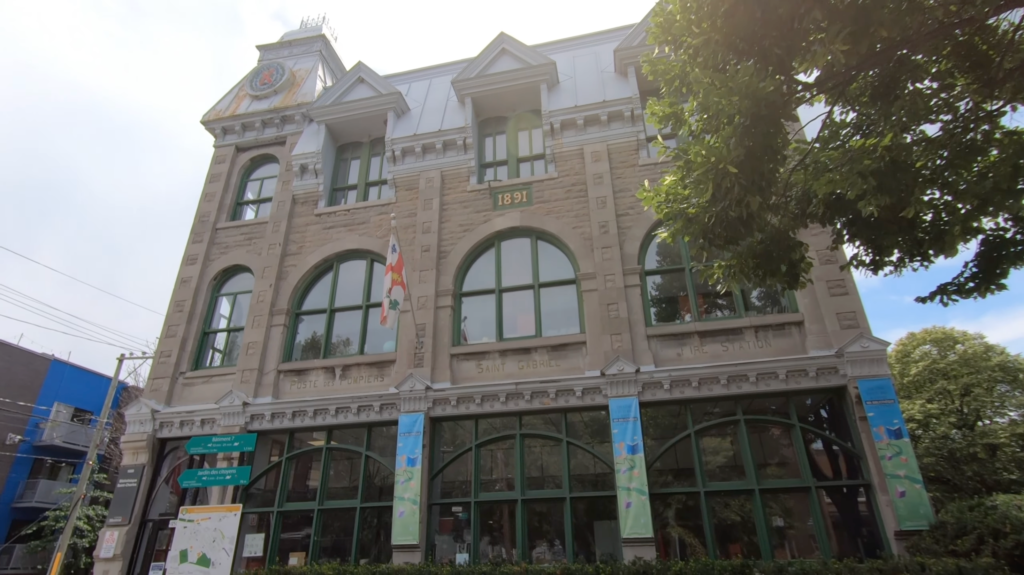
The impact of the communities actions has impacted what it is like to live in Pointe-St-Charles today in three major ways:
- First, there are a lot more public spaces in the Pointe that were developed for the benefit of residents.
- Second, the feeling of community in the Pointe is much stronger than in the neighbourhoods of Griffintown and Little Burgundy.
- Third, there is a lot more social housing and low income groups living in the Pointe. Although, the area is in the process of gentrifying.
If you visit the library for instance, you will find 30+ community projects that you can get involved in. There are also outdoor splash pads, local baseball teams and many more long term residents than you will find in other neighbourhoods of Le Sud-Ouest. When I lived in the Pointe, we were assigned a family doctor and a local nurse that was within a stones throw from our apartment. This is something that I have not experienced anywhere else on the island.
If you are looking to buy a property in the Pointe, there are specific things that you need to be aware of. For example, much of the housing stock comes from the early 20th Century. This means that many used dated construction techniques such as block foundations. These can create mould in your apartments. You should also check the Ville de Montreal website for the existence of lead piping in your area.
Côte-Saint-Paul
One neighbourhood over from the Pointe, you will find Côte-Saint-Paul. This is one of the best kept secrets of Montreal. It is a quiet, residential pocket that feels almost like its own village. And unlike Griffintown, Saint-Henri, Little Burgundy or even the Pointe, Côte-Saint-Paul has managed to avoid the fast paced cycle of gentrification.
Founded in 1662 by the Sulpician Order, Côte-Saint-Paul started life as farmland. Later on, when the Lachine Canal opened, it became housing for workers and, when the canal closed down, it to went through an economic downturn. During the 1960s, urban planners viewed Côte-Saint-Paul as an inner-city slum unfit for habitation. As such, the land was marked for urban renewal and, to this extent, the Décarie Expressway and the Turcot Interchange were built directly through the neighbourhood.
The roads that were added carved deep transportation corridors through the northern edge of Côte-Saint-Paul. The planners demolishing blocks, severing historic streets, and isolating the neighbourhood behind highways and rail lines. The area remained standing, but it was physically and economically cut off from the rest of Le Sud-Ouest.
As a result of this urban renewal project, Côte-Saint-Paul has become a much quieter, predominantly residential neighbourhood compared to others in Le Sud-Ouest. There is a notable absence of cafés, restaurants, bars, and a vibrant nightlife. Boulevard Monk, which borders Ville-Émard, does offer a commercial corridor of sorts, but its offerings are minor compared to the vibrant commercial scene on say Rue Notre-Dame in Saint-Henri.
The neighbourhood did get its own metro line in 1973. And today it is served by both the Monk metro station and Jolicoeur on the Green Line. Residents can also get to the canal on foot, however they are a 15 minute bike ride or a 45 minute walk from the real hub of canal activity. Compare this to living in the Griffintown Saint-Henri, Little Burgundy or Pointe-St-Charles, where you are probably only 10 minutes away on foot from all the main attractions. This is not necessarily a downside, since both metro lines will take you into the hub of activity within minutes, but something to bear in mind.
Côte-Saint-Paul access to a lot of parks. For example, Verendrye Park on the east side of the neighbourhood has tennis courts, a soccer and football pitch and views of Canal de l’aqueduct. Residents can also easily get to Parc Angrignon (one of largest parks in Montreal) via their neighbour Ville-Émard.
Ultimately, Côte-Saint-Paul offers a quiet, insulated, and predominantly residential living environment, combining abundant green space with excellent access to downtown, the Lachine Canal, and the Ville-Marie. Here, you can find more stable property and rental prices compared to other neighbourhoods in Le Sud-Ouest, while remaining close enough to the central hubs of activity.
Ville-Émard
The last neighbourhood in Le Sud-Ouest, and also the smallest, is Ville-Émard. This neighbourhood was originally part of Côte-Saint-Paul. However, in 1899, a businessman called Joseph-Ulric Émard, purchased the area now known as Ville-Émard. Together with his business partners, Émard subdivided the land and laid out new streets. After 1902, the area owned by Émard became its own independent municipality. This municipality was called Village du Boulevard-Saint-Paul. Émard became mayor of this new municipality and changed its name to Ville-Émard.
Today, living in Ville-Émard is very similar to living in Côte-Saint-Paul. It is quite, residential and has avoided the wave of gentrification that has swept through Le Sud-Ouest Boroughs. Ville-Émard is also incredibly walkable. Most residents are within 10 – 15 minutes walk from either the Monk Metro station or the Angringon Metro (in neighbouring LaSalle). From these metros you can get to most points of interest on the Island with minimal changes. This includes the airport, Gare Central (Central Station) for national or intercity transport.
Whilst there are only two parks directly inside Ville-Émard, there are there are several major parks within walking distance for the neighbourhood boundries. These include Angringon Park (which we mentioned earlier) and Ignace Bourget Park. Residents of Ville-Émard also have direct access to the Lachine Canal however, as with Côte-Saint-Paul, the residents are not near the centre of canal activity which is spans Saint-Henri, Little Burgundy, Griffintown and Pointe-St-Charles.
<Insert image – maybe the bike times?>
In conclusion, Ville-Émard is very similar to Côte-Saint-Paul. It is one of the quieter, more residential areas of Le Sud-Ouest Borough. This is mainly due to the fact that it is further away from the canal’s centre of activity. However, location wise it is still very good, especially for young couples.
Final thoughts
In the last 10 years, property prices in Le Sud-Ouest Borough of Montreal have skyrocketed. This is because Le Sud-Ouest is the last undeveloped area close to downtown Montreal. Whilst areas like Griffintown and Little Burgundy are now fully gentrified, the other boroughs are in different phases of gentrification. For example, Pointe-St-Charles is currently being pushed towards gentrification and Saint-Henri is in the later stages.
All of the neighbourhoods in Le Sud-Ouest offer a slightly different way of life.