
I lived along the Lachine Canal for more than five years between 2020 and 2025.
During that time, I watched the area transform firsthand. I saw abandoned warehouses turning into cafés, gyms, and bars; new condo towers rising along the water; and entire stretches of the canal shifting from quiet derelict buildings to lively, well-loved neighbourhood hubs.
In this article, I’ll share what it’s really like to live next to the Lachine Canal. This includes:
- Where is the Lachine Canal located?
- What is the history of Lachine Canal?
- What is it like to live next to the Lachine Canal?
- Lachine Canal demographics
- Lachine Canal commute
- Is Lachine Canal safe?
- What are the schools like next to Lachine Canal?
- What is the Lachine Canal real-estate market like? (Q4 2025)
- Final thoughts
Where is the Lachine Canal located?
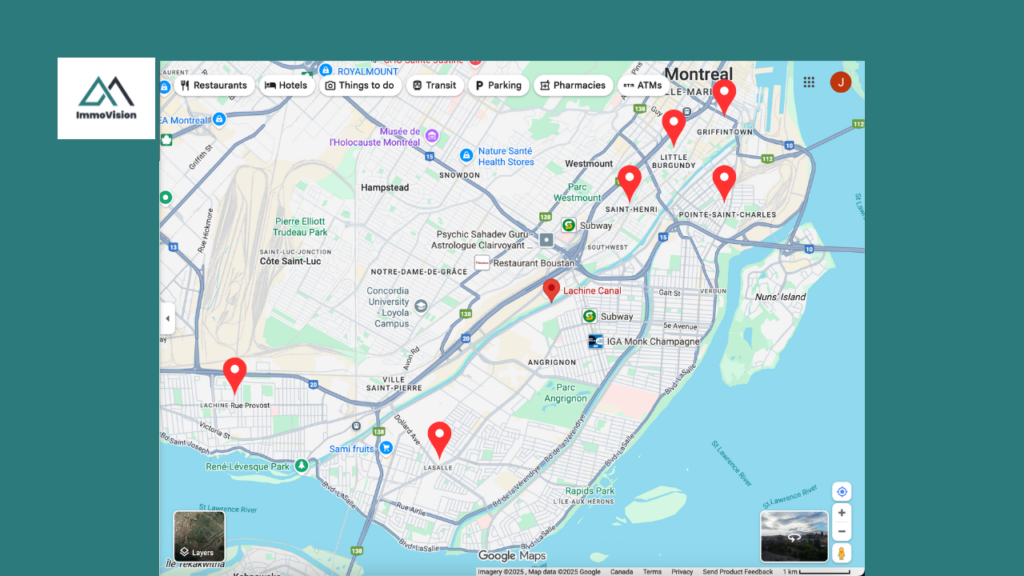
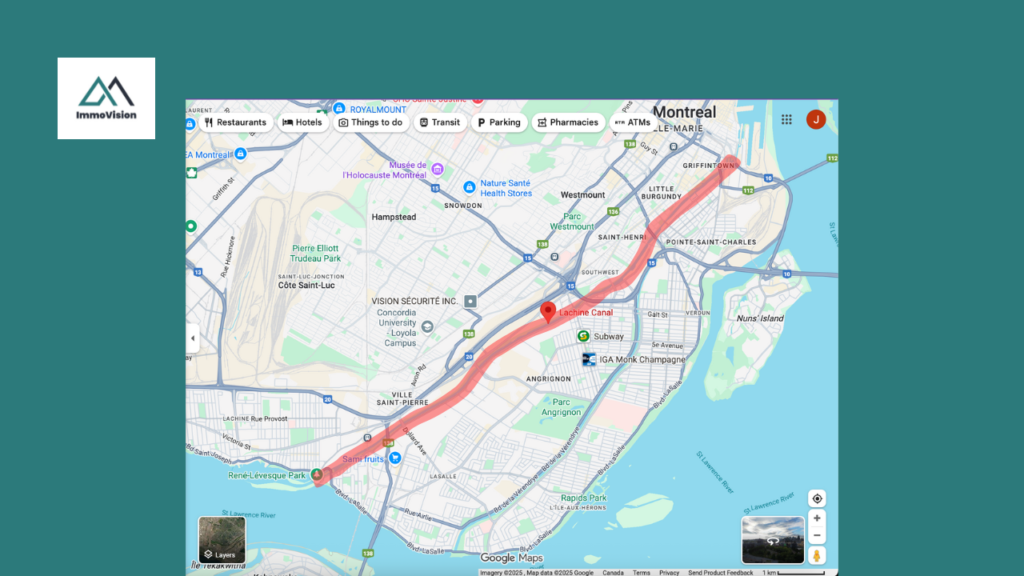
The Lachine Canal is located in the southwest of the Island of Montréal. The canal is 14.5 km long. It branches off from the St. Lawrence river in the borough of LaSalle, and reconnects with the river at the Old Port of Montreal. Originally built in the 18th and 19th centuries, its purpose was to provide a safe shipping route around the treacherous Lachine Rapids.
The Lachine Canal passes through several neighbourhoods including: LaSalle, Lachine, Saint-Henri, Little Burgundy, Pointe-Saint-Charles, Griffintown and Old Port. These areas are highlighted on the map below.
What is the history of the Lachine Canal?
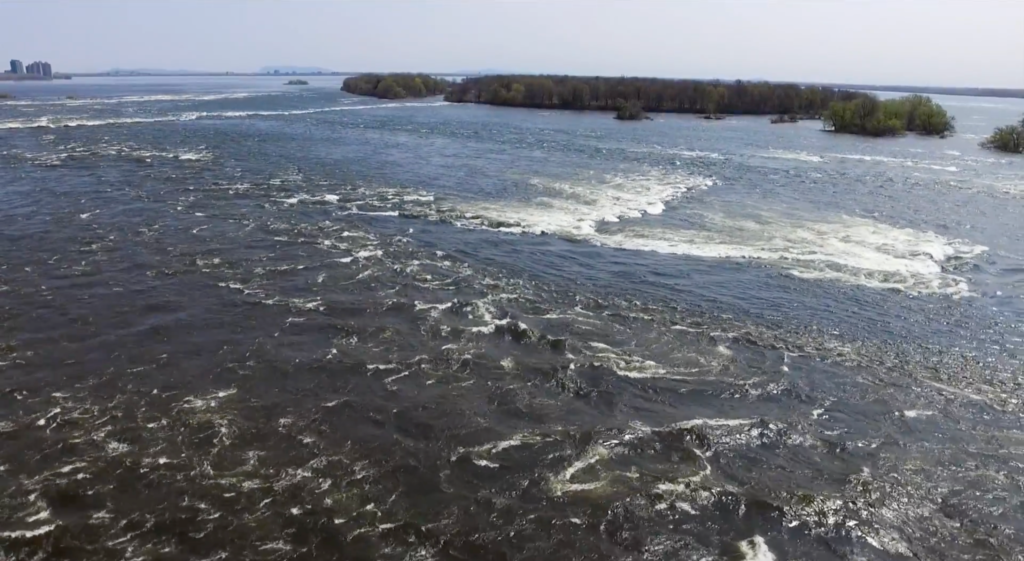
The Lachine Canal was first thought of by early French settlers in Montreal. As early as 1671, these settlers realized that they needed a way for ships to bypass the rapids on the St. Lawrance river. This was because the rapids made it extremely difficult for explorers’ ships to travel upriver toward the Great Lakes and the interior of the continent. The image below shows the Lachine Rapids.
The plan to build the Lachine Canal started in 1671 however, due to a series of setbacks, including attacks from the Iroquois (the Lachine Massacre) in 1689 and the death of a major patron (François Dollier de Casson) in 1701, the work was put on hold. Work did not resume until 1821, when Montreal merchants revived the project. Their goal, was to use the Lachine Canal to position Montreal as the major North American trade hub.
The Canal was completed in 1825, and helped transform Montreal into the commercial gateway to the Great Lakes. It carried coal in, and manufactured goods out. This turned the area around the canal into one of the busiest industrial zones in Canada from the mid-1800s to early 1900s. At its peak, just before the The Great Depression in 1929, nearly 15,000 ships used the canal annually. This all changed with the introduction of the St. Lawrence Seaway in 1959.
Lachine Canal, 1959 – 2000s (A period of decline)
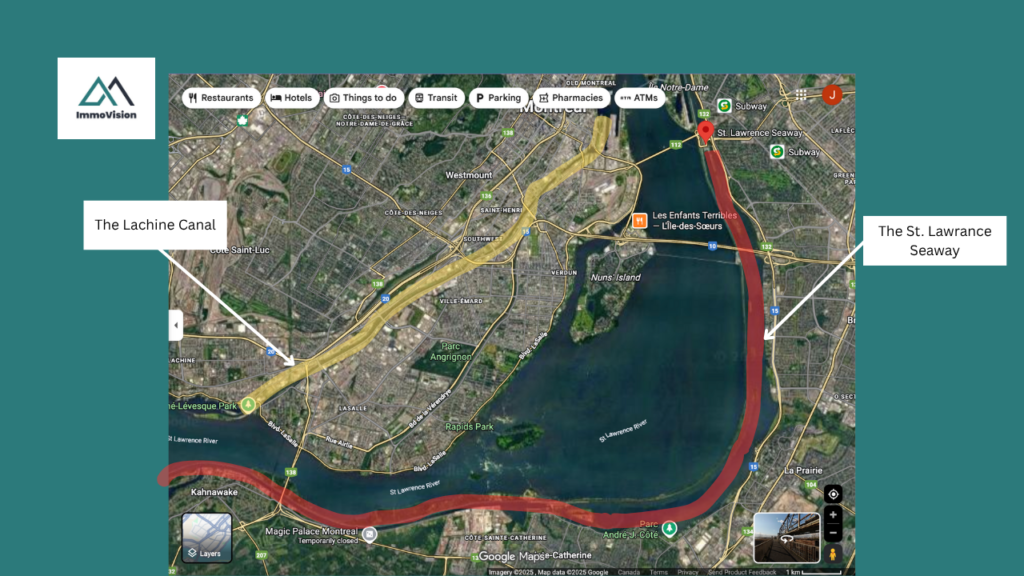
The St. Lawrence Seaway was introduced in 1959 to allow large ocean-going ships to travel directly from the Atlantic to the Great Lakes. It replaced Montreal’s older canal system, which had become too narrow and shallow for modern industrial shipping. This caused a rapid economic decline in areas like Griffintown, St. Henri and Little Burgundy, who were entirely dependent on the activity of the Lachine Canal.
The map below shows an image of how the St. Lawrence seaway provides an alternative route around the Lachine Rapids.
Lachine Canal, 2000s (Restoration of the Lachine Canal)
In the early 2000s, the Lachine Canal entered a new phase.
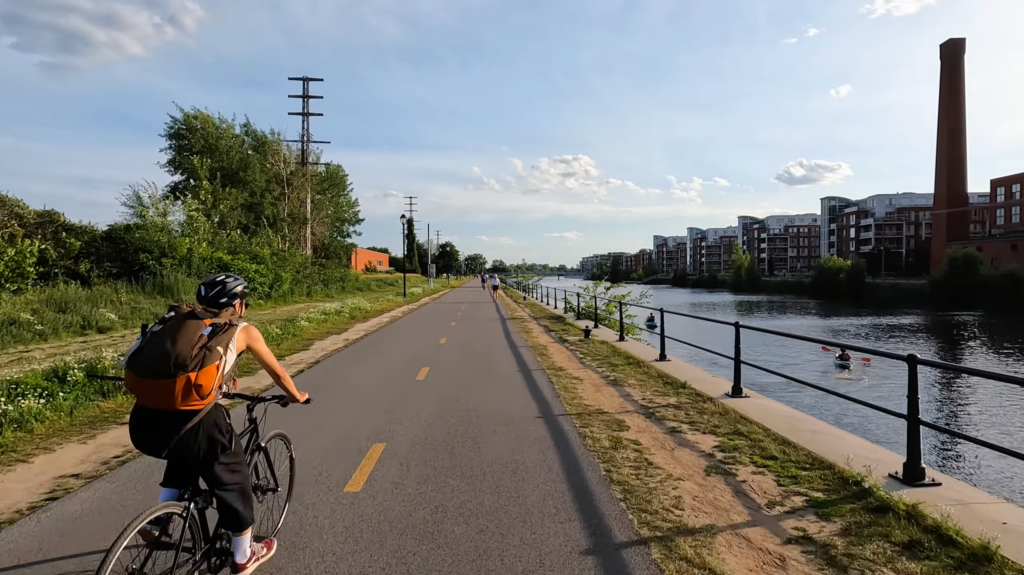
Parks Canada invested in major restoration work after the canal was designated a National Historic Site. This work transformed the derelict industrial corridor into a public space. The waterway reopened for recreational use in 2002 and the old towpath became one of Montreal’s most popular cycling routes. Former factories were redeveloped into condos, lofts, and parks. Today, the canal is a vibrant urban corridor that blends history, recreation, and modern living.
What is it like to live next to the Lachine Canal?
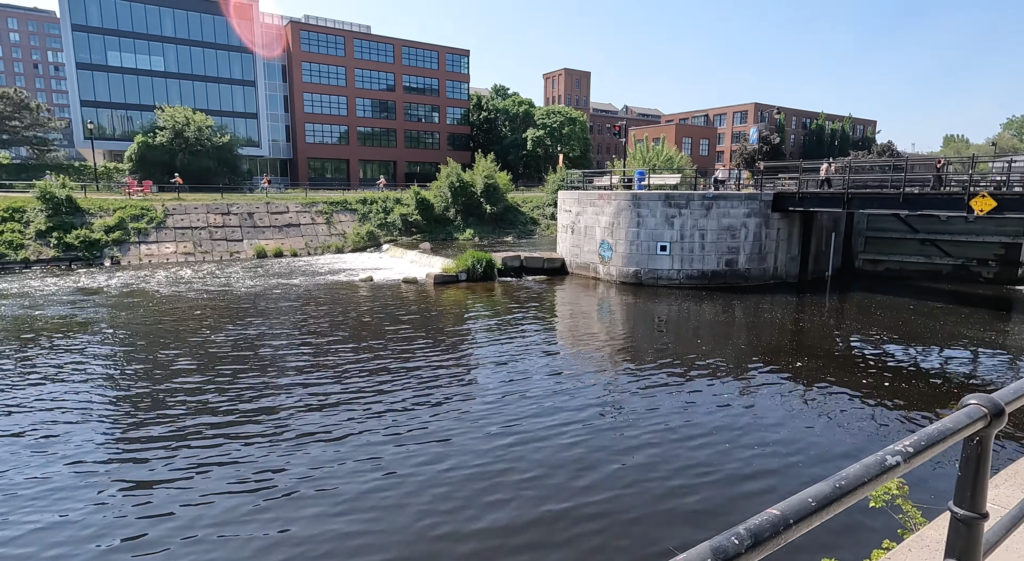
The Lachine Canal runs through several neighbourhoods, all linked by 14.5 km of bike paths, riverside parks, cafés, bars, restaurants, and a growing mix of houses, lofts, and condominiums. Locals are able to cycle along the riverside paths all the way to Montreal’s Old Port and back again.
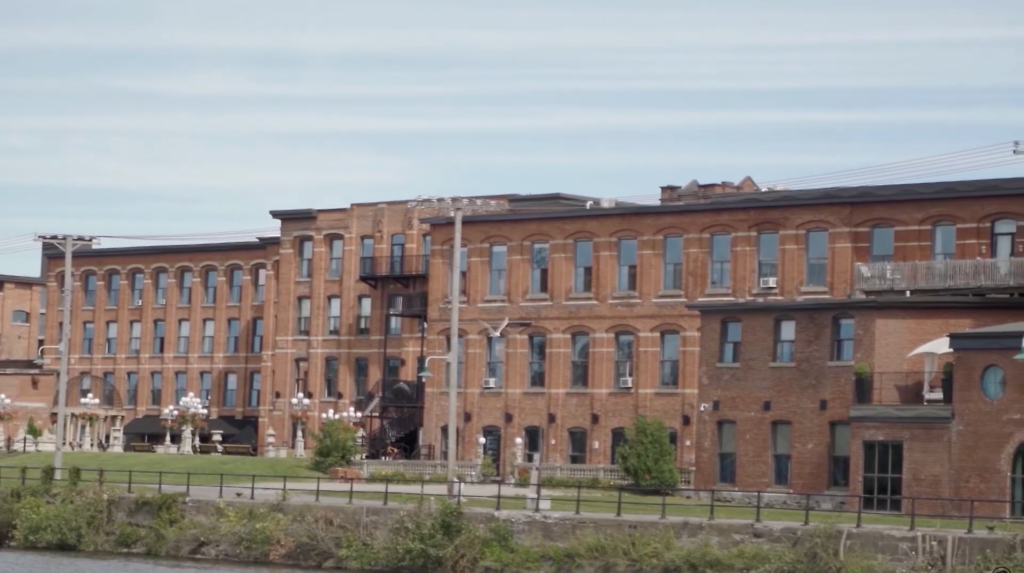
The canal is filled with remnants of old factories, grain silos, red-brick warehouses, and the machinery that once powered Montreal’s industrial era. Whilst a lot of the buildings (especially near St. Henri, Little Burgendy and Point-St-Charles) are still abandoned, huge sums of money have been invested into restoration projects in the area over the past 20 years.
Locals have no shortage of things to do along the riverfront. From sunbathing, barbecues, cycling, summer festivals, and watersports such as kayaking and paddleboarding are all part of daily life in the warmer months.
The area is also home to the Atwater Market, which attracts tourists but is equally appreciated by residents for its fresh produce, specialty vendors, and lively weekend atmosphere. From here, you can easily wander into the Old Port for museums, cultural attractions, waterfront activities, and year-round events. It’s no exaggeration to say that there is always something happening along this stretch of the city.
Lachine Canal demographics
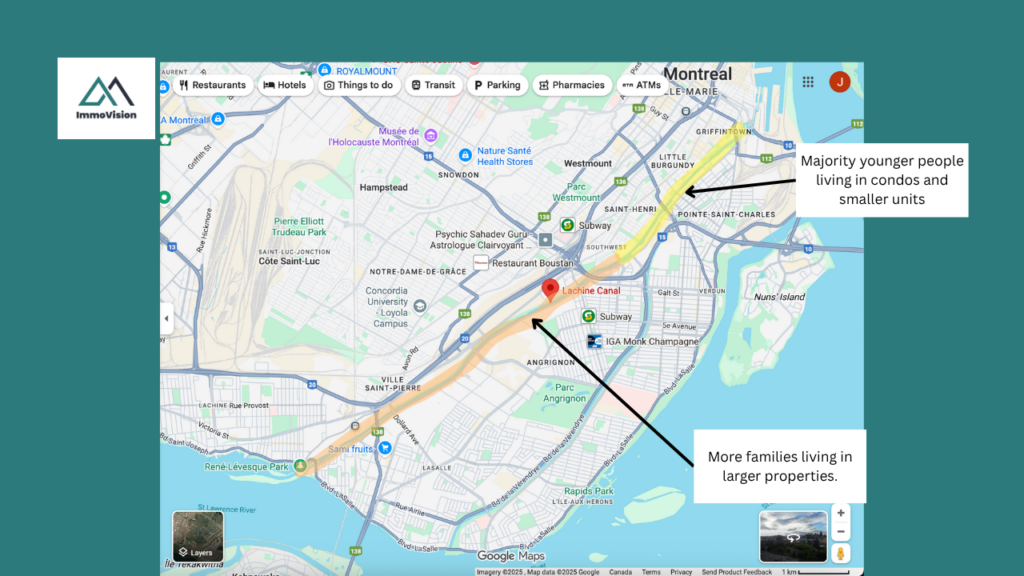
The demographics along the Lachine Canal vary significantly by neighbourhood. In the fast-changing condo-rich district of Griffintown, you’ll find a young, professional population. These people live in high-density towers and loft conversions. By contrast, in the borough of LaSalle, the population is more mixed in age and income, with more families in moderate-density housing.
As a general rule, the further you get from downtown, the larger the properties become and the more families you will find. For instance, Griffintown and Little Burgundy are dominated by condos and smaller loft-style units. Meanwhile, neighbourhoods further west such as Côte-Saint-Paul, and especially LaSalle offer larger apartments, more duplexes and triplexes, and a higher proportion of family households.
The map below shows how demographics change as you move down the canal.
Lachine Canal commute
In this section, we take a look at what it is like to commute for those people living along the Lachine Canal. We will look at three modes of transport:
Car
Overall, owning a car along the Lachine Canal is very doable, but the experience varies depending on the neighbourhood.
Griffintown is the most challenging for street parking unless your building includes a dedicated indoor spot. Fortunately, most newer condos do offer parking. The area also has excellent access to the highway network, with quick connections to Highway 720 and Highway 10.
As you move west through Saint-Henri, Pointe-Saint-Charles, and into LaSalle, car ownership becomes easier. These neighbourhoods offer more on-street parking, lower density, and wider residential streets. They also have excellent highway access. For example, Saint-Henri connects directly to Autoroute 20 and Route 136. Further west, Pointe-Saint-Charles provides quick access to Autoroutes 10 and 15.
Interestingly, many long-term residents live without a car, especially in Saint-Henri and Pointe-Saint-Charles. This is partly because owning a car is expensive, but also because the public transit options are excellent: metro stations, frequent buses, and easy cycling routes. This all makes driving unnecessary for daily life. As a result, many residents rely on Communauto. This is a car-sharing service that lets you rent vehicles by the hour or day without the cost of ownership.
Public transport (metro and bus)
Public transit access varies a lot depending on where you live along the Lachine Canal.
In the eastern sections (Griffintown, Pointe-Saint-Charles, and Saint-Henri) you are generally within walking distance of major metro stations. For instance, Saint-Henri and Pointe-Saint-Charles are both a short walk to Lionel-Groulx, one of Montreal’s best-connected transfer hubs. Meanwhile, in Griffintown, you are only a short walk to Bonaventure and Lucien-L’Allier stations. Residents of Griffintown also have access to the REM. This will take you directly to Gare Centrale, for national rail access and the airport for interational flights.
As you move west toward LaSalle, metro access becomes less direct, but bus service improves. Several bus lines connect LaSalle residents to the metro network in under 10–15 minutes. For many people this provides more than enough coverage for daily commuting.
Bike
Living along the Lachine Canal is ideal for anyone who loves to cycle. The canal’s 14.5 km multi-use path is one of Montreal’s most beautiful and practical bike routes. As we have already seen, it connects LaSalle, Saint-Henri, Little Burgundy, Griffintown, and the Old Port in a straight, uninterrupted line.
The path is fully separated from car traffic. It is also lined with parks, cafés, and river views and is one of the safest cycling corridors in the city. During the warmer months, it becomes part of everyday life. A scenic commute, a workout route, or simply a way to reach the Atwater Market or Old Port in minutes.
Montreal’s public bike-share program, BIXI, makes cycling even more accessible. This service allows you to rent a bike from bike stations throughout Montreal. You are allowed to grab a bike at one end of the canal and drop it off at another. BIXI is ideal for people who don’t want to store a bike at home or who only ride occasionally. Electric BIXIs are also widely available, which helps flatten the city’s hills and makes longer trips much easier.
Cycling also pairs well with public transit. Bikes are allowed on the Metro outside of rush hours, though some stations restrict access; this makes it possible to combine biking with longer commutes. Although beware, bikes are not permitted on buses.
Is Lachine Canal safe?
Safety along the Lachine Canal varies depending on where you are, but overall the area is considered reasonably safe for an urban environment.
The eastern half of the canal covers falls under Montréal police district PDQ 15. This is one of the more urban and densely populated police sectors in the city. According to SPVM data for 2021, PDQ 15 recorded crimes per resident to be roughly 14% higher than the median of Montréal’s 30 police districts. This means that the eastern canal neighbourhoods experience the typical level of activity you’d expect in a busy, rapidly growing part of the city.
Importantly, longer-term data shows that PDQ 15 has seen a 19% decline in total crime between 2012 and 2021, indicating that the district is becoming safer over time. Many residents describe the area as lively rather than dangerous. You will see joggers, cyclists, and families using the canal path throughout the day and into the early hours of the night.
Moving west along the canal toward Lachine and LaSalle, the environment becomes quieter, less dense, and more residential. This generally corresponds to lower crime levels. Lachine itself has lower-than-average crime rates for break-ins, vehicle theft, and property crime compared to many other Montréal districts. These western neighbourhoods see fewer nightlife-related disturbances and benefit from wider streets, lower density, and more single-family homes.
What are the schools like next to the Lachine Canal?
Schools along the Lachine Canal vary widely depending on the neighbourhood. Some canal-side areas, such as Griffintown, are highly urban and have no elementary or high schools directly inside the neighbourhood. Others, especially LaSalle and parts of Saint-Henri and Pointe-Saint-Charles, have multiple schools within walking distance. These include both French-language and English-language options.
However, what really matters is school zoning. In Montreal, you cannot simply choose any public school; your address determines which schools your child is eligible to attend. This applies to both the French-and English-language boards. Although you should be aware that for your child to attend an English-Language school, they must qualify under Quebec’s Charter of the French Language (Bill 101).
For parents moving to the canal area, the best first step is to check your precise school catchment. This can be done by using the school boards’ zoning maps or postal-code lookup tools on their websites. This will show you which school your child would be assigned to based on your address. The table below shows you where to check.
| Language | School Board | What It Covers | Link (Checked & Working) |
|---|---|---|---|
| English | English Montreal School Board (EMSB) | Griffintown, Little Burgundy, Saint-Henri, Pointe-Saint-Charles (most of Le Sud-Ouest east of Atwater) | School Finder: https://apps.emsb.qc.ca/SchoolFinder/en-CA |
| English | Lester B. Pearson School Board (LBPSB) | LaSalle, Lachine, parts of the West Island | Schools + Zoning: https://www.lbpsb.qc.ca/ |
| French | Centre de services scolaire de Montréal (CSSDM) | Griffintown, Little Burgundy, Saint-Henri, Pointe-Saint-Charles | Find Your School: https://cssdm.gouv.qc.ca/inscription/trouver-son-ecole/ |
| French | Centre de services scolaire Marguerite-Bourgeoys (CSSMB) | LaSalle, Lachine, Côte-Saint-Paul, Ville-Émard | School Locator: https://www.cssmb.gouv.qc.ca/trouver-un-etablissement/ |
To evaluate a school’s performance, you can consult the Fraser Institute school rankings (for secondary schools), the Ministère de l’Éducation’s annual results, and public data such as exam success rates and graduation rates. Google Maps and the school boards’ websites also list all nearby schools along with contact information, programs offered, and reviews from parents.
Overall, families living near the Lachine Canal have access to a mix of schools, but the quality and convenience depend heavily on exactly which neighbourhood (and even which street) you choose to live on.
What is the Lachine Canal real-estate market like? (Q4 2025)
The table below shows what the property prices are like for single family homes and divided condos in the neighbourhoods that span the length of the Lachine Canal.
| Neighbourhood | Property Type | Price (Approx) | Notes |
|---|---|---|---|
| LaSalle / Lachine (combined report) | Single Family Homes | ~$735,467 (Q2 2025) | From WOWA for LaSalle/Lachine region. (WOWA) |
| Condominiums | ~$463,598 (Q2 2025) | Same region. From WOWA. (WOWA) | |
| LaSalle | Single Family Homes | ~$637,000 (2023) | Median price from DuProprio summary using WOWA data. (DuProprio) |
| Condominiums | ~$402,000 (2023) | Same source. (DuProprio) | |
| Lachine | Single Family Homes | ~$666,000 (2023) | Median price from DuProprio summary. (DuProprio) |
| Condominiums | ~$389,000 (2023) | Same source. (DuProprio) | |
| Montréal Island (overall) | Single Family Homes | ~$632,000 (Oct 2025) | From WOWA’s monthly market report. (WOWA) |
| Condominiums | ~$429,000 (Oct 2025) | Same report. (WOWA) |
Real-estate along the Lachine Canal remains highly desirable, and prices reflect that.
According to WOWA’s market data, single-family homes in the LaSalle and the Lachine sector averaged ~$735,000 in Q2 2025, while condos averaged ~$463,000. This aligns with trends across Montréal, where the island-wide medians in late 2025 were ~$632,000 for single-family homes and ~$429,000 for condos.
For buyers with higher budgets, a detached, semi-detached or freehold townhouse along or near the canal can be an excellent long-term investment. This is because land is scarce and highly valued in these areas. That said, many older homes in canal-adjacent neighbourhoods come with the classic challenges of Montréal’s older housing stock. Block foundations, aging plumbing and electrical, moisture issues, and a need for major renovations. Therefore, a thorough pre-purchase inspection is essential.
Buyers Tip
Final thoughts
As someone who lived along the Lachine Canal in Pointe-Saint-Charles from age 31 to 36, I can say without hesitation that I loved my time there. What made it special was the convenience: I could walk or take public transit almost everywhere. Even in the depths of winter, getting out of the house was easy. And in summer, it was even better — I could stand up from my desk, slip on flip-flops, and be by the water within minutes, eating an ice cream or grabbing a beer with friends.
That said, our apartment was small and in an older building. It was affordable compared to the newer condos in Griffintown or the newer builds in Pointe-Saint-Charles, but it came with typical issues: mold in the walls, leaking drain pipes, old plumbing, and general signs of age. We loved the lifestyle, but not the maintenance headaches.
Ultimately, we would have stayed longer, but the cost of buying a larger place in the area was nearly double what we could get in the West Island. With the new REM stations opening across the island — making commuting easier than ever — it made more sense for us to move somewhere with more space, more nature, and better long-term value.
We may move back someday, but for now, the price point simply didn’t match the value we felt we’d get. For us, the West Island offered a better investment opportunity, especially given the amount of development happening there. It felt wiser to be early in a growing market than late in one where prices were already fully “baked in.”