
Buying or selling a property in Montreal is an emotional, logical and technical process.
With all this drama, you really do want to have an experienced and trusted advisor, to talk you through the process. However, picking an agent is hard for several reasons. Not least, all realtors will tell you that they are the best. And, from their pictures, all of them look like successful professionals.
Over the last few years, our team members have interviewed hundreds of brokers in Quebec. In this article, I will show you our framework on how to choose a real-estate agent in Montreal. Specifically we we ill cover.
- How to choose a realtor in Montreal at a glance
- How to choose a realtor in Montreal as a buyer
- How to choose a realtor in Montreal as a seller
- How to spot bad realtors
How to choose a realtor in Montreal at a glance
Below is a quick checklist of how to choose a realtor as a buyer or seller in Montreal. We will expand on these points later in the article.
| Check for: | How to choose a realtor as a buyer | How to choose a realtor as a seller |
| Experience in your type of property | At least 5 years experience in helping buyers in projects like yours | At least 5 years experience in helping sellers in projects like yours |
| Knowledge of your local area | Knows neighbourhoods, pricing trends, schools, amenities, zoning rules | Knows neighborhoods, pricing trends, buyer demand, seasonal selling patterns |
| Strong performance stats | Low sale-to-list ratios for purchases, low DOM for bought properties. | High sale-to-list ratios for sales, quick sales (low DOM). |
| Good, verified reviews | Positive reviews from buyers of similar properties. | Positive reviews from sellers of similar properties. |
| Professional network | Access to mortgage brokers, inspectors, contractors, lawyers. | Access to buyers’ agents, staging professionals, marketing channels. |
| Effective communication | Responds quickly, explains offers and negotiation strategies clearly. | Communicates pricing strategy, marketing plan, and buyer feedback efficiently. |
| Personal comfort | Comfortable with their negotiation style, communication, and personality. | Comfortable with their sales approach, openness, and handling of offers. |
| Red flags | Overpromises on properties, pushes unsuitable deals, lacks transparency. | Overpricing, aggressive selling tactics, avoiding disclosure, poor marketing follow-through. |
Next up, we will expand on each of these points, considering:
Please note, parts of the section “How to choose a realtor for a buyer” and “how to choose a realtor for a seller” are repetitive, so it would be better to read the one that pertains to your situation and then skip to the section: How to spot bad realtors.
Looking to find a realtor in Montreal?
How to choose a realtor in Montreal as a buyer
When choosing a realtor as a buyer, in Montreal, you need to consider the following things:
- Experience in your type of property
- Knowledge of your local area
- Strong performance stats
- Good, verified reviews
- Professional network
- Effective communication
- Personal comfort
- Red flags
Let’s break down each of these points now.
Experience in your type of property
There are 7 main categories of residential property in Montreal. Inside of each category, there are different types of property. These are shown in the diagram below.
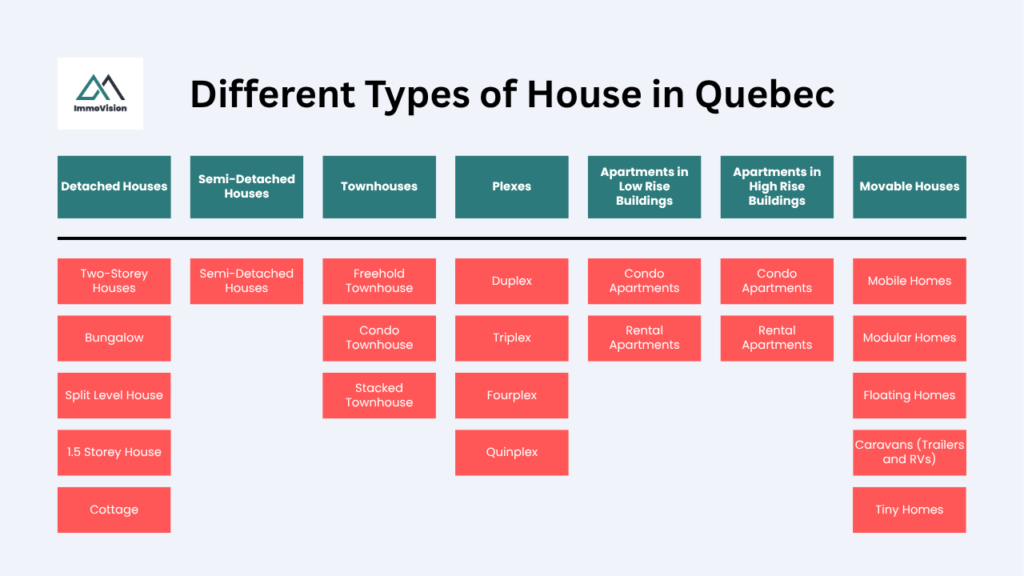
There are also other types of properties: Land, Commercial, recreational and mixed-use properties.
As a buyer, you need to make sure that your realtor has recent experience in the particular type of property that you are looking to buy. If you are not sure what type you can afford to buy, or would realistically like to buy, then it is important to choose an experienced realtor with a strong breadth of experience.
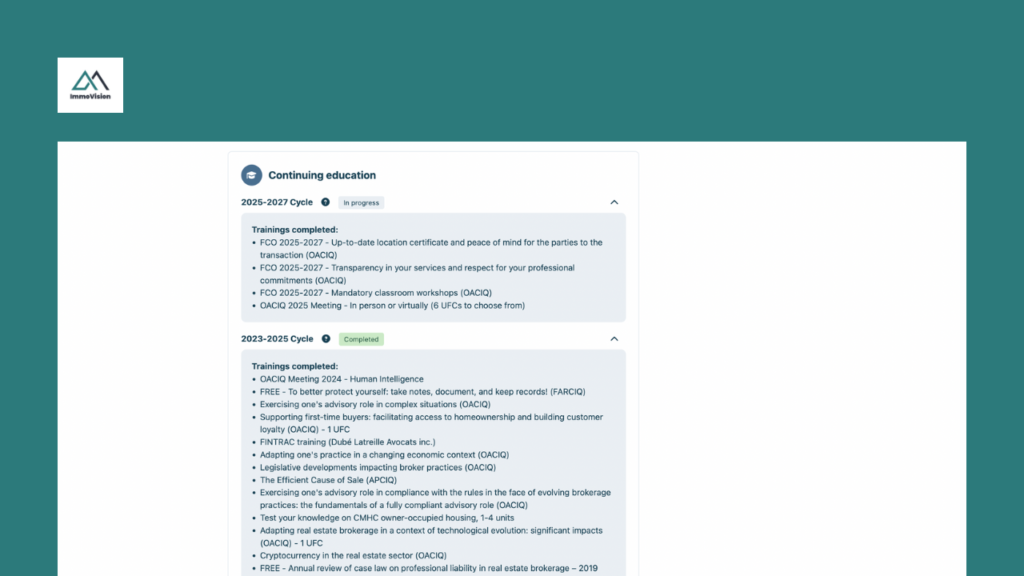
In addition, licensed agents participate in continuous training throughout their career. These trainings ensures that the broker keeps their knowledge, skills, and regulatory compliance up to date. You are able to review broker profiles on the OACIQ website. These profiles include a list of the trainings that any broker has taken, or is in the process of taking. An example is shown below
Knowledge of your local area
Realtors should have knowledge of your local area. For instance, if you are buying in Montreal, then the broker should have knowledge of the particular area in Montreal that you are interested in buying in. For example, if you want to buy in Le Sud-Ouest Montreal vs the West Island, then you should choose an agent who is knowledgable of Le Sud-Ouest.
There are several reasons for this, but what is boils down to is that local markets all behave very differently. For instance, in 2008, Griffintown, in the South West borough of Montreal saw an explosion in investment from the city. Realtors standing on the front lines were able to advise their clients that this represented the perfect moment to buy in the area.
On websites like Centris.ca or Realtor.ca, realtors set the areas that they consider themselves active in. This means that 99% of the realtors in Montreal say they are active right across Montreal. However, in reality, most of these relators have not completed a transaction in the last 12 months in most of their “active neighbourhoods”. As such, you should avoid these realtors.
One way to find a list of active brokers is to check out what listings are available in your area. If you click on the listings, you will see the listing broker. You can then make a shortlist of these brokers and reach out to them.
Link here.
Strong performance stats
You should aim to choose a real-estate agent who can demonstrate strong performance stats in your local market. The main statistic you want to check is the sale-to-list ratio (on properties bought like the type you want to buy). This metric tells you how effectively the realtor negotiated the purchase price relative to the listing price. You can tell a lot about a broker from this metric, especially when you compare it to the market’s average sale-to-list ratio at the time of the transaction.
Erin Wheeler, a reputable broker in New York with more than 18 years of experience puts it like this. “If the agent doesn’t have a good list-to-sale ratio, you probably shouldn’t be working with them.”
You will also want to check the number of transactions completed by the broker and their years of experience. Both of these can be clear indicators as to the quality of the broker.
Good, verified reviews
It is absolutely essential that you check the credentials of the broker you are going to work with. This can be done on the OACIQ website using their find a broker tool. However, beyond checking for the obvious things, you also want to check their online reviews. Here, most people will stick the name of their broker in Google and do a basic background check on the realtor.
However, this is not always a fool proof strategy since, realtors can present misleading reviews about themselves. In some (admittedly rare) cases, brokers will actually attempt to conceal negative information about themselves. They can do this by changing their name, removing or disputing negative reviews, selectively highlighting only positive transactions, or pressuring clients to leave favorable feedback.
At Immovision, we have a process for verifying broker reviews. You can use this tool to background check your realtor before working with them.
Professional network
The best brokers have a professional network of people who they have worked with in the past. This could be other realtors who might be able to help on parts of the deal where your realtor is less knowledgable. However, it could also include mortgage brokers, home inspectors, notaries, contractors, or other local professionals who play a role in real estate transactions. This can be very helpful, because it can make the transaction smoother however, there are a few things to be aware of here.
First, the OACIQ places rules around how introductions are made. For instance, the broker is allowed to refer home inspectors however, they must present at least two options for you to choose from. Second, there is no rule to prohibit brokers earning a referral fee on the introductions that they make. This means that their advice may not be entirely impartial. As such, it’s a good idea to consider your realtor’s recommendations while also doing your own research to ensure you’re making the best choice.
Effective communication
Effective communication means that when you speak to your broker he or she understands what you mean. And, when the realtors speaks to you, you can understand what they mean.
Buying a property is a very emotional experience. If you struggle to understand what your broker is saying or, if they are not able to understand you, this can lead to a very strained relationship. Whilst it is easy to get dazzled by a broker who uses a lot of industry specific language, the true mark of a good communicator is that they are able to quickly make themselves understood. As such, watch out for brokers who are unable to break down complex topics into something easy to understand.
Personal comfort
It is important to feel comfortable with your realtor. As we said earlier, buying a home is a highly emotional experience. You will need to express your ambitions around home ownership to your realtor. This is not always easy to do. Furthermore, if you are buying with a partner, there may be points in the transaction where you don’t agree on something. It is the realtors job to explain the facts to you and remain as objective whilst factoring what they know about the market and your personal situation.
However, you should not feel like the agent is pushing you down a path that is better for them and, you should feel comfortable speaking openly with your realtor. If either of these isn’t true, the relationship may not be the right fit.
Being comfortable with someone is, at least partly, an emotional decision. Therefore, when making a decision about who you feel comfortable with, you need to weigh your gut instincts against the facts. A realtor who you really like personally, but does’t have the correct experience is not the right choice. However a realtor who you are impartial to, but does have the track record could work out.
Red flags
On the broker profiles publish on the OACIQ website, you are able to see if a broker has any disciplinary records. Below is an example of what this looks like. We have anonymized the brokers face and name for privacy purposes.
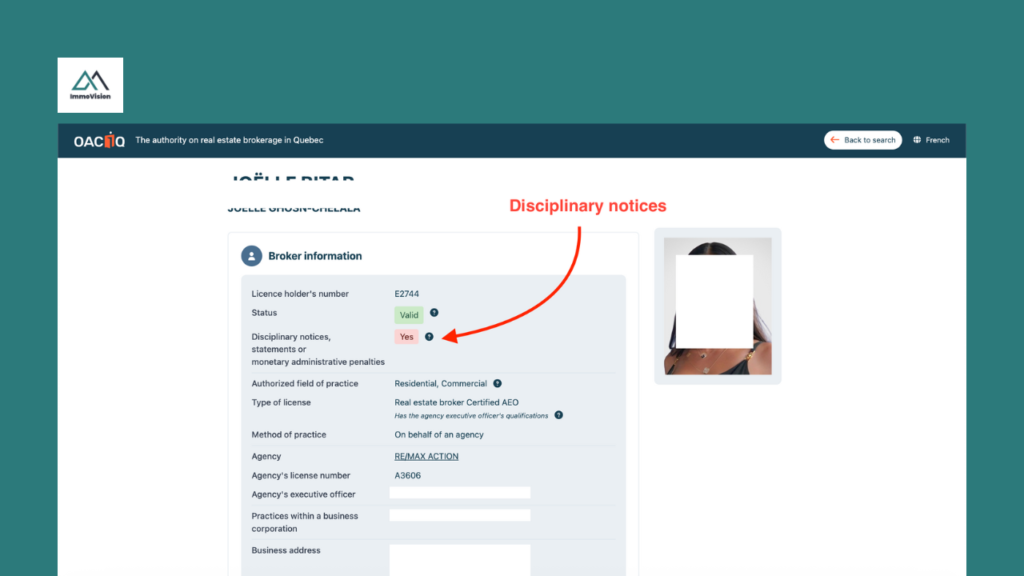
If you are speaking with a broker and it shows up that they have a disciplinary record, you should not discount them immediately. However, you should ask them about it and make sure that you are satisfied with the result of your questions. Also, in a case like this, you should try extra hard not to be persuaded by any emotional sales tactics that the broker may deploy.
How to choose a realtor in Montreal as a seller
When choosing a realtor as a seller, in Montreal, you need to consider the following things:
- Local experience selling your type of property
- Strong selling stats
- Comparative Market Analysis (CMA)
- Reputation and references
- Availability to resources (photographers, stagers, pre-listing inspectors etc.)
- Strong negotiation skills
- Clear communication
- Warning signs and personal comfort (pushiness, vague answers, lack of transparency, etc.)
Local experience selling your type of property
There are 7 main categories of property in Montreal. Each of these has sub-categories that are explained in the diagram below.
In addition to properties being of different types, some properties are also older and some are newer. The age of a property often indicates that they were built with different types of construction materials (for copper vs aluminum wiring). Age can also indicate different construction methods used in their development (for example block vs rubble foundations).
When choosing a real-estate agent to sell your property, it is important that the agent has recent experience selling your type of property. This is because, the type of property that you have will inform your listing strategy. For instance, a broker may advise the seller of an older freehold townhouse in central Montreal to list the property during the summer months, when demand is at its peak. By contrast, an older detached home in the Eastern Townships might be better listed in the fall, when buyers are actively searching for year-round or secondary residences in that area.
Inexperienced relators will not be able to provide this level of guidance. This can increase the likelihood of selling your house for less than it is worth.
Strong selling stats
Selling brokers are typically judged on the following stats:
- Sale-to-list ratio – Shows how close the final selling price was to the listing price. A higher ratio suggests stronger pricing strategy and negotiation.
- Average DOM & CDOM – Days on Market (DOM) and Cumulative Days on Market (CDOM) indicate how long a property takes to sell. A lower numbers often reflect better marketing, pricing, and buyer targeting.
- Number of transactions – Reflects the broker’s activity level and experience. More completed sales generally indicate consistent performance and market familiarity.
- Years of experience – Gives context to their expertise, judgement, and ability to navigate different market conditions.
Both the Sale-to-list ratio and average DOM & CDOM need to be looked at in relation to the rest of the market at the time when the transactions were recorded. For instance, a broker who has a high sale-to-list ratio and low DOM when demand is high is not as impressive as one who is able to achieve the same result in a slow market. Therefore, you need to understand these two figures in context.
Comparative Market Analysis (CMA)
An experienced realtor should be able to provide a comparative market analysis (CMA) to determine the best price for your property. They should have a strategic approach to pricing that considers market conditions (for instance, if you are in a buyers or sellers market), recent sales, and the unique features of your home.
Reputation and references
A listing agents reputation is very important. A listing agent’s reputation is very important because it reflects their professionalism and reliability. You will be able to assess the broker in part through their online reviews. Realtors who consistently oversell themselves will end up with 3* and 4* reviews for their work over time.
Reputation is also important when generating potential buyers for your home. For instance, buyer brokers will often warn their clients to avoid agents known for being sloppy with paperwork, dishonest, or unfair negotiators. This is because buyers and their agents are reluctant to engage with someone they do not fully trust; if concerns arise about a broker’s transparency or accuracy in presenting a property, it can slow negotiations or even jeopardize the sale.
Availability to resources
A listing agent has one objective. Sell your house at a price higher than the comparable properties in your local market. To do this, they will need to enlist the support of experiences photographers, stagers, pre-listing inspectors and anyone else who can facilitate the sale of your property. Therefore, you should ask the realtor about his or her professional network and ask to see some examples of their past work.
In addition to this the listing broker will also need to demonstrate that the have availability to work on your project. You should ask them how many open houses are they willing to attend and will the agent be directly involved, or will it be a member of their team that does the work. Whilst it is totally fine for the agent to enlist professionals to support them with general marketing activities, the agent themselves should know how to market and sell your home.
Strong negotiation skills
The best negotiators consistently achieve strong outcomes. In real estate, both seller and buyer agents can fall into common traps. For example, junior listing agents sometimes discuss contract terms before a promise to purchase is signed, wasting time since the buyer hasn’t committed. Negotiating too early can let the buyer walk away, leaving the seller with no real progress and the agent focused on hypothetical scenarios instead of a concrete deal. Similar pitfalls exist for both listing and buyer agents.
To assess a broker’s negotiation skills before signing a contract, consider asking how they handle questions such as:
- “How would you respond if a buyer asked if we had received any interest in the property yet?”
- “How would you respond if multiple offers come in simultaneously?”
A good agent will answer in a way that creates buyer urgency, whilst remaining honest in their response.
Clear communication
When you first meet a listing agent, their role is to listen to what you as a seller want. They then need to devise a plan to get you what you want or, if what you want is not possible, they need to clearly explain why. If the agent cannot fully understand what you want or if they cannot explain their plan in a way that you can understand, then this represents a communication challenge between you and the realtor.
A good communicator can find a way to communicate with anyone. However, bad communicators can only communicate well with people who think the same way as them. As such, if you cannot understand what the agent is saying, then it probably means this is not the right agent for you.
Warning signs and personal comfort
In recent years, scientists have revealed that the vast majority of our decision making is instinctive. Years of evolution have honed our abilities to sense danger way before the logical side of our brain is able to figure out why. As such, you should definitely listen to your gut when looking to find a realtor. This is especially the case given how much information you will need to share about your current situation with the listing agent. We would definately advise against working with any real-estate agent who makes you feel uncomfortable.
By contrast, some agents will make you feel relaxed. Communication will be easy and you find yourself leaning towards them. At this point you need to be very careful not to bypass any warning signs just because you like the agent. For instance, some realtors who make a lot of transactions, also have received disciplinary actions for unethical behavior. This kind of information can be see if you search for the relevant broker profile on the OACIQ website.
As a good rule of thumb, you it is better to work with an agent who is direct in their communication style, gives you the space to make decisions, and is transparent with you about any challenges they foresee in working together.
How to spot bad realtors
Whilst we all want to work with the best realtor in Montreal. The truth is that most of us are going to work with someone in the middle of the market. And this is fine. Middle of the market is good. It gets the job done.
A few of us will be lucky enough to work with exceptional brokers. However, a few of us will also be exceptionally unlucky and end up working with very bad brokers. There are two governing frameworks that attempt to mitigate these risks. These are the Real Estate Brokerage Act and the OACIQ Code of Ethics. These documents explicitly outline things that brokers are not allowed to do when trying to win a client. These include:
- Make false, misleading, or unverifiable claims
Example: A broker says, “I sell every property for 15% over asking,” but cannot provide any data to support the claim. - Pressure or manipulate a seller into signing a brokerage contract
Example: A broker refuses to leave a homeowner’s kitchen until they sign “just to get the paperwork started.” - Claim to have buyers lined up when they don’t
Example: A broker tells a seller, “I have three qualified buyers ready to make an offer today,” even though no such buyers exist. - Offer illegal incentives
Example: A broker offers a seller cash “under the table” if they sign an exclusive contract. - Bad-mouth or smear competing brokers
Example: A broker claims, “Don’t hire Linda. She is terrible at her job”. - Guarantee a sale price or sale timeframe in a misleading way
Example: A broker promises, “I guarantee your condo will sell in 7 days for at least $750,000,” despite knowing the market cannot support that number. - Hide conflicts of interest
Example: A broker recommends a home inspector who secretly pays them a referral fee, without disclosing the relationship. - Misrepresent their identity or professional status
Example: A person claims to be a licensed real-estate broker when they have no licence. - Discriminate against potential clients
Example: A broker refuses to represent a buyer because of their ethnic background or family status. - Solicit in prohibited ways
Example: A broker goes door-to-door in a building with a “No Soliciting” rule, despite being told the syndicate prohibits it.
Final remarks
Whilst it is incredibly hard to find a realtor in Montreal, this article should have given you some ideas on how to do this.
The first step is to make a list of active brokers in your neighbourhood, narrow it down to those with the strongest performance metrics, and then schedule interviews with a handful of the top candidates.
After you have found a list of realtors that you think will be a good fit for your project, the next step is to actually choose one. To do this, you will need to set up broker interviews. When you do this, you will speak with the agent to confirm that they are a good fit for your project. Your decision on which realtor to choose should be based on a balance of emotion and logical reasoning.
At Immovision, we have created a suite of tools to help you find the best realtor in Montreal, for your project. This involves a four step process that involves:
- Finding the active brokers in your neighbourhood;
- Running an advanced human in the loop AI, that checks past performance, verified reviews, and local expertise of each broker;
- Generating a report on the best relators in your neighbourhood for you to review;
- Preparing you for your broker interviews.
This solution is completely free (for the time being) and you can access it at the following link. Immovision Broker Matching Service.