
Key takeaways
– 2008 – 2016: a period of rapid gentrification. The population of Griffintown 7,450 (a +93% increase since 2006). Mainly young, high income professionals. Property prices increase faster than anywhere else in Montreal. High end businesses (cafés, restaurants, bars, gyms, yoga studios) enter the area.
– 2017 – 2020s: the area stabilizes and continues to densify but in a more gradual way.
– After 2025: Griffintown has been fully gentrified and residents should expect slower, more incremental changes, a gradual shift toward long-term residents, and property prices that reflect its permanent status as one of Montréal’s most desirable urban neighbourhoods.
I lived as a resident of Griffintown for almost 4 years in my 20’s.
I then moved to Point St. Charles which is about 5 minutes walk from Griffintown.
In this article, I will give you everything that you need to know about Griffintown, from my perspective as both a resident and a local.
By the end of the article, you will know more about Griffintown that most local tour guides and real-estate agents. This will allow you to full understand what is it like to live in Griffintown so that you can make the most informed decision about if this area is good for you or not.
More specifically I will cover:
- Where is Griffintown located?
- What is the story behind Griffintown?
- What is it like to live in Griffintown?
- Griffintown demographics
- Griffintown commute
- Is Griffintown safe?
- What are the schools like in Griffintown?
- What is the real-estate market like? (Q4 2025)
- Final thoughts
Where is Griffintown located?
Griffintown is located in the Le Sud-Ouest borough of Montreal. It is bordered by the Rue Notre Dame Ouest to the north, Bonaventure Expressway and Ville-Marie to the east, the Lachine Canal to the south and Boulevard Georges Vanier and Little Burgundy to the west.
What is the story behind Griffintown?
On May 17th 1642, Paul de Chomedey and Jeanne Mance founded Montreal (or Ville-Marie as it was then called) as a missionary colony. Jeanne Mance then founded a hospital – Hôtel-Dieu (translates literally to “Hostel of God”) on the Island.
In 1654, Paul de Chomedey awarded Jeanne Mance and Hôtel-Dieu a plot of land called “the fief of Nazareth.” The area was divided into lots which were converted into farmland and awarded to early settlers. These settlers then paid rent to Jeanne Mance and the Hôtel-Dieu. Rents were used as a means to support the Hôtel-Dieu and other religious institutions in Ville-Marie.
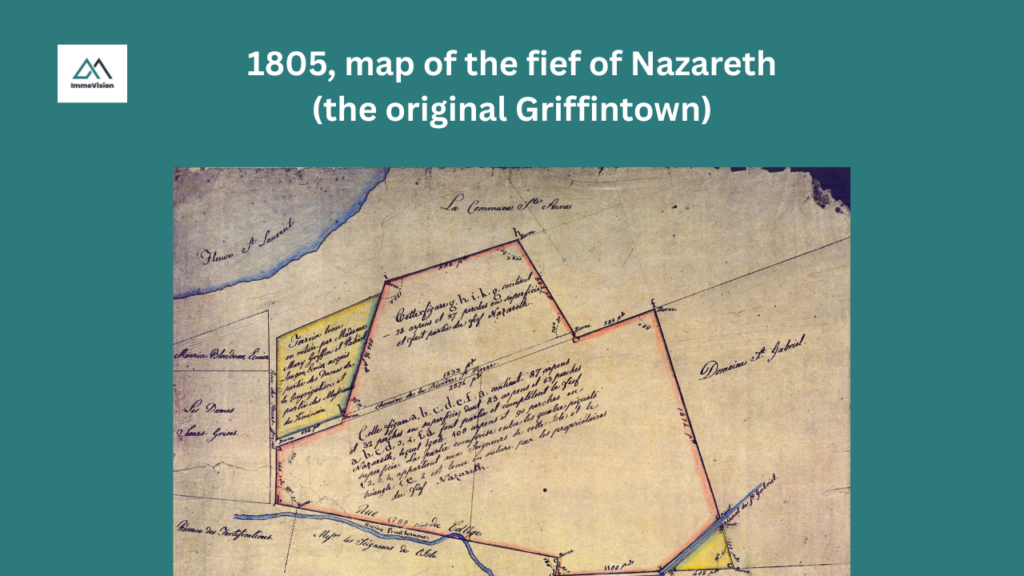
After Jeanne Mance’s death in 1673, the Hôtel-Dieu and its assets (including the fief of Nazareth) came under the full control of the Sœurs hospitalières de Saint-Joseph, the religious order that had worked alongside her since their arrival in 1659. The Sisters decided to lease the land to an Irish Merchant called Thomas McCord in 1791. McCord intended to develop the land however, while he was away on a trip to Ireland, he asked an associate called Patrick Langan to handle his Montreal affairs in his absence. While McCord was away, the unscrupulous Patrick Langan illegally sold the lease to Mary Griffin.
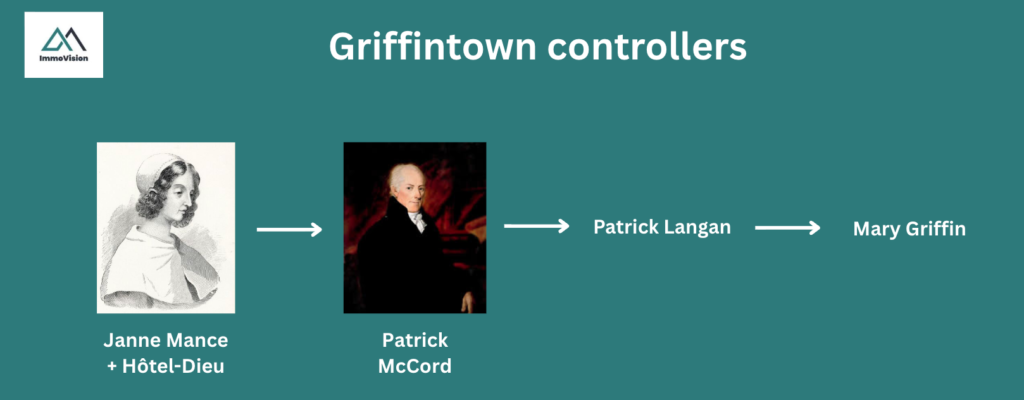
The fief’s location made it highly valuable. It was directly beside Ville-Marie which was expanding and required a labour force. Seeing its potential, Griffin reached an agreement with the Sisters to further subdivide the land and construct low-cost worker housing for people priced out of the old city. The profits from this were to be shared between her and the religious order. This arrangement laid the groundwork for the neighbourhood that would later take her name — Griffintown.
Griffintown in the 19th Century
In 19th Century, Griffintown transitioned from a primarily agricultural neighbourhood to a residential one. Starting from about 1815, Irish immigrants chose to settle in Griffintown because it offered low cost accommodation and the opportunity to work in the nearby port and city construction projects.
In 1821, work started on the Lachine Canal, creating thousands of jobs and an immediate demand for labour. Between 1821 – 1825, more then 1,000 workers arrived in the area (most of them Irish). This turned Griffintown into one of Montréal’s major working-class districts.
Once the canal was complete, it provided hydropower and a transportation corridor for inland barges to transport goods between Ocean going ships and the Canadian railroads. The accessible, low cost Irish workforce, combined with the hydropower and transportation links brought factories to the area. At this point, the population of Griffintown and all of the surrounding neighbours in the Southwest of Montreal exploded. Montreal was now the working-class industrial heart of Canada, powered by the Lachine Canal and low-cost labour.
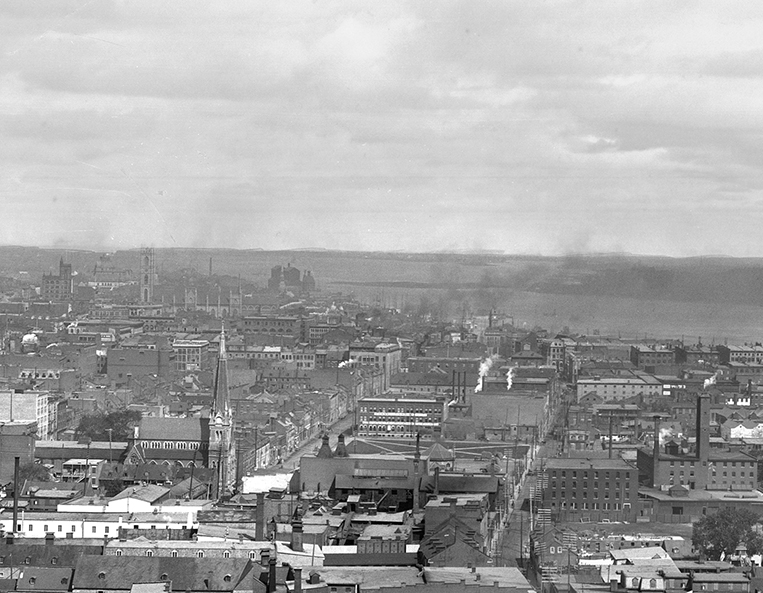
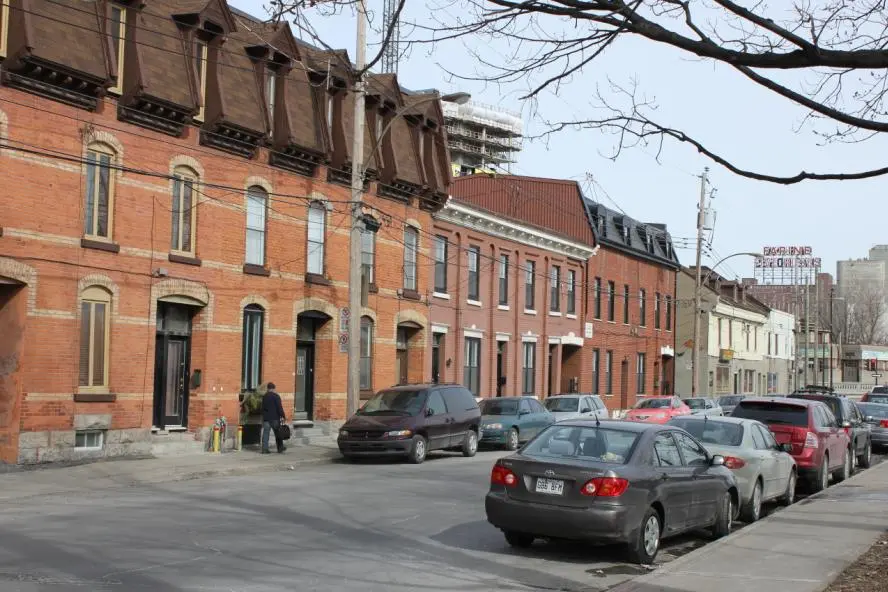
During this period, most of the neighbourhood filled up with low cost row houses built to accommodate the large influx of Irish immigrants who worked in the nearby industries. Today, intermingled with the newer housing stock, you can still see dense streets of modest brick homes clustered around factories and warehouses.
Griffintown decline (1950s – 1990s)
Griffintown’s decline began in the 1950s, when factories no longer required hydropower and industrial shipping shifted away from the Lachine Canal. The eventual opening of the St. Lawrence Seaway in 1959 meant that Ocean ships could bypass Montréal entirely, rendering the canal obsolete. This ultimately led to the closure of the Lachine Canal to shipping in 1970.
As factories shut down, the population of Griffintown fell sharply. Many homes were left empty, and the city imposed strict zoning regulations that made it illegal to rebuild residential structures after fires or other damage. This massively accelerated the decline of the area. Over time, the neighbourhood transformed into a landscape of vacant lots, abandoned warehouses, and parking lots.
Rebirth: 2008–Present
In 2008, Jacqueline Montpetit, Mayor of the South-West Borough, came up with a plan to develop on the land in Griffintown. The plan envisaged approximately 3,900 housing units, designed for singles, couples, families and seniors who wanted to live on this prime location close to downtown Montreal and Ville-Marie (the Old Port).
The planned construction was initially estimated to cost roughly $1.3 billion. However, since 2008, the development plans for the land in Griffintown has further expanded. As of the 2016 census, there were a reported 10,764 residents living in Griffintown. This represents enormous growth of more than 625% since 2010.
What type of people live in Griffintown?
The original plan was to build Griffintown to house singles, couples, families and seniors who want to live near downtown Montreal. However, in reality, the area has attracted mainly young professionals with roughly 40% being 25 – 34 years of age. Moreover, according to the 2016 census, 54.4% of households were single-person homes. Lastly, regional data shows that more than one third of the Condos are owned by property investors, who rent their units out.
Taken together, the lack of families, the renter-heavy atmosphere and the fact that all of this is still very new construction without long term residents, Griffintown does feel especially transient.
There are many reasons why Griffintown may not have attracted as many couples, families or elderly people. Some factors that likely contribute include: the lack of spacious family-sized units; the near-absence of row houses or townhouses; and no detached homes. There is also no school within the neighbourhood (though one is planned), limited child daycare options, and a general shortage of family-oriented parks and community facilities (although more are being built).
What is it like to live in Griffintown?
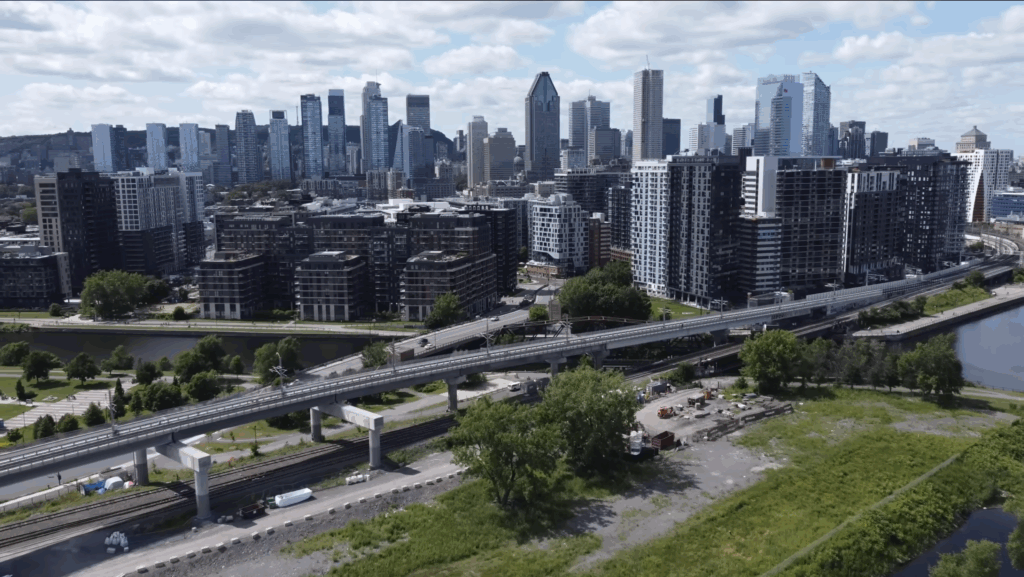
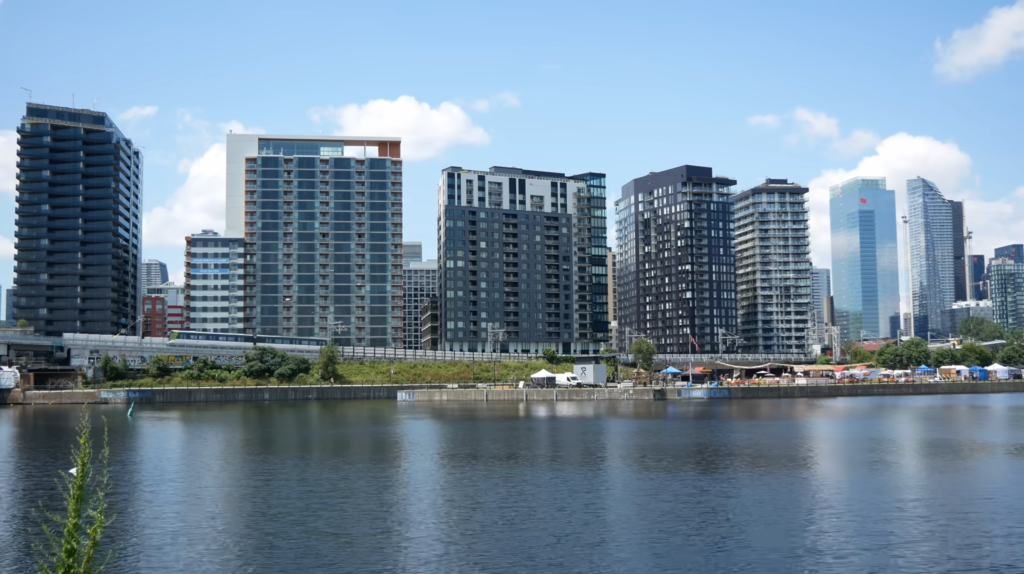
Many locals call Griffintown “Condo City”. This is because the majority of its housing stock consists of modern, mid and high-rise condominium towers built after 2010.
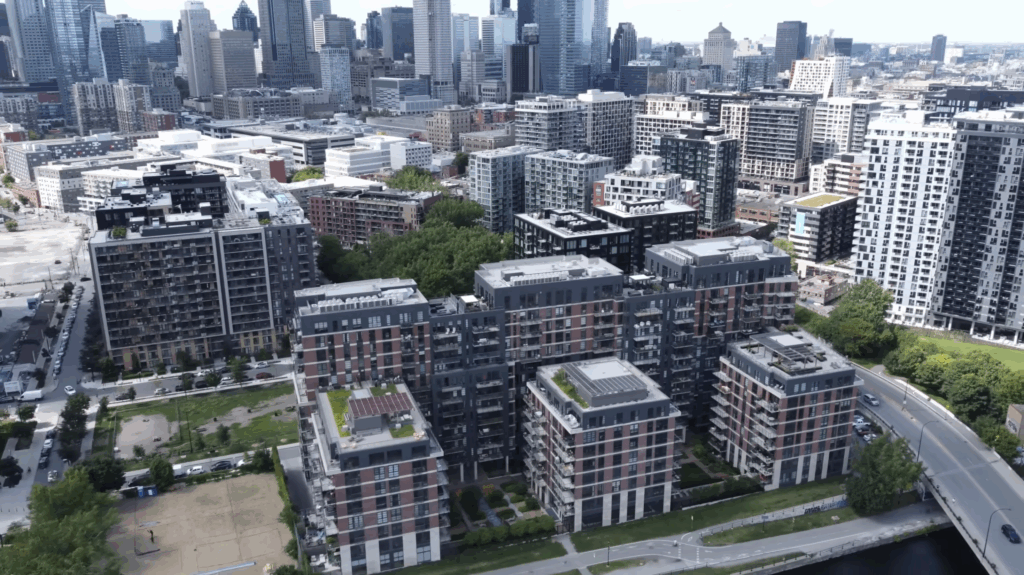
In some parts of the neighbourhood, the towers stand so close together that certain streets can feel shaded and dark for much of the day. This is not always a bad thing, however it is worth noting if you are looking to live in Griffintown, you should check the direction your condo is pointing towards.
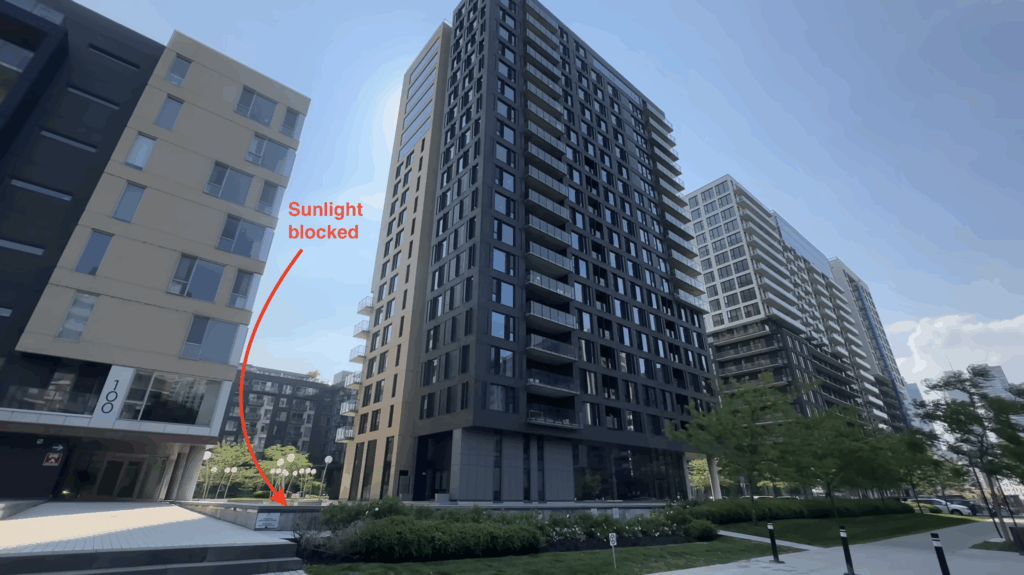
All that being said, it really depends on where you are. For example, along the Lachine Canal, the openness, water views, and walking paths make the area feel bright, airy, and surprisingly peaceful for somewhere so close to downtown.
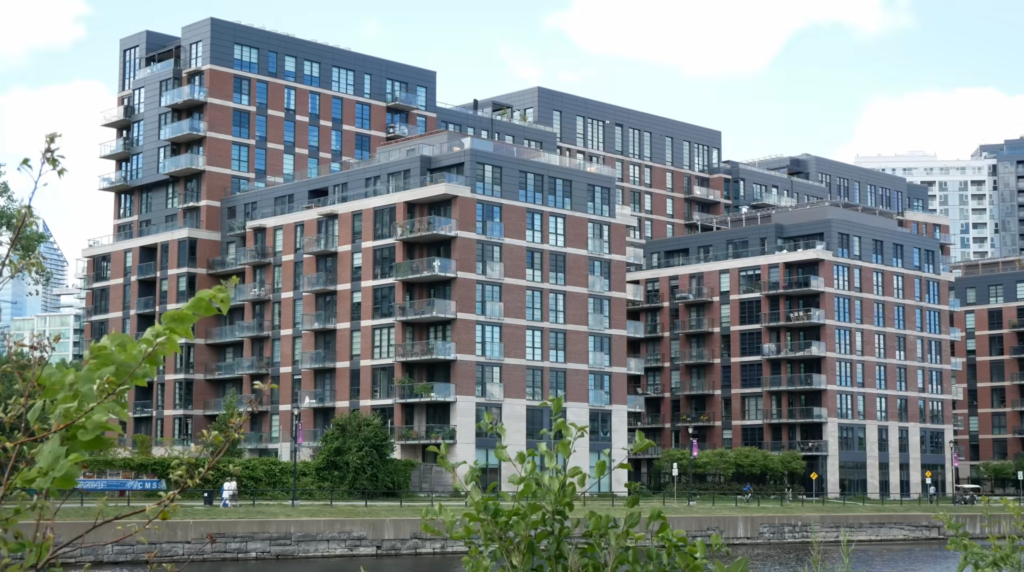
Thanks to its recent development, walking around Griffintown is very pleasant. There are lots of pedestrian walkways and the roads are very wide and include wide Danish style bikeways. Many of the roads are also very new construction which makes Griffintown feel noticeably modern.
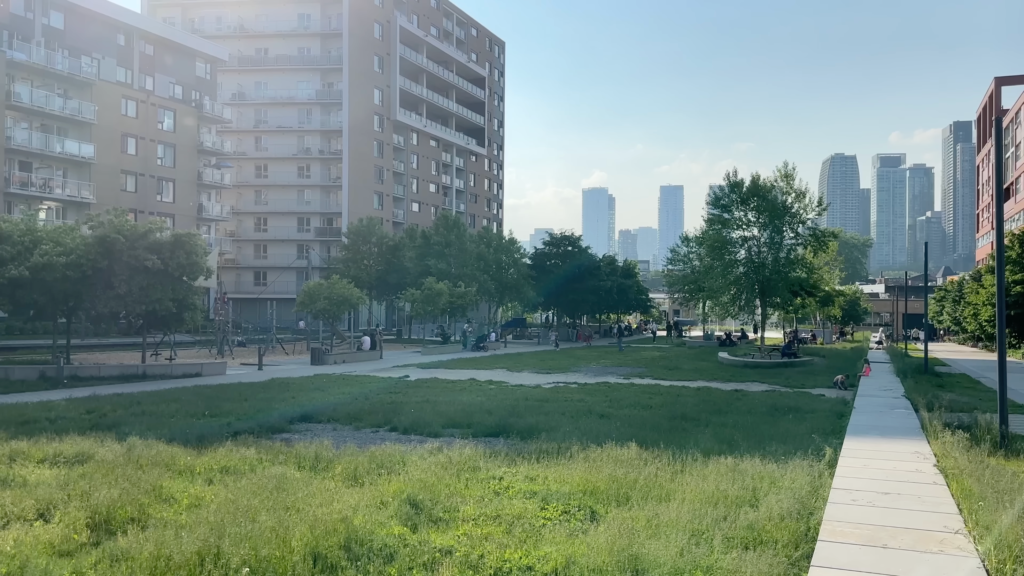
You can also get to a lot of desirable spots on foot from Griffintown. For instance, you can walk along the canal right through Atwater and into St. Henri, a route that will take you past lots of small coffee shops, cafes, restaurant, bars, gyms and yoga studios. Meanwhile walking along the canal to the west, you will quickly reach Montreal’s historic port (Ville-Marie). And to the north, you have two metro lines (Lucien-L’Allier and Bonaventure), as well as the entire downtown Montreal.
As mentioned earlier, the newness can also sometimes make the neighbourhood feel a bit transient. However, the area is starting to evolve into a community of high-paid professional residents. These people work particularly in tech, finance, design, and other knowledge-economy roles. Furthermore, with new cafés, restaurants, gyms, and co-working spaces, the social fabric is getting stronger every year.
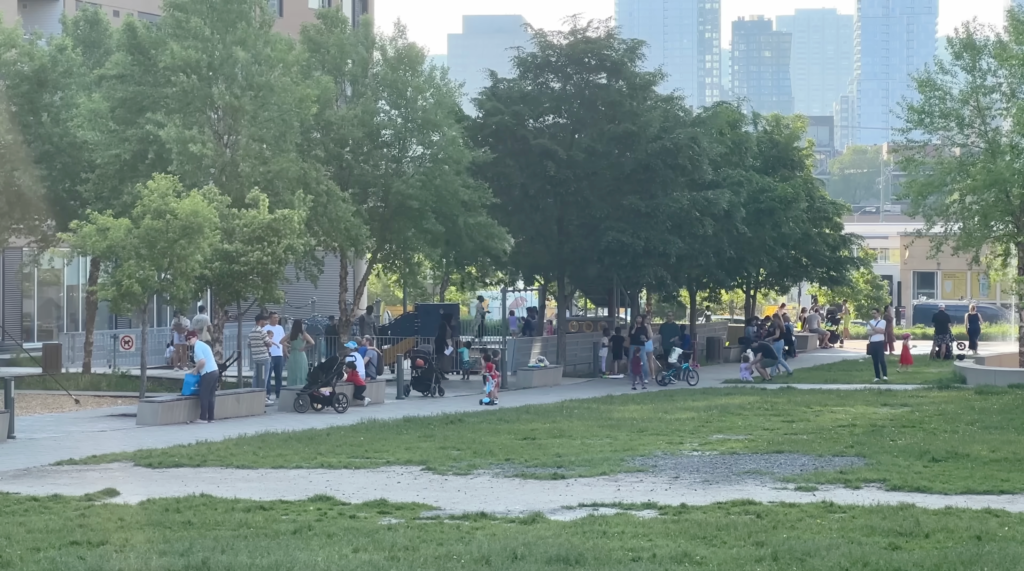
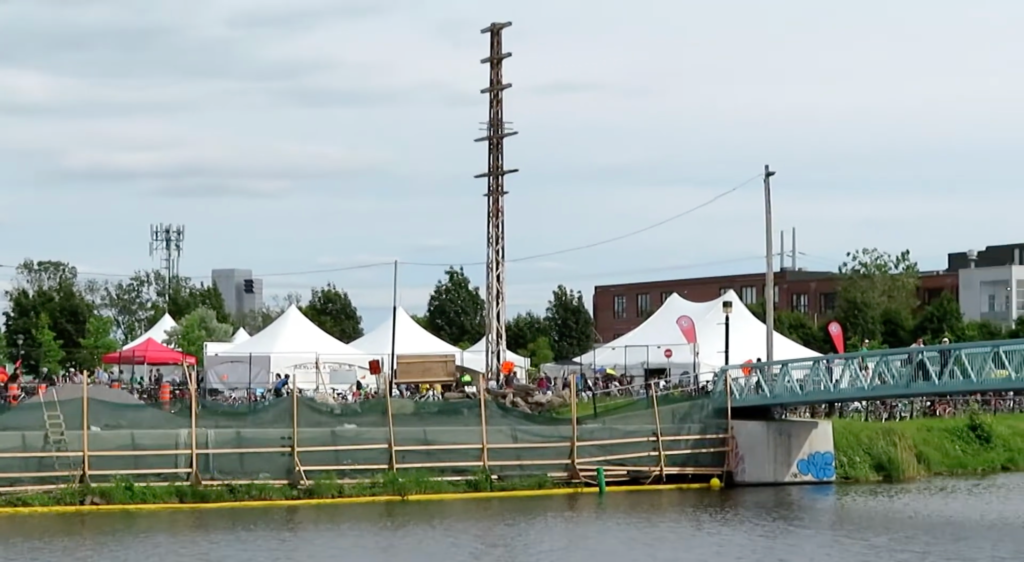
In summer, the neighbourhood really comes alive with recurring festivals along the Lachine Canal such as Festival sur le Canal and La Guinguette du Sud-Ouest, volleyball parks and barbecue areas opening up, pop-ups, patios, and canal-side gatherings. All of this is helping to create a sense of community and belonging that continues to grow as more residents settle in.
Griffintown commute
In this section, we take a look at what it is like to commute in Griffintown using three modes of transport:
Car
Owning a car in Griffintown is absolutely manageable, as long as you have your own parking space (most condo buildings include indoor parking for residents). Because of its central location, driving from Griffintown gives you quick access to almost anywhere on the island. You can reach neighbouring areas like Saint-Henri, Verdun, Westmount, the Plateau, and downtown in just a few minutes.
Griffintown also offers excellent access to major roadways. From the neighbourhood, you can quickly reach Highway 720 (Ville-Marie Expressway), the Bonaventure Expressway, and Highway 10. These connections make it easy to travel to other parts of Montréal and just as easy to leave the island. In particular, Highway 10 takes you straight toward the Eastern Townships, making weekend trips to Mont-Saint-Bruno, Bromont, Magog, and Sherbrooke fast and convenient.
Montreal’s car share program Communauto is avaiable throughout Griffintown. With this program you can reserve a car through an app, pick it up from a nearby parking spot, and return it when you’re done. Residents who want to save money by not owning a car typically use this.
Public transport
If you don’t have a car, don’t worry!
Griffintown is well-connected by public transit. There are three metro stations within walking distance of the neighbourhood: Lucien-L’Allier, Bonaventure, and Square-Victoria–OACI. Depending on where you live in Griffintown, these stations are usually a 10–20 minute walk.
There is also easy access to the REM at Gare Lucien-L’Allier / Gare Windsor (beneath the Bell Centre) and at Gare Centrale, both of which connect you quickly to the airport, the South Shore, and other emerging REM lines. From Gare Centrale, you can also catch intercity trains on VIA Rail and international routes through Amtrak, giving you options to nationwide travel across Canada and into the United States without ever needing a car.
Griffintown is also served by several excellent bus routes, including lines that run along Peel, Wellington, Guy, and William Street. These buses connect directly to downtown, the Old Port, Atwater, and Verdun.
Bike
The neighbourhood has an extensive network of bike paths, including direct access to the Lachine Canal route and wide, well-marked cycling lanes along major streets. It’s one of the easiest places in the city to get around by bike.
Montreal’s public bike-share system BIXI is avaiable throughout Griffintown. It lets you unlock a bike with the app, ride to your destination, and dock it at any nearby station. The neighbourhood has dozens of BIXI stations, especially near the canal, Peel Basin, Wellington Street, and the major condo clusters. Many residents use the BIXI bikes to get around.
Is Griffintown safe?
Griffintown is generally considered a safe neighbourhood by Montréal standards. It is largely residential, well-lit, close to the downtown police station. It also has a steady flow of pedestrians and cyclists throughout the mornings, afternoons, evenings and the early part of the night. Especially near the canal and main streets like Peel and Wellington.
Most issues tend to be minor, opportunistic crimes (bike thefts, car break-ins), which are common in dense urban areas. Violent crime is low, and walking around during the day or evening is typically safe. Like anywhere in Montréal, taking normal big-city precautions is wise, but overall, Griffintown is seen as a safe, livable, and comfortable neighbourhood for young professionals, students, and newcomers.
What are the schools like in Griffintown?
There are currently no schools in Griffintown. However, a new 24-class French-language elementary school has been approved and is in development. There are also several other French- and English- language schools nearby. For example, St. Gabriel School in neighbouring Pointe-Saint-Charles.
If you are looking for a school for your child, you can consult the public school lists:
- For French-language schools, visit the Centre de services scolaire de Montréal (CSSDM) website and search using the borough filter “Le Sud-Ouest” to see which schools serve your catchment area.
- For English-language schools, visit the English Montreal School Board (EMSB) website. On EMSB’s site, enter your address to confirm which school your child is zoned for.
These tools will help you identify the nearest elementary and high schools that serve Griffintown residents.
What is the real-estate market like in Griffintown? (Q4 2025)
Below are the key statistics on Griffintown’s real-estate market as of Q4 2025.
| Metric | Value | Notes | Source |
|---|---|---|---|
| Average condo price (Griffintown – recent) | ≈ $450,000 | Typical price range quoted for Griffintown condos in mid-2020s | (Soumissions Condo) |
| Average condo price (Griffintown – earlier) | ≈ $301,000 | Average Griffintown condo price cited in 2019 investor article | (Rentals.ca) |
| Median condo price (Montréal, Sept 2025) | $430,900 | Montréal-wide condo benchmark, +4.6% YoY | (nesto.ca) |
| Population (2016, Griffintown) | 10,764 residents | Most recent official census neighbourhood profile | (WOWA) |
| Young-adult share (25–34) | ≈37.7% | Shows strong young-professional skew | (WOWA) |
Final thoughts
Griffintown is a fantastic place to live, especially if you’re in your 20s or early 30s and want to be surrounded by energy, convenience, and modern living. I genuinely enjoyed my years there. The location is unbeatable, the canal is beautiful in every season, and the neighbourhood gives you a unique blend of downtown access with pockets of calm and waterfront space.
But as I got older, started craving more room, and eventually had a baby. In this case my priorities shifted and, the cost of a larger space was very steep. So, like many people who outgrow high-density neighbourhoods, I found myself looking for more space at a more affordable price, more greenery. This ultimately took me to the West Island.
Griffintown remains a vibrant, evolving community that continues to attract young professionals and new arrivals to Montréal. If you’re in that stage of life, it’s an incredible place to call home. If you’re looking for more space or a more family-oriented environment, you may eventually find yourself doing what I did… and moving on.
Either way, Griffintown leaves an impression and, for many, it’s the perfect first chapter in their Montréal story.
Need a realtor?
Do you want to work with a real-estate agent who specializes in Le Sud-Ouest, Griffintown or Montreal as a whole. Get access to exclusive listings throughout Montreal, property pricing data and the best realtors in Montreal. Simply tell us about your project now to start the process.