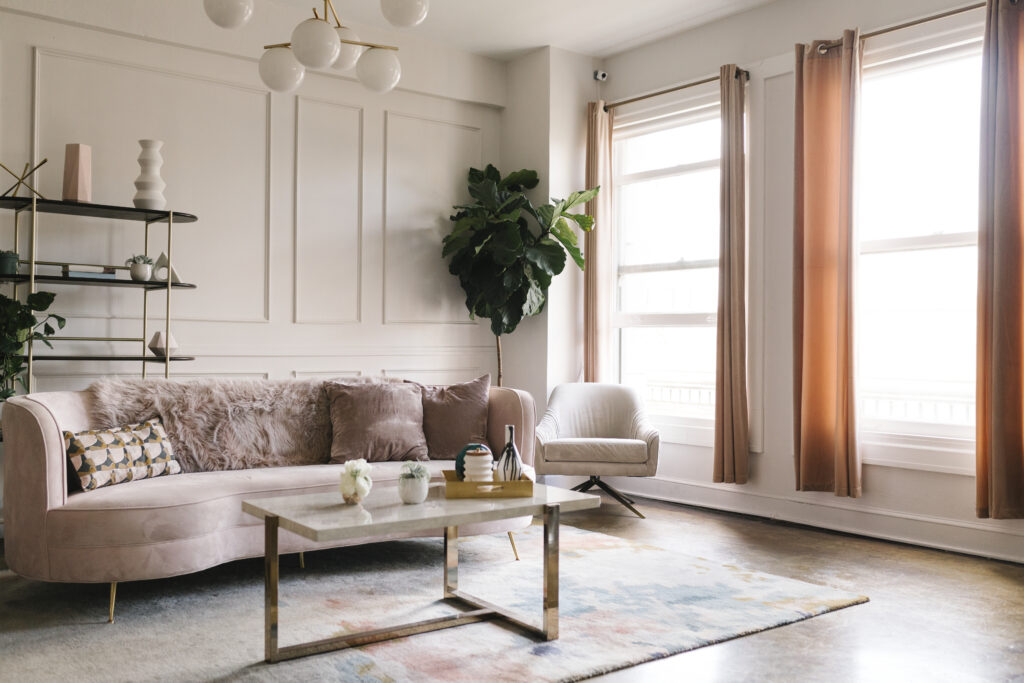

According to a study by the Real-Estate Staging Association, staged homes spend 73 % less time on the market compared to un-staged homes. In another complementary study, data from the National Association of Realtors shows that staged homes can see a more than 5 % increase in sale offer value.
These numbers indicate that home staging is far more than just a buzzword. In fact it is one of the easiest and lowest cost ways that home sellers can increase the sale price of their home. In this article we will cover:
- What is home staging
- The difference between virtual vs physical staging vs no staging
- What is the cost of home staging?
- 5 expert tips on how to stage your home
- Frequently asked questions
- Final remarks
What is home staging?
Home staging is a real-estate marketing strategy that creates showcases a home’s best features to attract buyers and increase sale value. It involves arranging furniture, decorating, and setting out visuals so that buyers can imagine themselves living inside your property.
Since the majority of buyers’ first interaction with your home will be online, staging should focus on creating spaces that look attractive in photos and videos. This means that many of the techniques used, for instance lighting, furniture placement, and so on are intentionally chosen to make a strong visual impact for online shoppers browsing listings.
The difference between virtual staging vs physical staging vs no staging
When it comes to home staging, there are typically three options to conisder:
There are pros and cons with each option. Let’s take a deeper look.
Physical staging
Physical is the traditional route that many home sellers take. It involves bringing in real furniture, decor, and accessories into your home. Professional stagers will position this furniture (sometimes in and amongst your own furniture) so that buyers can get a sense of how the space can be used. Any furniture used in staging will be rented for the duration of you home listing.
Physical staging was the traditional route that many home sellers took up to around 2019 when COVID-19 made it impossible for stagers to get physically inside homes. Since 2019, the economics around this traditional method of shifted significantly. In particular, research shows that the cost of physical staging has nearly quadrupled over the last seven years. However, the reported benefits have actually decreased. In 2026, less than 19% of realtors believed that staging actually reduces the days on market.
All of this means that physical staging has become a luxury item that not all home sellers can afford. It is still essential for high end, luxury properties where buyers expect a quality buying experience, and for properties with awkward layouts to prove the home is functional. However, many sellers will now look to cut costs by using virtual staging or taking a DIY approach with their own furniture.
Virtual staging
Virtual staging is a game changer for the mid market or for empty properties. The solution involves taking photographs of the unit and then giving these images to a graphic designer who will super impose virtual furniture and decor to showcase the home’s potential.
The main benefit of virtual staging is that it closes the visualization gap for buyers who are unable or unwilling to imagine how an empty or unfurnished space could look once furnished. However, virtual staging is not as powerful as physical staging since, when buyers show up to view the property, they will be left to imagine the furniture and layout for themselves. Reasearch shows that in this environment, buyers will spend 70% less time physically touring the property, simply because there is nothing to create an emotional connection with an empty home.
For this reason, many listing agents see virtual staging as a top of funnel marketing tool. It can get buyers through the doors however, once inside the listing agent must be there to actively sell the home.
No staging (a DIY job)
The last option is to do no professional staging at all. In this case, you may want to use your own furniture or simply clean your home and then leave it empty. This can work however, you will likely receive less online attention compared to professionally staged homes and therefore less buyer demand for your home. In this case, your home may spend more time on the market, and you could receive lower offers than if it had been professionally staged.
What is the cost of home staging?
The choice of wether to stage your home or not, boils down to core financial decision. Essentially you are choosing how best to spend your real-estate marketing dollars. Let’s break down the costs of each option and what the expected return on investment (ROI) is for each staging option.
| Staging Option | Estimated Cost (CAD) | Expected ROI / Impact |
|---|---|---|
| Physical Staging | $2,000 – $8,000 per month* (varies by home size, rental furniture and days on market). | Can increase sale price by 1–5% (sometimes more), reduces time on market, high buyer appeal |
| Virtual Staging | $100 – $500 per listing** | Moderate ROI; improves online appeal, faster showings, helps buyers visualize potential, lower upfront cost |
| No Professional Staging | $0 – $500 (cleaning / minor decor) | Lowest ROI; may reduce online interest, slower sales, buyers struggle to visualize space |
**Price is typically charged on a per photo basis, somewhere between $30 – $75 per picture.
As you can see physical staging is both the most expensive and the highest impact. The right decision for you depends on your exact situation. For example, imagine your home is valued at $500,000 and costs you $2000 to professionally stage but, this yields a 1% increase in sale price. In this case you will have made $3000 net profit on your investment.
5 expert tips on how to stage your home
In this section we give you some expert tips that will supplement your real-estate agents advice on how to stage your home. These are:
- Depersonalize
- Declutter
- Consider colours and textures
- Hang pictures at “gallery height”
- A visual trick with curtains
1. Depersonalize
When staging your home, remove highly specific or personal items that appeal to a narrow audience and replace them with subtle, aspirational cues that appeal to a broad range of buyers. To do this, use neutral décor, clean surfaces, tasteful artwork, and universally appealing lifestyle elements such as travel magazines, plants, or classic books. The goal is to suggest the lifestyle and social status your home can offer. This will make your home more desirable to potential buyers who will begin to imagine what your home can help them achieve.
Removing personal items makes your home more appealing to a wider audience when buyers view it online. This will increase the chance of them booking a visit to see your home. You can also remove any family photographs, flags, religious symbols, controversial or potentially offensive books. In children’s rooms, you can take down posters, or put toys away.
2. Declutter
You should declutter your home to remove anything that might distract prospective buyers from seeing how beautiful your home is and, to make the living space appear bigger. General advice is that you should remove 20-30% of the items that are inside your home, box them up and put them into storage. For instance, if you remove 30% of your clothes from your closet, a prospective buyer will look into the closet and immediately thing the closet is larger than it actually is.
At the same time, you should remove items from table tops, bedside tables, sinks and kitchen surfaces. You can then strategically add things back so as to make a surface look more expensive, or leave them clear if a minimalist look better suits the room. Designers often refer to the rule of three which says that grouping objects in sets of three makes the room look more visually appealing.
3. Consider colours and textures
When staging your home, use neutral colours to create a calm, versatile backdrop. Choose white bedspreads, light-coloured linens, and simple, understated décor so buyers can focus on the space rather than personal style. Some realtors recommend adding a single “pop of colour” for visual interest, but design psychology suggests that bold accent colours can actually distract buyers and make it harder for them to imagine the home as their own.
Instead of relying on a single accent colour, professional stagers will introduce a mix of textures such as wood, metal, glass, fabric, and stone. Layering textures adds visual depth and helps a room feel more refined and expensive. In contrast, rooms with flat, single-texture finishes often feel one-dimensional and builder-grade. You can add texture through rugs, throw pillows, woven baskets, velvet curtains, and similar elements.
4. Hang pictures at “gallery height”
One mistake that sellers make all the time is that they will hang their pictures too high. This is because it makes them easier to see when living in the home however, staging is not for everyday life. Professional designers therefore suggest that you hang your artwork such that the centre of the piece is positioned approximately 57-60 inches from the floor. This is known as “gallery hight”.
The idea behind this is that it aligns with natural eye level, it photographs better, and creates a more visually appealing space. Since the goal of real-estate marketing is to drive prospective buyers to view the photographs on your online listing, it makes sense to arrange décor and staging elements in ways that look their best in photos and grab buyers’ attention online.
5. A visual trick with curtains
You can make your ceiling appear higher with the use of curtains. To do this, hang your curtain rods as close to the ceiling, well above the window frame. This draws the eye upward and instantly makes ceilings appear taller than they are.
To make the room feel wider, you can use curtains that closely match the wall color and that create a continuous visual flow. Make sure that you hang the curtains perfectly straight and just graze the floor, avoiding the pooling or “puddling” of fabric at the bottom. If you are selling in the summer and your baseboard heaters are off, you can also hang the curtains over the baseboard heaters without worrying about a potential fire or damage to the curtains.
Frequently asked questions
Home staging is a strategic marketing tool designed to sell a property. The goal is to make the home appeal to the widest possible pool of buyers and help them visualize themselves living there. As such, staging centres around decluttering and depersonalizing you home so that prospective buyer’s can visulize themselves living there.
Interior decorating, by contrast, is about personalizing a space for the people who live there. Decorators focus on style, comfort, and aesthetics that match the homeowner’s tastes and lifestyle. The goal is not to sell the property but to make it enjoyable, functional, and visually pleasing for the current occupants.
1. Living Room / Family Room
2. Kitchen
3. Master bedroom
4. Bathroom
5. Dining area
6. Outside (if you have it)
Conversely, if you do not stage your home you immediately make it harder for buyers to visualize themselves living in your home. Research shows that buyers spend 70% less time touring a vacant home, simply because there is nothing there to create the emotional connection. A totally empty home also feels cold and uninviting, and any scuff or blemish becomes more noticeable.
Final remarks
Home staging is a key part of real-estate marketing. In hot, seller-driven markets, it acts as an offensive strategy to help maximize your sale price. In slower, buyer-driven markets, it serves a defensive role by maintaining a strong valuation and keeping your home competitive.
You can choose to hire a professional company for physical staging, use virtual staging, stage your home yourself, or combine these approaches. The right choice depends on your specific situation, local market expectations, and other costs.
Your realtor can advise you on the most effective approach, but ultimately the best method is the one that delivers the highest risk-adjusted return on your investment. Staging isn’t just about furniture — it’s a core financial decision involving possibly one of your most high value assets, your home.