
In 2017, a Quebec couple bought a property only to later discover that part of their parking area actually belonged to their neighbour. This mistake led to a multi-year court battle that they eventually lost. The issue was an outdated certificate of location that failed to show the true boundaries of the lot.
In this article, we explain:
- What is the certificate of location?
- What is included in the certificate of location?
- Why is the certificate of location important?
- Is the certificate of location mandatory?
- When do I need a new certificate of location?
- How to get a new certificate of location in Montreal?
- How long does it take to get a certificate of location?
- How much does a certificate of location cost?
What is the certificate of location?
In Quebec, the provincial government divides land into cadastral lots. Property owners may construct buildings as long as they comply with municipal zoning regulations, bylaws, and obtain the required permits. For instance, a plex in Montreal must respect maximum height limits, setback rules from the street, and parking requirements.
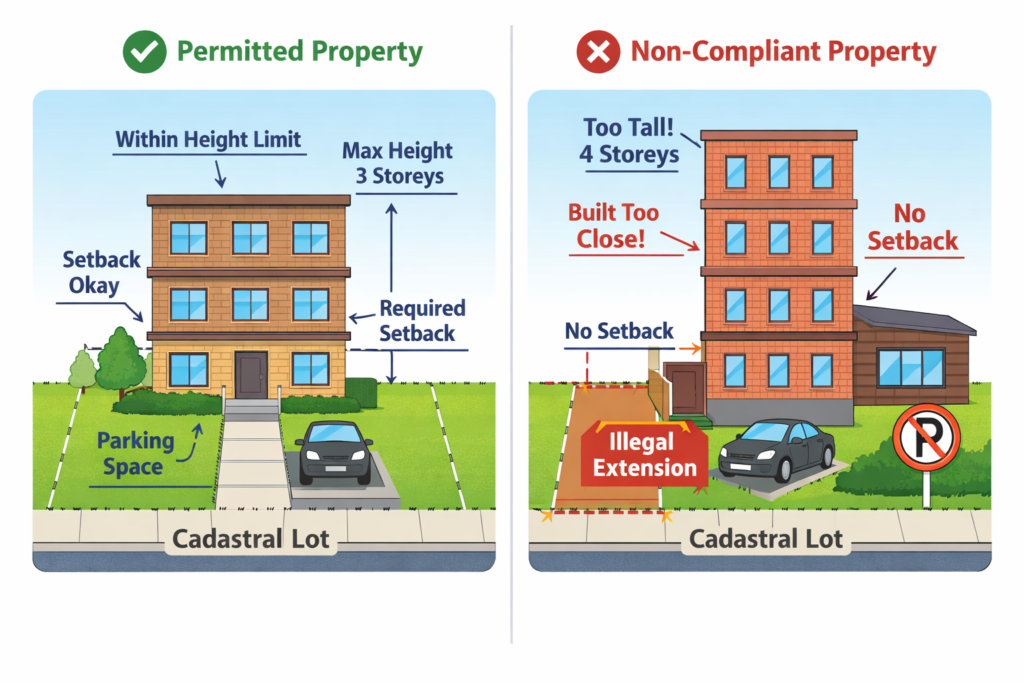
The certificate of location is an official document that shows whether the property respects these rules. It highlights any deviations, illegal additions, or discrepancies between the actual structures and the legal boundaries.
What is included in the certificate of location?
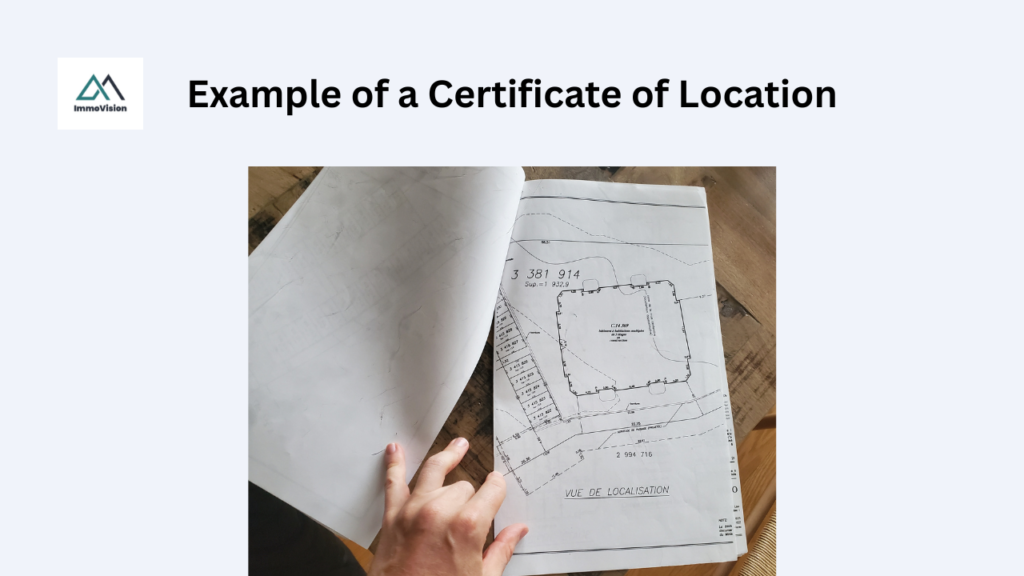
The certificate of location includes a detailed plan and a written report about the current state of a property. A land surveyor prepares the report and typically breaks it down into four sections:
- Boundaries and structures: This shows exactly where your property starts and ends, and where the buildings sit on the lot. Think of it as a map of your land that lets you see if anything is too close to the property line, or if a building or extension goes beyond the legal boundaries.
- Municipal by-laws: This section checks whether your property follows the city’s rules, including how tall you can build, how far the building must sit from the street, and how much parking you must provide.
- Servitudes: This lists any legal rights others have to use part of your property, such as utility lines, shared driveways, or restricted views. For instance, you cannot build a high-rise condo directly in an airplane’s flight path, or put a window where you could see directly into your neighbor’s bathroom.
- Encroachments or irregularities: Here you’ll find issues like fences, sheds, or extensions that cross onto a neighbor’s lot or don’t line up with the official boundaries.
Note
Why is the certificate of location important?
The certificate of location is important because it helps buyer’s understand exactly what it is that they are buying. For instance, let’s suppose someone buys a property that has a shed and part of a fence built over the neighbour’s lot. In this case, you are buying the property and all of the potential issues that come with your illegal shed extension. In this case, your neighbour (current or future) could force you to move the shed or rebuild the fence.
Alternatively, let’s suppose that someone buys a house with a garage that sits too close to the street, in violation of municipal setback rules. If the city requires compliance, the new owner might have to pay thousands to move the garage back or even demolish part of the structure.
So the question is, if you buy a property with a violation in either a zoning law, municipal bylaw, or a servitude or easement, are you really buying the property that you see? Obviously the answer is “no” — you pay for something that may look like a fantastic structure, but you will need to alter it or remove it entirely.
Is the certificate of location mandatory?
The certificate of location is not a 100% firm legal requirement on all real estate transactions in Quebec. For example, if someone is buying a home in cash, they might choose to waive their right to a certificate of location. However, practically speaking, you should assume that buyers will want to see a certificate of location to close.
This is for the obvious reason that buyers and their lenders want to know exactly what they are paying for. The notary must also verify the legal status of the property before transferring ownership and to do this, they will need the certificate of location.
The certificate of location also protects the seller by ensuring they disclose any material information about the property before completing the transaction. This prevents the situation where the buyer discovers a hidden problem (known as a latent defect) after closing. This is important because in Quebec, the law (Quebec’s Civil Code) holds sellers financially responsible for hidden defects even after the sale, so they must disclose everything.
When do I need a new certificate of location?
You need to get a new certificate of location in the following two cases:
- When the existing certificate is older than five years, you should order a new survey. This is because, in Quebec, certificates of location are valid for up to a maximum of five years and a new survey ensures the boundaries and property features remain accurate.
- After any renovations to the property – this is to ensure that all changes, additions, or modifications comply with zoning regulations, municipal bylaws, and permit requirements, and that the certificate accurately reflects the current state of the property.
Note
How to get a new certificate of location in Montreal?
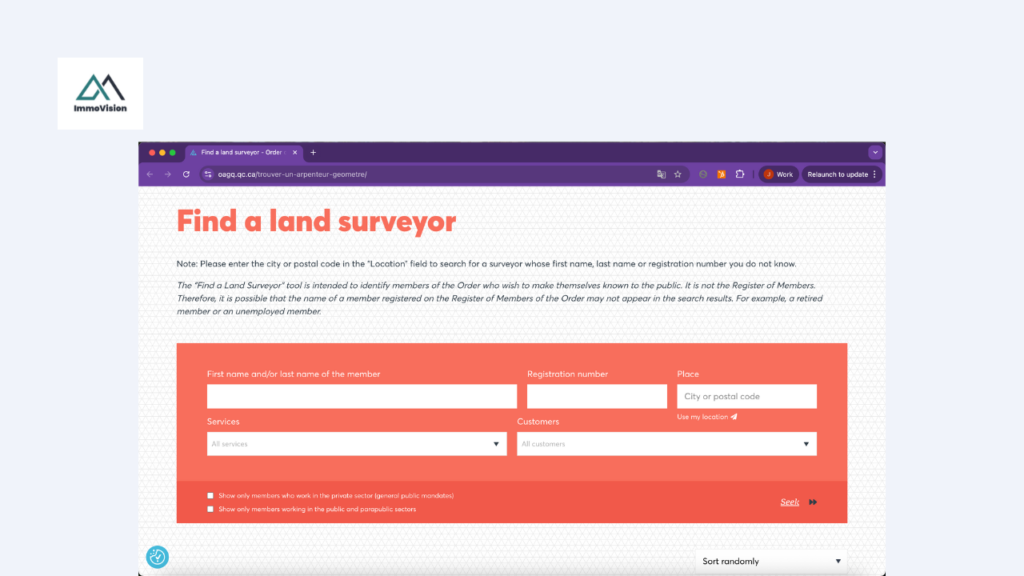
In Quebec, a Quebec Land Surveyor prepares the certificate of location. The Land Surveyor must be a member in good standing of the Ordre des Arpenteurs-Geometres du Quebec (OAGQ).
You can either order a certificate of location yourself, by visiting Trouver un arpenteur-géomètre and then contacting a land surveyor yourself. When you speak with the surveyor you will ask them to prepare a certificate of location of your property.
Once you found a land surveyor and asked them to prepare the certificate of location, the land surveyor will check the Land Register (Registre foncier du Québec) to confirm cadastral information and servitudes attached to the property. They will then visit the property to take precise measurements of the land and all structures, verify boundaries against cadastral records, and note any issues such as encroachments, setbacks or by-law violations.
How long does it take to get a certificate of location?
A land surveyor prepares the certificate of location, and the time to receive it depends on the surveyor’s availability. In Montreal, the normal time to get a certificate of location is 3 – 4 weeks. However, it can take longer. For instance, during COVID it could take 6 – 8 months to get a new certificate of location.
How much does a certificate of location cost?
A surveyor determines the cost of a certificate of location based on the property’s size and complexity, the number of structures to measure, and the time needed to research cadastral records, property titles, and municipal bylaws.
For a standard single-family detached house on a typical city lot, you usually pay between $1,200 and $2,000 for a new certificate. Larger lots, multiple buildings, or irregular boundaries will push the price higher.
Usually, the seller covers the cost of the certificate, but if the buyer requires a new certificate in the promise to purchase and there have been no changes to the property, the buyer must pay for the new certificate.
Need help from an expert?
If you need any help regarding your certificate of location, the best place to start is by contacting a real-estate agent. These property experts know how to interpret the boundaries and structures shown on the plan and the legal information in the accompanying report. Good, local realtors will be able to connect you with municipal authorities, surveyors, and other local experts who can help quickly address property and legal questions.
It is best to work with a realtor who knows your neighbourhood since they will understand the local laws, regulations, and market trends better than someone from outside the area or a generalist agent. You can use our free Immovision Agent Finder tool to find a local agent in Quebec.
Read more about essential real-estate documents
- Understanding the Seller’s Declaration – What Every Buyer and Seller Should Know (2026)
- Deed of Sale in Quebec – Everything you need to know (2026)
- Title vs Deed in Quebec: What is the difference? (2026)
- How to make a promise to purchase: The top 6 things to check (2026)
- Declaration of co-ownership – Everything you need to know (2026)