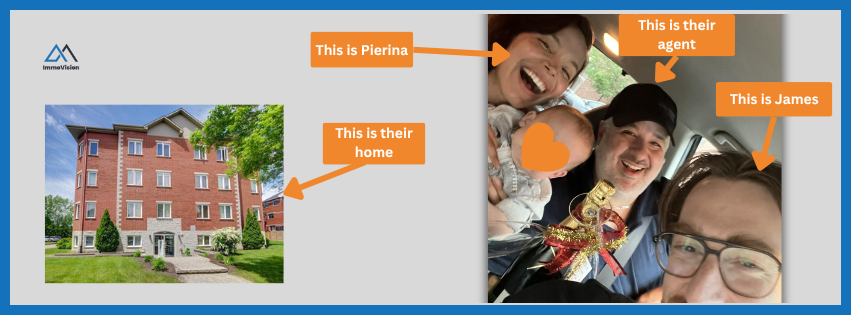

Pierina Chacon – Montreal Home Buyer
It was October 30th, 1.45am, a day before Halloween and James and Pierina were living in the ground unit of a triplex on Rue Ropery Street in Pointe-St-Charles. But unlike previous years, they were not planning to go and drink with their friends, they were instead lying in the maternity ward of St. Mary’s hospital, staring at their newborn baby.
Their baby boy had been born 3 weeks early and so the hospital kept the new family in the hospital for 3 days. James spent this time traveling between the hospital and home, trying to get their apartment on the ground floor Rue Ropery ready for Pierina and his new baby to return. The things the couple had put off for weeks suddenly became urgent.
They had already filed a complaint against their landlord with the TAL for failing to deal with mold that had materialized in their apartment during the summer. The inspector was due to come later in the week, and so James returned home, poured bleach onto rags and scrubbed every inch of the home, worried because he didn’t want to bring his newborn son back to a dangerous and mold infested home.
However, in spite of all the efforts, a week later a home inspector told that the home was not safe to live in. And in particular, the bedroom where James, Pierina and their baby were sleeping was the worst.
As Pierina puts it:
“When the city inspector finally came, he got out some equipment, ran some tests and then told us our home wasn’t fit for a baby. He told us the worst of it was in our bedroom. He advised that we empty this room, close it off and sleep in the living room.
You have to understand, in a 590 square foot apartment, where the bedroom is 300 square foot, we just lost around half of our home. We were now two new parents and a 1 week old baby living and working out of one room. James runs his own business, and so he would spend a lot of the day working in the bathroom to try and keep from disturbing us.
We knew our landlord was at fault, and we appealed to her decency to allow us to move into the apartment upstairs that she owned, and that was empty, but she refused. And told us she would allow us to break the lease, but nothing more.
Honestly, we knew that we couldn’t raise a baby in this tiny apartment and, so we’d been saving up really hard for a downpayment on a house for almost 18 months. We’d done all the research into how home buying works in Quebec and so, we felt relatively confident and decided that now we had to move.
But yeah… as we were about to find out, this confidence was definitely misplaced.”
Finding a house and making an offer
“Because of the pressure of living and working in a tiny apartment, we began looking for a new home aggressively. We would visit 5 – 10 houses per week. At the start, we just went to anywhere that looked good in the pictures however, as we quickly learnt, pictures are quite often very deceiving.
Eventually after about 3 months, we found a place in Brossard, a three bedroom town house, that was very competitively priced. We met the listing agent, who came to show us round. He was very smart, and answered all of our questions about the property.
We decided to make an offer to purchase, and he sent us the seller’s declaration to sign. We read through this and realized that we didn’t really understand what a lot of it ment. There was lots of things about how the house had been built and the materials used in construction. We had no idea what was good and what was bad.
So I went online and started looking for some answers. I think I Googled for something like “how to read a seller’s decleration” and I found this company Immovision. I read that this company had developed some software that would analyze the seller’s declaration and highlight key risk areas. So I uploaded my document and the software said there were about 4 things that I needed to be aware of. I remember the things that caught my attention were, a special assessment and aluminum wiring.
I decided to call the agent and ask about the aluminum wiring. I explained that I had run the seller’s deceleration through some online software this is something it flagged. The agent thought this was hilarious. He basically laughed at me, and then he told me that he’d been in the market for 15+ years and there was nothing wrong with aluminum wiring. He said that other people were interested in the property, so either we wanted to make an offer or not. But that was up to us.
I left that phone call feeling a bit uncomfortable.
So we decided to get a second opinion. We spoke to a few independent buyer’s agents through Immovision, and every single one of them told us the same thing — aluminum wiring is a problem. One agent explained that insurance companies often charge higher premiums, or sometimes won’t insure the property at all, because it’s considered a fire risk. And that if we wanted to go ahead with an offer, we should ask for a price reduction.
This really hurt especially since we had a small baby, and clearly this listing agent was above informing us of potential risks that could literally put the life our child in danger.
We realized that we didn’t actually understand what we were doing. And if you don’t understand what you’re doing, you can’t negotiate properly. So we walked away from the deal.
This was quite a desperate moment in our home buying journey. We felt very vulnerable. We had saved really hard for a deposit and now we had it, we felt like there were predators everywhere trying to get their hands on it.
But… we have a small boy who needs us, and so we said, alright, we can do this… we just need a new approach.
Check. Double check. Everything.
Going forward we approached every document with the mentality of check, then double-check, everything…
We decided to work with the buyer’s broker who gave us the advice about the wiring. Before we hired him, we ran the buyer’s agents contract through Immovision. The system showed that the agent’s commission was set at 2% of the purchase price, which is usually paid by the seller.
However, it also flagged that if the seller’s agent only offered 1% commission to the buyer’s agent, James and I would have to pay our agent the remaining 1% ourselves.
On a $700,000 home, that’s $7,000 out of our own pocket—something we had no idea we were agreeing to. When we flagged this to the agent, he said that he would update our agreement to say that he would only be paid what the seller offers, with no extra cost to us. We were very happy with this.
Next… we learnt how to visit properties
You can waste so much time visiting properties look great on online listing platforms like Centris. However, when you get there and start looking through the documents, you realize that they are fraught with hidden costs that you as a buyer will have to pay when you move in. Sometimes these costs are in the tens of thousands.
To get around this, before every visit, we asked our agent to send us the seller’s declaration. This is document where the seller’s basically list out every known issue with their property. We then uploaded them into Immovision, and decide whether the property was even worth visiting.
For example, if a property has recurring issues with mold, damp, flooding, or signs of more serious problems like foundation cracks, outdated wiring, bad smells, or plumbing issues, we could spot it right away and avoid wasting time on a visit.
The software helped us to understand some problems and, which could be fixed vs others that were not worth taking on. Like we didn’t want to buy a place in known flood zone, for instance. Or somewhere with Pyrite in the foundation.
None of this is complicated, it is just opaque and the Immovision platform really makes it less opaque in an obvious way.
We did it!
In the end, we bought a home in the West Island that we really understood and felt comfortable with.
We knew that the property had some issues with it when we bought it. Specifically the windows needed to be replaced, which we understood going in would cost us $3000 – $5000 after purchase.
Ultimately I would say that sure, no home is without problems. But if you know what the problems are in advance, and what it might cost to fix them, you can actually make an informed decision about whether the property is still worth it, and negotiate accordingly.
That puts you in control of the transaction, and sets you up on a much stronger financial footing from day one.”