Common law definition
Common law is the system used across Canada. It is mainly based on the idea of precedent: when a court makes a decision about a case, that decision becomes a part of the law of the country.
For example, the duty not to hide serious defects when selling a home did not come from one single, detailed statute listing every possible situation. Instead, courts decided over time that sellers cannot knowingly conceal major hidden defects. Judges ruled that if a seller is aware of a serious problem that a buyer could not reasonably discover during an inspection, the seller must disclose it. Those court decisions established the legal principle, and future courts continue to apply it.
What is the Canadian system?
Canada is a constitutional system in which legislatures enact statutes, courts develop and apply common law through precedent, and the Constitution is the supreme authority governing both.
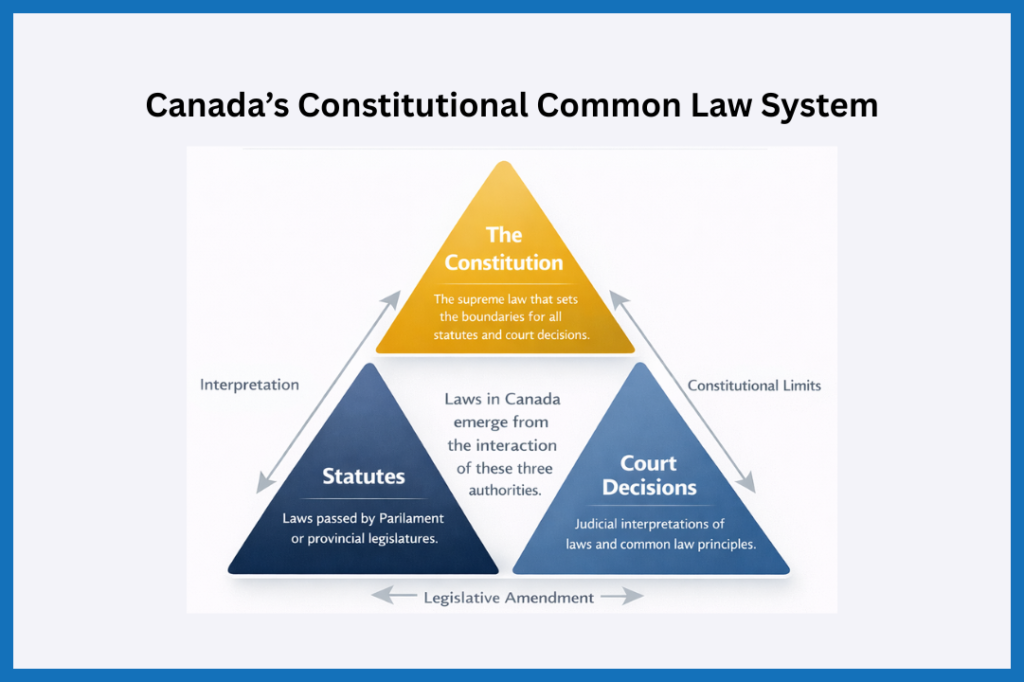
In the Canadian system, statutes, court decisions and the Constitution interact with each other to create and apply the law. The Constitution has ultimate authority. This means that if a statute (or law) is passed by Parliament, an individual, organization, or provincial government can choose to challenge the statute on the basis that it violates the Constitution.
Meanwhile, if the courts create a rule through judicial precedent (common law development) that violates the Constitution, the government can challenge this ruling by appealing to a higher court, ultimately to the Supreme Court of Canada.
Who are the main actors and what are their roles?
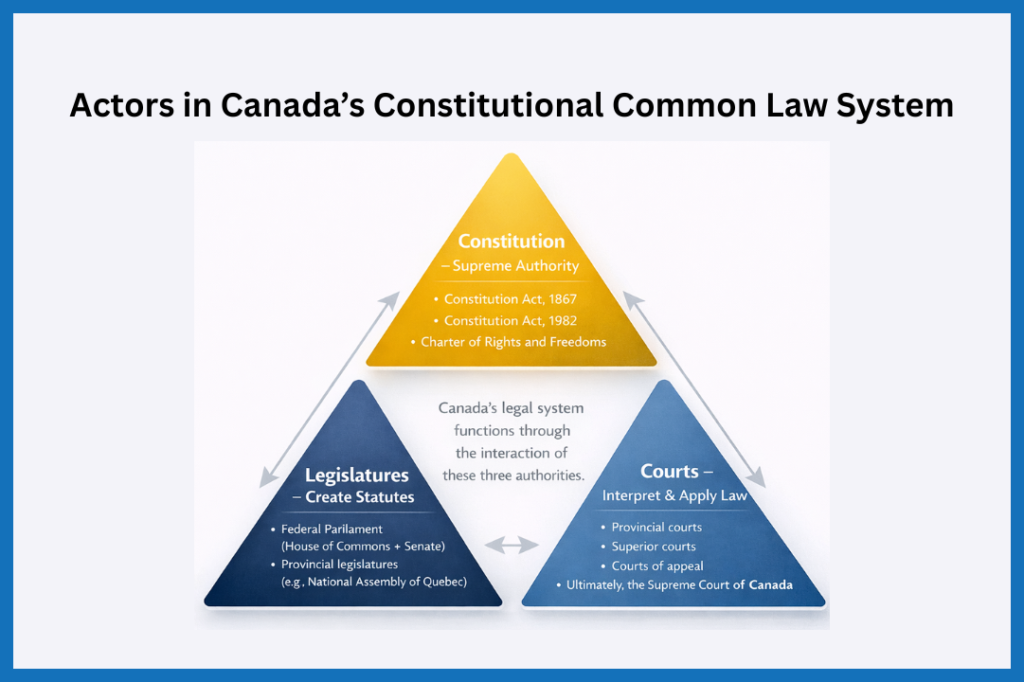
In Canada, legislatures write the laws, courts interpret and develop them, and the Constitution sits above both. Legislatures cannot pass laws that violate the Constitution, and courts cannot create rules that contradict it. Each actor checks the others, but the Constitution has final authority.
Legislatures
Legislatures are the law-making bodies of government. There are two types of legislatures in Canada: federal and provincial.
The federal legislature is Parliament, which consists of the House of Commons and the Senate. It is responsible for statutes that cover areas such as criminal law, immigration, national defence, banking, taxation, and trade and commerce.
Provincial legislatures are responsible for statutes that cover areas such as property and civil rights, education, health care, municipalities, and local matters. Each province has its own legislature. For example, in Quebec, the legislature is the National Assembly of Québec.
Courts
Courts are the law-interpreting and law-applying bodies of government. Their role is to resolve disputes, interpret statutes, develop the common law, and ensure that laws comply with the Constitution.
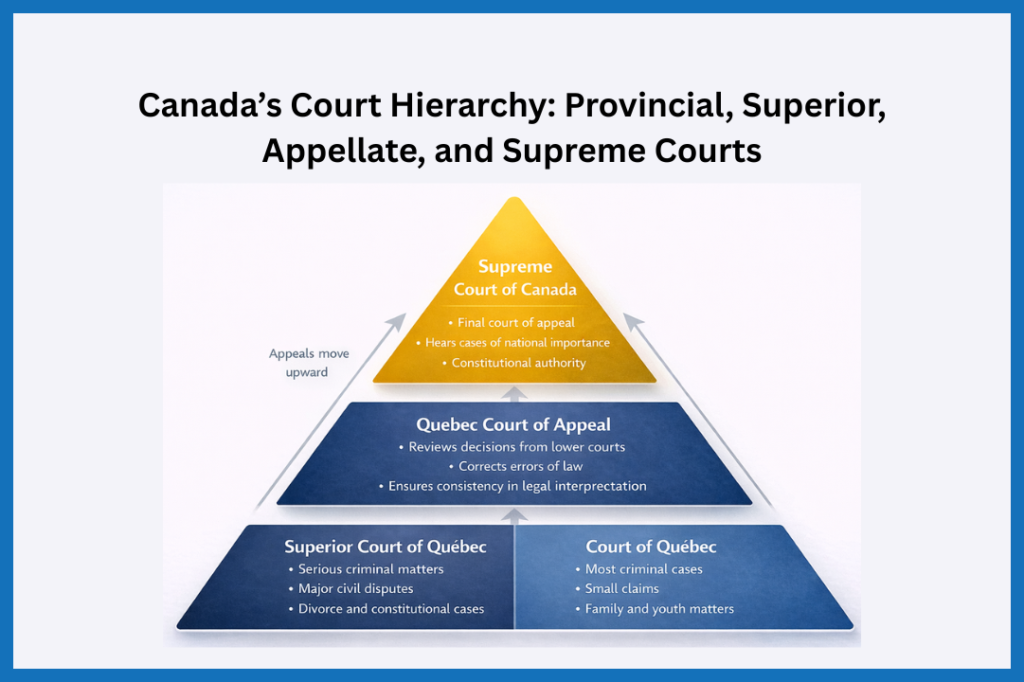
In Canada, every province has a provincial court, a superior court, and a court of appeal. These courts operate within a clear hierarchy.
Provincial courts
At the bottom of the hierarchy are the provincial courts. These courts handle most day-to-day legal matters, including the majority of criminal charges, small claims, youth matters, and many family law cases. They are statutory courts, meaning their authority is defined by legislation i.e. they can only take on claims that they are allowed to by law.
Superior courts
Adjacent to the provincial courts are the superior courts. These courts deal with more serious criminal matters, major civil disputes, and cases involving divorce. Superior courts have inherent jurisdiction, which means they have broad authority to hear any matter unless a statute specifically limits their power. Superior courts can develop a law through their decisions by interpreting statutes and applying common law principles, creating precedents that lower courts must follow. Provincial courts cannot do this, they can only apply the law.
Court of appeals
Above both the provincial court and the superior court is the court of appeal. The court of appeal does not conduct new trials. Instead, it reviews decisions from lower courts to determine whether legal errors were made and ensures consistency in the interpretation of the law. For example, in Quebec, this hierarchy consists of the Court of Québec, the Superior Court of Québec, and the Quebec Court of Appeal.
Supreme Court of Canada
At the top of the judicial system is the Supreme Court of Canada. It is the country’s highest court and has the final authority on questions of federal law, provincial law, and constitutional interpretation. Its decisions are binding on all lower courts across Canada.
Constitution
If legislatures write the law and courts interpret and apply it, the Constitution defines the limits of both.
The Constitution is the supreme law of Canada. It sets out the structure of government, divides powers between the federal and provincial levels, and protects fundamental rights and freedoms. Any statute passed by Parliament or a provincial legislature must comply with it. Any rule developed by the courts must also respect it. If a law conflicts with the Constitution, the Superior court, Court of Appeals or the Supreme Court of Canada can declare it of no force or effect.
Note
– The Constitution Act, 1867
– The Constitution Act, 1982 (which includes the Canadian Charter of Rights and Freedoms)
What is the difference between civil law vs common law?
Civil law is based on legislation – general, written laws made by the government. In this legal system, judges in the Superior Court, Court of Appeal, or Supreme Court of Canada interpret the Civil Code to resolve disputes, but their decisions do not create legally binding precedent. Higher court decisions may guide lower courts, but only the legislature can formally change the law.
Canada is predominantly a common law system however, it uses a civil law system in Quebec for specific areas of law, such as property and real estate law, family law, successions (wills and estates). These rules are codified into the Civil Code of Quebec.
Frequently asked questions
Provincial Courts handle most day-to-day legal matters. This includes the majority of criminal charges, bail hearings, youth criminal matters, small claims (up to the province’s monetary limit), and many family law issues such as child custody and child support. These courts are created by statute, which means they can only hear the types of cases the law specifically assigns to them.
Superior Courts deal with more serious or complex matters. They hear major criminal cases (including jury trials), significant civil disputes such as contract or property claims, personal injury cases, and all divorce proceedings. Superior courts have inherent jurisdiction, meaning they can hear any type of case unless legislation restricts them. Most constitutional challenges begin at this level.
Courts of Appeal do not conduct new trials. Instead, they review decisions made by provincial and superior courts to determine whether legal errors occurred. They hear appeals in criminal, civil, and constitutional matters.
At the top of the system is the Supreme Court of Canada, which is the country’s highest court. It hears appeals from provincial Courts of Appeal and has the final authority on constitutional interpretation and major questions of national importance.
In short, routine matters start in provincial courts, more serious and complex cases go to superior courts, appeals move up to courts of appeal, and the Supreme Court of Canada has the final word.
Final remarks
Common law is law developed through court decisions and judicial precedent rather than statutes alone.
Canada operates a mixed common law and civil law system, with common law governing most provinces and civil law in Quebec for private matters. As Canadian citizens, knowing how to access the justice system empowers you: it allows you to bring a case forward, influence lawmaking, protect your rights, and participate knowledgeably in public debates about those rights.