
To market your house for sale in 2026, you need to fully understand how buyers shop in the digital world.
Recent studies show that 94% of buyers in Montreal start their home buying journey with a Google search. They then visit popular property listing sites such as Centris, DuProprio, or Realtor.ca to browse homes.
With hundreds of new properties hitting the market every day, your listing must grab attention immediately. If it does not, buyers will choose to spend their time visiting similar homes that capture their attention while your house could linger on the market for months.
In this article we will show you exactly how real-estate marketing works so that you can attracts a large number qualified buyers to your home and ultimately sell your home for a higher price.
Choose the right pricing strategy
The first thing to do when marketing your home is to set the “list price” for your property. This is a marketing number chosen to attract prospective buyers and give them a rough idea of the properties value. It is NOT the price we expect to finally sell the property for.
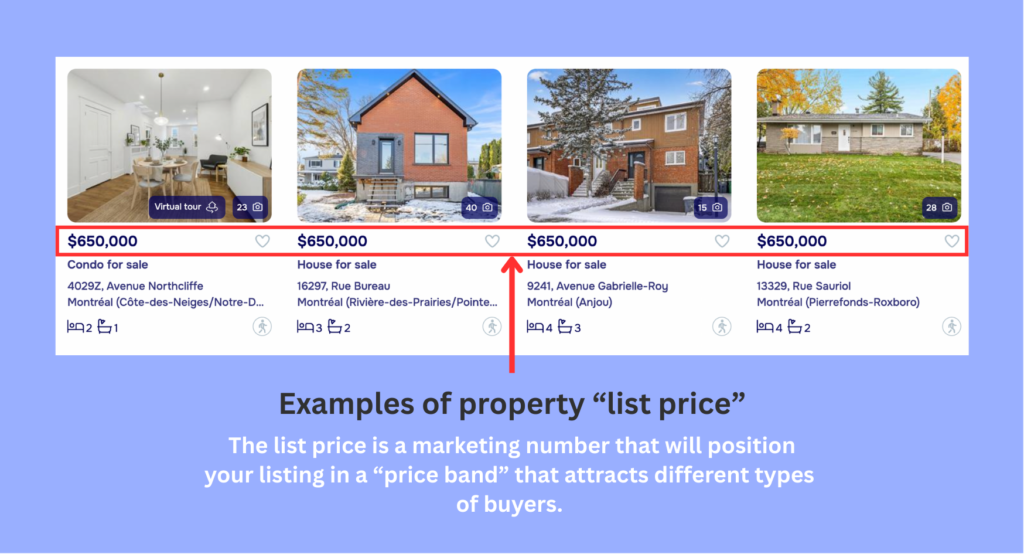
In real-estate marketing, agents call this your home’s “pricing strategy”, and in Montreal, most agents use one of three list-price strategies in 2026. These are:
- List low with a set offer date
- List at or slightly above market value and negotiate one on one
- List at market value with a time window to submit offers
Let’s dive into what each of these strategies are and what are the pros and cons of each.
1. List low with a set offer date
This strategy involves setting a list price below market value, with the goal of attracting more buyers to come out and view your home. For example, you might deliberately list your home at $500,000 even though you know its true value is closer to $550,000.
In this context, the list price is really just a marketing number, it is not a reflection of the true value of your home. However, the goal of setting the price below asking is to get a lot of attention from prospective buyers.
With this strategy, the realtor will also set a firm deadline for when buyers must submit their offers. For example, the realtor may set a timeframe between 3pm – 6pm on a Sunday afternoon. By doing this, the agent aims to create a fear of missing out amongst buyers and obtain multiple offers.
Once offers come in, the agent informs interested buyers that there are multiple offers and invites them to submit their highest and best offer. At this point, many buyer’s will come back and re-submit their offers at a higher price. This functions a bit like a silent auction and since no one can see each other’s bids, the spread on between the highest and second highest bid can sometimes be very wide. In Montreal, we have seen spreads of as high as $100k to $200k on high value properties.
Does this strategy work every time? No. However, this strategy can be very effective for certain types of properties, in specific locations, and at particular times of the year.
2. List at or slightly above market value and negotiate one on one
This strategy involves listing at or slightly above market value and then negotiating one on one with buyers and their agents. The approach essentially involves buyers and sellers saying exactly what they think the value of the home is and then negotiating (mostly down) from the starting list price. This strategy can still put you into a multiple offer bidding war however, this is not the strategic intent of this strategy.
Realtors will often recommend this strategy when there is less buyer demand for the property and it is unlikely to get into a multiple offer scenario. For instance, luxury properties, generic properties (like condos), investor properties (like a plex), unique properties that might not have much demand and in slower moving markets.
3. List at market value with a time window to submit offers
The listing strategy involves pricing the property at market value and setting a defined time window for buyers to submit their promise to purchase. The listing agent should make this window long enough to generate strong interest and encourage multiple offers.
One challenge with this approach is that buyers and their agents do not have to follow the seller’s timeline. The buyers are well within their rights to submit offers with shorter, more aggressive deadlines that do not leave time for the listing agent to search for other offers. For instance, some buyer’s agents will give the listing agent windows as short as 4 – 6 hours to respond. In this case, the strategy can backfire, leaving the listing agent to negotiate with only one offer.
This kind of pricing strategy is very good for slower market conditions or when there is a questionable valuation on the property. More experienced listing agents use this strategy when there is a rookie or very polite buyer’s agent who will ad-hear to the request and, who does not fully understand how competitive the Montreal real-estate market is.
Choose a target customer
In real estate marketing, sellers define the target customer as the buyer who they think will pay the most for the property and its features. For example, when you list a four-bedroom detached house on the West Island, you typically attract family buyers who value space, nearby schools, and long-term livability, rather than investors or first-time buyers. As such, you will highlight features in your listing that are most likely to grab the attention of families.
To do this, you will primarily focus on three aspects of your listing:
- The visual presentation, especially through professional property staging
- Copywriting, a compelling and targeted set of features and your property description
- Audience targeting, how you get your listing in-front of the most qualified buyers
Staging and the visual presentation
Buyer’s in 2026 are viewing property listings while on the go using mobile devices and tablets. They spend their time browsing online platforms like Centris, Realtor.ca, Duproprio and social media. Because of this, the job of the real-estate agent is to create an impact on a digital screen within a split second while the buyer is scrolling at the gym, on their morning commute or waiting for their coffee order.
Once the agent has the buyer’s attention, the next step is to get prospective buyer’s to click on that listing, to read more details and book a viewing.
To create the visual impact, you must:
- Stage your home well
- Photograph your home
- Add a 3D walk through
- Add floor plans
- Video and drone footage (optional)
Stage your home well
According to data from the National Association of Realtors (NAR), professional home staging can boost the offer price by up to 10%. The reason for this is that professional home staging follows interior design rules specifically tailored for online marketing and digital browsing.
A couple of quick examples of this include, hanging pictures at 57–60 inches from the floor (otherwise known as “gallery height”) or the use of white colors with the incorporation of biophilic design (greenery within the home). Both of these design choices help photographers capture more visually appealing images of your home.
It is important to note two things when it comes to staging. First, attention to detail matters immensely and so, your listing agent should be a uncompromising on every aspect of your home staging. Second, to maximize the sale price of your property, your listing agent should recommend that you hire a professional staging company.
Photograph your home
Once you stage your home, the next step is to take professional photographs of your staged home. Listings with professional photos receive up to 61% more online views than those with amateur photos, which directly increases buyer interest. This can add tremendous value to your listing.
Skilled real estate photographers use techniques such as bracketing to create high-resolution, high-contrast images that stand out online. As with staging, hiring a professional photographer is usually the best choice. It costs relatively little to hire a photographer and will mostly generate a positive Return On Investment (ROI), whereas doing it yourself would require renting or buying expensive equipment and picture editing software.
Add a 3D walk through
A skilled real-estate photographer can also create a 3D walkthrough of your home.
To capture a 3D tour, the photographer uses a 3D or 360-degree camera mounted on a monopod (not a tripod). 3D camera options range from high-end DSLR-based systems to compact 360 cameras like the Ricoh Theta series. When choosing a photographer note that, more expensive DSLR photographs will not necessarily add additional value above those taken on the Ricoh Theta series.
After capturing the images, photographers edit and color-correct them in software such as Adobe Lightroom. They then upload the processed images to 3D tour platforms like Matterport, which automatically stitches the images together into an interactive walkthrough that buyers can explore online.
Add floor plans
An absolutely critical bit of marketing that every agent should have when selling real-estate is a floor plan. These save buyers and sellers a huge amount of time by helping buyers quickly understand the properties layout and room sizes so that only genuinely interested parties schedule showings. In fact, data shows that roughly 1 in 10 buyers skip scheduling a showing when a listing doesn’t include a floor plan.
Despite these benefits, the number of listing agents who include floor plans in the final listing remains surprisingly low. For instance, some industry sources report only 4–5% of photo/video shoots include a floor plan.
Video and drone footage
Video and drone footage can help however, drone footage is normally only useful for larger homes such as detached, semi-detached, townhouses or potentially condos with stunning views.
As with home staging, the goal of the video and drone footage is to showcase the property in its best light. So if you are marketing a house right surrounded by busy roads, you might choose not to take an arial shot and instead focus on the interior of the property. You can also market the property location, by creating a short video of nearby amenities. For instance, let’s say that you are marketing an owner-occupied duplex in Pointe-St-Charles. In this case, you might choose to create footage of the nearby Lachine Canal and the countless independent coffee shops and restaurants that give this area its unique character.
Real-estate copywriting
Copywriting is an essential skill in real-estate marketing. It refers to the written text that you use to sell your property either online or in print. To quote one of the all time copywriting greats, “Good copywriting should be like a good sermon — it must not only comfort the afflicted, it must afflict the comfortable” (David Ogilvy).
In real-estate you will need to write copy for the following:
- Your description and feature list
- Write copy for a custom website
- Write copy for brochures
- Social media copywriting
Your description and feature list
Effective property descriptions and feature lists will tell a story about the property that is for sale. They will clearly explain who the home is for, the stand out features and the benefits of those features. After reading a well written description, buyer’s will be able to better visualize themselves moving into the property and, their desire to visit and ultimately buy the property will have increased.
The property description has the following structure:
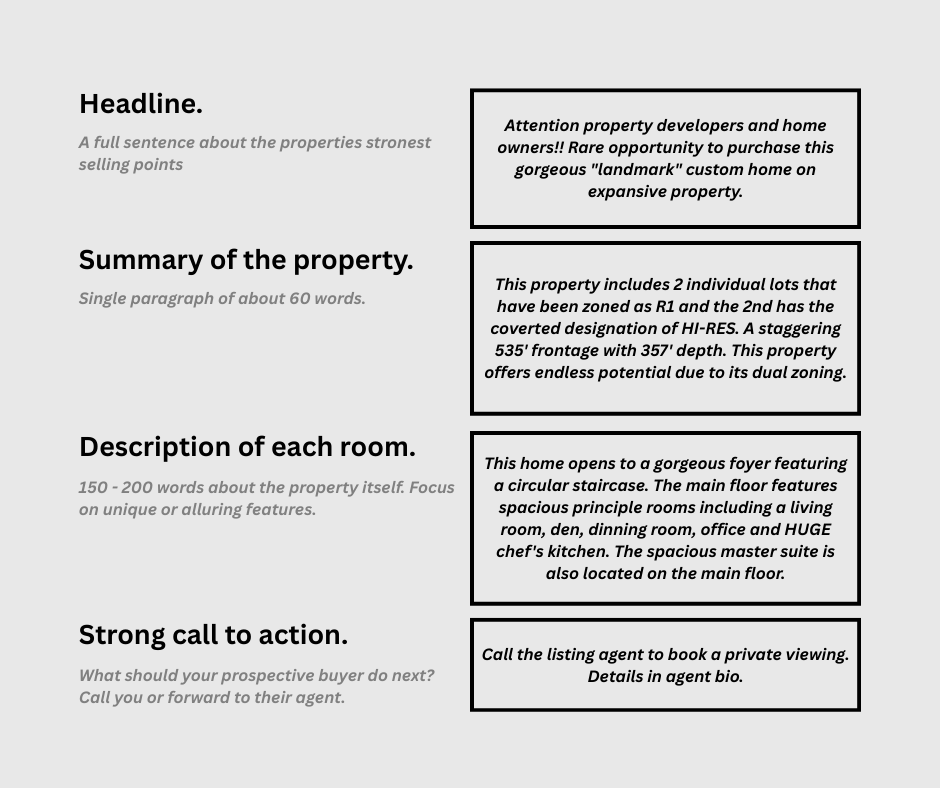
- The headline should reference the property type, the location or target audience, and one stand out feature about the property that will connect with your target persona. Some common themes for the standout feature can be location, curb appeal, amenities or price.
- The summary of the property should expand on the headline, with the goal to create enough interest that the reader will go into the body of the description. This section should be no more than 60 words (roughly 3 lines of text).
- Next, the description is 150 – 200 words about the property itself. It should describe each room of the property and the benefits of this room for prospective buyers.
- Finally, close with what the potential buyer should do next. For example, call your phone number, email you or book a viewing through the portal.
Write copy for a custom website
Platforms like Centris and Realtor.ca take a one size fits all approach to property listings. They do this by offering a fixed layout with a limited number of fields that agents can fill in, along with character, file attachment and image limits. This can make it hard to fully tell the story of your home and present it in its best light.
Because of this, good listing agents will build 100% custom websites for their clients that allow prospective buyers to read and view more about the property. This will include, the full length property descriptions, video, neighbourhood information, pdf downloads, the full photo gallery, floor plans and much more. The listing agent will then aim to drive traffic to the custom website.
Write copy for brochures
High quality print collateral, such as buyer brochures help to re-enforce online marketing and build trust with prospective buyers. Many real-estate agents will either skip this step entirely or, use a low cost option such as a scannable QR code that directs you to the custom website or will leave out a black and white paper print out on from the MLS.
In contrast, top listing agents create a custom brochure printed on high-quality paper to showcase the home at its best. These brochures provide detailed information about the property and give buyers something tangible to review after a showing. Buyers can also share them with key decision-makers, such as parents (who may be offering a gifted downpayment) or other influencers such as their friends. Again, this will build trust and reinforces the professionalism of the listing agent and agency handling the transaction.
Social media copywriting
Buyers spend a significant amount of time on social media platforms like Instagram, TikTok, and Facebook. These channels are ideal for showcasing real estate through high-quality photography and short-form video. Property content is naturally aspirational and visual, which allows it to blend seamlessly into buyer feeds. Images and videos of professional staged homes capture the attention of active or inactive buyers as they scroll. Well-crafted copy then prompts interested viewers to click through to a custom-built property website for more details.
Montreal listing agent Reda Wahba explains that a “inactive buyers will often discover homes in Montreal on their social media, click on a listing, and forward it to an agent they’ve worked with in the past to book a showing.” Studies show that a single Instagram Reel can reach 25,000–30,000 highly targeted viewers Reda continues, “often we see that with minimal ad spend, turning re-activating buyers who have slowed down their buyer’s search.”
Audience targeting
Once you have developed the marketing collateral (visual presentations, plus your copywriting) for your listing, the next step is to get this collateral in from of as many qualified buyers as possible. To do this, your listing agent push your content into multiple online channels where your target audience is looking for homes.
There are two primary channels that realtors use to do this:
Online listing platforms
Real estate agents will upload your listing to the Multiple Listing Service (MLS). This is a centralized database used by licensed professionals to list and market properties. Once your property appears on the MLS, platforms such as Centris, Realtor.ca, and brokerage websites automatically pull the listing onto their website and display it to their buyers. These platforms attract millions of visitors each month, giving your home significant online exposure and immediate visibility with active, qualified buyers.
Use social media
Some listing agents who are more tech savvy will also run paid social media campaigns targeting buyers with your listing. These are primarily run using platforms like Meta Ads which will distrubute your listing across Facebook and Instagram.
Agents with large social media followings can also give your home more reach. For instance, agents with 2000+ followers based in Montreal, may have buyers or buyers friends who follow them. In this case, you will get additional exposure if the realtor advertizes your property on their own social media channel.
Track your data to know what works
Good listing agents will constantly test and track the performance of all the real-estate marketing that they do. As soon as they lock onto something that is working for one client, this information will be shared amongst all their other clients. Similarly, they will be able to tell you what to avoid so that you do not waste time and money on a channel that will likely never work.
When choosing a real-estate agent to list your home, you should ask to see both a marketing plan for your home and the data that backs up their suggested method of marketing method. The key data points you want to see are:
- Reach
- Conversion rates from clicks to qualified buyers
- Days on market vs the market
- Sale-to-list price vs the rest of the market
Final thoughts
The goal of real-estate marketing is to capture a prospective buyer’s attention and direct it toward your listing. Agents do this by choosing the right pricing strategy and combining it with strong visual presentation, persuasive copywriting, and precise audience targeting.
Experienced listing agents understand that the more buyers who see your property, the higher the likelihood of generating multiple offers, selling quickly, and achieving a price above market value. The best realtors in Montreal continuously test different marketing techniques and collect unique data insights to understand what works best in this rapidly changing market. When hiring a realtor, you should consider not only their experience, but also how effectively they can leverage these insights to generate more interest in your home and ultimately to help you sell faster and above market value.
In today’s online-driven environment, marketing a home requires a broad and increasingly specialized skill set. Listing agents are becoming more focused on how to attract, qualify, and convert online buyers. As a result, Montreal has seen a significant decline in the lone-agent model, where one agent works independently. Instead, realtors are increasingly operating in teams, allowing them to provide stronger marketing, better support, and improved outcomes for their clients.