
The real-estate pricing strategy you choose is the single biggest factor in how fast your home sells and the final price you achieve. It is also the number one mistake sellers make. Sometimes this happens because the listing agent lacks experience. Other times, it’s because sellers want to list high and the agent — eager to win the business — goes along with it.
In this article we give you a breakdown of eight essential things that you need to know about real-estate pricing strategies. By the end of this article, you will understand the core components of a property pricing strategy, how listing agents come up with a list price and when it is time to change your pricing strategy.
Real-estate pricing strategy #1 Think about the price band
A price band is simply the bucket bars that buyers use to set their search filters. In Montreal, most buyers and their agents will set up automated alerts for new property listings based on their price bands.
Data shows that buyers set their price band filters in terms of round numbers. For example $450,000 – $500,000. This means that if you price your home at $505,000, you will be at the bottom of the $500,000 – $550,000 bucket. However, a home priced at $499,000 will show up at the top of the $450,000 – $500,000 bucket.
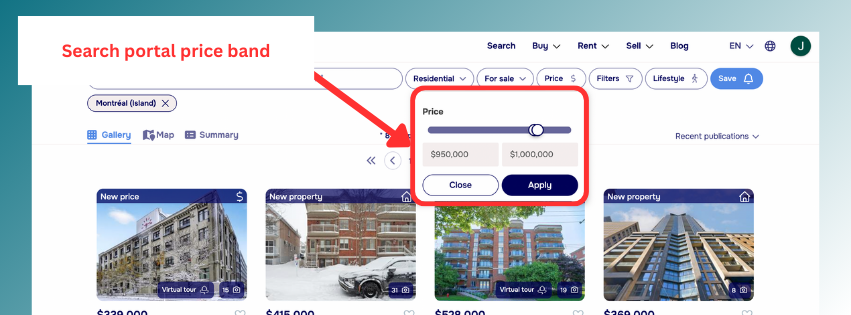
Sellers should strategically position different types of properties either at the top of one price band or at the bottom of another. The choice of where to position your home depends on the features that your property offers compared to other homes at that price point.
Real-estate pricing strategy #2 Look at comparable sales
Fifty years ago, the only way to get a home price valuation was to pay for a home appraisal. However nowadays, there is so much data online that you can actually see what the list price is for comparable homes (aka “comps”) in your neighbourhood.
For instance, you can use platform like Centris.ca to see what are the current list prices are for homes in your neighbourhood. On top of this, real-estate agents pay for historical transaction data. They can see what the past transaction prices were for homes in your area and what feature differences, construction methods and material cause price differences. Good realtors use systems like Matrix, a platform developed by Centris, to generate highly accurate price estimates. that allow good realtors to produce highly accurate price estimates.
Realtors call the process of looking at comparable sales to gauge your home value is called a Comparative Market Analysis (or CMA). You can do your own comparative market analysis but, it is probably better to hire an experienced realtor to do one for you. This is primarily because, a good, local realtor who is active in your area will have access to more data and, know better how to interpret this data.
Real-estate pricing stragey #3 Take account of current market conditions
In addition to the comps, when pricing your property, you also need to take account of current market conditions. The key metrics to consider here are days on market (DOM) and the sale-to-list price ratio.
In a seller’s market, homes sell quickly and buyers pay closer to (or above) the asking price. This results in in decreasing DOM and a rising sale-to-list price ratio. In a buyer’s market, the opposite happens: homes take longer to sell and sell for less relative to the asking price. This information can inform your property pricing strategy since if you are in a buyer’s market, the property prices will be trending downwards with each sale and in this case you may want to list your home at a lower price to drive buyers towards your property and get ahead of the downward motion of the market.
Real-estate pricing strategy #4 Start with a price range
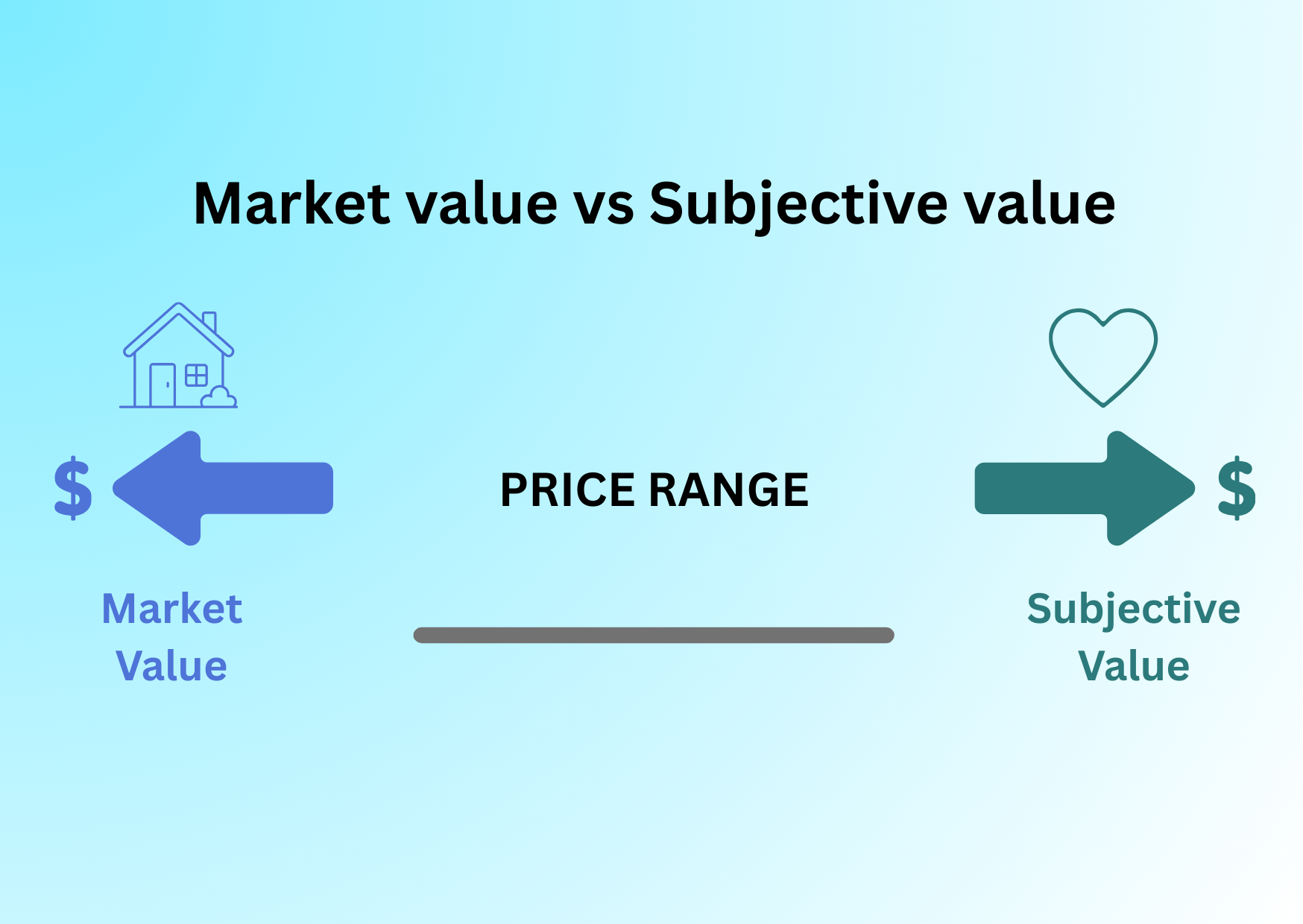
All homes have a market value and a subjective value. Appraisers and realtors determine a home’s market value by analyzing comparable sales, while a specific buyer sets the subjective value based on their personal wants. For example, let’s say that your home has an Electrical Vehicle charger in the garage. This feature could be easily worth $10k – $15k for a buyer who owns an electrical car whilst similutaniously be worth nothing for a buyer who does not own a electrical vehicle.
The existence of these two home home values creates a price range where sellers are able to position their home so as to attract the right buyers while allowing the market to determine the final price.
Real-estate pricing strategy #5 Use the real-estate pricing pyramid
The real-estate pricing pyramid is a long-standing tool used by realtors to predict how much visibility a listing will receive based on its asking price relative to recent comparable sales. The real-estate pricing pyramid looks as follows:
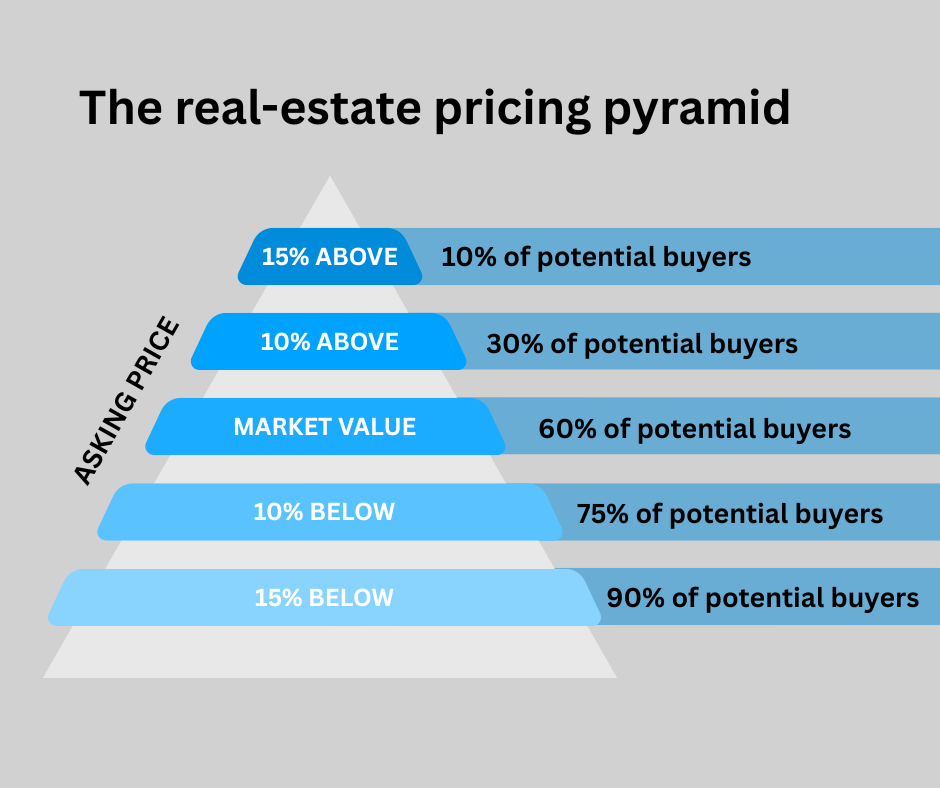
As you can see, there are five pricing bands, and each band reduces the pool of potential buyers. If you price your home 15% above market value, only about 10% of buyers will view it. Price it 15% below market value, and roughly 90% of potential buyers will be interested.
There are some pros and cons to listing at:
Pricing real-estate below market value
In some cases, real-estate agents will recommend pricing real-estate below market value. This is so as to cast a wide net, attract more buyers and create a competitive market for the property. The ultimate goal is to generate multiple offers to purchase and spark a bidding war that will result in the seller selling above market value. You can think of this like a blind auction since, none of the buyer’s know what the other buyers offer price is, so they bid high to make sure that they get the best price. To give an idea of what this can look like, Montreal real-estate agents regularly comment that the spread between the top two offers can sometimes be $100k – $200k wide.
Whilst this pricing strategy can work very well, especially during a hot sellers market, there is some risk. For If you list below market value and the price falls into a lower pricing band, you may exclude buyers with higher purchasing power — particularly those with larger mortgage pre-approvals — and risk selling below true market value.
Pricing real-estate at market value
In Montreal, buyer’s and their agents will also run a CMA before making a promise to purchase. Because of this, a safe strategy is to price at market value. This will attract a qualified pool of potential buyers who will make fair offers for your home.
Pricing real-estate above market value
Pricing above market value rarely works. However, in certain conditions it can make sense. Specifically when buyer demand is very strong and the property sits at the very top of its category. Think of a top-floor, newly renovated condo, in a prime location with beautiful, unobstructed city views.
In a market where days on market are falling and the sale-to-list price ratio is rising, this type of property can sometimes justify a higher starting price. In these situations, pricing slightly above market can allow you to move into a higher price band and potentially capture the upward momentum of the market rather than chasing it.
Real-estate pricing strategy #6 Know how your prospective buyers search
Different types of buyers search for homes in very different ways. For example, investors often search by monthly cash flow, cap rate, or yield, while owner-occupiers tend to search by features such as number of bedrooms, layout, outdoor space, parking, school catchments, or proximity to transit.
Because of this, your listing needs to highlight the features that matter most to the specific buyer you want to attract. If you’re getting plenty of showings but very few offers, the issue is usually positioning — the features being emphasized aren’t connecting with the right buyers, and the listing needs refinement. If you’re getting very few showings at all, the problem is more likely pricing, and you may need to adjust the price band to regain visibility.
Real-estate pricing strategy #7 Get multiple opinions
For all decisions that can have a major impact on your life, it is best to get multiple professional opinions. Whether this is for a surgery that one doctor has recommended, or for the list price of your home. As such, you should interview at least three realtors and ask them to run a CMA before putting you into contract.
To do this, the real-estate agent will need to physically view your home. The agent must do this because they will need to this because, in addition to the metrics that they can gather online such as location, size, age and so on, they will also need to assess the quality of the construction, renovation work and complete a seller’s declaration with you to properly price your home.
If the real-estate agent pushes back and tells you that you need to be in a contract before they can run a CMA, it might be a sign that you are working with a bad agent.
Real-estate pricing strategy #8 Make uncomfortably large price reductions
If you’re getting very few viewings, your home is almost certainly priced incorrectly. That can be hard to hear, but the market doesn’t lie. At this stage, many sellers or inexperienced agents respond by making small price reductions of $1,000 to $5,000. These cuts rarely work. If a buyer were interested at that level, they likely would have submitted an offer already at $5,000 below asking.
To reset buyer interest, the price reduction usually needs to move the property into a new price band. This often means a larger adjustment, sometimes $50,000 or even $100,000, rather than a series of minor reductions. When you do this, you dramatically increase visibility, attract a broader pool of qualified buyers, and give the listing a real chance to regain momentum and potentially even come in above asking at true market value.
Final remarks
The real-estate pricing strategy that you choose will determine the amount of buyer demand for your home. A home with higher demand will have a better chance to sell faster and above asking price.
When choosing your pricing strategy, you need to consider price bands and comparble sales current market conditions. You then need to choose a price range that you are comfortable with and position yourself either at the bottom of this range or above market value, depending on the current state of the market and how many prospective buyers you are aiming to attract.
It is best to get multiple opinions before listing your home on the market and, although no one wants to sell below market value, if the market is not responding to your list price, you will need to make a large price reduction to get the property back in front of the right buyers again.