
Before you start the home buying process, it is advisable to get a mortgage pre-approval. This will make the home buying journey significantly easier since, it will allow you to determine precisely what your budget is, so that you can focus your home search with intention.
In this article, we will cover:
- What is a mortgage pre-approval?
- How much does it cost to get a mortgage?
- What are current interest rates?
- How to get mortgage pre-approval
- What factors affect your mortgage pre-approval
- Why pre-approval is not the final step
- Final remarks
What is a mortgage pre-approval?
A mortgage pre-approval is a lender’s conditional commitment to lend you a specific amount of money at a specified interest rate before you buy a home. For example, a lender might offer to lend you $300,000 at 5% rate of interest. This means that you can take the $300,000 and combine it with your own savings to create your budget for how much you can afford to spend on a property.
You can get pre-approved for free without committing to any one lender. In fact, many savvy borrowers will get pre-approvals from multiple lenders or even work with a mortgage broker to see which lenders offer the best rates.
Most lenders honour pre-approvals for 90–120 days, protecting you from rate increases while you hunt for your new home. And, if rates drop while you are looking for a home to buy, most lenders will give you the lower rate when it comes time to actually buy.
How much does it cost to get a mortgage?
For many people, a mortgage is one of the largest expenses they will ever pay. For example, a $300,000 mortgage amortized over 25 years at a 5% fixed rate results will cost you around $226,000 over the life of the mortgage. In spite of this reality, most people focus on the purchase price and underestimate the true cost of borrowing.
When you borrow money from a lender, you must repay it in monthly installments over time. You split your monthly mortgage payment into two parts: principal and interest. Your principal payments reduce the amount you owe on the loan, while your interest payments go to the lender as the cost of borrowing.
For example, let’s say you borrow $300,000 at a 5% interest rate over a 25-year term. In this case, your monthly payment will be roughly $1,754. Over the first 5 years, you will pay approximately $70,000 in total interest payments (this is money you will not get back when you sell) vs 34,000 in principal paid (this is money you can in theory get back when you sell). The table below shows the exact yearly breakdown for this example.
| Year | Interest Paid | Principal Paid | Remaining Balance |
|---|---|---|---|
| 1 | $14,717 | $6,328 | $293,814 |
| 2 | $14,393 | $6,652 | $287,312 |
| 3 | $14,053 | $6,992 | $280,477 |
| 4 | $13,695 | $7,350 | $273,293 |
| 5 | $13,319 | $7,726 | $265,741 |
Small changes in interest and the length of a mortgage can massively impact the total cost. For example, let’s say that instead of 5%, you manage to borrow $300,000 at a 4% interest rate. This 1% drop reduces your monthly payment to roughly $1,584, and over the first 5 years, you will pay approximately $55,000 in interest vs $39,000 in principal. This means that you save roughly $15,000 over 5 years with a meager 1% drop in interest rates.
To work out exactly how much a mortgage is going to cost you over the mortgage term, you need to use a mortgage calculator.
What are current interest rates?
To get access to current rates, you can use websites like RateHub.ca.
How to get mortgage pre-approval
There are four main steps to get mortgage pre-approval. These are:
- Connect with a lender or mortgage broker
- Provide your financial information
- Choose your mortgage type
- Consent to a credit check
1. Connect with a lender or mortgage broker
When most people think about applying for a mortgage, they will go to one of the major Canadian banks. Generally speaking, the bank is the safe choice for many borrowers because the government heavily regulates it. However, there are many different types of institutions that will offer you a mortgage. This includes credit unions, trust companies, private lenders, and mortgage brokers who can connect you with multiple lenders.
2. Provide your financial information
To get a mortgage pre-approval, the lender will need to see details about your income, employment, debts, and assets. Whilst different lenders may request for different information, common documents include pay stubs, bank statements, investment summaries, and ID.
3. Choose your mortgage type
There are several types of mortgages. Most homeowners choose a closed mortgage, which offers either a variable or fixed interest rate for a set term, commonly 3 or 5 years. Variable rates change if the Bank of Canada adjusts its key interest rate, which affects lenders’ prime rates. This means that your payments could go up or down. Fixed rate mortgages, on the other hand, remain the same for the term.
4. Consent to a credit check
Lenders will ask to review your credit score and history to assess your borrowing risk, to help them decide if they will lend you the money and determine your rate. A credit score of 680 or higher is generally high enough to get pre-approval from banks and other “A” lenders.
How long does it take to get pre-approved?
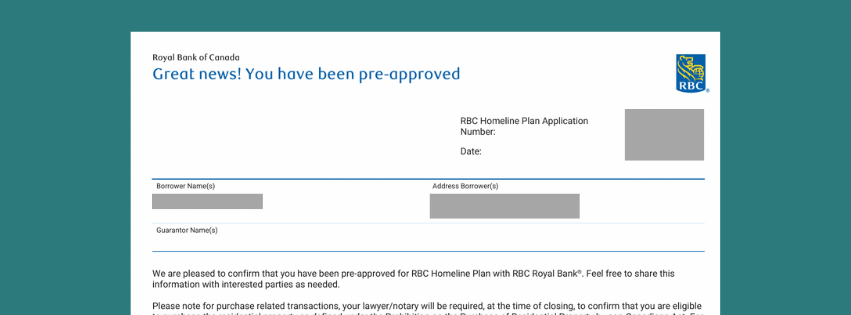
Typically, a lender reviews your information and issues a pre-approval within 1–3 business days. The lender will then provide you a letter stating the amount you are pre-approved to borrow. You can combine this amount with your down payment to determine your maximum home-buying budget.
What factors affect your mortage pre-approval
Lenders assess four main criteria when determining your maximum mortgage amount. These are:
1. Credit Score
A credit score is a number that lenders use to determine how “trustworthy” you are with borrowing money. A high credit score tells lenders that you are someone who has handled credit responsibly in the past and will allow them to offer you their best rate.
| Credit score | What this means? |
| 680 – 900 | You will generally qualify you with most bank and other “A” lenders. It will also allow the lender to offer you their best rate. |
| 600 – 679 | You will still qualify you with an “A” lender, but the lender will consider other parts of your financial profile, such as your income and debt levels. If you don’t meet their criteria, you may need to apply through a “B” or non-prime lender. |
| Below 600 | You will most likely have to work with a “B” lender or private lender. These lenders will charge you a higher rate of interest and put more restrictions around the loan. |
2. Debt service ratios
Your debt service ratios help lenders assess how much they are willing to loan you. There are two ratios that lenders will consider: your Gross Debt Service (GDS) ratio and your Total Debt Service (TDS) ratio. By examining these ratios, the lender is able to see how much of your gross monthly income goes towards housing and other debts.
For example, if you earn a monthly salary of $8,000 before taxes, the lender wants to know how much of that income can go towards mortgage payments vs property tax (school and municipal), utilities and other monthly payments including outstanding debts. Using this information, the lender can decide how much money they can safely lend you.
A general rule is that lenders offer a mortgage where your total monthly housing costs stay around 32–35% of your gross monthly income, and your total debt payments (including other loans) stay below roughly 40–44%. For instance, if you earn $8,000 per month, the lender may offer you a mortgage with monthly payments of approximately $2,560–$2,800, depending on your other debts.
3. Down payment size
In Canada, the minimum required down payment is dependent on the purchase price of the property.
- Homes under $500,000: Minimum 5% down
- Homes between $500,000 and $999,999: 5% on the first $500,000 + 10% on the portion above $500,000
- Homes $1,000,000 or more: Minimum 20% down
If your down payment is less than 20% you will have to purchase mortgage default insurance (from CMHC, Sagen, or Canada Guaranty) to protect your lender in case you default on the loan. Lenders usually add the cost of mortgage default insurance to your mortgage and include it when calculating your monthly payments and debt service ratios. As such, your down payment size directly affects the amount the lender will approve.
For instance, if you put down 20% or more, not only do you reduce the risk for the lender, but you also avoid having to pay mortgage insurance. This will improve your debt service ratios, so that lenders can approve a larger mortgage or offer you a better interest rate.
4. Supporting documentation
The documentation you need for mortgage pre-approval varies by lender. Many Canadian lenders ask you to provide a signed letter of employment, a passport or proof of Canadian residence, and three months of bank statements and pay stubs to verify your down payment and income.
The lender may also ask for proof of other assets such as a car, or boat and the lender will want to know if you have any other debts including: credit cards or lines of credit; spousal or child support payments; student loans; car leases or loans; and personal loans.
If you are self-employed, the lender may also request a Statement of Account from the CRA and a Notice of Assessment (in Quebec). This is to confirm that you do not have any outstanding tax that is currently unpaid. Finally, if someone has gifted you part of your down payment, you must provide proof that it’s a gift and deposit the money into your account at least 15 days before your pre-approval.
Why pre-approval is not the final step
It’s important to understand that while a pre-approval plays a crucial role in buying a home, the lender does not finalize your mortgage until you agree on a promise to purchase with the seller. This document sets out the key details of your real-estate transaction including the address and cadastral number of the property, the purchase price, how much downpayment you are going to make and the terms of financing.
Before the final approval, the lender will typically do a home appraisal, so as to check that the value of the home is close to the agreed purchase price. This is so that the lender does not lend more money than the home is worth and, so that it limits the lenders risk if you default on the loan. To reduce the risk of approval delays or a financing shortfall, you should avoid overpaying for the property. To do this, you should work with a realtor who understands local market values and does a thorough Comparative Market Analysis (CMA) before you submit your promise to purchase.
Final remarks
Securing a mortgage pre-approval sets the foundation for a stress free and ultimately successful home-buying journey. Once you get your pre-approval, you will be able to know what your maximum budget is, so that you can begin your property search.
A mortgage pre-approval is typically valid for 90 – 120 days. And lenders will typically lock in the interest rates for the term of the pre-approval, giving you certainty about your borrowing costs while you shop for a home. Furthermore, if rates fall during this period, lenders will typically allow you to take advantage of the lower rate when you finalize your mortgage.
However, it is important to remember that a pre-approval is not a final approval, and a lender reserves the right to not finance a home if its value, condition or type does not meet their lending criteria. It is also wise not to spend up to your maximum limit, since closing costs, repairs, or appraisal shortfalls can quickly strain your finances.